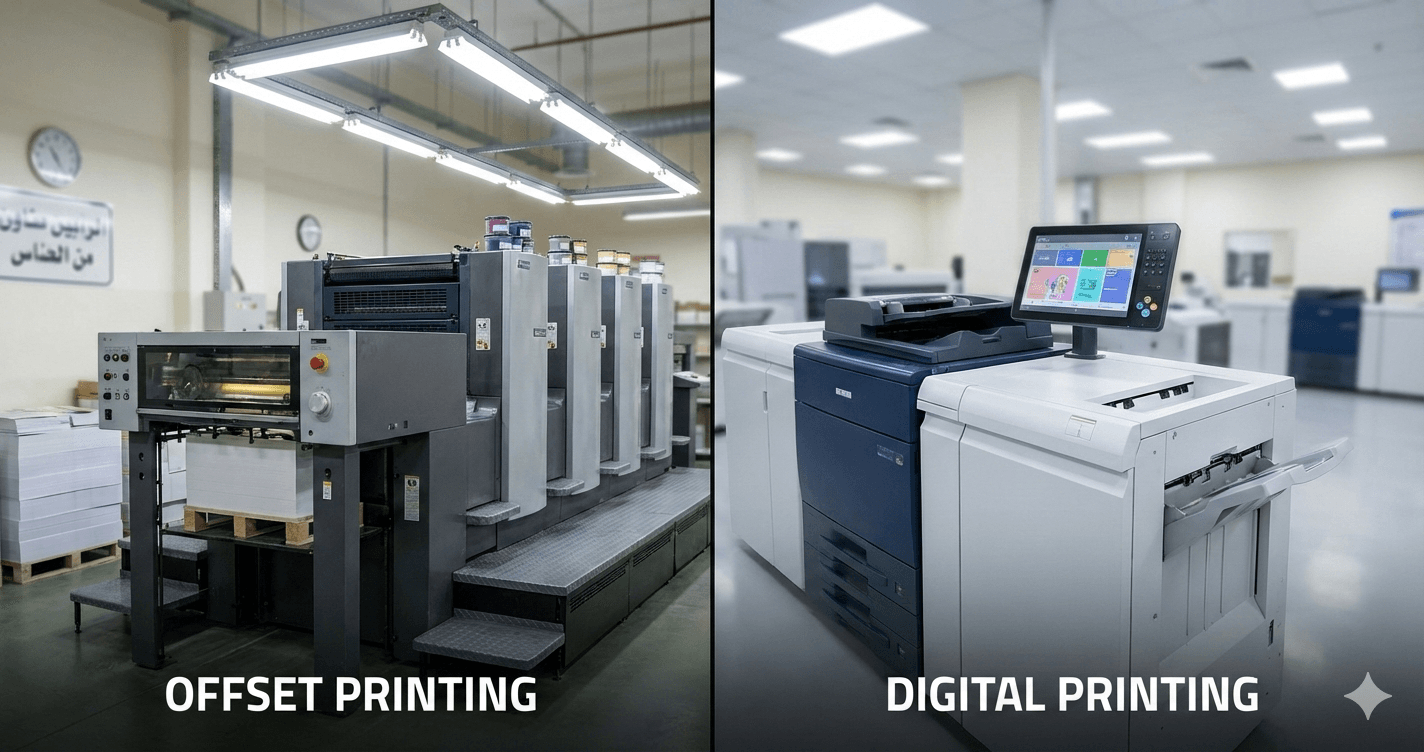
Choosing between offset printing and digital printing can significantly impact your project’s budget, timeline, and final quality. For businesses in Riyadh and across Saudi Arabia, understanding the differences between these two printing methods isn’t just about technical specification, it’s about making smart decisions that align with your specific needs, volume requirements, and business goals.
Both offset printing and digital printing have distinct advantages, and neither is universally “better” than the other. The right choice depends on your project’s unique requirements: how many pieces you need, your timeline, your budget, and the level of customization required. This guide will help you understand when to use each method and how to maximize your printing investment.
Understanding Offset Printing
Offset printing, also known as lithographic printing, is a traditional printing method that has been the industry standard for decades. The process involves transferring (or “offsetting”) ink from a metal plate to a rubber blanket, then onto the printing surface.
How Offset Printing Works
The offset printing process includes several steps:
- Plate Creation: Your design is transferred onto metal plates—one for each color (typically cyan, magenta, yellow, and black)
- Press Setup: Plates are mounted on printing cylinders and the press is calibrated
- Printing: Ink is applied to plates, transferred to rubber blankets, then pressed onto paper
- Drying and Finishing: Printed materials dry and undergo finishing processes like cutting, folding, or binding
Advantages of Offset Printing
- Superior Quality for Large Runs: Offset printing produces consistently sharp images and text with precise color matching, especially important for brand-critical materials.
- Cost-Effective at High Volumes: Once plates are made and the press is set up, printing thousands of additional copies costs very little per unit. The more you print, the lower your per-piece cost.
- Wide Material Options: Offset printing works with virtually any paper stock, cardstock, or specialty material, including textured papers, metallic stocks, and unusual sizes.
- Pantone Color Matching: Perfect for brands requiring exact color matching across all materials—crucial for corporate identities and franchises.
- Special Finishes: Offset printing easily accommodates special techniques like spot varnish, embossing, foil stamping, and die-cutting.
Limitations of Offset Printing
- High Setup Costs: Creating plates and setting up the press requires significant upfront investment, making small runs expensive.
- Longer Turnaround Times: The multi-step process means offset printing typically requires days or weeks, not hours.
- Higher Minimum Quantities: To make offset printing economical, you usually need to print at least 500-1,000 pieces.
- No Economical Customization: Each variation requires new plates, making personalized or variable data printing impractical.
Understanding Digital Printing
Digital printing is a modern printing method that transfers your design directly from a computer file to paper without plates or extensive setup. Think of it as a sophisticated version of your office printer—but with professional-grade quality, speed, and capabilities.
How Digital Printing Works
Digital printing is straightforward:
- File Preparation: Your design file is prepared and sent directly to the digital press
- Printing: The digital press applies toner or ink directly onto the paper
- Finishing: Materials are cut, folded, bound, or finished as needed
No plates, no lengthy setup, no waiting for ink to dry.
Advantages of Digital Printing
- No Setup Costs: Without plates to create, you avoid expensive setup fees, making small runs affordable.
- Fast Turnaround: Digital printing can deliver finished materials in hours or days, perfect for rush projects or time-sensitive campaigns in Riyadh’s fast-paced business environment.
- Economical Short Runs: Print exactly what you need—10 pieces or 500—without penalty. Per-unit costs remain consistent regardless of quantity.
- Easy Customization: Variable data printing allows each piece to be personalized with different names, addresses, offers, or images—ideal for targeted marketing.
- Flexibility Between Runs: Need to update your design? Make changes instantly without redoing expensive setup work.
- On-Demand Printing: Produce materials as needed rather than storing large inventories that might become outdated.
Limitations of Digital Printing
- Higher Per-Unit Cost at Volume: For large quantities (typically over 1,000-2,000 pieces), digital printing becomes more expensive per unit than offset printing.
- Limited Special Effects: While digital printing quality is excellent, some special finishes available in offset printing are difficult or impossible to replicate.
- Color Consistency Across Reprints: Slight color variations can occur between different print runs, though modern equipment minimizes this issue.
- Material Limitations: Digital printing works with most common materials but has some limitations with very thick, textured, or specialty stocks.
Offset Printing vs. Digital Printing: The Cost Breakdown
Understanding the cost dynamics helps you make informed decisions:
Offset Printing Cost Structure
- High fixed costs: Plate creation and press setup (typically 500-2,000 SAR depending on complexity)
- Low variable costs: Each additional piece costs very little (often pennies)
- Break-even point: Usually around 500-1,000 pieces, depending on the project
Example: Printing 1,000 brochures might cost 3,000 SAR (3 SAR per piece), while 5,000 brochures might cost 5,000 SAR (1 SAR per piece).
Digital Printing Cost Structure
- Minimal fixed costs: No plate creation or extensive setup
- Consistent variable costs: Each piece costs roughly the same regardless of quantity
- No break-even threshold: Small runs are economically viable
Example: Printing 100 brochures might cost 500 SAR (5 SAR per piece), while 500 brochures might cost 2,500 SAR (still 5 SAR per piece).
For most projects, digital printing is more cost-effective up to about 500-1,000 pieces. Beyond that volume, offset printing typically becomes more economical. However, this crossover point varies based on:
- Complexity of the design
- Number of colors
- Paper type and size
- Finishing requirements
- Turnaround time needs
When to Choose Offset Printing
- Offset printing is your best choice when:
- High Volume Needs (1,000+ pieces): You’re printing thousands of brochures, catalogs, magazines, or marketing materials where per-unit cost matters most.
- Budget Allows Upfront Investment: You have the budget for setup costs and can wait for the longer production time.
- Consistent Design Across All Pieces: You’re printing identical pieces without personalization or customization needs.
- Longer Timeline Available: Your project timeline allows for the 1-2 week (or longer) production schedule.
- Brand Color Precision Required: Exact Pantone color matching is critical for maintaining brand standards across all materials.
- Special Finishes Needed: Your design requires embossing, foil stamping, spot varnish, or other specialty techniques.
- Premium Quality Materials: You’re printing on unusual paper stocks, very thick materials, or specialty substrates.
Ideal Offset Printing Projects for Riyadh Businesses
- Annual reports for Saudi corporations
- High-volume marketing campaigns
- Product catalogs for retail businesses
- Magazines and publications
- Corporate brochures for conferences
- Packaging materials
- Large-scale event materials (10,000+ programs, for example)
- Brand guideline materials requiring perfect color matching
When to Choose Digital Printing
- Digital printing is your best choice when:
- Low to Medium Volume (under 1,000 pieces): You need hundreds, not thousands, making setup costs prohibitive with offset printing.
- Fast Turnaround Required: You need materials in days or hours, not weeks—perfect for last-minute events or urgent campaigns.
- Personalization Needed: Each piece requires unique information like names, addresses, or customized offers for targeted marketing.
- Testing Different Versions: You want to print multiple design variations to test what resonates with your audience before committing to large quantities.
- Frequent Updates Required: Your materials change regularly (menus, price lists, event calendars) and reprinting should be quick and affordable.
- On-Demand Production: You prefer printing materials as needed rather than storing large inventories that might become outdated.
- Budget Constraints on Small Runs: You can’t justify offset setup costs for smaller quantities.
Ideal Digital Printing Projects for Riyadh Businesses
- Business cards and stationery
- Small to medium brochure runs
- Personalized direct mail campaigns
- Event invitations and programs
- Real estate property brochures
- Restaurant menus
- Point-of-sale materials for retail promotions
- Trade show handouts
- Presentation materials
- Test marketing materials
- Short-run booklets and manuals
Quality Comparison: Offset Printing vs. Digital Printing
Modern digital printing quality rivals offset printing for most business applications. Here’s how they compare:
Text and Line Art
Both methods produce sharp, crisp text and clean lines. Most viewers cannot distinguish between offset and digital printing for text-based documents.
Color Reproduction
Offset printing excels at exact Pantone color matching and maintaining color consistency across massive runs. Digital printing produces vibrant colors but may show slight variations between print runs.
Photography and Gradients
Both methods handle photographs well. Offset printing traditionally had an advantage, but modern digital printing technology has largely closed this gap for most applications.
Paper and Material Options
Offset printing accommodates virtually any material. Digital printing works excellently with most common stocks but has some limitations with highly textured or specialty materials.
Making Your Decision: A Practical Framework
Use this decision framework to choose between offset and digital printing:
Start with Volume
- Under 500 pieces: Digital printing is almost always more cost-effective
- 500-1,000 pieces: Get quotes for both methods; could go either way
- Over 1,000 pieces: Offset printing typically becomes more economical
Consider Timeline
- Need it in 1-3 days: Digital printing is your only realistic option
- Can wait 1-2 weeks: Both methods are viable
- Flexible timeline: Choose based on other factors like cost and quality needs
Evaluate Customization
- Every piece identical: Both methods work
- Personalization required: Digital printing is necessary
- Multiple versions to test: Digital printing provides flexibility
Assess Quality Requirements
- Exact brand color matching critical: Offset printing provides precise Pantone matching
- Good quality sufficient: Digital printing delivers excellent results
- Special finishes needed: Offset printing offers more options
Review Budget
- Limited budget for small runs: Digital printing avoids setup costs
- Budget available for setup investment: Offset printing reduces per-unit costs at volume
- Need best ROI at high volume: Offset printing wins on economics
The Hybrid Approach: Using Both Methods Strategically
Smart businesses in Riyadh don’t choose one method exclusively—they use both strategically:
Test with Digital, Scale with Offset: Print small test runs of marketing materials using digital printing to identify what works best. Once you’ve validated the design, print large quantities using offset printing for better economics.
Different Materials, Different Methods: Use digital printing for frequently updated materials (menus, price lists) and offset printing for stable, high-volume needs (annual catalogs, corporate brochures).
Volume-Based Decisions: Start with digital printing when launching new products or services. Switch to offset printing once demand proves the volume justifies it.
Personalization + Volume: Print shells (templates without variable information) using offset printing, then add personalized elements using digital printing.
Professional Printing Services in Riyadh
Whether you need offset printing for high-volume projects or digital printing for fast, flexible production, working with experienced printing professionals ensures the best results. Quality printing services help you:
- Assess which method suits your specific project
- Optimize files for the chosen printing method
- Select appropriate materials and finishes
- Meet deadlines without compromising quality
- Stay within budget while maximizing impact
For businesses across Riyadh—from startups in SEVEN to established corporations in King Abdullah Financial District—having access to both offset and digital printing options means you’re never limited by printing method constraints.
If you’re ready to explore professional printing solutions that deliver quality, speed, and value, expert printing services in Riyadh can guide you to the right choice for every project.
Conclusion: Choose Based on Your Specific Needs
The offset printing vs. digital printing debate isn’t about which method is better—it’s about which is better for your specific project. Understanding the strengths and limitations of each method empowers you to make informed decisions that optimize quality, cost, and timeline.
- Choose offset printing when you’re printing large quantities (1,000+ pieces), have time for production, need exact color matching, or require special finishes.
- Choose digital printing when you need fast turnaround, printing smaller quantities, want to personalize each piece, or need flexibility to update designs frequently.
Most successful businesses in Riyadh use both methods strategically, selecting the right tool for each job rather than committing to one approach exclusively. By matching printing method to project requirements, you’ll reduce costs, improve results, and ensure your printed materials support your business goals effectively.
Need help deciding which printing method is right for your next project? Professional printing experts can evaluate your specific requirements and recommend the most cost-effective, high-quality solution for your business. Get solutions at your doorstep now.