
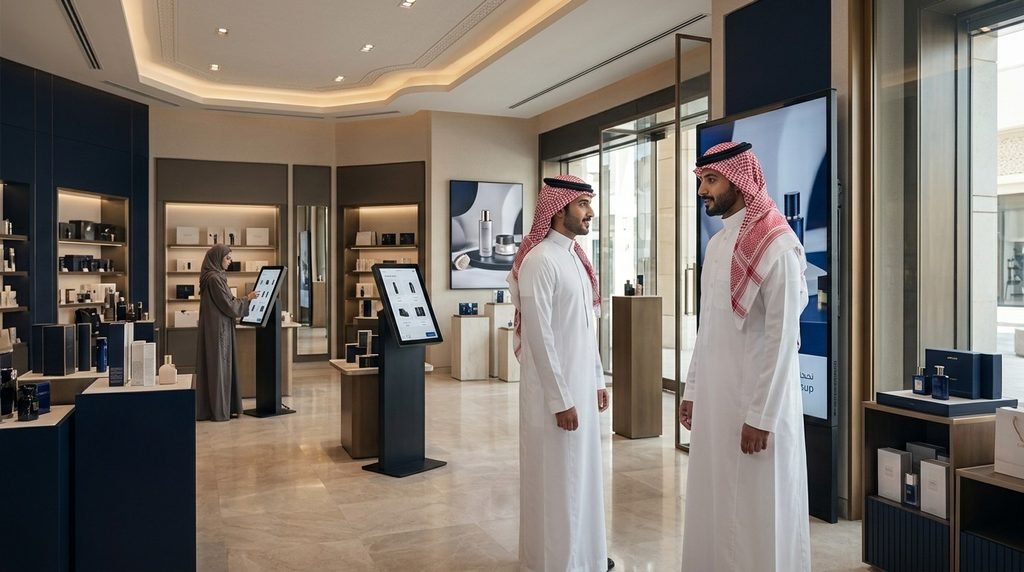
Digital signage for retail in Riyadh includes indoor LED displays, digital menu boards, interactive kiosks, digital wayfinding systems, window displays, wall-mounted screens, floor-standing totems, double-sided displays, tabletop screens and outdoor digital signage.
The right solution depends on your store type, where the screen will be installed, how far customers will view it, how often your content changes and whether you need simple display or interactive functionality.
This guide covers the main types of retail digital signage solutions, where they are used, the hardware involved, project costs, installation, common mistakes and what to look for when choosing a digital signage supplier and installer in Riyadh.
What Types of Digital Signage Are Available for Retail in Riyadh?
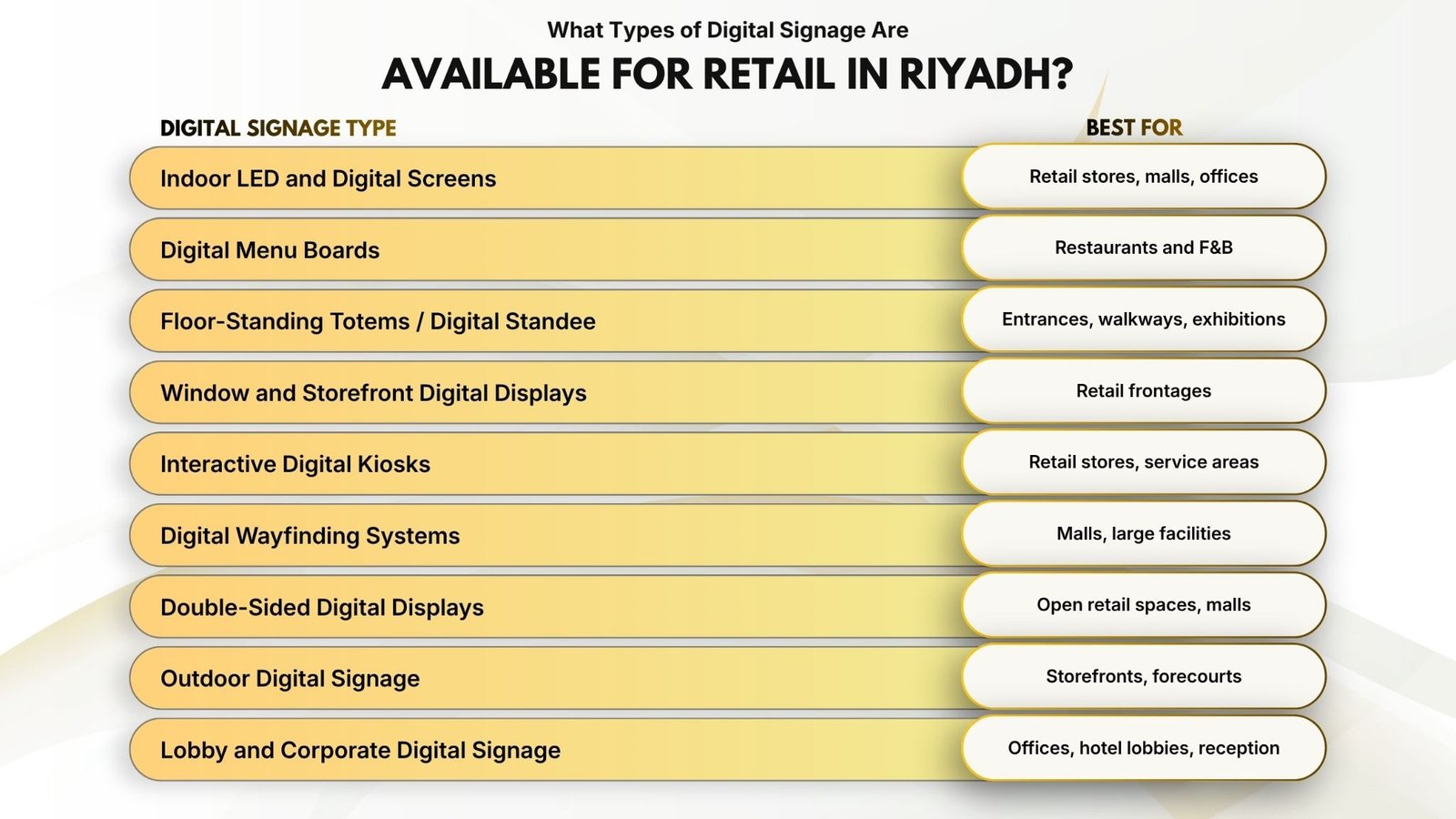
| Digital Signage Type | Best For |
| Indoor LED and Digital Screens | Retail stores, malls, offices |
| Digital Menu Boards | Restaurants and F&B |
| Floor-Standing Totems / Digital Standee | Entrances, walkways, exhibitions |
| Window and Storefront Digital Displays | Retail frontages |
| Interactive Digital Kiosks | Retail stores, service areas |
| Digital Wayfinding Systems | Malls, large facilities |
| Double-Sided Digital Displays | Open retail spaces, malls |
| Outdoor Digital Signage | Storefronts, forecourts |
| Lobby and Corporate Digital Signage | Offices, hotel lobbies, reception |
Indoor LED & Digital Display Screens
Indoor digital display screens are the most common starting point for retail businesses. Wall-mounted commercial displays show product campaigns, promotional offers, brand video, seasonal content, and announcements. Depending on viewing distance and location, the right choice is commercial LCD displays for standard retail screen sizes, or LED digital signage for larger installations where visual impact at distance matters more.
Use indoor digital signage if you are:
- Running promotional campaigns that change frequently across one or multiple locations
- Replacing static printed posters with updateable brand and product content
- Building a consistent in-store digital experience that matches your brand standard
Digital Menu Boards
Digital menuboards replace static printed menus with screens you can update without reprinting anything. Price changes, daily specials, unavailable items, promotional offers — all managed through the content system rather than through a print order.
For outdoor-facing F&B businesses or drive-through formats, outdoor digital menu boards need brightness specifications appropriate for the daylight and ambient light conditions of the installation. An indoor digital menu display spec will not be readable in direct sun.
Use digital menu boards if you are:
- Running a restaurant, café, or F&B operation where menu content changes regularly
- Looking to remove the operational cost of reprinting and replacing menu boards across locations
- Needing outdoor-facing menus that remain readable in Riyadh’s daylight conditions
Floor-standing Totems & Digital Standees
A digital totem display or floor-standing digital display positions a screen directly in the customer’s path without requiring wall mounting. It can be placed at an entrance, near a product zone, at a checkout, or at an exhibition stand — and repositioned when the layout changes.
Use floor-standing digital signage if you are:
- Operating in a space where wall mounting is not practical
- Needing a freestanding display that can be moved when the retail layout changes
- Running an exhibition stand or pop-up retail environment where portability matters
Window & Storefront Digital Displays
Your storefront is the first communication your brand has with someone who has not yet decided to enter. Window digital displays and storefront digital signage show promotions, product launches, and brand content to people outside — but only if the screen brightness is specified for the actual daylight conditions it faces.
A standard indoor screen facing a bright Riyadh shopfront will wash out in daylight. High-brightness commercial displays are the correct specification for this application.
Use window digital displays if you are:
- Communicating campaigns to pedestrians and passing traffic before they enter the store
- Replacing static window graphics with content that can change as quickly as your promotions do
- Looking to make your shopfront more visually competitive in a busy retail strip or mall
Interactive Digital Kiosks
Interactive digital signage gives customers control — product browsing, self-service, product comparisons, catalogue access, loyalty programme registration, or wayfinding — without requiring staff involvement for every interaction.
A touchscreen digital display at the right location does not just display content. It reduces the queue at your service counter and lets customers make more informed decisions independently.
Use interactive digital kiosks if you are:
- Looking to reduce customer waiting time for product information or service
- Running a product range complex enough that customers benefit from self-guided exploration
- Managing a large footprint where staff cannot be present at every decision point
Digital Wayfinding Systems
Digital wayfinding and digital wayfinding solutions help visitors navigate large retail environments without asking for directions. Store directories, maps, routes, and search-by-store functionality are managed through the wayfinding system rather than through staff time.
An interactive digital wayfinding kiosk in a mall or large retail park handles the navigation questions that otherwise reach information desks repeatedly throughout the day.
Use digital wayfinding signage if you are:
- Managing a large mall, retail park, or commercial facility where navigation is a consistent challenge
- Looking to reduce the volume of directional questions reaching your front desk or information staff
- Operating a multi-tenant commercial environment where tenant listings change regularly
Double-sided Digital Displays
In open retail spaces, shopping mall corridors, and high-traffic walkways, a single-sided screen gives up half its potential audience. Double-sided digital displays face both directions of customer movement simultaneously.
Outdoor Digital Signage
Outdoor digital signage — including outdoor LED digital signage and outdoor digital signs for business on building facades, forecourts, and street-facing positions — requires hardware specified for the outdoor environment. Brightness, weather protection, heat management, dust resistance, and UV exposure are all genuine specification requirements in Riyadh’s outdoor conditions. An indoor commercial display installed outdoors will fail.
Tabletop & Counter Digital Displays
Table top digital signage at checkout counters, reception desks, and product display points communicates promotions, pricing, and product information at exactly the moment a customer is stationary and paying attention. It does not require significant floor or wall space to be effective.
Vertical Digital Signage
Portrait-format vertical digital signage works in narrow retail spaces, beside product displays, along aisles, and in positions where a landscape screen would not fit the physical environment. Content designed for vertical viewing communicates differently from landscape — treat it as a format decision, not just a screen orientation.
How Digital Signage Requirements Differ Across Business Types in Riyadh
| Business Type | Recommended Digital Signage |
| Retail and Fashion | Promotional screens, window displays, product screens |
| Restaurants and F&B | Digital menu boards, outdoor menu boards |
| Malls and Commercial Centres | Wayfinding kiosks, directories, promotional screens |
| Hotels and Hospitality | Lobby displays, wayfinding, menu boards |
| Corporate Offices and Banks | Announcement screens, lobby displays, meeting room signage |
| Healthcare and Clinics | Queue systems, wayfinding, patient information screens |
| Government and Institutional | Queue management, information screens, wayfinding |
| Education and Training | Timetable displays, directional signage, announcement screens |
The same screen setup does not work everywhere. Your industry, customer journey, physical environment, and how frequently your content changes all determine what makes sense — and what does not.
Fashion & Apparel Retailers
Your digital signage needs to support the visual side of the shopping experience, not compete with it. Dynamic product displays, new collection launches, and campaign content alongside the physical product — plus window digital displays communicating to people outside the store before they have decided to enter.
Luxury & Premium Retail
The screen itself is part of the environment. High-resolution commercial displays, carefully controlled content, and interactive kiosks that let customers explore products at their own pace — all without making the space feel like a conventional retail floor.
F&B and Restaurants
Speed and flexibility are the requirements. Digital menuboards that update without a print order. Outdoor digital menu boards for external ordering areas with brightness specifications that hold up in daylight. Promotional content that changes as quickly as your daily specials do.
Hotels & Hospitality Venues
Hotel digital signage handles the information load that paper-based hotel communication creates — facility hours, event schedules, restaurant menus, directional wayfinding. Hospitality digital signage in lobby areas reduces the volume of routine questions that would otherwise reach the front desk repeatedly throughout the day.
Supermarkets & Grocery Retailers
You have more information to communicate than almost any other retail format. Digital price displays that update centrally, promotional screens at high-traffic decision points, department signage that guides customers through the store, and checkout-area displays that communicate offers at the last point of decision.
Electronics & Technology Retailers
Your products need explanation that a price tag and a printed spec sheet cannot provide. Interactive digital displays for product comparison, digital price signs that update when specifications change, and touchscreen digital displays that let customers explore features independently reduce the burden on your sales team.
Corporate Offices & Workplace Environments
Corporate digital signage and office digital signage in reception areas, meeting room lobbies, and shared spaces display visitor information, internal announcements, and brand content. A lobby digital display handles the first impression a corporate environment makes on every visitor — before anyone from the team has spoken to them.
Malls & Multi-brand Environments
Digital wayfinding systems, interactive wayfinding kiosks, tenant directory displays, and promotional screens coordinate navigation and communication across a complex multi-tenant environment. When tenant mix changes, the directory updates without physical replacement.
Healthcare Facilities & Clinics
Healthcare digital signage and waiting room digital signage manage patient information, queue status, directional wayfinding, and facility communication in environments where printed materials become inaccurate faster than they can be replaced. A queue management display in a clinic waiting area reduces the pressure on reception staff handling the same directional questions throughout every shift.
Government & Institutional Facilities
Government buildings and public service facilities handle high visitor volumes where consistent, bilingual directional information reduces pressure on front desk and counter staff. Queue management screens, wayfinding displays, and service information screens all handle communication that printed posters cannot keep current.
Real Estate & Property Showrooms
Interactive kiosks in a property showroom allow buyers to explore floor plans, unit specifications, and project details independently — at their own pace, without requiring a sales team member to be present at every stage of the visit. Large-format displays present development visuals at a scale that printed brochures cannot match.
Automotive Showrooms
Interactive product displays in automotive showrooms let buyers explore specifications, configurations, and options independently — which reduces the pace pressure of a sales conversation and gives customers confidence in the decisions they are making. Digital price signs update when specifications or offers change without reprinting materials across multiple showrooms.
Banks & Financial Services
Branch digital signage manages the waiting experience and communicates promotional content at the moments customers are most likely to be receptive — while they are already in the queue. Queue management displays, promotional screens, and information displays replace the static poster arrangements that most branches still rely on.
Education and training institutions
Campus digital signage — timetable displays, event announcements, directional wayfinding, and departmental information screens — handles the communication load that changes fastest in an educational environment. When schedules change, the screens update. Printed timetables posted on notice boards do not.
What Hardware Does Retail Digital Signage Actually Require?
A screen is one component of a complete digital signage installation. A properly specified retail digital signage system also includes media players, mounts, cabling, network connectivity, content management software, and where applicable, interactive hardware and enclosures.
Commercial displays vs. consumer screens
A consumer television is designed for home use at moderate operating hours. A commercial digital display screen is designed for professional environments — continuous operation, wider viewing angles, more robust connectivity, and hardware specified for the operating conditions of a retail environment.
For any installation running more than six to eight hours per day, or in a high-ambient-light position, commercial-grade hardware is the correct specification.
LED vs. LCD: when each is the right choice?
| Factor | LCD Display | LED Display |
| Typical use | Standard indoor retail screens | Large-format and high-impact installations |
| Image quality | Strong at standard screen sizes | Strong for large visual areas and distance viewing |
| Installation | Wall-mounted displays, standard retail positions | Custom display formats, larger visual areas |
| Viewing distance | Close to medium range | Depends on pixel pitch and installation |
| Best choice | Standard retail content and menu boards | Large-format brand zones and feature installations |
Indoor vs. Outdoor Specifications
Outdoor digital screens face conditions that indoor displays are not built to handle. In Riyadh specifically: heat, direct UV exposure, dust, and high ambient light conditions. An outdoor commercial display needs brightness levels significantly higher than an indoor screen, environmental protection rated for the conditions, and heat management specified for the climate.
Any outdoor digital signage installation in Riyadh should start with a site assessment before hardware is specified. The wrong hardware in an outdoor position will fail faster than the campaign it was installed for.
Screen Size
Screen size follows viewing distance and content complexity — not available wall space. A screen too small for the viewing distance produces content customers cannot read. A screen too large for a small retail space dominates the environment and competes with the products it is meant to support.
Every retail digital signage installation starts with the right hardware specification — and that starts with understanding your space, your conditions, and your content requirements. Message us on WhatsApp and we will give you a complete site assessment and hardware recommendation for your retail digital signage project, whether it is a single display or a multi-zone outdoor installation.
What Are the Most Common Digital Signage Mistakes in Riyadh Retail Projects?
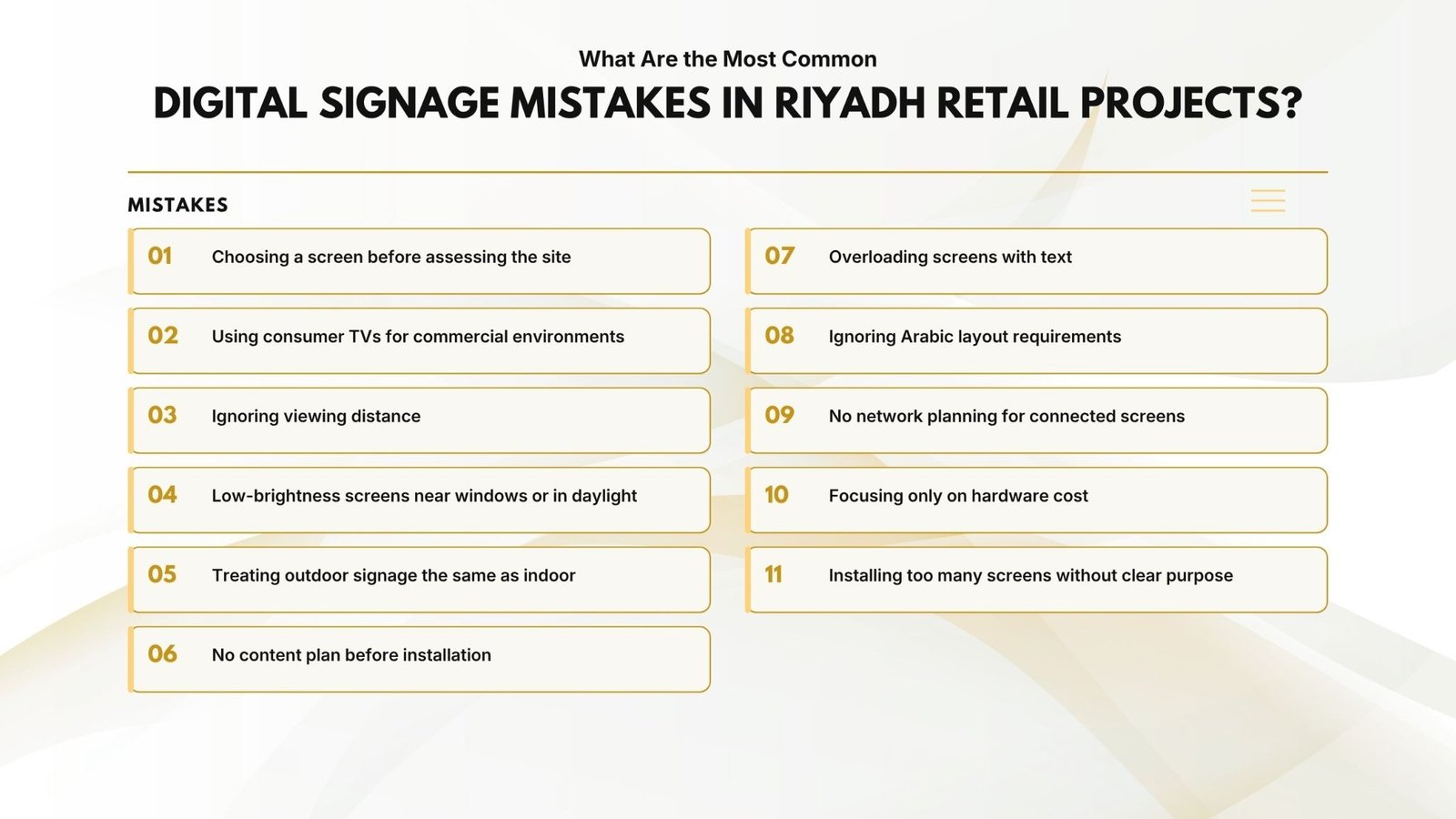
| Mistakes |
| Choosing a screen before assessing the site |
| Using consumer TVs for commercial environments |
| Ignoring viewing distance |
| Low-brightness screens near windows or in daylight |
| Treating outdoor signage the same as indoor |
| No content plan before installation |
| Overloading screens with text |
| Ignoring Arabic layout requirements |
| No network planning for connected screens |
| Focusing only on hardware cost |
| Installing too many screens without clear purpose |
What Does Digital Signage Cost for a Riyadh Retail Business?
| Solution | Cost Level |
| Indoor Digital Display Screen | Low to Moderate |
| Digital Menu Board | Low to Moderate |
| Floor-Standing Totem / Digital Standee | Moderate |
| Interactive Digital Kiosk | Moderate to High |
| Outdoor Digital Signage | Moderate to High |
| Digital Wayfinding System | High |
| Large LED Digital Signage Installation | High |
| Multi-Screen Digital Signage Network | High |
There is no single price for retail digital signage. A single indoor promotional screen and a multi-branch network of outdoor displays and interactive kiosks are different projects with different hardware, software, installation, and support requirements.
Ongoing costs Riyadh retailers often underestimate: content creation and management, content management software licensing, network connectivity, hardware maintenance, screen cleaning, and technical support. For multi-location businesses, these recurring costs need to be part of the initial project discussion — not discovered after the hardware is installed.
For any accurate quote, the supplier needs to understand the site, the content plan, the operating schedule, and the number of locations before recommending hardware. A generic screen price is not a project quote.
How Etihad Golden Falcons Handles Digital Signage for Retail in Riyadh
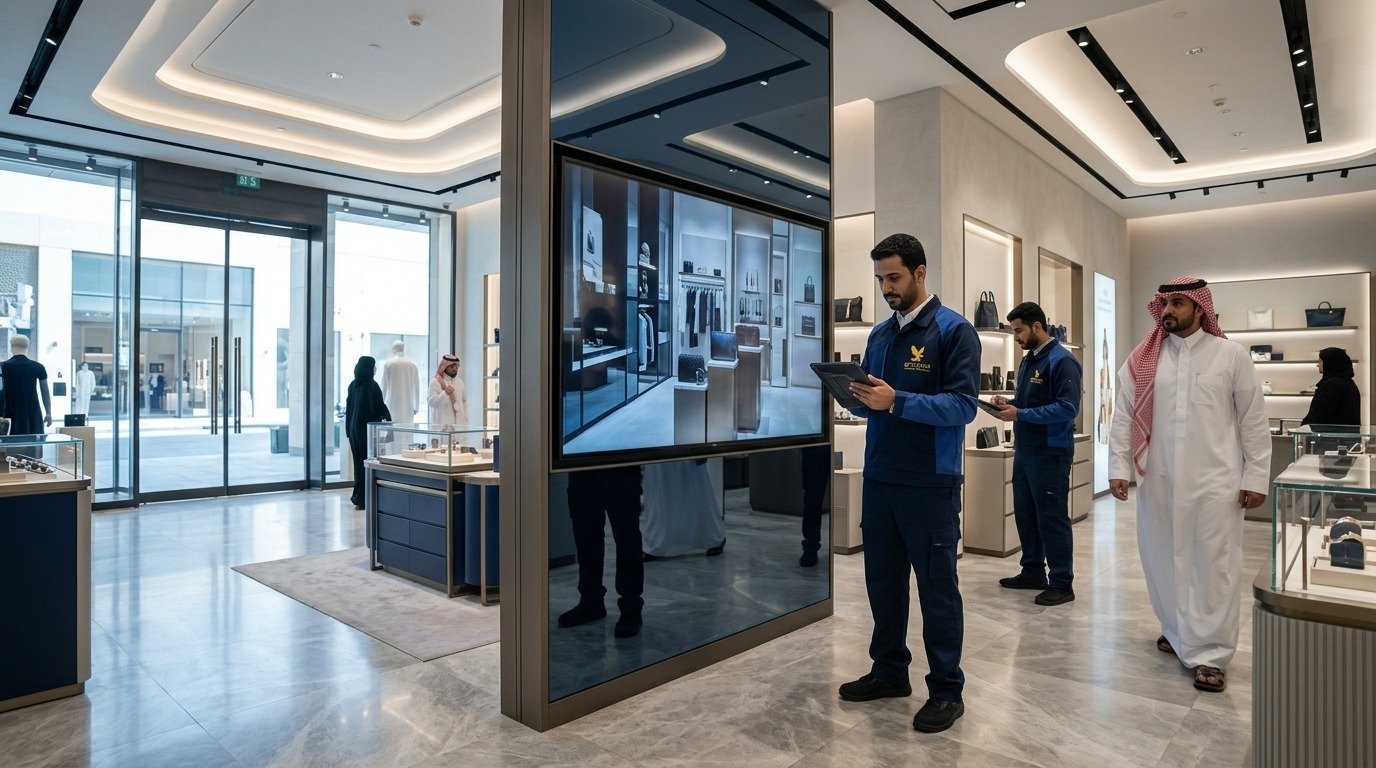
We start with the space and the objective — not with a screen recommendation.
Viewing distance, ambient light, mounting surface, power availability, network access, content plan, operating hours, and whether the installation is indoor or outdoor all determine the hardware specification before anything is purchased. A screen specified without this information is a guess.
We supply commercial digital signage hardware — not consumer televisions repurposed for commercial use — across indoor, outdoor, interactive, and large-format applications. Hardware is selected for the actual operating conditions of your retail environment, not for what looks right in a product catalogue.
Installation covers mounting, cabling, content management configuration, Arabic and bilingual content testing, and commissioning. For multi-location businesses, content management across the network is planned as part of the project — not addressed after the screens are already on the walls.
Ongoing support for hardware, content, and connectivity is available after installation. Digital signage needs attention beyond installation day, and the support arrangement should be confirmed before the project begins, not after something stops working.
FAQs
Commercial displays are designed for continuous professional use — longer operating hours, better connectivity, more robust mounting options, and hardware specified for retail environments. Consumer televisions are built for home use. For any retail installation running six or more hours daily, commercial-grade digital display screens are the correct specification.
Yes. Indoor and outdoor installations have different hardware requirements. Outdoor digital signage needs brightness ratings, environmental protection, and heat management appropriate for Riyadh’s outdoor conditions. We assess the installation location before specifying outdoor hardware — not after.
It depends on screen count, hardware availability, site conditions, content requirements, and whether custom structures or software are involved. A single indoor screen installs faster than a multi-branch network of outdoor displays and interactive kiosks. We confirm a realistic timeline after the site survey — not before it.
Yes. Arabic content, right-to-left formatting, bilingual layouts, and mixed Arabic-English display are all supported. Arabic content should be tested on the actual hardware and content management system before go-live — not assumed to work correctly without testing.
There is no universal answer. Screen size follows viewing distance and content complexity. Brightness follows ambient light — window-facing and outdoor displays need significantly higher brightness than screens installed deeper inside a store. We determine both after a site assessment.
We handle the full scope: hardware supply, mounting, cabling, content management configuration, Arabic content testing, installation, and commissioning. The scope is confirmed based on your specific project requirements.
Yes. Digital menu boards connected to a content management system can be updated by non-technical staff for routine changes — prices, daily specials, availability. The ease of update depends on the system configured for your installation. We confirm this capability before specifying the software.
We provide support for display issues, connectivity, configuration, and hardware maintenance. The appropriate support arrangement depends on the number of screens, locations, and system complexity — confirm this as part of the project discussion before installation, not after something requires attention.