Safety signage in Riyadh is under increasing regulatory scrutiny across every sector, construction, industrial, commercial, and institutional. SASO (Saudi Standards, Metrology and Quality Organization) standards and Saudi Civil Defence requirements define what must be communicated, how it must look, and where it must be placed. For facilities and site managers, getting this right is not optional. For the workers and visitors who rely on these signs, it is more fundamental than that.
Safety signage covers fire safety signs, emergency exit signs, construction site safety signs, electrical and chemical hazard signs, PPE and mandatory signs, caution and warning signs, first aid signs, industrial and warehouse safety signs and road and traffic safety signs.
The right solution depends on your facility type, the hazards present, the regulatory standards that apply and whether signage needs to be in Arabic, English or both.
This article covers every category of safety signage, what each requires, what affects cost and what to look for when choosing a safety signage company in Riyadh.
What Types of Safety Signage Are Available in Riyadh?
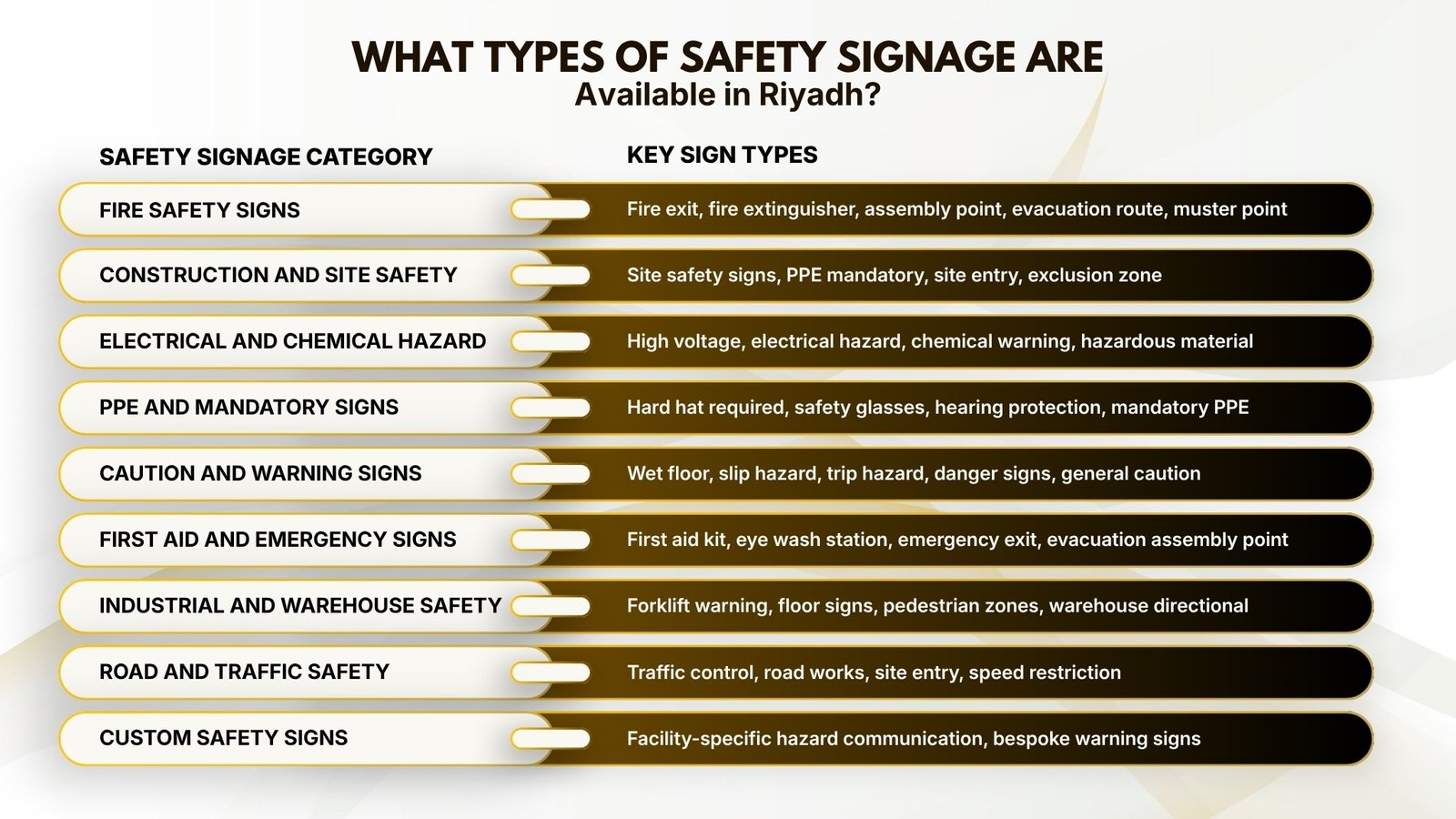
| Safety Signage Category | Key Sign Types |
| Fire Safety Signs | Fire exit, fire extinguisher, assembly point, evacuation route, muster point |
| Construction and Site Safety | Site safety signs, PPE mandatory, site entry, exclusion zone |
| Electrical and Chemical Hazard | High voltage, electrical hazard, chemical warning, hazardous material |
| PPE and Mandatory Signs | Hard hat required, safety glasses, hearing protection, mandatory PPE |
| Caution and Warning Signs | Wet floor, slip hazard, trip hazard, danger signs, general caution |
| First Aid and Emergency Signs | First aid kit, eye wash station, emergency exit, evacuation assembly point |
| Industrial and Warehouse Safety | Forklift warning, floor signs, pedestrian zones, warehouse directional |
| Road and Traffic Safety | Traffic control, road works, site entry, speed restriction |
| Custom Safety Signs | Facility-specific hazard communication, bespoke warning signs |
Fire Safety Signs
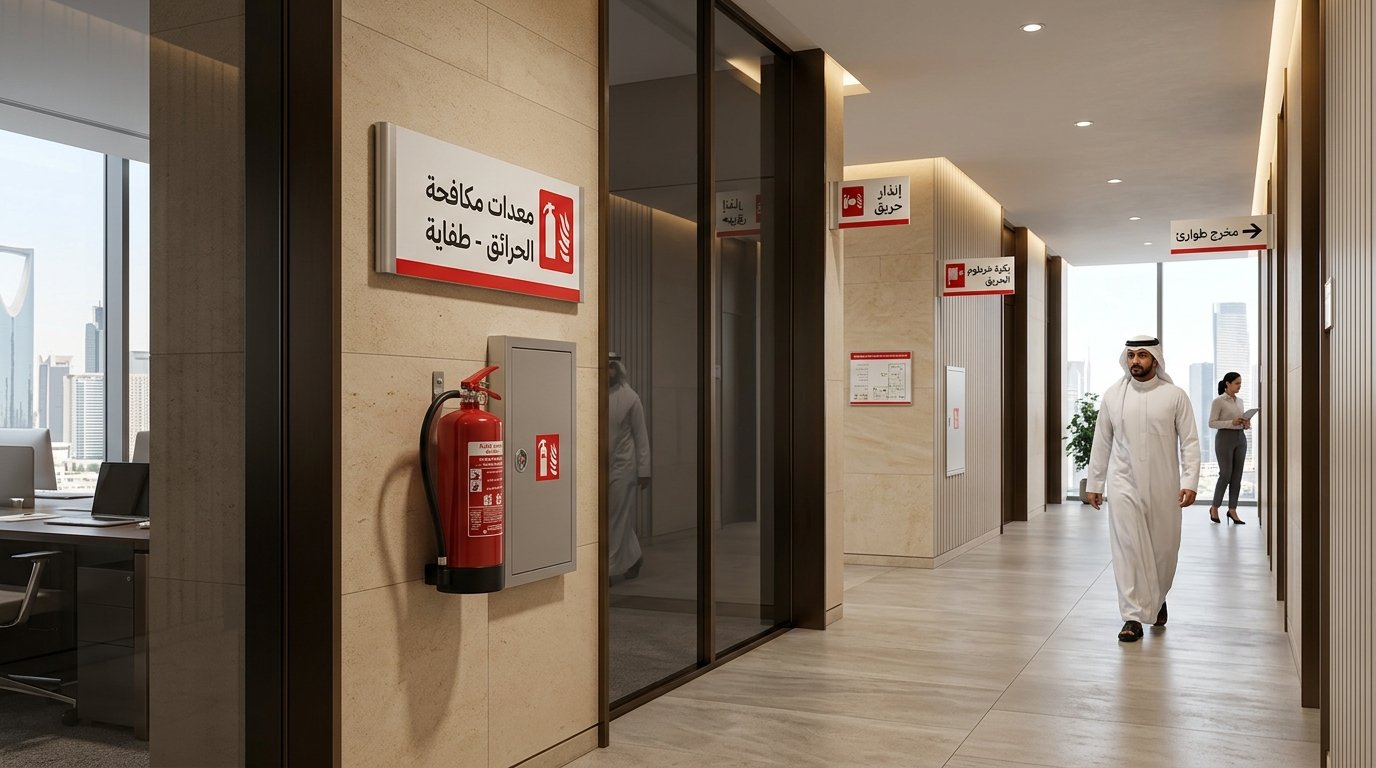
Fire safety signs are mandatory across every commercial, industrial, and institutional facility in Riyadh. They cover fire exit signs, fire escape signs, and emergency exit door signs that mark the route out of the building. Fire extinguisher signage identifies the location of fire-fighting equipment. Fire assembly point signs and emergency assembly point signs direct everyone on site to the designated gathering location when an evacuation is called. Muster point signs and emergency muster point signs serve the same function on larger sites and construction projects.
Fire evacuation signage needs to be visible under normal lighting conditions and, critically, in a power failure. Photoluminescent fire exit signs continue to emit light after power is lost — a material requirement for any facility where electrical failure accompanies an emergency.
Every fire safety sign must be positioned before the decision point it is communicating — not at the junction after someone has already taken the wrong direction.
Construction & Site Safety Signs
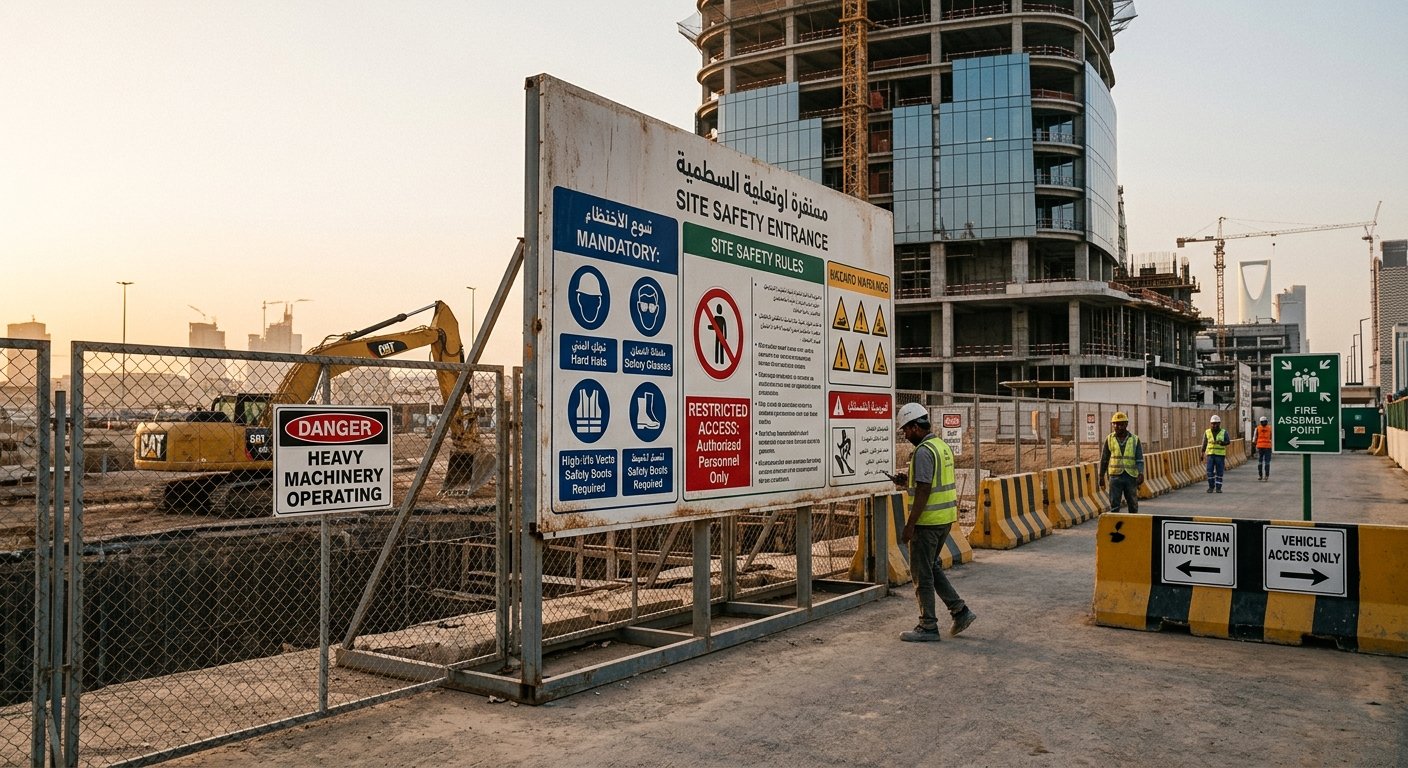
Active construction sites in Riyadh operate under specific signage requirements that cover site entry, exclusion zones, PPE mandatory areas, traffic control, and emergency information. Construction site safety signs and building site safety signs communicate the rules and hazards that apply the moment someone enters the site boundary.
For Riyadh’s giga-projects and infrastructure sites, the scale of the operation multiplies the signage requirement proportionally. A site with thousands of workers across multiple zones needs a signage system, not a collection of individual signs placed when a hazard is noticed.
Electrical & Chemical Hazard Signs
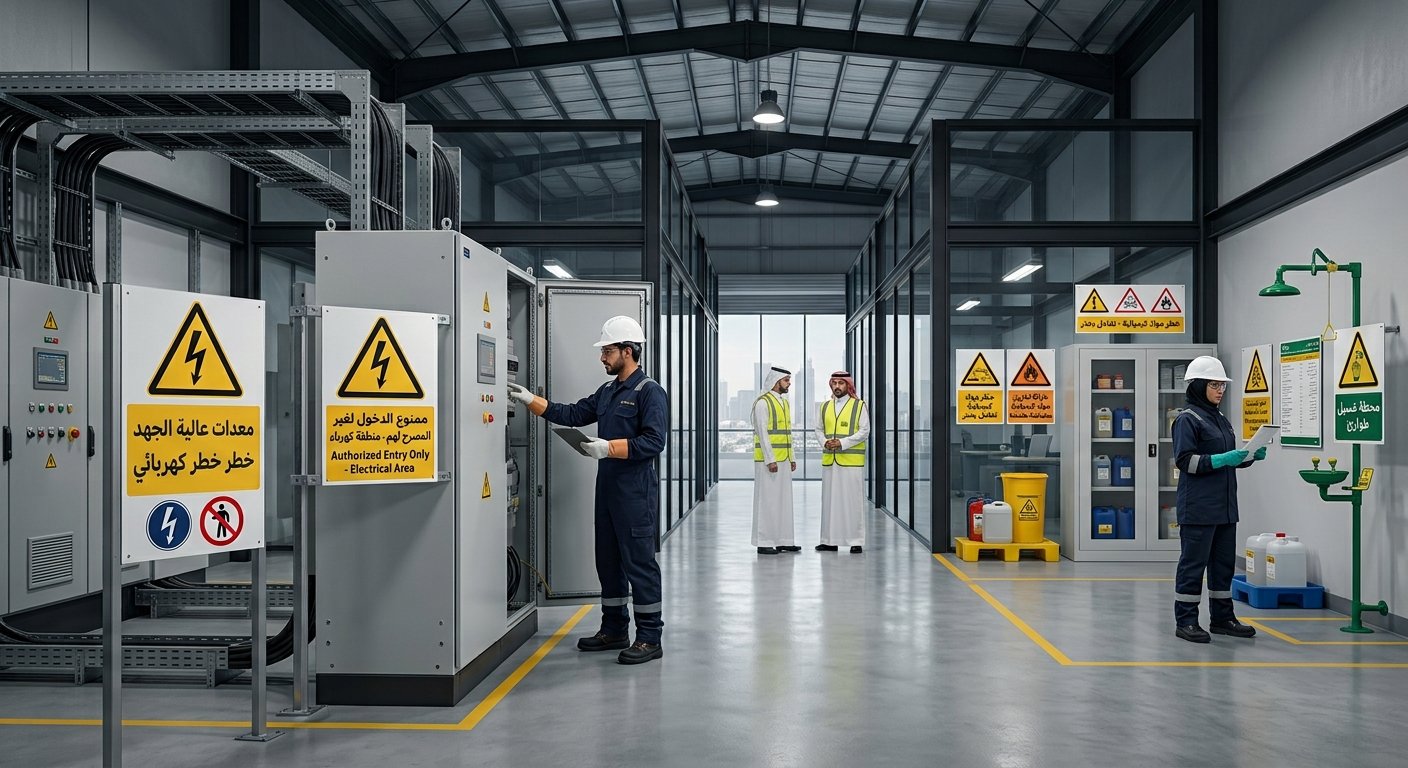
Electrical hazard signs and high voltage warning signs communicate the presence of live electrical infrastructure, transformer stations, switchgear rooms, and high-voltage equipment. These signs must be visible before someone reaches the hazard — not positioned at the point of contact.
Chemical warning signs, chemical safety signs, and hazardous material signs are required wherever substances that present a risk through contact, inhalation, or spillage are stored, handled, or used. SASO and GHS requirements govern the symbol sets and colour coding that apply to chemical hazard communication in Saudi Arabia. Standard text-only warning signs are not compliant for chemical hazard communication.
PPE & Mandatory Signs
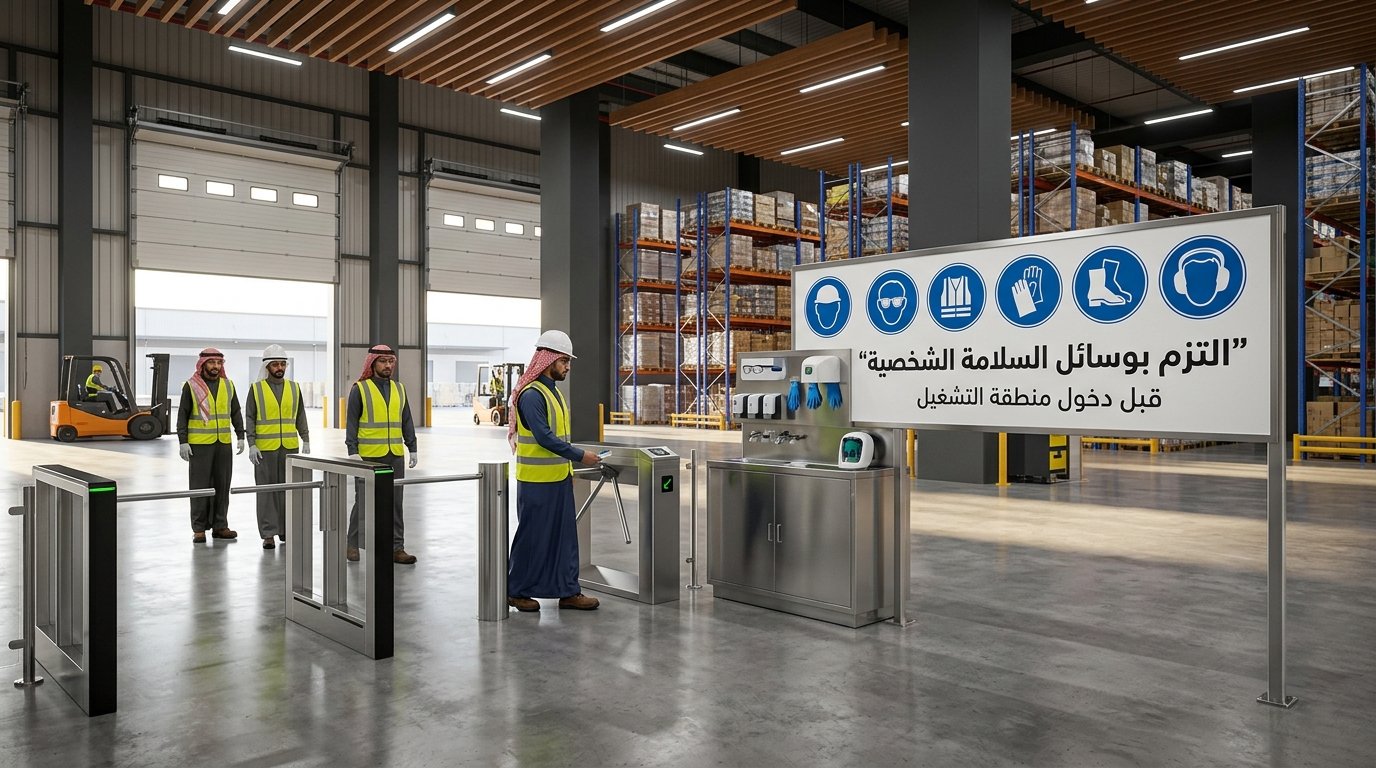
PPE signs and mandatory signs communicate the personal protective equipment required in a specific area. Hard hat required signs at site entry points. Hearing protection signs adjacent to high-noise equipment. Safety glasses signs in workshop and manufacturing environments. These are not advisory — they are mandatory instructions that must be communicated clearly before a worker enters the relevant area.
The design, colour, and symbol format for mandatory signs is defined by SASO standards. Blue circular signs with white symbols are the correct format for mandatory instructions. A text-only sign in the wrong colour is not SASO-compliant even if the instruction is correct.
Caution & Warning Signs
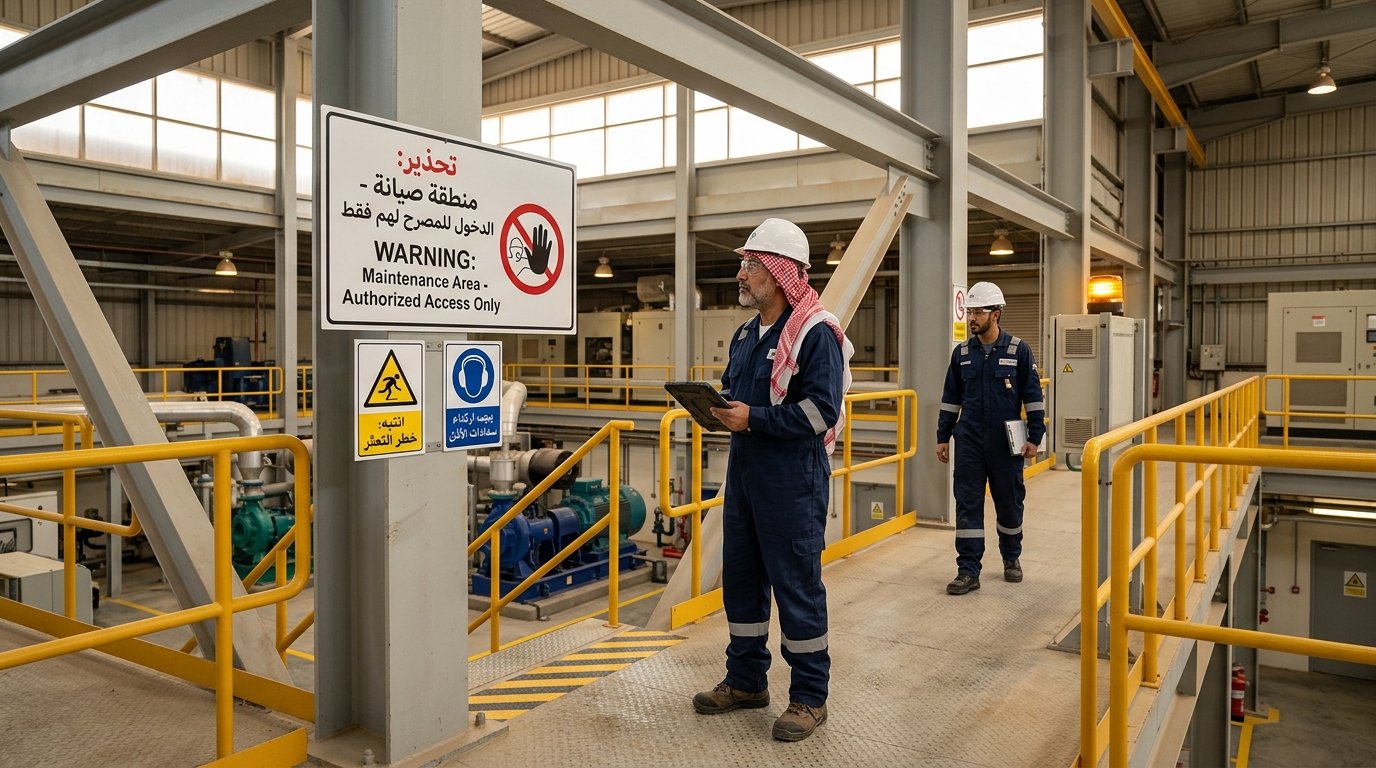
Caution and warning signs communicate hazards that do not require immediate prohibition but that every person in the area needs to know about. Wet floor signs and caution wet floor signs in commercial environments. Slip hazard signs and trip hazard signs in industrial and construction environments. Danger signs for high-risk areas where injury is likely without caution.
The distinction between warning, caution, and danger is not semantic — each level has defined colour coding and symbol requirements under SASO standards, and using the wrong level for a given hazard is a compliance failure as much as having no sign at all.
First Aid & Emergency Signs
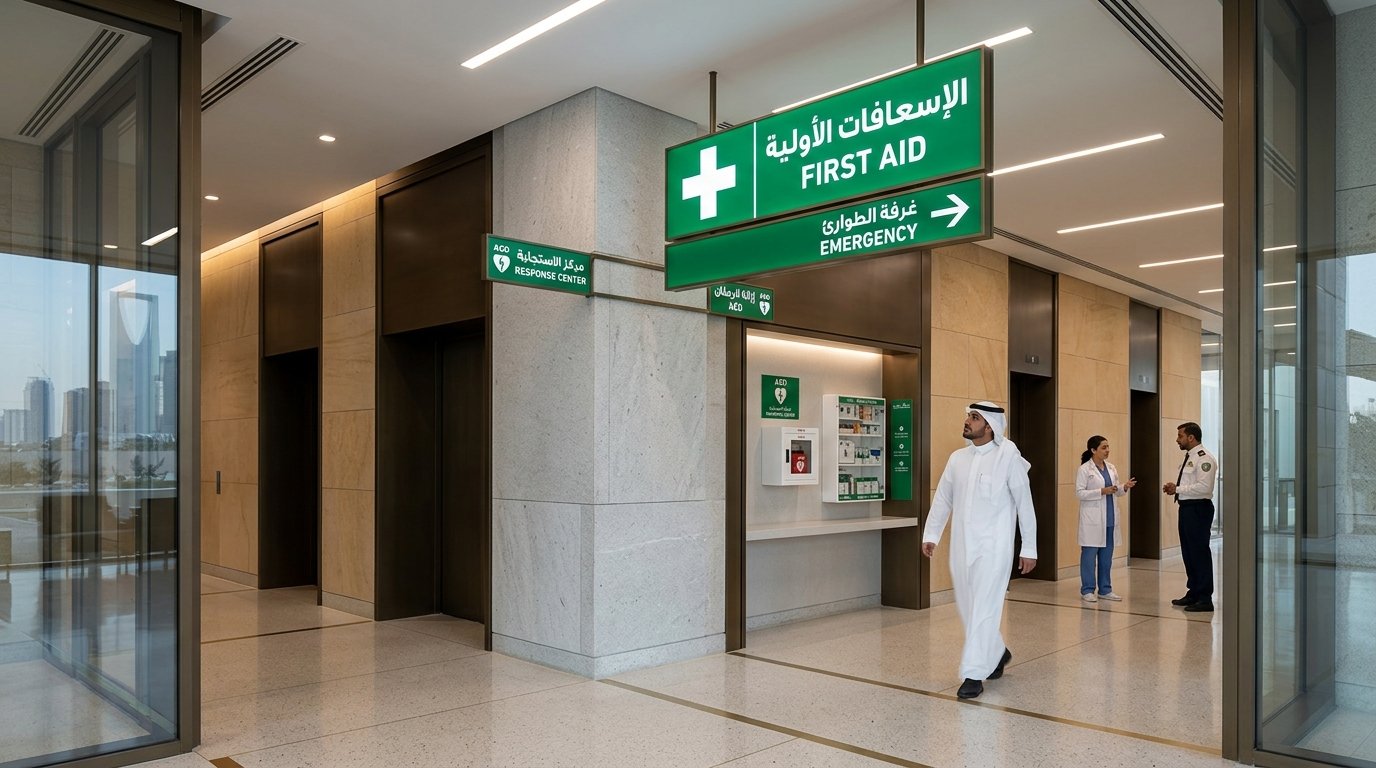
First aid signs and first aid kit signs mark the location of first aid equipment and designated first aid areas. Eye wash station signs identify emergency eye wash facilities in environments where chemical splash is a risk. Emergency exit signs and evacuation assembly point signs complete the emergency response communication system that every facility requires.
These signs need to be visible from the point at which someone would make a decision about where to go — not from directly beside the equipment itself.
Industrial & Warehouse Safety Signs
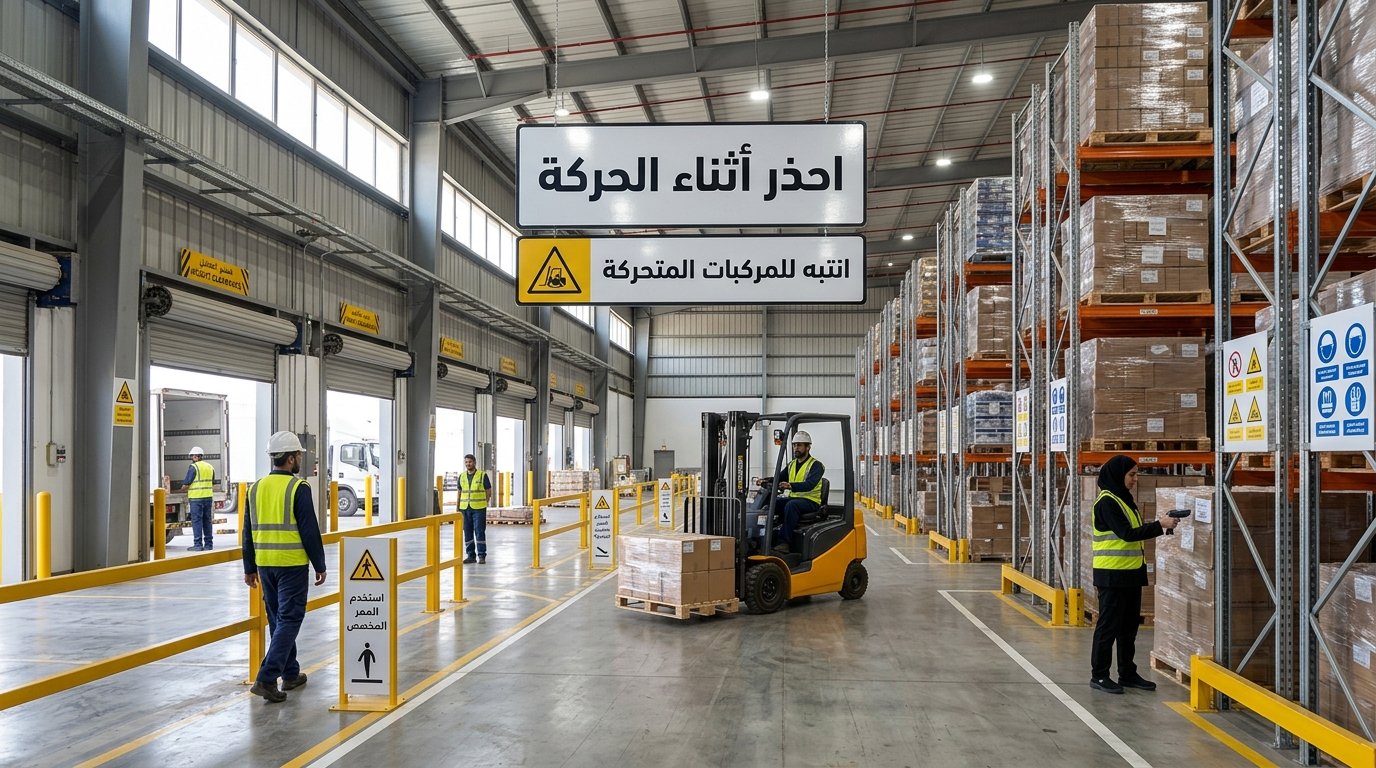
Industrial safety signs and warehouse safety signs manage the movement of people and vehicles in environments where both are operating simultaneously. Forklift safety signs and forklift warning signs mark active vehicle zones and communicate right-of-way and pedestrian restrictions. Warehouse floor signs and floor signs define pedestrian paths, vehicle lanes, and hazard zones directly on the floor surface where they are read at the point of decision.
Industrial safety signage needs to account for the viewing conditions of the environment — ambient noise, reduced visibility from dust or steam, and the speed at which equipment and people are moving.
Road & Traffic Safety Signs
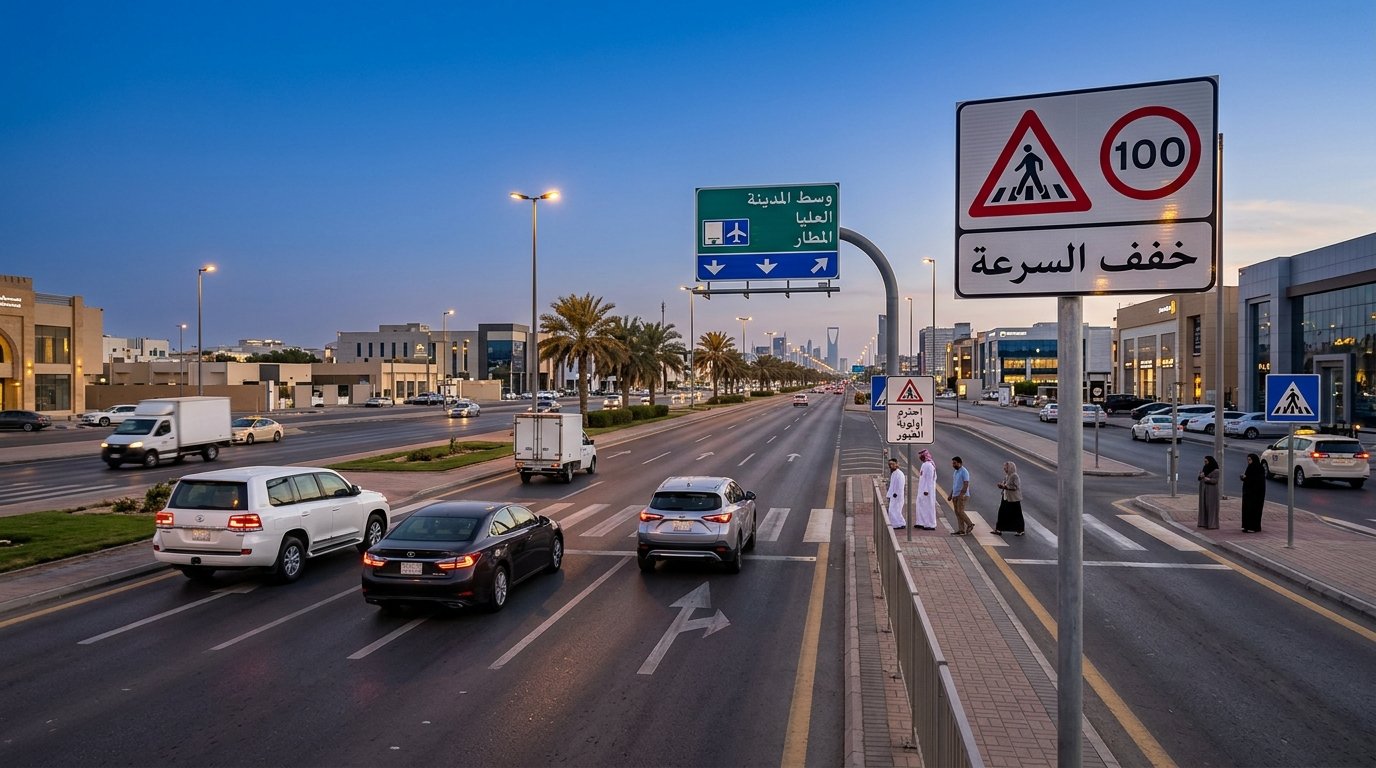
Road safety signs, traffic safety signs, and traffic control signs manage vehicle and pedestrian movement on road works, utility projects, and large-scale infrastructure development sites across Riyadh. Construction traffic control signs direct vehicles approaching and moving through active works areas. Site entry and speed restriction signs communicate the conditions that apply before vehicles enter the controlled zone.
Traffic safety signage on public-facing road works must meet the standards set by the relevant Riyadh municipal authority as well as the general SASO requirements for hazard communication.
Custom Safety Signs
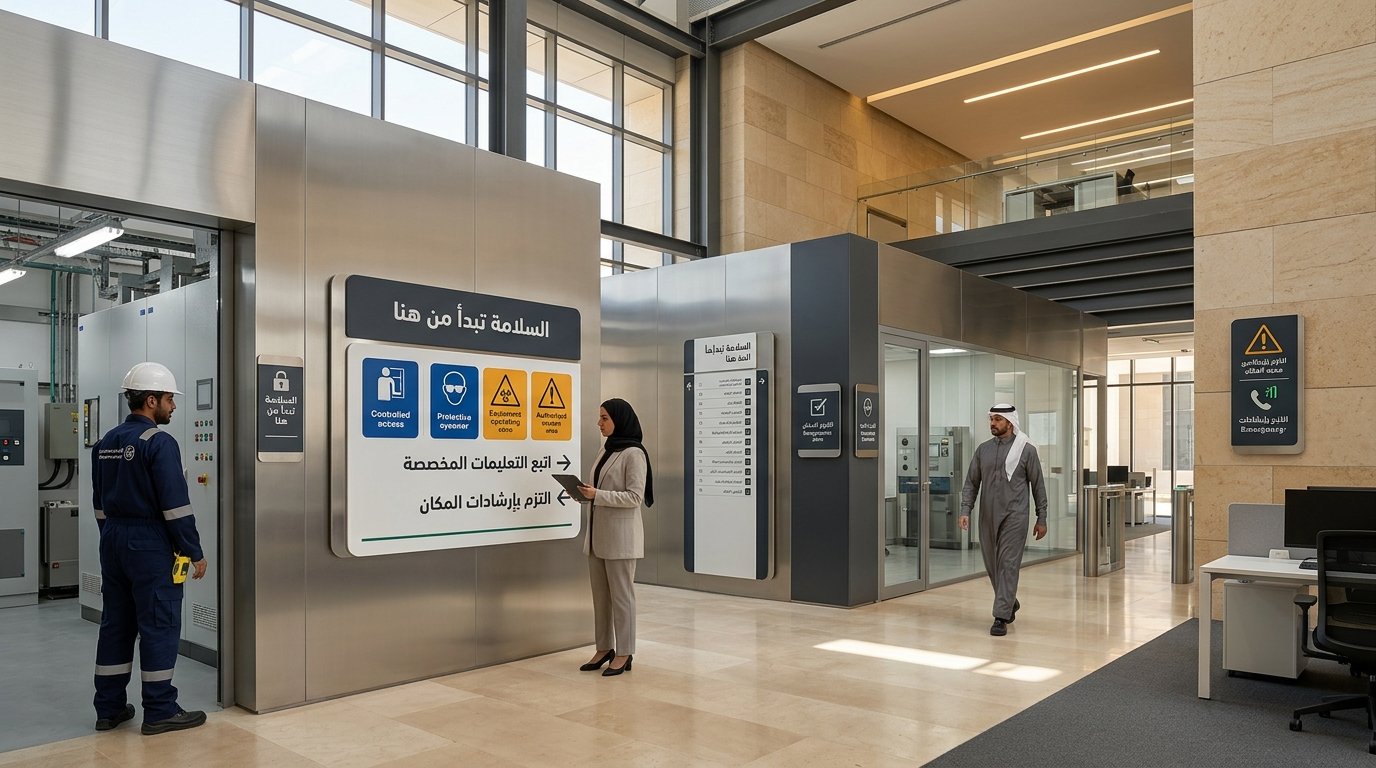
Standard catalogue safety signs do not cover every hazard in every facility. Custom safety signs and custom warning signs are produced for facility-specific hazard communication requirements — specific equipment, specific processes, specific site conditions that require a sign designed for that hazard rather than a generic nearest equivalent.
Custom safety sign boards are also used when the combination of Arabic text, facility-specific symbols, and regulatory compliance requirements produces a sign that does not exist in any standard format.
What Makes Safety Signage Compliant and Effective in Riyadh?
SASO standards: what they require from safety signage
SASO standards define the design requirements for safety signage in Saudi Arabia across four primary sign categories:
- Prohibition signs: red circle with diagonal bar, white background; no smoking, no entry, no unauthorised access
- Mandatory signs: blue circle, white symbol; PPE requirements, required actions
- Warning signs: yellow triangle, black symbol; hazards, caution areas, danger zones
- Safe condition signs: green rectangle or square, white symbol; fire exits, first aid, assembly points
Each category has defined colour values, symbol sets, and minimum size requirements based on viewing distance. A sign that uses the correct text but the wrong colour is not SASO-compliant. A sign that uses the correct colour but the wrong symbol format is not SASO-compliant. Both create regulatory exposure regardless of the intent behind them.
Arabic and bilingual safety signage
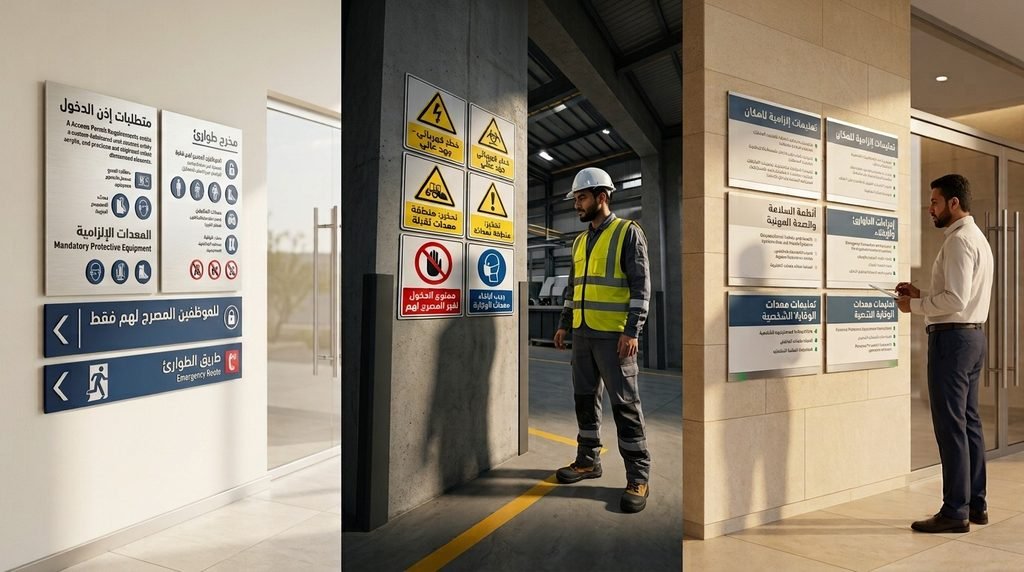
Saudi Arabia’s construction and industrial workforce is linguistically diverse. Sites with workers who read primarily in Arabic and workers who read primarily in English require bilingual safety signage that communicates equally clearly in both languages — not English-primary signs with Arabic text added below in a smaller size.
Arabic-first bilingual safety signage places Arabic as the primary text and English as supporting text — matching the reading pattern of the majority of workers on most Saudi sites. Both languages need to be produced at sizes and in positions that allow them to be read at the intended viewing distance.
Single-language English-only safety signs on a site with Arabic-speaking workers is a compliance failure. It is also a communication failure at the moment when communication matters most.
Sign placement, visibility, size and material
Placement needs to anticipate the path of travel and the point of decision. A fire exit sign mounted at the exit is confirmation — it is not direction. The direction sign needs to be at every junction along the evacuation route before the exit is reached.
A sign that cannot be read from the distance at which a decision needs to be made is not a functional sign. Minimum viewing distance determines minimum sign size — and that calculation needs to be made before signs are specified, not after they are installed and found to be too small.
Material selection needs to reflect the environment. A PVC sign in a chemical storage area where surfaces are regularly exposed to solvents will degrade. A paper-backed vinyl sign on an outdoor construction site will fail in Riyadh’s UV and dust conditions. The right material for the sign is determined by where it will be installed and what it will be exposed to.
Getting the sign type, material, placement, and bilingual layout right is what makes safety signage actually work. Contact us now on WhatsApp and we will make sure your safety signage is correctly specified for your facility, your environment, and your workforce — and fully compliant with SASO requirements.
What Materials Are Used for Safety Signage in Riyadh?
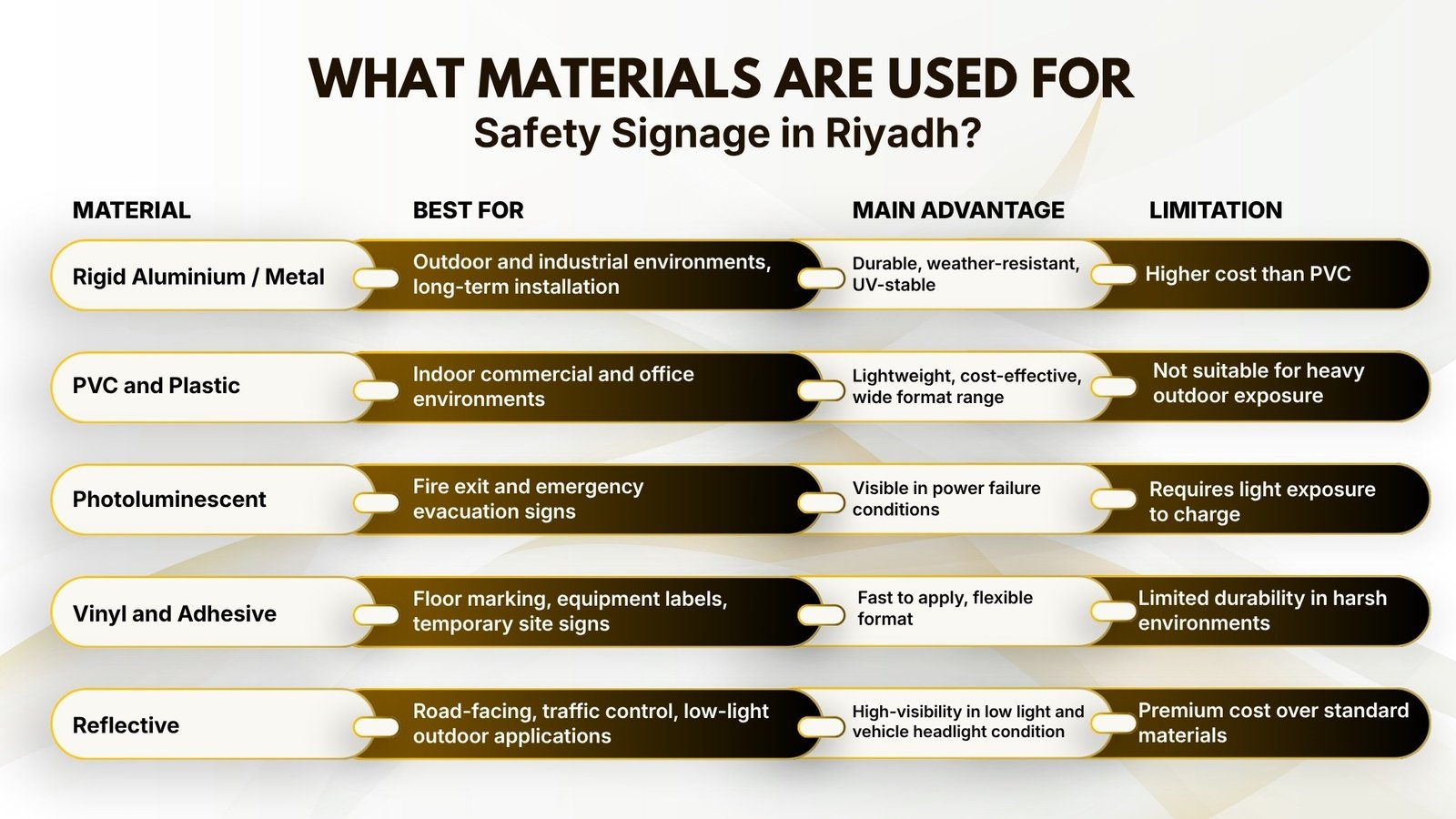
| Material | Best For | Main Advantage | Limitation |
| Rigid Aluminium / Metal | Outdoor and industrial environments, long-term installation | Durable, weather-resistant, UV-stable | Higher cost than PVC |
| PVC and Plastic | Indoor commercial and office environments | Lightweight, cost-effective, wide format range | Not suitable for heavy outdoor exposure |
| Photoluminescent | Fire exit and emergency evacuation signs | Visible in power failure conditions | Requires light exposure to charge |
| Vinyl and Adhesive | Floor marking, equipment labels, temporary site signs | Fast to apply, flexible format | Limited durability in harsh environments |
| Reflective | Road-facing, traffic control, low-light outdoor applications | High-visibility in low light and vehicle headlight conditions | Premium cost over standard materials |
Rigid Aluminium & Metal Safety Signs
Aluminium safety signs are the correct specification for outdoor installations, construction sites, and industrial environments in Riyadh. They resist UV exposure, heat, and dust without the surface degradation that PVC shows in sustained outdoor conditions. For safety signs that need to remain legible and structurally intact across years of outdoor exposure in Riyadh’s climate, metal is the material.
PVC & Plastic Safety Signs
PVC safety signs are practical for indoor commercial and office environments where the sign is protected from direct sun and does not face heavy physical contact. They are lightweight, produced in the full range of SASO-compliant colours and formats, and cost-effective for high-quantity indoor applications. For outdoor or industrial use, they are not the correct specification.
Photoluminescent Safety Signs
Photoluminescent fire exit signs and emergency evacuation signs absorb light during normal operating conditions and continue to emit a visible glow when power fails. In a fire or power failure scenario, conventional internally lit signs may fail with the electrical system. Photoluminescent signs continue to function. For fire escape signs, emergency exit door signs, and evacuation route markers, photoluminescent material is not optional — it is what ensures the sign works in the conditions under which it will most urgently be needed.
Vinyl & Adhesive Safety Signs
Adhesive vinyl safety signage covers warehouse floor signs and floor marking, equipment labelling, and temporary site applications where a rigid sign is impractical. Warehouse floor signs defining pedestrian walkways, forklift lanes, and hazard zones are produced in adhesive vinyl rated for the traffic and cleaning conditions of the specific floor surface.
Reflective Safety Signs
Reflective material is the specification for road-facing safety signs, construction traffic control signs, and any outdoor safety signage that must be readable in low-light conditions or under vehicle headlights. Standard non-reflective signs are invisible in the dark. On a road works site operating at night or in low visibility, non-reflective traffic control signs are a safety failure, not just a compliance gap.
How Safety Signage Requirements Differ Across Riyadh Facility and Industry Types
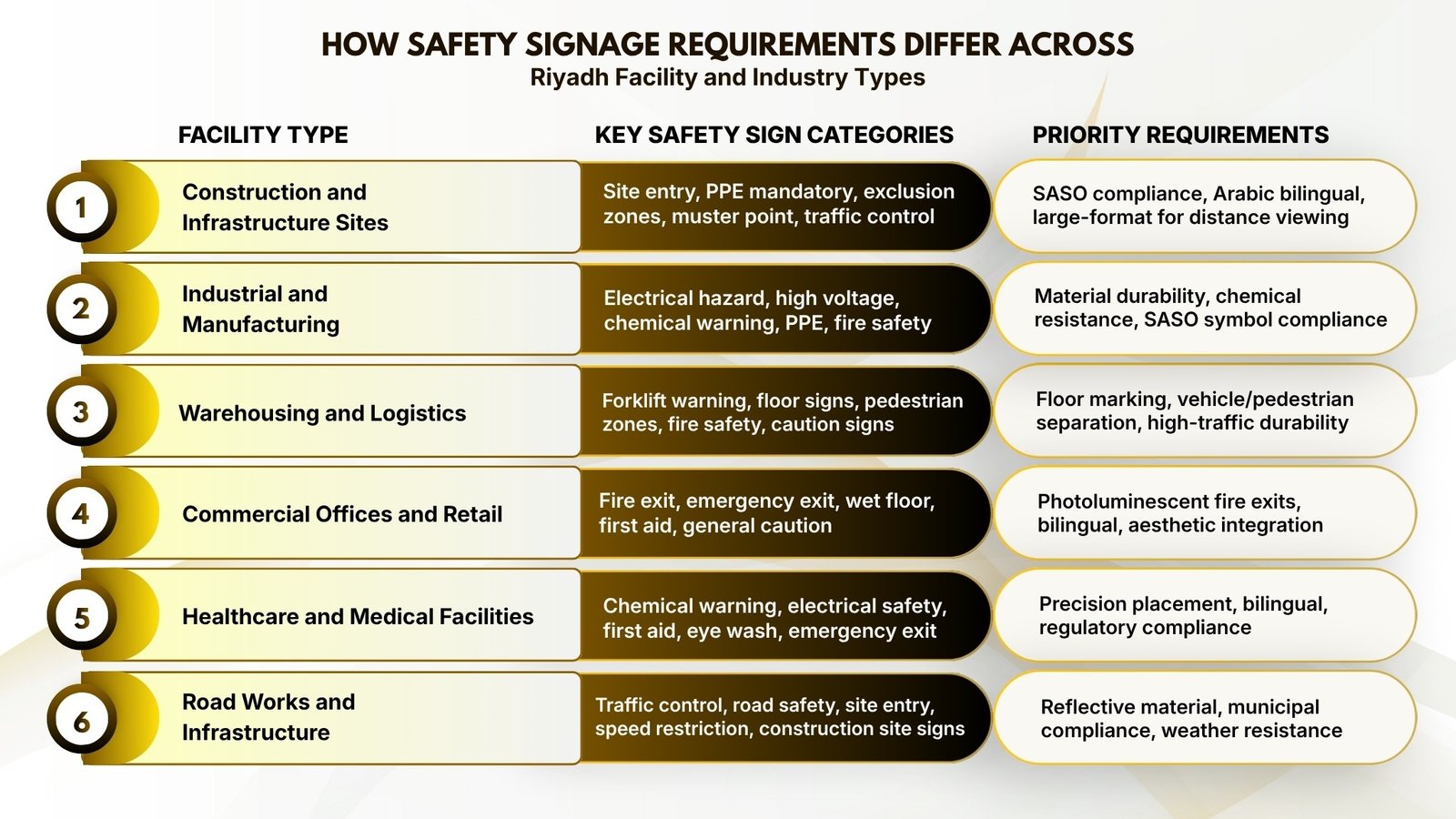
| Facility Type | Key Safety Sign Categories | Priority Requirements |
| Construction and Infrastructure Sites | Site entry, PPE mandatory, exclusion zones, muster point, traffic control | SASO compliance, Arabic bilingual, large-format for distance viewing |
| Industrial and Manufacturing | Electrical hazard, high voltage, chemical warning, PPE, fire safety | Material durability, chemical resistance, SASO symbol compliance |
| Warehousing and Logistics | Forklift warning, floor signs, pedestrian zones, fire safety, caution signs | Floor marking, vehicle/pedestrian separation, high-traffic durability |
| Commercial Offices and Retail | Fire exit, emergency exit, wet floor, first aid, general caution | Photoluminescent fire exits, bilingual, aesthetic integration |
| Healthcare and Medical Facilities | Chemical warning, electrical safety, first aid, eye wash, emergency exit | Precision placement, bilingual, regulatory compliance |
| Road Works and Infrastructure | Traffic control, road safety, site entry, speed restriction, construction site signs | Reflective material, municipal compliance, weather resistance |
Construction & Infrastructure Sites
Your site has the most complex safety signage requirement of any environment. Multiple hazard types, vehicle and pedestrian movement, restricted zones, emergency assembly points, and mandatory PPE areas all need to be communicated simultaneously across a large footprint.
Site safety signs at entry points communicate the rules before anyone steps onto the site. Hard hat required signs, PPE signs, and mandatory safety glasses signs are positioned at every entry to controlled zones. Muster point signs and emergency muster point signs need to be positioned where they can be found without prior knowledge of the site layout — by a worker on their first day as effectively as by someone who has been there for months.
Construction site safety signs for Riyadh’s giga-projects need to account for sites that evolve as construction progresses. A signage plan that works for a site at foundation stage needs to be updated as structures rise, zones change, and new hazards are introduced.
Industrial & Manufacturing Facilities
Industrial safety signs in manufacturing and processing environments cover a wider range of hazard types than most other facility categories. Electrical hazard signs and high voltage warning signs in electrical substations and switchgear rooms. Chemical safety signs and hazardous material signs in areas where substances are stored or used. Hearing protection signs adjacent to high-noise equipment. Forklift safety signs where vehicles and workers share movement paths.
Material durability is a primary specification consideration. Safety signs in chemical storage areas need to resist the chemical exposure they are warning about. Signs in high-temperature manufacturing environments need materials rated for the ambient temperature. Signs in areas with regular washdown need adhesive and substrate systems that hold up to water and cleaning products.
Warehousing & Logistics Operations
Warehouse safety signs manage the interaction between pedestrians and forklift vehicles — the most common source of serious incidents in logistics environments. Warehouse floor signs and floor signs that define pedestrian walkways and vehicle lanes communicate the separation at the floor level where it is most immediately relevant to someone moving through the space.
Forklift safety signs at entry points to vehicle operating zones, combined with floor marking that is legible and durable under forklift traffic and cleaning cycles, form the primary safety communication system for a functioning warehouse environment.
Commercial Offices & Retail Environments
Office and retail environments have a smaller range of hazard types but the same obligation to communicate them clearly. Fire exit signs, emergency exit signs, and fire assembly point signs are mandatory regardless of the perceived low-risk character of a commercial office. Wet floor signs and caution wet floor signs for any cleaning or spillage situation. First aid signs marking first aid equipment location.
The material and finish of safety signs in commercial environments also needs to fit the interior standard. A photoluminescent fire exit sign in a premium office lobby should be produced to a finish standard that matches the environment — SASO-compliant in design and professionally produced in appearance.
Healthcare & Medical Facilities
Healthcare environments present specific chemical and electrical hazard communication requirements alongside the standard fire and emergency signs. Chemical warning signs for storage and handling areas. Eye wash station signs where chemical splash risk exists. Electrical safety signs for equipment rooms and utility areas. First aid signs in clinical areas where emergency response equipment is positioned.
Bilingual Arabic and English safety signage in healthcare environments is essential — the patient population, visitor population, and clinical workforce all need to be able to read and act on safety information quickly.
Road Works & Infrastructure Projects
Traffic control signs and road safety signs on active road works in Riyadh need to comply with both SASO requirements and the standards applied by the relevant municipal authority for public road infrastructure. Construction traffic control signs directing vehicles through active works areas, speed restriction signs, and site entry signs all need to be produced in reflective material rated for the traffic speeds and lighting conditions of the specific location.
What Are the Most Common Safety Signage Mistakes in Riyadh?
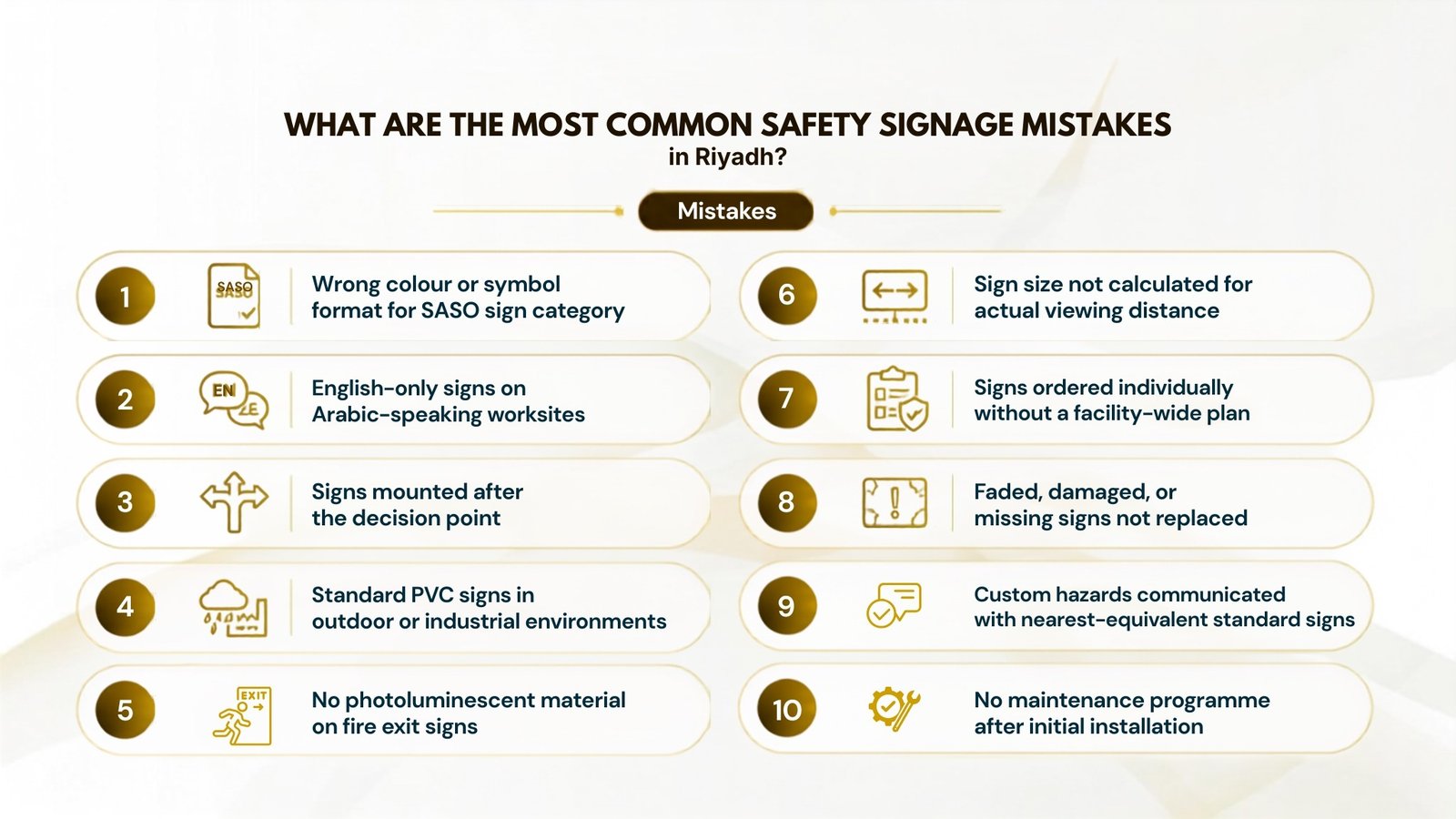
| Mistakes |
| Wrong colour or symbol format for SASO sign category |
| English-only signs on Arabic-speaking worksites |
| Signs mounted after the decision point |
| Standard PVC signs in outdoor or industrial environments |
| No photoluminescent material on fire exit signs |
| Sign size not calculated for actual viewing distance |
| Signs ordered individually without a facility-wide plan |
| Faded, damaged, or missing signs not replaced |
| Custom hazards communicated with nearest-equivalent standard signs |
| No maintenance programme after initial installation |
What Does Safety Signage Cost in Riyadh?
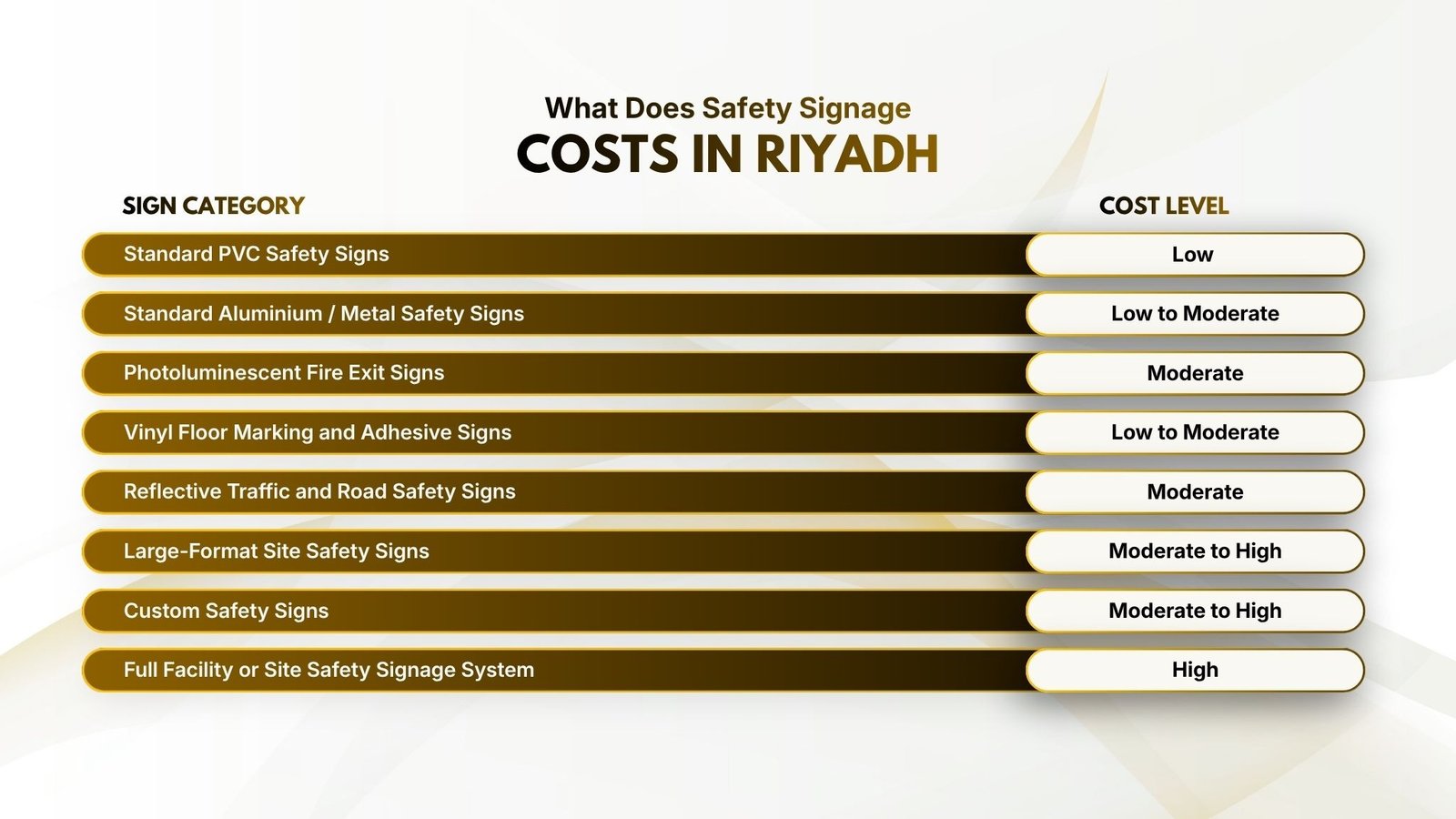
| Sign Category | Cost Level | Main Cost Drivers |
| Standard PVC Safety Signs | Low | Quantity, size, standard SASO format |
| Standard Aluminium / Metal Safety Signs | Low to Moderate | Material grade, size, quantity |
| Photoluminescent Fire Exit Signs | Moderate | Photoluminescent substrate premium |
| Vinyl Floor Marking and Adhesive Signs | Low to Moderate | Area coverage, material grade, anti-slip finish |
| Reflective Traffic and Road Safety Signs | Moderate | Reflective material, size, post mounting |
| Large-Format Site Safety Signs | Moderate to High | Size, material, mounting hardware |
| Custom Safety Signs | Moderate to High | Design, symbol creation, non-standard format |
| Full Facility or Site Safety Signage System | High | Sign count, site size, installation, bilingual requirements |
What drives cost up beyond the sign itself: site assessment, compliance review against SASO requirements, installation hardware and fixing, access equipment for elevated positions, bilingual design for Arabic and English, and the maintenance programme for replacement of degraded signs over time.
The cost of non-compliant safety signage discovered during an inspection — replacement production, rework, potential penalty, and operational disruption — is always higher than the cost of specifying it correctly the first time.
How Etihad Golden Falcons Handles Safety Signage in Riyadh
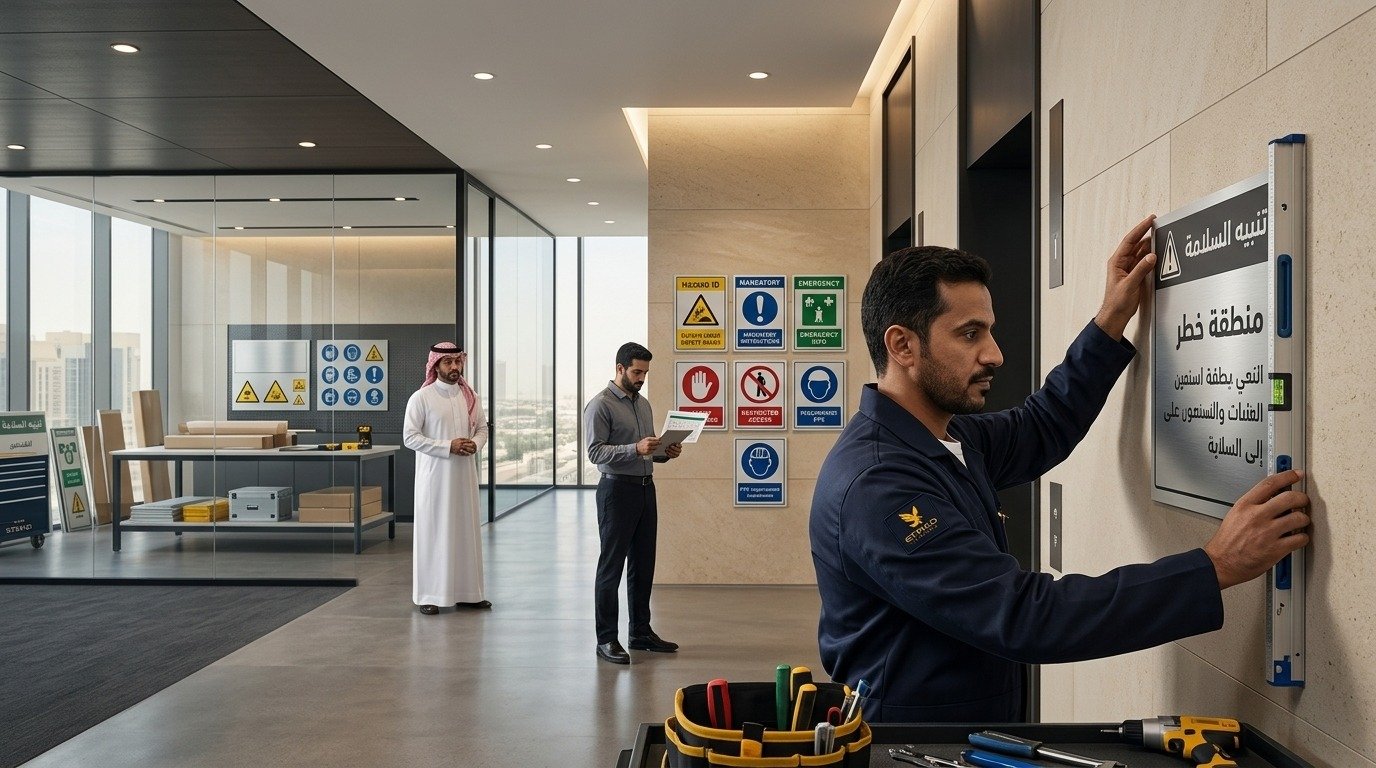
Site Assessment First
Before a single sign is specified, Etihad Golden Falcons builds a hazard map. Every location on your facility that needs signage is identified first. This map becomes both the compliance record and the production brief, not a catalogue pulled off the shelf.
Design Confirmed Before Fabrication
Colour coding, symbol format, size, and bilingual Arabic and English text are checked against SASO requirements before production starts. Getting this right upfront saves you the alternative: signs reproduced after an installed batch fails inspection.
Fabrication In-House
Materials are matched to your environment: aluminium and metal for outdoor and industrial sites, PVC for indoor commercial spaces, photoluminescent substrate for fire exit and emergency signs, adhesive vinyl for floor marking, reflective material for road-facing and traffic control signage. Because production stays in-house, we keep material grade, format, and bilingual layout consistent across your full sign set.
Installation Follows the Map
Mounting method, fixing hardware, height, and position are confirmed against the signage map, not estimated on-site. On large construction and industrial projects, we sequence installation so coverage is in place before each zone goes active.
Maintenance After Handover
Degraded or damaged signs get tracked and addressed before they turn into a compliance gap for you, once your signage is installed.
FAQs
Yes. Safety signs are produced to SASO-defined colour coding, symbol formats, and size requirements for each sign category. For fire safety and emergency evacuation signs, Saudi Civil Defence requirements are incorporated into the specification. Sign design is confirmed against these standards before production — not after installation.
Yes. Arabic-only and bilingual Arabic and English safety signs are produced with correct RTL layout and equal visual clarity for both languages. For sites with mixed-language workforces, bilingual signage is the standard specification — English-only signs are not adequate where the primary workforce reads in Arabic.
Rigid aluminium and metal safety signs are the correct specification for long-term outdoor installations in Riyadh. They resist UV exposure, heat, and dust accumulation without the surface degradation that PVC shows in sustained outdoor conditions. Reflective aluminium is used for road-facing and traffic control applications where low-light visibility is required.
Standard safety sign production for a confirmed specification runs two to five working days depending on quantity and material. Large-format site signage systems and photoluminescent sign packages may take longer. Installation timelines depend on site size, access conditions, and the number of fixing positions. Confirm your operational deadline at inquiry — we confirm the production and installation programme before the order is placed.
Yes. Custom safety signs are produced for facility-specific hazard communication requirements — specific equipment, specific processes, specific site conditions. Custom warning signs incorporate SASO-compliant colour coding and symbol formats appropriate to the hazard level, combined with the specific text and imagery required for the hazard being communicated.
Yes. Photoluminescent fire exit signs, emergency exit door signs, and evacuation route markers are produced for facilities where emergency signage must remain visible in power failure conditions. Photoluminescent substrate is the correct material specification for fire evacuation signage — not standard non-luminescent material.
Yes. Large construction and infrastructure site signage programmes — covering site entry, PPE mandatory zones, exclusion areas, muster point signs, traffic control, and bilingual hazard communication across a large footprint — are managed from site assessment through fabrication, installation, and maintenance. For projects where the site evolves as construction progresses, the signage plan is updated to reflect new zones and changing hazard configurations.
Under SASO standards: a danger sign communicates an immediate hazard that will result in serious injury or death if not avoided — red background, specific format. A warning sign communicates a hazard that could result in serious injury or death if not avoided — yellow triangle, black symbol. A caution sign communicates a hazard that may result in minor or moderate injury — yellow background, black symbol. Using the wrong level for a given hazard is a compliance failure — the severity level communicated by the sign must accurately reflect the actual risk.