
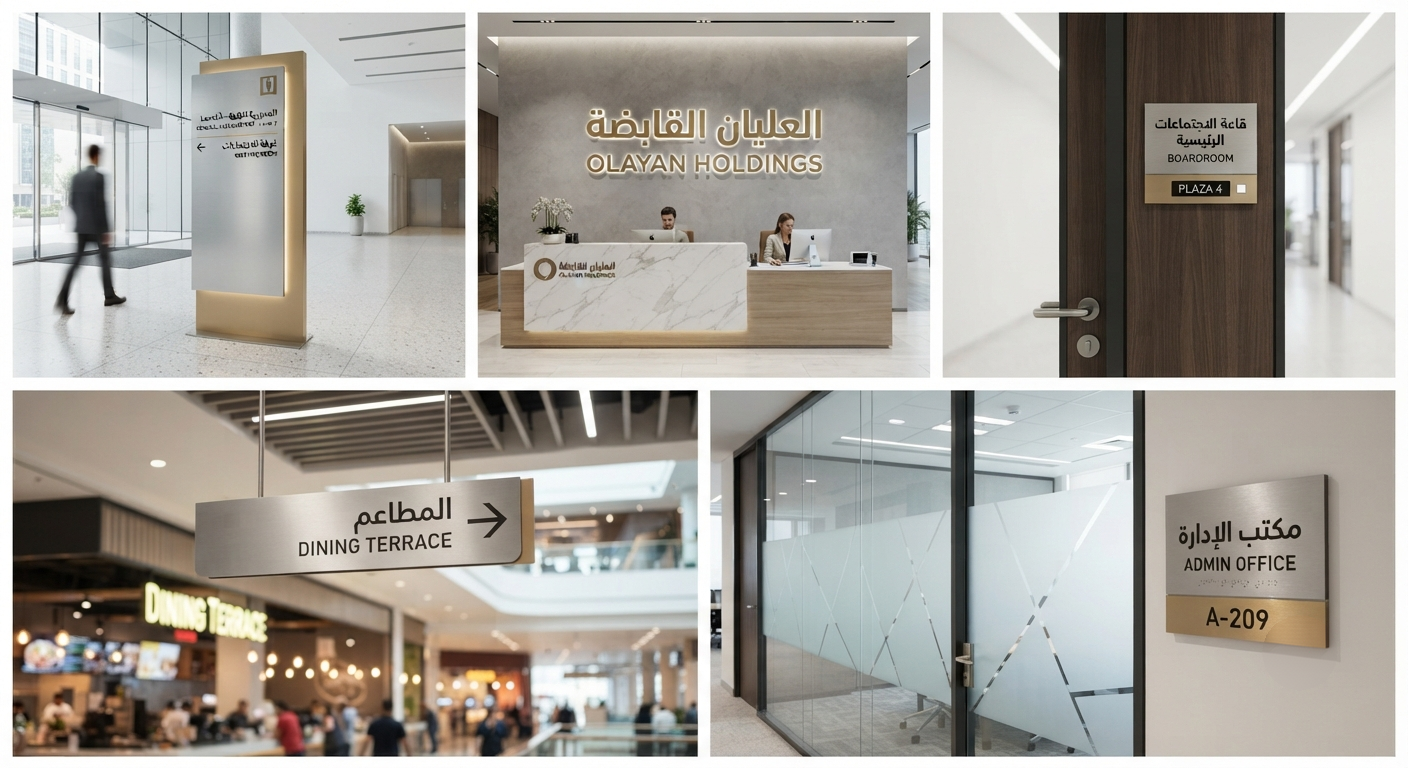
Indoor signage in Riyadh is a requirement for every business today because it is what makes your business operate more efficiently. A well-designed office or retail space looks complete, but without interior signs, your business has no branding, visitors struggle to find their way, and safety requirements set by the authorities go unaddressed.
Indoor signage covers your business needs, from reception branding and office directories to wayfinding systems, retail displays, safety signage, and illuminated feature signage.
What most businesses get wrong is treating indoor signage as something added after the space is finished. In reality, material, placement, and compliance matter as much as design, and getting them wrong means damaging finished walls to fix it later, or failing an inspection your business should have passed the first time.
This guide shows you the types of indoor signage available, how to choose what fits your space, and what to budget for a system that works from day one.
What Are the Main Types of Indoor Signage Available in Riyadh?
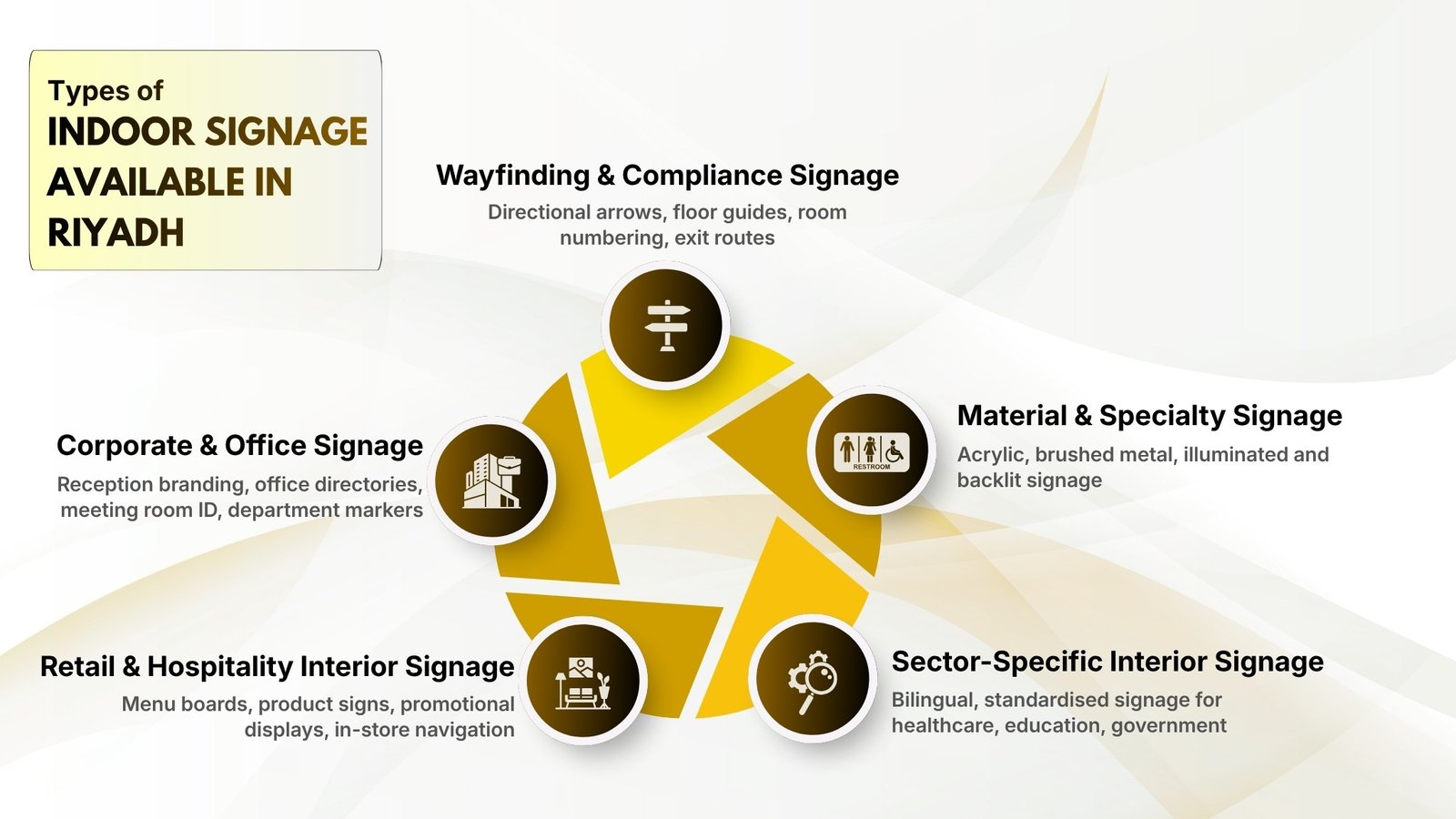
| Signage Type | What It Covers |
| Corporate & Office Signage | Reception branding, office directories, meeting room ID, department markers |
| Retail & Hospitality Interior Signage | Menu boards, product signs, promotional displays, in-store navigation |
| Wayfinding & Compliance Signage | Directional arrows, floor guides, room numbering, exit routes |
| Material & Specialty Signage | Acrylic, brushed metal, illuminated and backlit signage |
| Sector-Specific Interior Signage | Bilingual, standardised signage for healthcare, education, government |
Indoor signage is not a single product category. It is several systems working together inside a building, each handling a different layer of how people experience and navigate the space.
Here’s what you need to know about each type of indoor signage, so you can figure out exactly which one fits your space.
Corporate and Office Signage
This is what your clients, partners, and new employees read the moment they walk in. Reception branding and office directories do the most basic job your indoor signage has: telling people whose space this is and confirming they are in the right place.
Your reception signage needs to hold up to being seen up close, not just from across the lobby, since this is signage people stand in front of and read carefully. If your meeting rooms and departments are not clearly marked, every visitor becomes a question your staff has to answer. If your signage doesn’t identify your space instantly, it’s not doing its job for you.
Retail and Hospitality Signage
If you need signage that influences what customers notice, buy, or spend time near, this is your category.
Menu boards, promotional displays, and in-store navigation shape how customers move through your space and what they see first. Retail activity in Riyadh depends on customers finding what they came for and noticing what they didn’t, so if your signage isn’t guiding that movement, you’re losing sales it should be generating.
Hospitality signage carries the same weight from a guest’s side: room identification and lobby signage are read at close range, repeatedly, by people forming an impression of your service before staff even speak to them. If your guest-facing signage looks inconsistent or unclear, it undercuts every other part of the experience you’re paying for.
Wayfinding and Compliance Signage
This is the signage your visitors only notice when it’s missing. Directional signs, room numbering, and exit routes guide people through your building without needing to ask staff.
If you run a large office, hospital, or institutional site, your visitors make movement decisions in seconds, and this signage is often the only way to guide them. Your corridors, department entrances, and exit routes all depend on this signage being placed correctly, numbered consistently, and readable under your building’s actual lighting.
Material and Specialty Signage
If your space needs to signal quality the moment someone touches or reads a sign up close, this is your category.
Acrylic, brushed metal, and illuminated signage let your brand read as an investment rather than an afterthought. Reception walls and boardrooms are read at close range, so if your material choice looks cheap up close, it undoes what your interior design already achieved.
Illuminated and backlit signage also holds attention in corridors and spaces with lower ambient light, where a flat, non-illuminated sign gets missed entirely. If your building has low-light zones or areas where signage competes with other visual elements, illumination will perform better for you than a standard finish would.
Sector-Specific Signage
If you operate in healthcare, education, or government, this covers you: bilingual signage, standardised formats, and compliance-driven layouts.
You don’t need creative differentiation here, but you do need every sign to read consistently across a large building and hold up under clinical or institutional lighting. Whether you’re fitting out a hospital wing or a government office, your signage needs to meet the regulatory format required, not just look the part.
When Does Indoor Signage Become a Priority for a Riyadh Business?
Indoor signage is a priority from the moment you plan your business, not after the space is finished. It is not a finishing touch added once construction wraps up, it is part of how the space is meant to work from day one.
That said, a few specific triggers tend to move indoor signage to the top of the list, whether you are opening a new location or already running one:
Operational Friction
If visitors cannot navigate your space without asking staff, if reception has become a help desk for basic directions, or if the same question gets asked by every new arrival, your signage is already failing its job. The cost is being absorbed by your people instead of being managed by the environment.
Visual Mismatch
If you have renovated or rebranded and the signage on your walls still reflects an older version of your business, that inconsistency is visible to everyone, from returning visitors to people seeing your space for the first time.
New Construction or Fit-Out
If you are opening a new space, the right time to plan indoor signage is before it opens, when layout is confirmed and surfaces are ready. Signage mapped in at this stage avoids retrofitting around finished walls and furniture later.
What Can You Install as Indoor Signage for Your Business in Riyadh?
Different businesses need different interior sign systems. Below is where each type of indoor signage actually fits, and what it does once it’s installed.
Corporate Offices and Headquarters
Law firms, consultancies, corporate offices, and co-working spaces all rely on indoor signage to manage identity and internal navigation.
- For your reception, you can install Acrylic Reception Logo Signs, Backlit Halo Lit Logo Walls, and 3D Acrylic Lobby Signs to establish your brand at the first point of contact.
- Inside your office, Office Sign Boards and Department & Nameplate Signs guide employees and visitors between floors and teams.
- For individual spaces, Executive Cabin Signage and Door & Room Identification Signs handle identification at the room level.
Retail Stores and Shopping Malls
Fashion outlets, electronics stores, supermarkets, and mall tenants all compete for shopper attention.
- For your storefront, you can use Illuminated Kiosk Signs and LED Display Kiosk Signs to draw attention at the point of purchase.
- Inside the store, Suspended Acrylic Hanging Signs and Promotional & Offer Display Boards direct shoppers toward specific zones and offers.
- If you operate in a mall, Mall Directory Boards and Wayfinding Hanging Signboards help shoppers navigate without asking staff.
Restaurants and Hospitality Venues
Cafes, restaurants, hotels, and serviced apartments all deal with regularly changing content and guest-facing branding.
- For your counter or dining area, you can install Digital Restaurant Menu Boards and Acrylic Backlit Menu Displays to update pricing and specials without reprinting.
- For your lobby, Backlit Halo Lit Logo Walls and Acrylic Reception Logo Signs establish your brand at the point guests first walk in.
- For wall-mounted setups, LED Wall-Mounted Menu Panels keep your offerings visible without taking up counter space.
Healthcare Facilities
Hospitals, clinics, and diagnostic centres deal with high foot traffic and patients who need clear direction.
- For patient areas, you can install Patient Room Identification Signs, ICU & Emergency Room Signs, and Bed Number & Ward Signs so patients and staff move independently.
- For clinics, Reception Clinic Signs and Illuminated Clinic Name Boards handle identification at every entry point.
- For labs, Clean Room Laboratory Signs and Chemical Hazard Laboratory Signs meet the compliance standards your facility is required to follow.
Government and Institutional Spaces
Municipal offices, ministries, and public institutions need to manage large volumes of visitors with minimal confusion.
- For compliance, you can install Hazard Warning Signs, Mandatory Instruction Signs, and Workplace Compliance Signage to meet regulatory requirements.
- For emergency preparedness, Photoluminescent Exit Signs and Fire Assembly Point Signs are required across your building.
- For visitor movement, Building Directory Boards and Floor Guides & Navigation Signs guide people across departments without staff redirecting them.
Which Indoor Signage Type Is Right for Your Space?
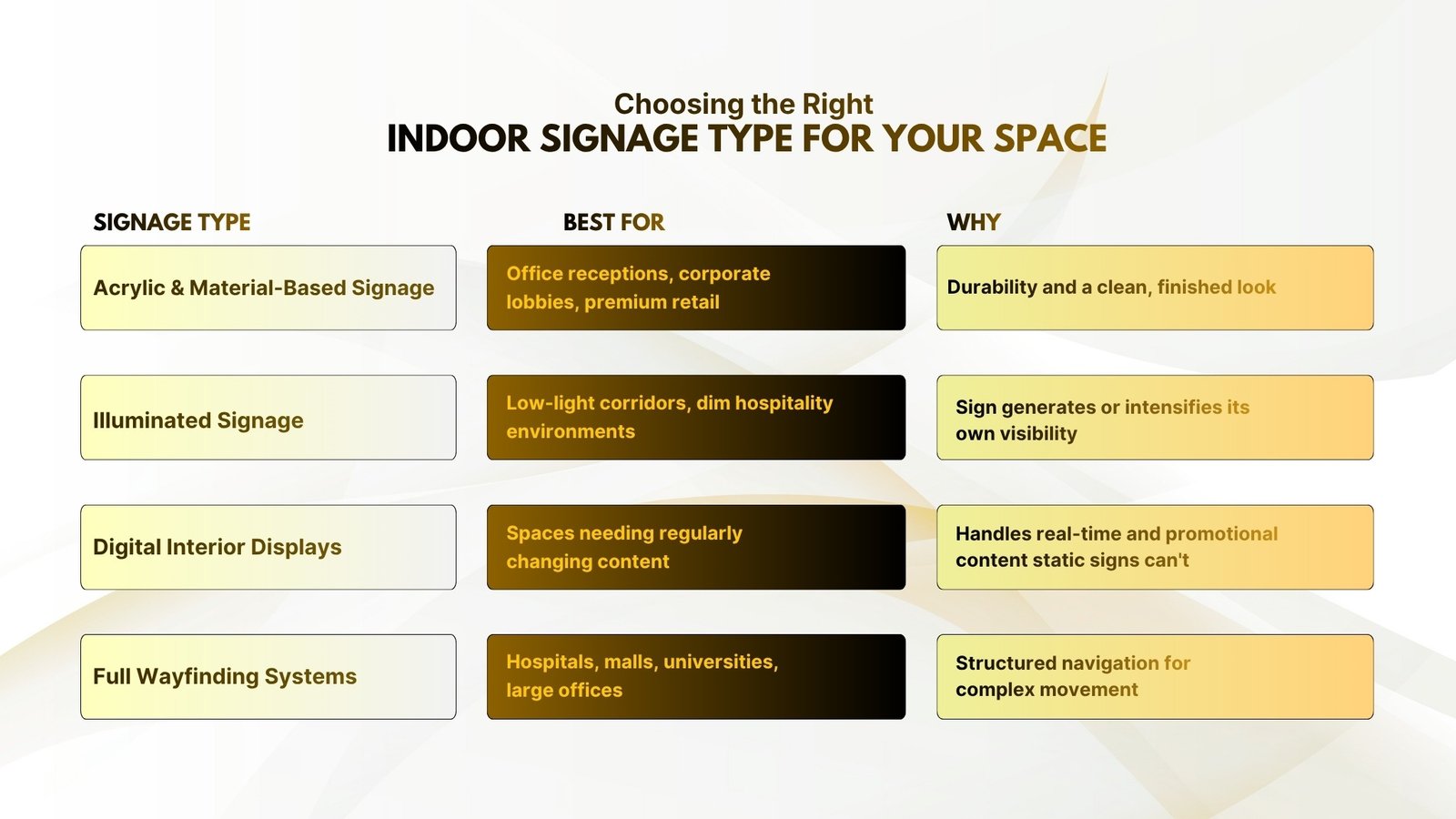
| Signage Type | Best For | Why |
| Acrylic & Material-Based Signage | Office receptions, corporate lobbies, premium retail | Durability and a clean, finished look |
| Illuminated Signage | Low-light corridors, dim hospitality environments | Sign generates or intensifies its own visibility |
| Digital Interior Displays | Spaces needing regularly changing content | Handles real-time and promotional content static signs can’t |
| Full Wayfinding Systems | Hospitals, malls, universities, large offices | Structured navigation for complex movement |
Function determines the correct format, not appearance.
Acrylic and material-based signage is used when durability and a clean, finished look matter more than flexibility. Common in office reception areas, corporate lobbies, and premium retail environments. Indoor acrylic signage and metal interior signs read as intentional material choices rather than default solutions.
Illuminated indoor signage, including indoor illuminated signs, light box signs indoor, and backlit interior signage, is used where lighting conditions require the sign itself to generate or intensify visibility. In low-light corridors, dimly lit hospitality environments, or spaces where signage competes with other visual elements, illumination is function, not decoration.
Digital interior displays are used where content changes regularly. Indoor digital signage displays, interior digital signage, and indoor digital displays handle real-time information, promotional content, and interactive applications that static signs cannot manage. The decision to go digital should be driven by content frequency, not by a preference for screens over print.
Full wayfinding systems are used when movement inside the building is complex enough to require a structured, layered directional approach. Hospitals, malls, universities, government buildings, and large multi-floor offices fall into this category. A partial wayfinding system in a complex building is usually worse than no system — it gives visitors false confidence before failing them at a critical junction.
What Are the Most Common Indoor Signage Mistakes in Riyadh Projects?
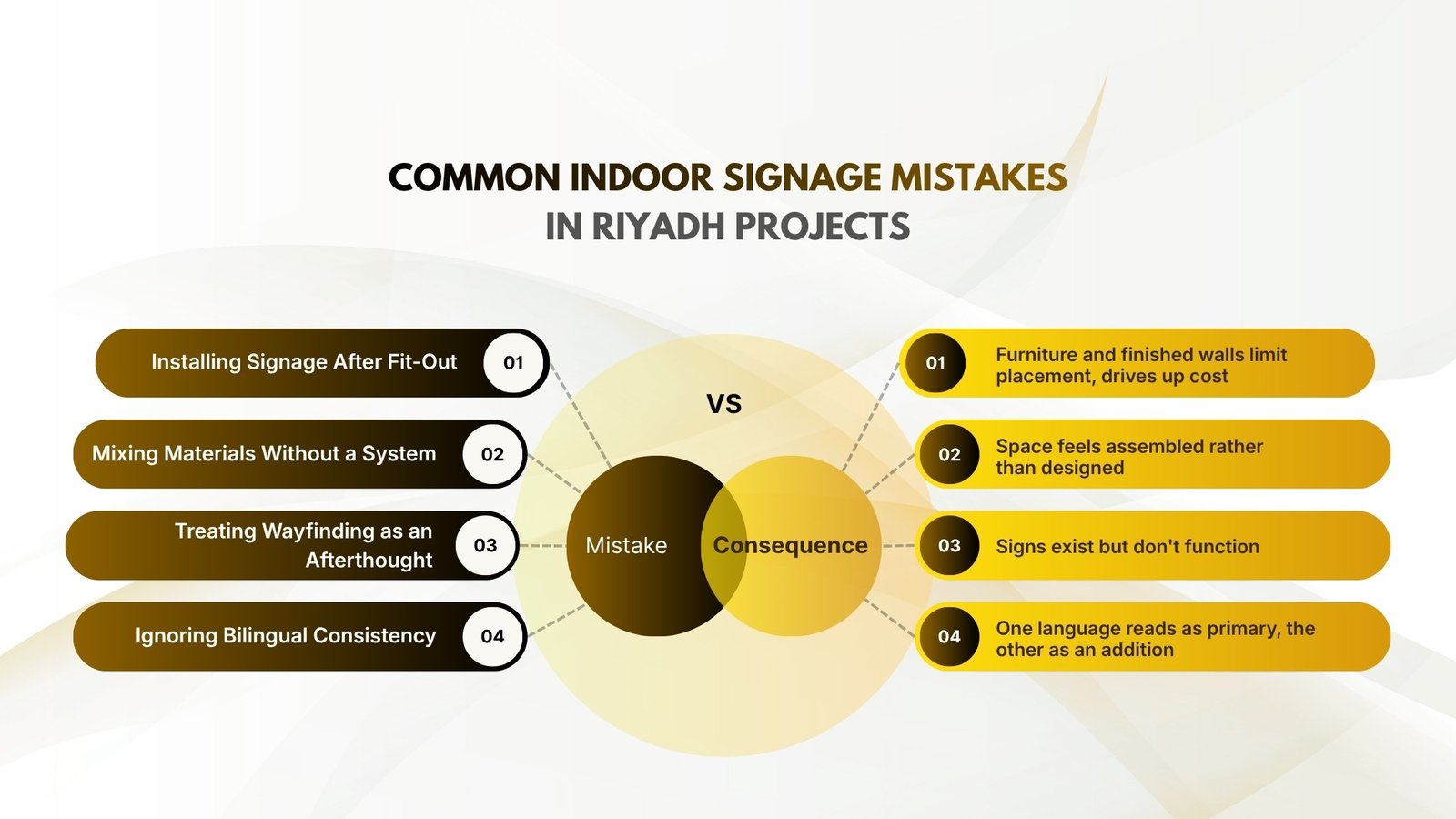
| Mistake | Consequence |
| Installing Signage After Fit-Out | Furniture and finished walls limit placement, drives up cost |
| Mixing Materials Without a System | Space feels assembled rather than designed |
| Treating Wayfinding as an Afterthought | Signs exist but don’t function |
| Ignoring Bilingual Consistency | One language reads as primary, the other as an addition |
What Does Indoor Signage Actually Cost in Riyadh?
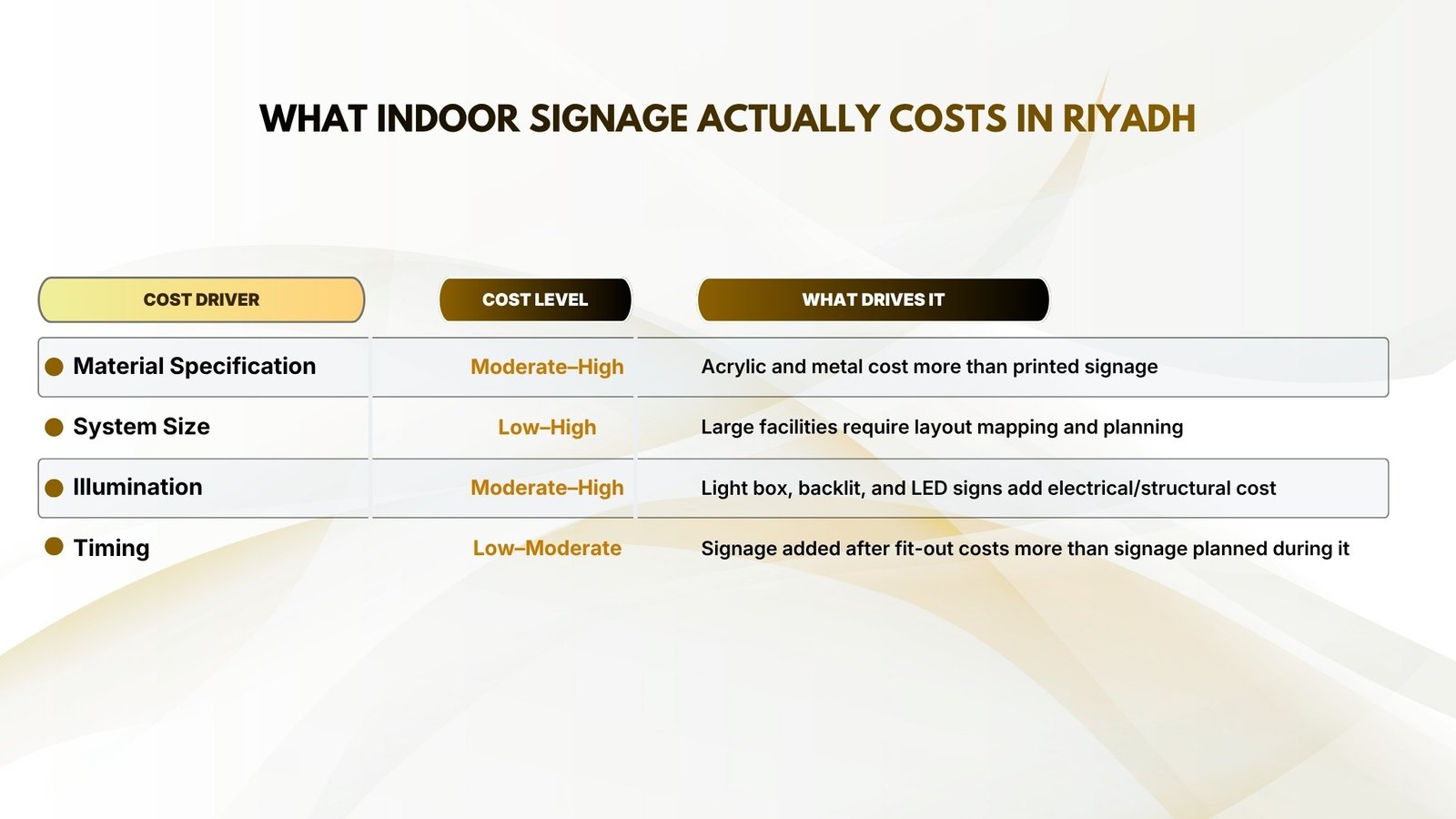
| Cost Driver | Cost Level | What Drives It |
| Material Specification | Moderate–High | Acrylic and metal cost more than printed signage |
| System Size | Low–High | Large facilities require layout mapping and planning |
| Illumination | Moderate–High | Light box, backlit, and LED signs add electrical/structural cost |
| Timing | Low–Moderate | Signage added after fit-out costs more than signage planned during it |
Quick Decision Guide: Which Indoor Signage Do You Need?
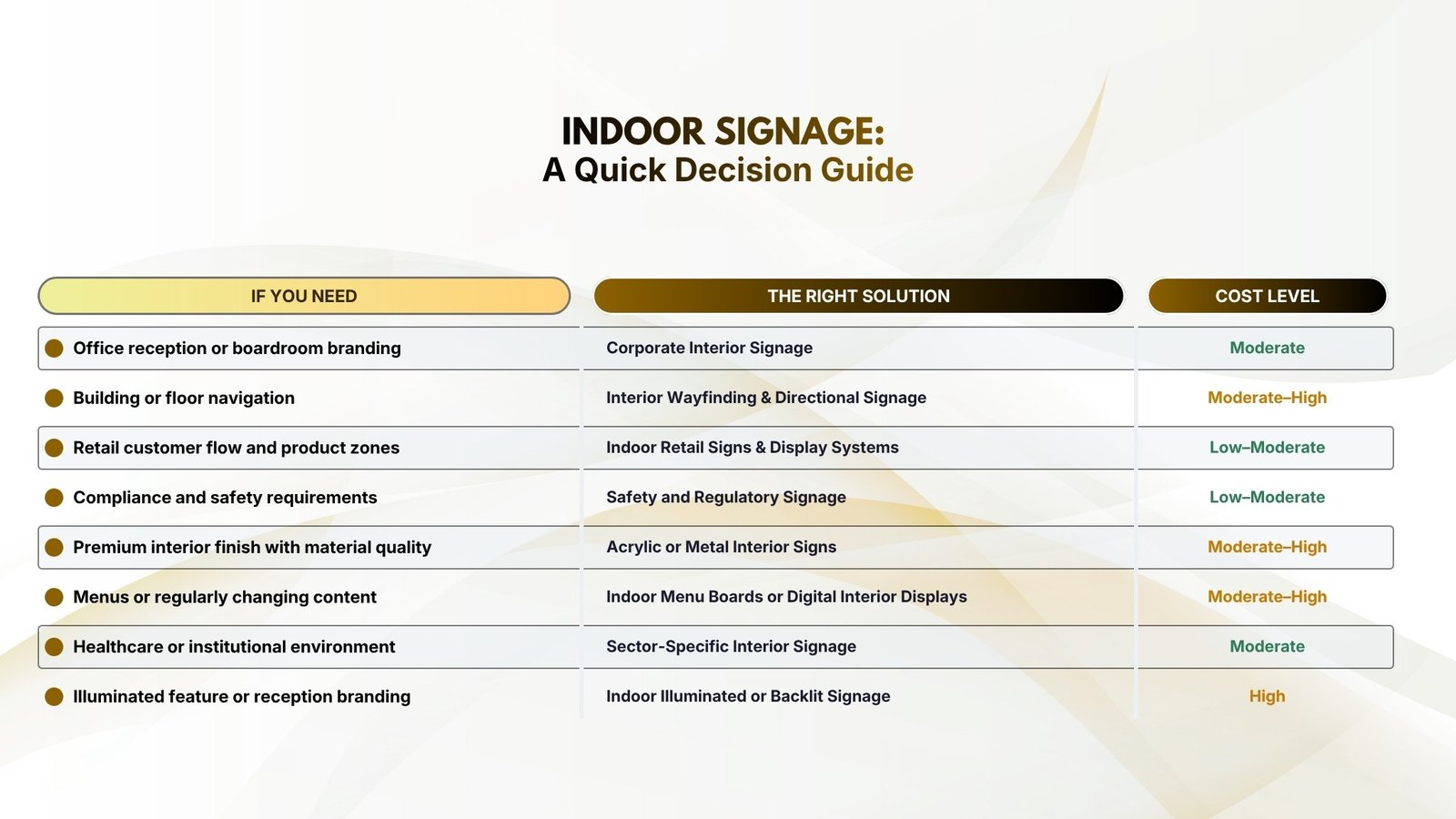
| Need | Solution | Cost Level |
| Office reception or boardroom branding | Corporate Interior Signage | Moderate |
| Building or floor navigation | Interior Wayfinding & Directional Signage | Moderate–High |
| Retail customer flow and product zones | Indoor Retail Signs & Display Systems | Low–Moderate |
| Compliance and safety requirements | Safety and Regulatory Signage | Low–Moderate |
| Premium interior finish with material quality | Acrylic or Metal Interior Signs | Moderate–High |
| Menus or regularly changing content | Indoor Menu Boards or Digital Interior Displays | Moderate–High |
| Healthcare or institutional environment | Sector-Specific Interior Signage | Moderate |
| Illuminated feature or reception branding | Indoor Illuminated or Backlit Signage | High |
How Indoor Signage Projects Are Planned and Installed in Riyadh
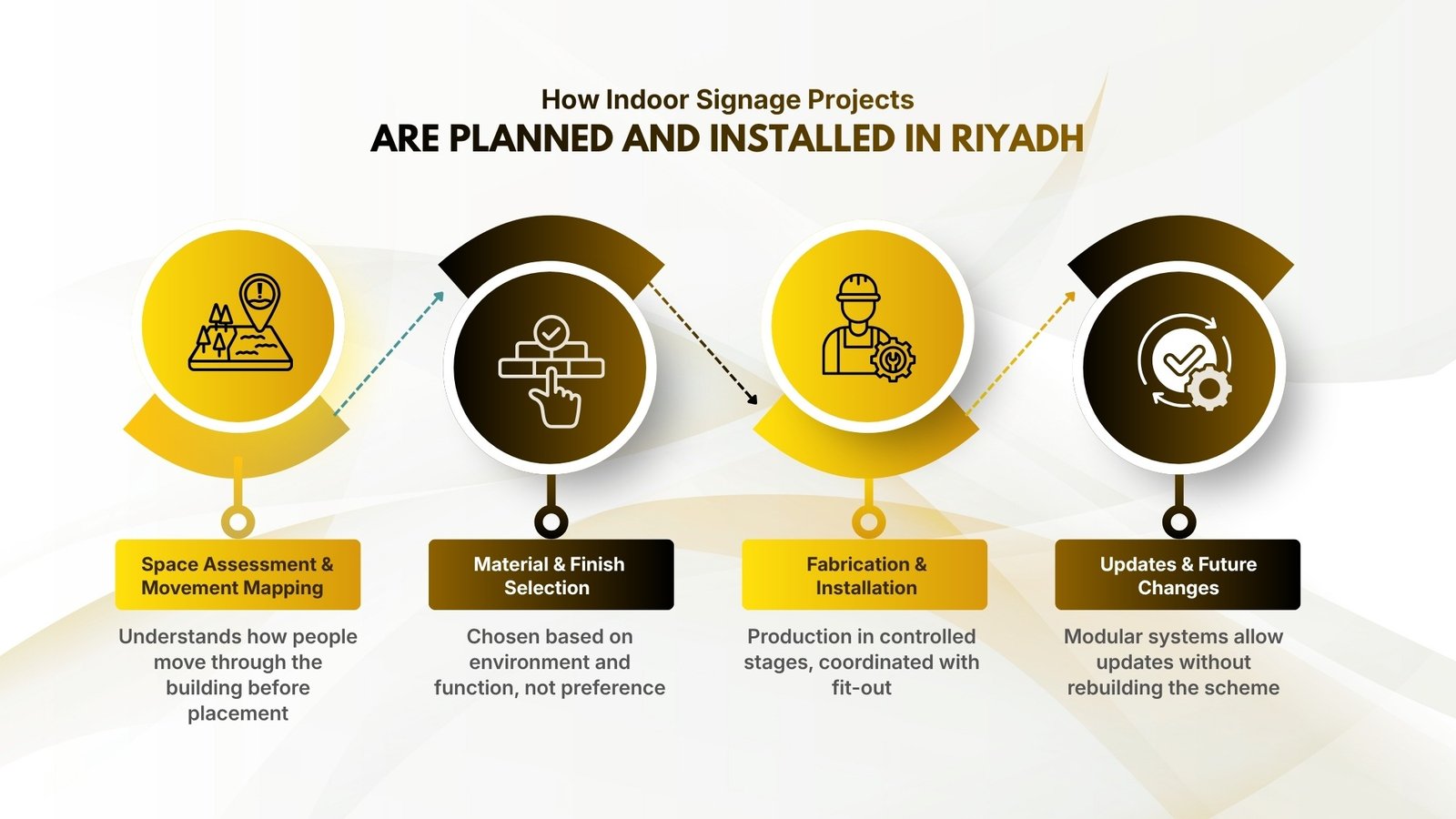
| Stage | What Happens |
| 1. Space Assessment & Movement Mapping | Understands how people move through the building before placement |
| 2. Material & Finish Selection | Chosen based on environment and function, not preference |
| 3. Fabrication & Installation | Production in controlled stages, coordinated with fit-out |
| 4. Updates & Future Changes | Modular systems allow updates without rebuilding the scheme |
Space assessment and movement mapping
Before material or format decisions are made, we understand how people move through the building. Where they enter. Where they stop. Where the decision points are. Where confusion is most likely to occur. Signage is placed based on that understanding, not based on what walls are available.
Material and finish selection
Materials are chosen based on environment and function — not preference. A hospital corridor has different requirements from a corporate reception. A retail environment has different requirements from a government institution. The same finish applied uniformly across different environments produces inconsistency in how the signage performs and how it looks within the space.
Fabrication and installation
Production is handled in controlled stages. Installation is coordinated with the fit-out programme where possible, and managed carefully in completed spaces to avoid surface damage. Alignment, fixing method, and final positioning are all confirmed on site before installation is signed off.
Updates and future changes
A well-designed indoor signage system allows changes to be made without rebuilding the entire scheme. For growing businesses, relocating departments, or spaces that evolve over time, modular systems that accommodate updates are worth specifying from the start.
How Does Etihad Golden Falcon Handle Indoor Signage Projects in Riyadh?
An indoor signage system is only as good as the planning behind it. Etihad Golden Falcons treats layout, material specification, fabrication, and installation as one connected process, not separate stages handled by different parties. That’s the part of indoor signage that’s easy to overlook and the part most likely to cause problems if it’s skipped.
Here’s how each stage is covered, from planning through to long-term use:
Space Assessment Before Production
We map how people move through the space before any material or fabrication decision is made. Where they enter, where they stop, and where confusion is most likely to occur all shape where we place signage. Signage placed without this understanding ends up on the walls that were available, not the walls that actually needed it.
In-House Fabrication Across Every Material
We fabricate acrylic, metal, printed, illuminated, and composite systems in-house. Consistency across a full interior project, from lobby branding to room identification to wayfinding, only holds when we produce and finish everything under the same controlled process.
Coordinated With Fit-Out Teams
We work alongside fit-out contractors and interior designers on new builds and renovations, and manage standalone signage projects in operational spaces where installation has to work around active occupancy. Early coordination between signage and fit-out reduces installation complexity and avoids the surface damage that retrofitting always risks.
Built to Update, Not Rebuild
We design modular systems from the start so components can be replaced or updated as branding, layout, or department names change, without rebuilding the entire scheme. This matters most for growing businesses, hospitals, and multi-floor facilities where change is constant, not occasional.
End-to-End Delivery
We run layout assessment, fabrication, finishing, and installation under one engagement. Businesses don’t have to coordinate between a design firm, a fabricator, and an installation crew across a process that needs them to work in sequence.
FAQs
Can Etihad Golden Falcon supply and install a complete indoor signage system?
Yes. Full project delivery from layout assessment through fabrication, finishing, and installation is handled as one engagement.
What materials are most commonly used for indoor signage in Riyadh offices and commercial spaces?
Acrylic, brushed aluminium, stainless steel, and composite materials depending on finish requirements and environment. Illuminated options including light box signs indoor and backlit interior signage are used where lighting conditions or design intent require it.
How long does an indoor signage project take from planning to installation?
Timeline depends on system size and complexity. Planning and fabrication are always separated into distinct stages. A standard office signage project runs two to four weeks from confirmed design to completed installation. Large-scale systems for hospitals, malls, or multi-floor facilities take longer.
Can signage be updated after installation if the layout or branding changes?
Yes, if the system is designed with updates in mind from the start. Modular systems allow individual components to be replaced without affecting the rest of the installation.
Do you work alongside fit-out contractors and interior designers?
Yes. Most projects are coordinated alongside fit-out teams. Early coordination between signage and fit-out reduces installation complexity and avoids the surface damage that retrofitting always risks.