

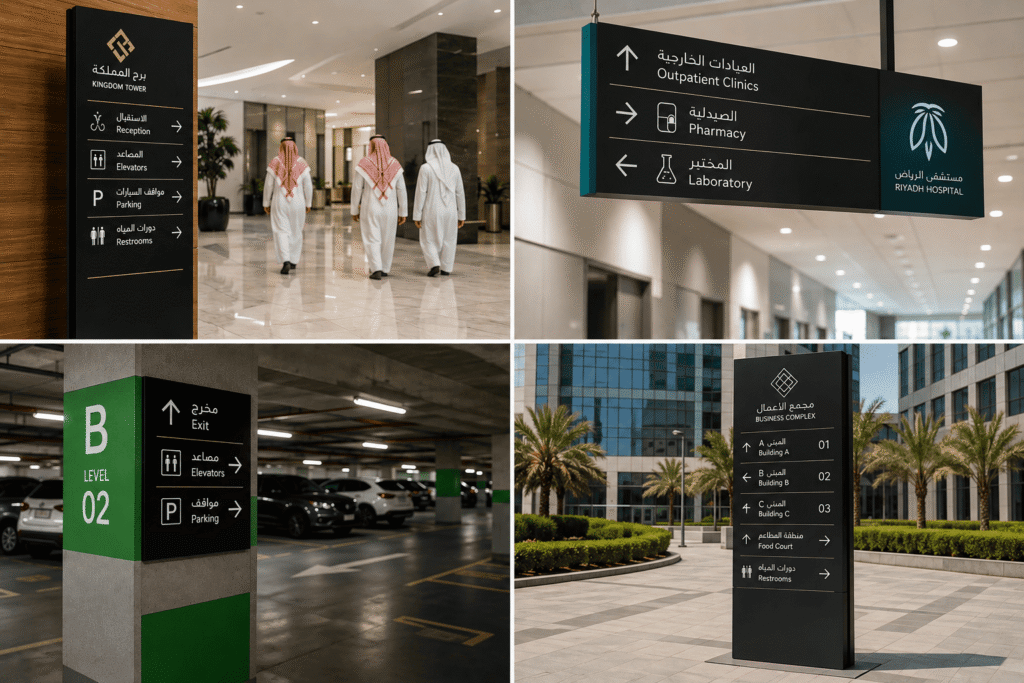
Wayfinding signage is the system of signs that tells people where to go and answers the questions they would otherwise ask your staff. It works across every type of business: a retail shop directing customers to a fitting room, a clinic guiding patients to the right department, a corporate office moving visitors from reception to a meeting room, a campus routing students between buildings.
There are multiple types of wayfinding signs: directional signs, identification signs, informational signs, and safety signs. Each type serves a specific purpose and is placed where that purpose is needed. For any business in Riyadh, the goal is to have all of these working together, not one or two signs placed randomly, but a complete system where every sign plays its role.
Wayfinding & directional signage should be planned from day one, before the fit-out is finished or before the first visitor walks in. A system designed alongside the space costs less, installs cleaner, and works better than one added after the fact. This guide covers the main types, what different businesses actually need, and what planning a proper wayfinding signage system in Riyadh involves. This guide covers the main types, how each is used, what different businesses actually need, and what planning a proper wayfinding signage system in Riyadh involves.
What Are the Main Types of Wayfinding Signage?
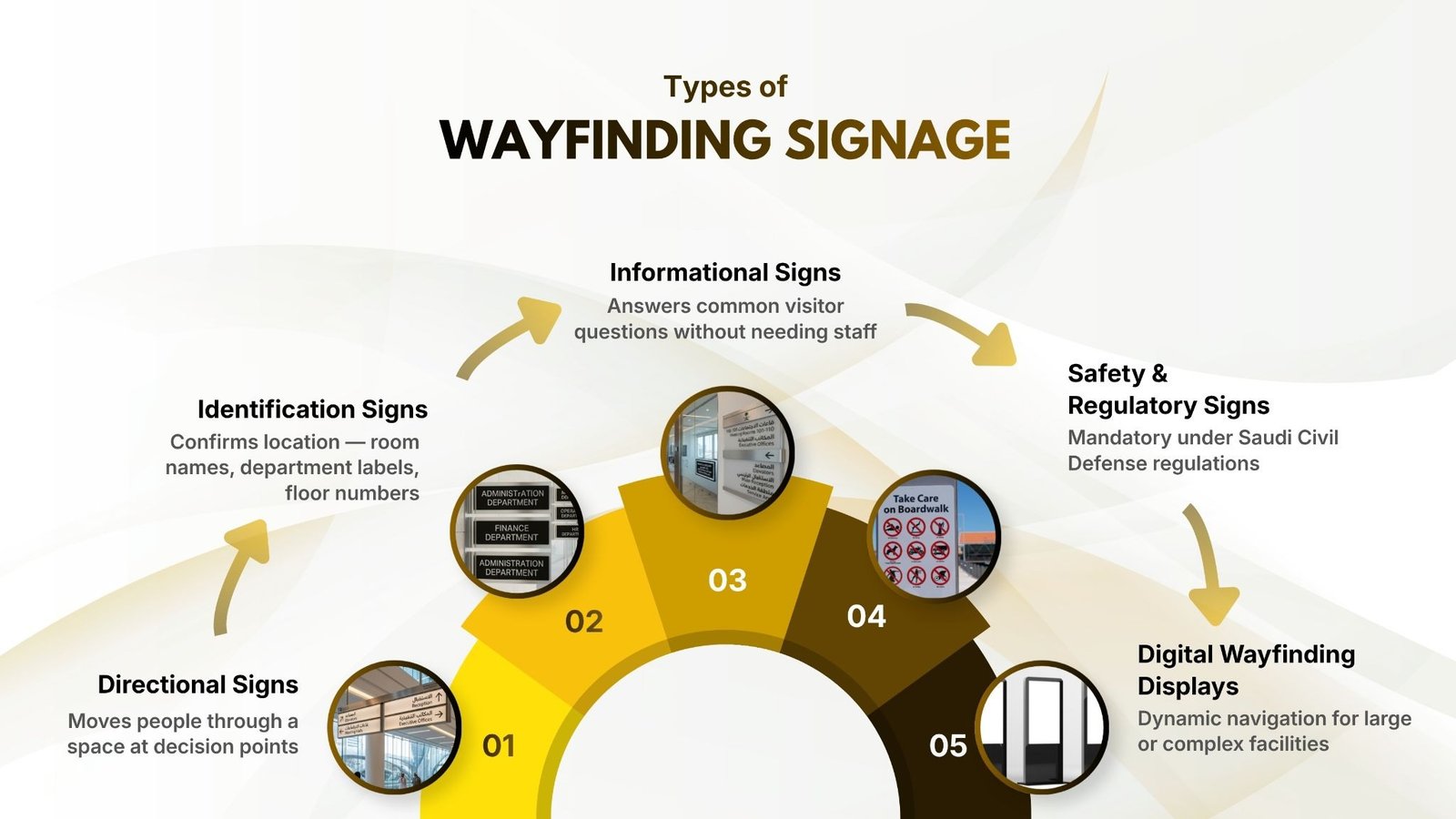
| Signage Type | What It Does |
| Directional Signs | Moves people through a space at decision points |
| Identification Signs | Confirms location — room names, department labels, floor numbers |
| Informational Signs | Answers common visitor questions without needing staff |
| Safety & Regulatory Signs | Mandatory under Saudi Civil Defense regulations |
| Digital Wayfinding Displays | Dynamic navigation for large or complex facilities |
Directional Signs
For any business in Riyadh, directional signs are the foundation of the wayfinding system. These are the signs placed at decision points: anywhere a person can go left, go right, take the stairs, or choose the wrong corridor. A retail shop needs one at the entrance pointing customers toward departments. A clinic needs them at every junction between the reception and consultation rooms. A corporate office needs them at lift lobbies and floor landings.
In Riyadh and across KSA, directional signs are produced bilingually in Arabic and English. Arabic appears first. A system produced in English only does not work for the majority of visitors in most Saudi commercial environments.
Identification Signs
Directional signs get people moving in the right direction. Identification signs confirm they have arrived. Room names, department labels, floor numbers, suite identifiers; these are placed at the destination itself, on the door or above the entrance, not on the path leading to it.
Think of a retail store with fitting rooms at the back, or a medical centre with ten consultation rooms on one floor. Without identification signs at each point, your customers can get confused about where to go.
Informational Signs
Some questions come up repeatedly in every business. Where is the bathroom? What floor is accounts on? What are the operating hours? Informational signs answer these before a visitor has to ask.
For a shop, this could be a small directory near the entrance. For a hospital, a full floor map at every lift lobby. For a government facility, operating hours and service counters at the main entrance. The result is fewer interruptions to your staff and a smoother experience for every visitor who walks in.
Safety and Regulatory Signs
Safety signage is not optional. In Saudi Arabia, commercial and institutional buildings are required under Saudi Civil Defense regulations to display fire exit routes, emergency assembly points, fire extinguisher locations, first aid stations, and restricted area signs. These must meet specific standards for colour, symbol, size, and placement.
Planning safety signs as part of the wayfinding project from the start is the right approach. Adding them separately after the main installation is finished costs more and produces a less consistent result.
Digital Wayfinding Displays
For larger or more complex businesses, static signs alone may not be enough. Digital wayfinding displays, touchscreen kiosks, auto-updating directory boards, interactive floor maps, handle destinations that change frequently or facilities where the variety of locations makes a static system hard to maintain. This is one of the more practical applications of digital signage, since the value comes from constant updates rather than a one-time install.
A hospital with dozens of departments, a university campus with multiple buildings, a large government ministry serving high visitor volumes — these are environments where a screen at the entrance that lets a visitor search for their destination and get a route is genuinely useful. In Riyadh, new commercial developments are integrating digital wayfinding infrastructure from the planning stage as a standard part of the fit-out.
Which Businesses and Facilities Need Wayfinding Signage in Riyadh?
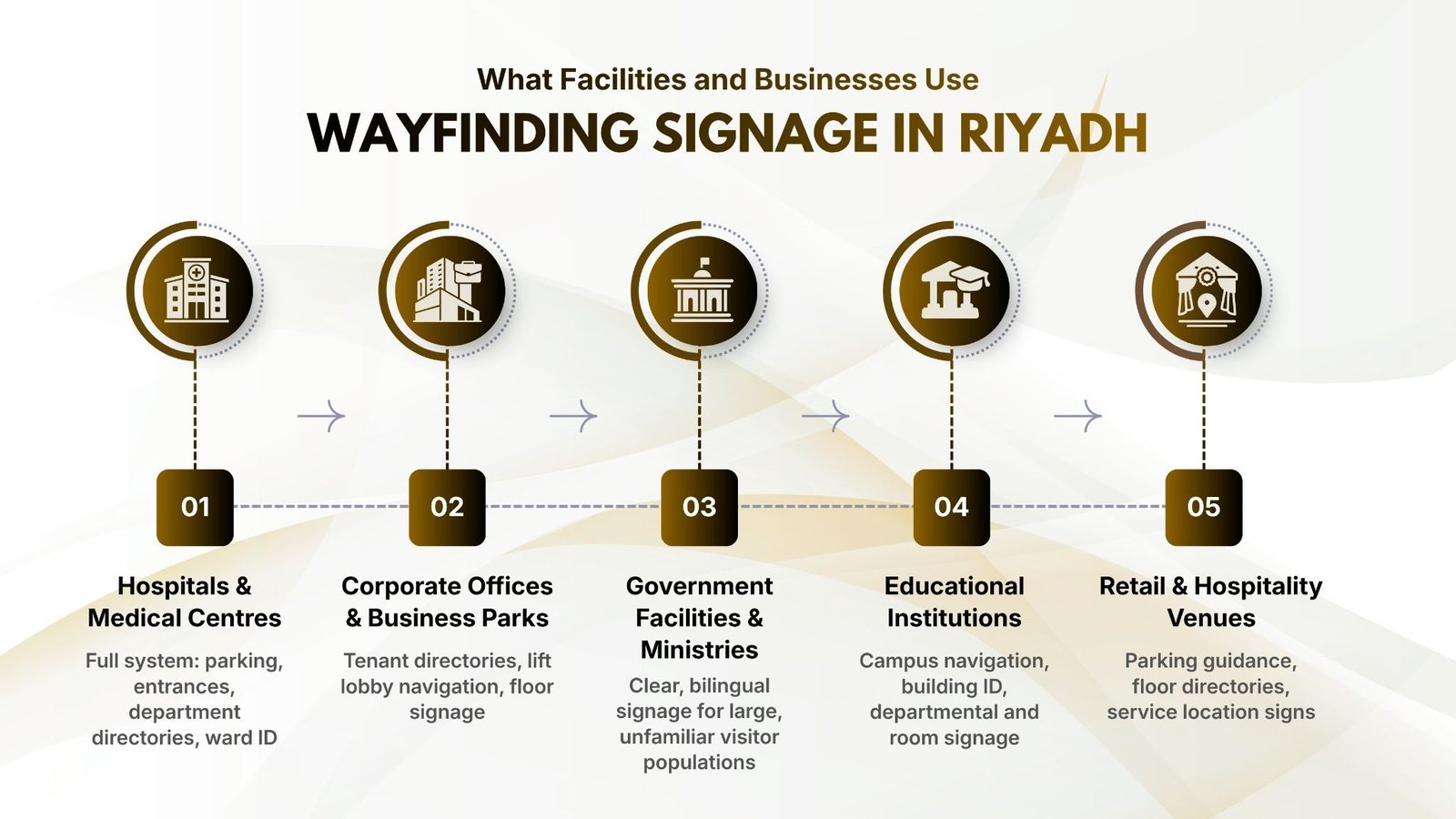
| Facility Type | Key Wayfinding Requirement |
| Hospitals & Medical Centres | Full system: parking, entrances, department directories, ward ID |
| Corporate Offices & Business Parks | Tenant directories, lift lobby navigation, floor signage |
| Government Facilities & Ministries | Clear, bilingual signage for large, unfamiliar visitor populations |
| Educational Institutions | Campus navigation, building ID, departmental and room signage |
| Retail & Hospitality Venues | Parking guidance, floor directories, service location signs |
Hospitals and Medical Centres
Of all facility types, hospitals carry the most demanding wayfinding requirements. Patients, visitors, and staff move through the same environment with completely different levels of familiarity — and patients are often under stress when they arrive. A wrong turn in a hospital is not a minor inconvenience. It costs time, raises anxiety, and places pressure on staff who are then pulled away from their actual roles to give directions.
A proper hospital wayfinding system in Riyadh covers the full journey: parking guidance from the road, entrance identification for main and secondary access points, department directories at the lobby, lift lobby signage on every floor, ward identification at each unit, and discharge area signs at the exit. The system works end to end or it does not work. For a closer look at how each stage fits together, our hospital wayfinding guide breaks down the full setup in more detail.
- Directional signs at every junction reduce the time patients spend searching and lower the volume of navigation questions reaching front desk staff
- Identification signs at ward entrances and department doors confirm arrival and remove the last step of uncertainty
- Informational signs at lift lobbies with floor maps let visitors self-navigate without assistance
- Safety and regulatory signs are mandatory under Saudi Civil Defense requirements and must be integrated from the start
Corporate Offices and Business Parks
A corporate office in Riyadh receives clients, job candidates, delivery personnel, and first-time visitors daily. Each of them arrives with no prior knowledge of the layout. Without a wayfinding system, every one of those visits begins with someone at reception explaining where to go — or someone getting lost before they even reach reception.
For multi-tenant business parks, the complexity increases. Different tenants, different floors, different branding — but the wayfinding system needs to hold the entire building together as a coherent navigation experience.
- Directional signs at building entrances and lift lobbies keep visitors moving without needing staff assistance
- Identification signs at meeting rooms, department entrances, and suite numbers confirm location at the final step
- Tenant directory boards at main lobbies give visitors a reference point the moment they walk in
- Digital wayfinding displays in larger corporate campuses handle meeting room availability and visitor check-in in real time
Government Facilities and Ministries
Government buildings in Riyadh serve some of the highest and most varied visitor volumes of any facility type. Members of the public arriving to complete transactions, submit documents, or attend appointments often have no familiarity with the building layout and no prior experience with the facility.
Clear, bilingual Arabic and English wayfinding signage is a baseline requirement for any public-facing government building. Arabic appears first by convention. A system that is not bilingual does not function correctly for a large share of the visitors it is meant to serve.
- Directional signs in both Arabic and English at every decision point reduce queue formation at information counters
- Informational signs showing service counters, operating hours, and document requirements reduce basic enquiries to staff
- Identification signs at each service window or department confirm that the visitor has reached the right place
- Safety signage meeting Saudi Civil Defense standards is mandatory and must be part of the initial project scope
Educational Institutions
Schools, universities, and training campuses in Riyadh present a specific wayfinding challenge: the users of the space change every year. New students, new parents, new staff — and a campus layout that may span multiple buildings across a large footprint.
A university campus without a proper wayfinding system means every new intake begins with the same confusion. A school without identification signs on classroom doors means parents at open days and delivery staff alike have to ask every person they pass.
- Campus directional signs between buildings guide students and visitors across the full site without needing a map
- Building identification signs at entrances distinguish structures from each other clearly
- Room numbering and department signs inside buildings complete the navigation from campus entry to final destination
- Informational signs with campus maps at key entry points allow self-navigation for first-time visitors
Retail Shops and Shopping Malls
Retail wayfinding works differently from institutional wayfinding. The goal is not just to help customers find what they came for — it is to keep them in the space longer and expose them to more of what is available. A well-signed retail environment reduces friction and increases dwell time.
For individual shops, wayfinding covers product categories, fitting rooms, checkout counters, and service points. For multi-level malls, it covers parking levels, mall entrances, anchor tenant locations, floor directories, toilets, prayer rooms, and food courts.
- Directional signs at mall entrances and floor transitions keep foot traffic distributed across the full space
- Identification signs at store entrances and category zones help customers confirm they are in the right area
- Informational signs with floor directories and mall maps reduce the time customers spend searching and increase the time they spend browsing
- Digital wayfinding displays in large malls handle tenant directories, promotional content, and real-time navigation in a single installation
Hotels and Hospitality Venues
Hotels have one of the widest wayfinding footprints of any single building type. Reception, food and beverage outlets, conference and event facilities, accommodation floors, leisure facilities, parking — a guest may need to navigate all of these across a single stay.
In Riyadh’s hospitality sector, wayfinding signage is also a design element. The system needs to function precisely and sit within the interior design language of the property. A luxury hotel in which the wayfinding signs look like an afterthought signals poor attention to detail across the whole operation.
- Directional signs from the car park through to each facility keep guests moving confidently without asking staff
- Identification signs at room doors, restaurant entrances, and conference rooms confirm arrival at each destination
- Informational signs with facility hours, floor plans, and amenity locations reduce pressure on concierge and reception staff
- Digital displays in conference and event areas handle room booking, event schedules, and guest announcements in real time
Exhibition and Event Venues
Exhibitions, trade shows, and corporate events in Riyadh present a concentrated wayfinding challenge. Large numbers of unfamiliar visitors, a layout that changes for every event, and a short window in which the signage system needs to work perfectly.
For exhibition organisers, wayfinding signage covers registration points, hall entrances, exhibitor booth numbering, seminar rooms, hospitality areas, and exits. The system needs to be clear enough for a first-time visitor to self-navigate from the car park to a specific booth number without assistance.
- Directional signs at venue entrances and hall transitions move high volumes of visitors without bottlenecking at information points
- Identification signs at booth numbers, seminar rooms, and registration desks confirm each destination clearly
- Informational signs with event maps and schedules at key points reduce the load on event staff during peak arrival periods
- Temporary and modular signage systems allow the wayfinding layout to change between events without full reprinting
Healthcare Clinics and Specialist Centres
Smaller than hospitals but with their own specific requirements, clinics and specialist medical centres in Riyadh serve patients who are often attending for the first time and may be anxious about the visit. A clear, well-planned wayfinding system reduces that anxiety before the appointment even begins.
Unlike large hospitals, clinics typically need a more compact system: entrance identification, a reception directional sign, consultation room identification, and a pharmacy or checkout point. The system is smaller but no less important for the patient experience.
- Directional signs from the building entrance to reception remove the first point of uncertainty for new patients
- Identification signs on consultation room doors prevent patients from knocking on the wrong door or waiting in the wrong area
- Informational signs showing waiting area rules, payment counters, and pharmacy locations reduce repeated questions to reception staff
- Safety signage covering fire exits and emergency procedures is mandatory regardless of the clinic’s size
How Do Riyadh Businesses and Institutions Plan Wayfinding Systems?
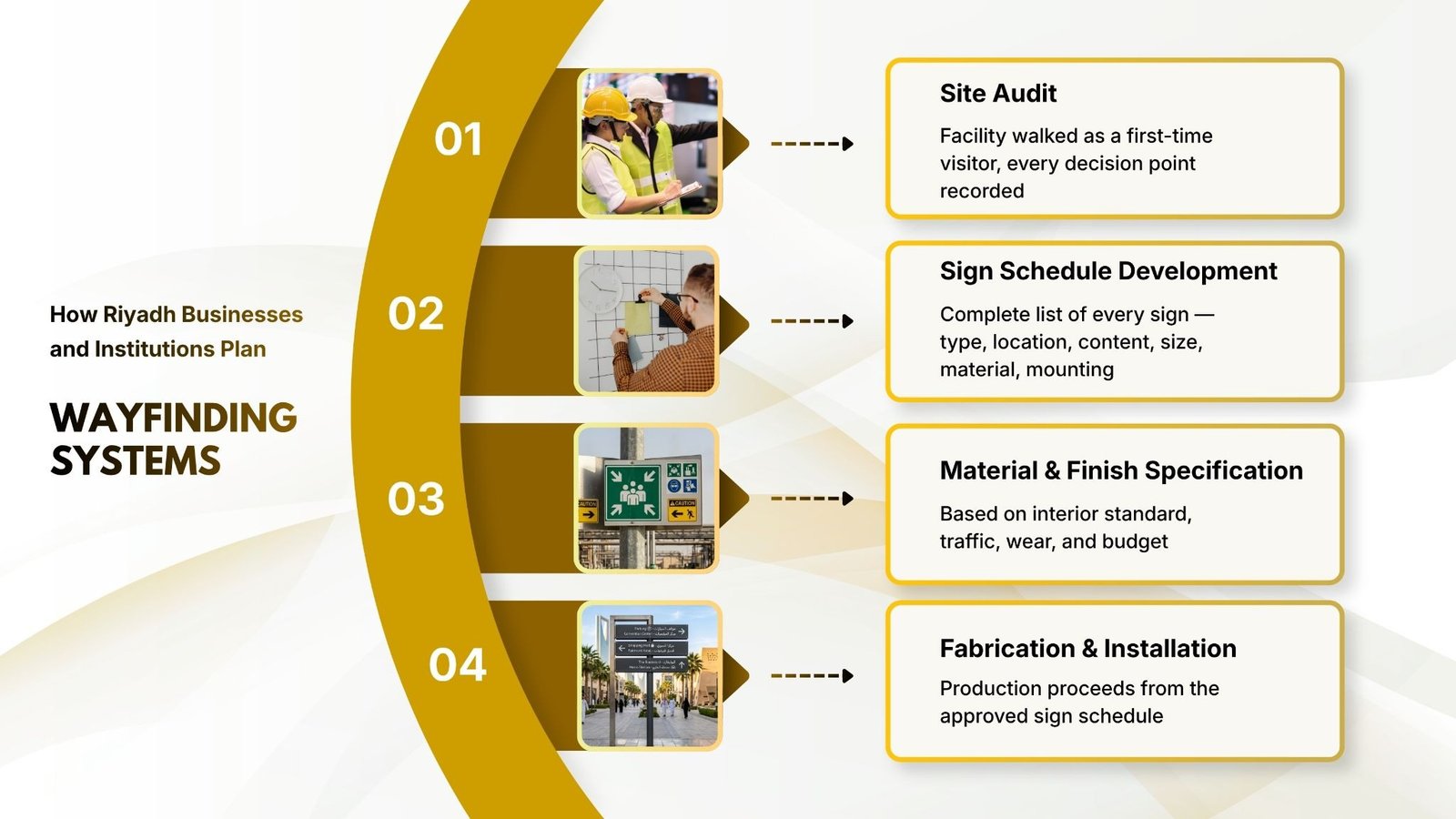
| Stage | What Happens |
| 1. Site Audit | Facility walked as a first-time visitor, every decision point recorded |
| 2. Sign Schedule Development | Complete list of every sign — type, location, content, size, material, mounting |
| 3. Material & Finish Specification | Based on interior standard, traffic, wear, and budget |
| 4. Fabrication & Installation | Production proceeds from the approved sign schedule |
Effective wayfinding signage planning starts with a site audit. The facility is walked as a first-time visitor and every decision point — every location where someone needs to choose a direction — is identified and recorded. This produces a map of where signs are needed before any content or specification decisions are made.
A sign schedule is then developed. This is a complete list of every sign in the system — its type, location, content, size, material, and mounting method. The sign schedule is the document that the fabricator produces from and the client approves before production begins. A project that proceeds to fabrication without a sign schedule will have gaps, duplications, and inconsistencies in the finished system.
Material and finish specifications are determined based on the interior design standard of the facility, the expected traffic and wear at each location, the maintenance programme available, and the budget. A premium hotel lobby has different requirements from a hospital corridor or a university stairwell, and the specification should reflect those differences.
Which Wayfinding Signage Type Is Right for Your Business?
Every wayfinding system starts from the same foundation and scales from there based on what your facility actually needs. Here is the right order to think about it.
Start with what is mandatory. Safety signage is non-negotiable for any commercial or institutional facility in Riyadh. Saudi Civil Defense requirements apply regardless of your facility size, sector, or budget. Plan safety signs first, not last.
Then build the core system. For most businesses, directional signs and identification signs form the working backbone of the wayfinding system. Directional signs get people moving in the right direction. Identification signs confirm they have arrived. Without both, the system has gaps.
Add informational signs where the questions are predictable. Every business has locations where visitors consistently ask the same questions. Those locations need informational signs. A lobby without a directory, a floor without a map, a service counter without operating hours posted — each of these creates a recurring burden on your staff that a single well-placed sign eliminates.
Then comes digital wayfinding. Digital displays are the right choice when your destinations change frequently, your visitor volumes are high, or your facility’s size makes a fully static system hard to maintain. For most small and mid-size businesses in Riyadh, a well-planned static system does the job at a fraction of the cost. Digital earns its place when the operational need is real, not because it looks impressive. If you’re not sure where your facility falls, contact our experts on WhatsApp and we’ll help you figure out the right starting point.
How Much Does Wayfinding Signage Cost in Riyadh?
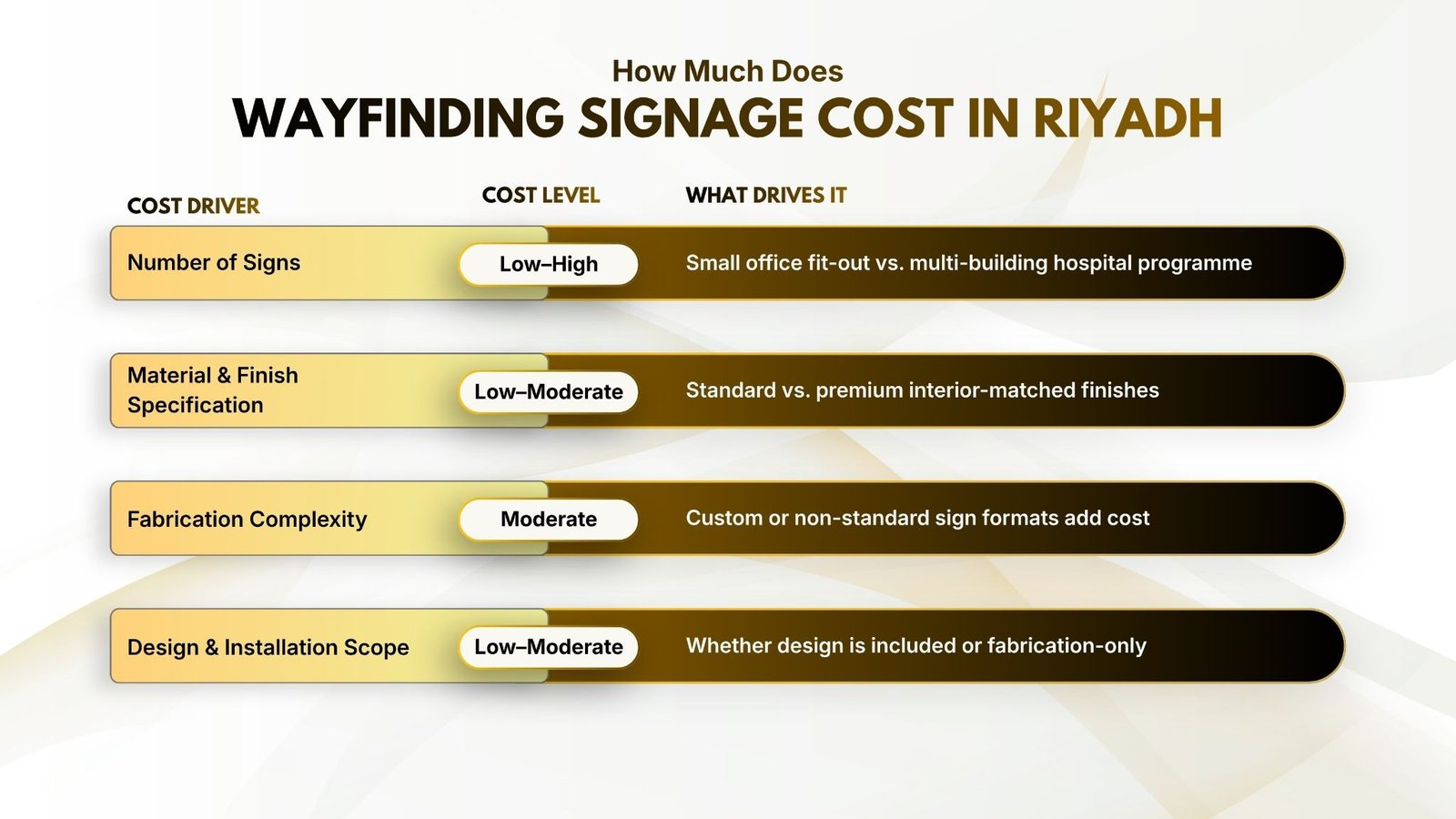
| Cost Driver | Cost Level | What Drives It |
| Number of Signs | Low–High | Small office fit-out vs. multi-building hospital programme |
| Material & Finish Specification | Low–Moderate | Standard vs. premium interior-matched finishes |
| Fabrication Complexity | Moderate | Custom or non-standard sign formats add cost |
| Design & Installation Scope | Low–Moderate | Whether design is included or fabrication-only |
Wayfinding signage costs are driven by the number of signs, the material and finish specification, the fabrication complexity, and whether design and installation are included in the scope.
A basic set of room identification and directional signs for a small office fit-out is a very different budget from a comprehensive hospital wayfinding programme covering multiple buildings and several hundred individual signs in both Arabic and English.
The most reliable way to produce an accurate budget is to develop a sign schedule first. A complete list of every sign required, with location and content, allows a signage company to produce a precise quote rather than a rough estimate based on a general description. Budgets based on vague scope descriptions are almost always wrong — either too high or too low — and the discrepancy creates problems during production.
Wayfinding Signage: A Quick Decision Guide
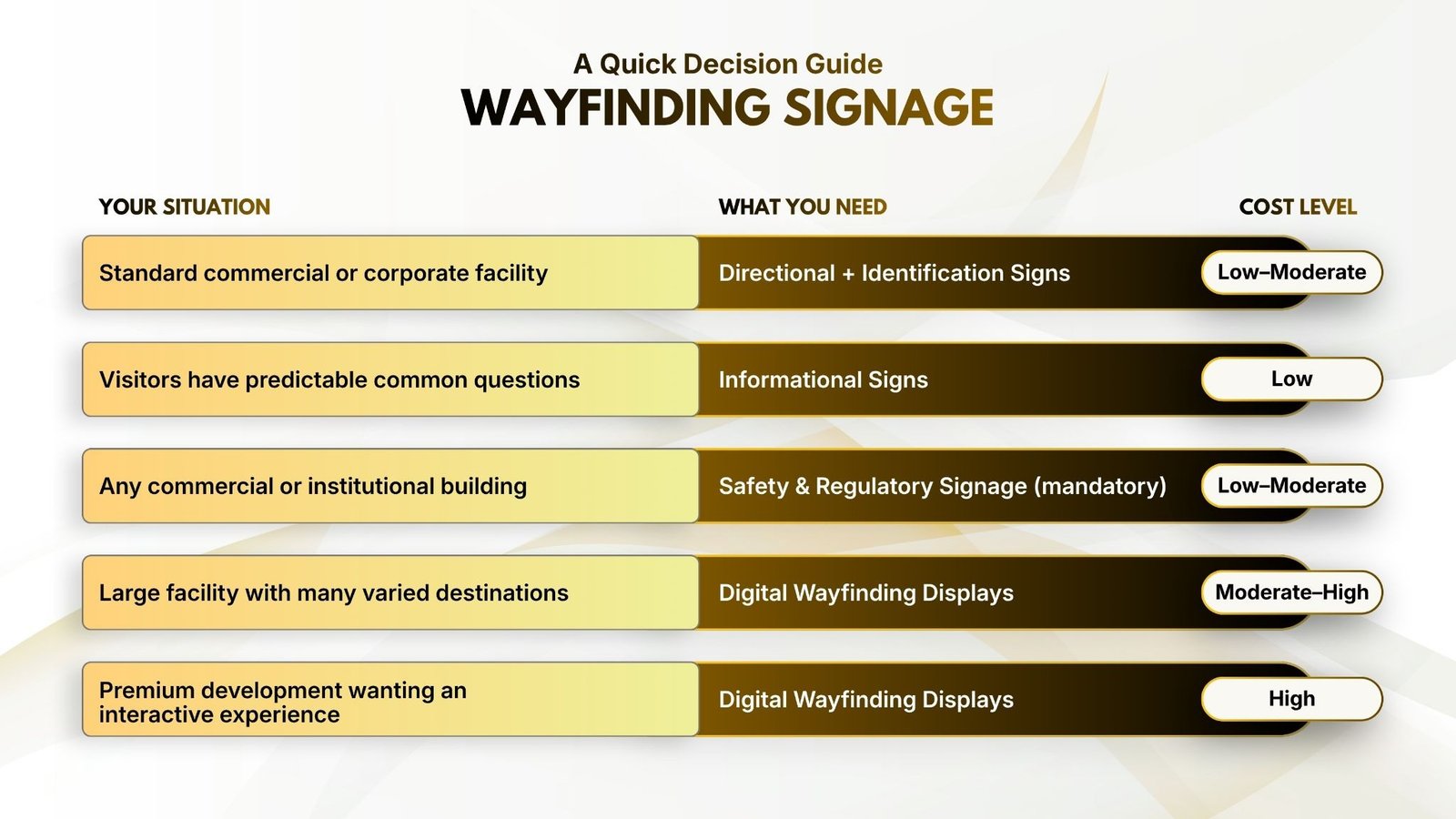
| Your Situation | What You Need | Cost Level |
| Standard commercial or corporate facility | Directional + Identification Signs | Low–Moderate |
| Visitors have predictable common questions | Informational Signs | Low |
| Any commercial or institutional building | Safety & Regulatory Signage (mandatory) | Low–Moderate |
| Large facility with many varied destinations | Digital Wayfinding Displays | Moderate–High |
| Premium development wanting an interactive experience | Digital Wayfinding Displays | High |
What Should You Check Before Choosing a Wayfinding Signage Provider in Riyadh?
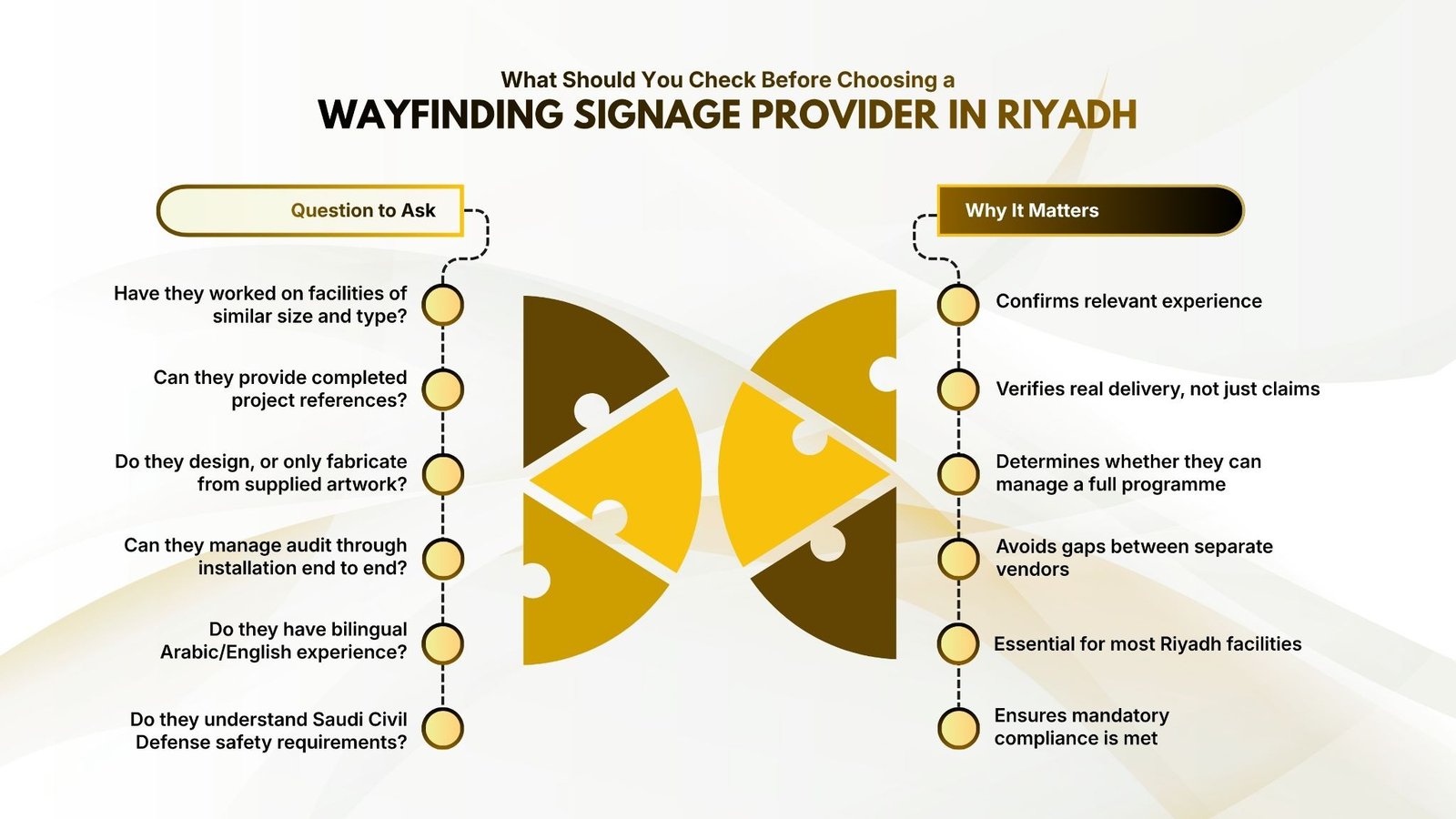
| Question to Ask | Why It Matters |
| Have they worked on facilities of similar size and type? | Confirms relevant experience |
| Can they provide completed project references? | Verifies real delivery, not just claims |
| Do they design, or only fabricate from supplied artwork? | Determines whether they can manage a full programme |
| Can they manage audit through installation end to end? | Avoids gaps between separate vendors |
| Do they have bilingual Arabic/English experience? | Essential for most Riyadh facilities |
| Do they understand Saudi Civil Defense safety requirements? | Ensures mandatory compliance is met |
Common Mistakes to Avoid When Planning Wayfinding Signage in Riyadh
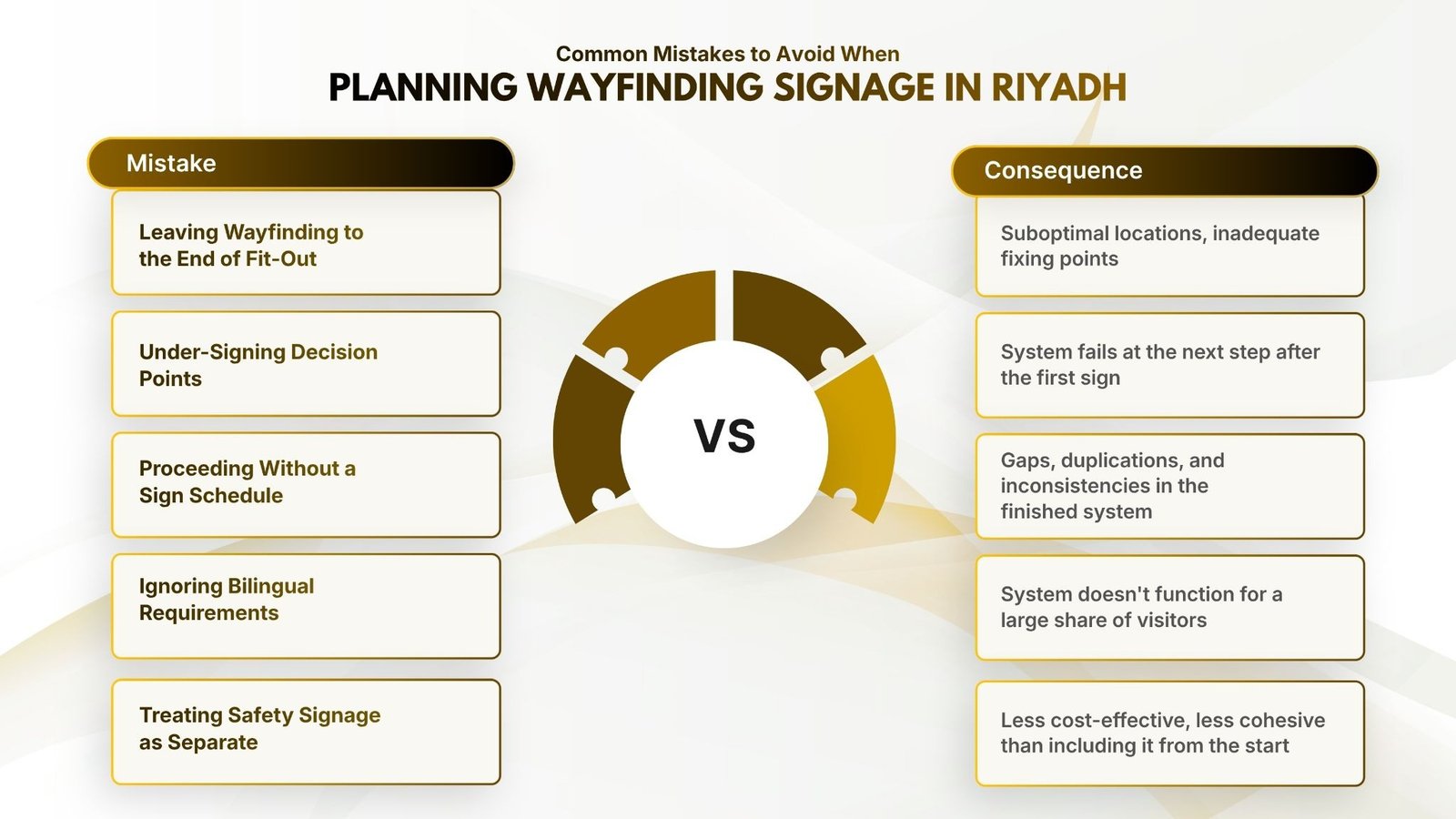
| Mistake | Consequence |
| Leaving Wayfinding to the End of Fit-Out | Suboptimal locations, inadequate fixing points |
| Under-Signing Decision Points | System fails at the next step after the first sign |
| Proceeding Without a Sign Schedule | Gaps, duplications, and inconsistencies in the finished system |
| Ignoring Bilingual Requirements | System doesn’t function for a large share of visitors |
| Treating Safety Signage as Separate | Less cost-effective, less cohesive than including it from the start |
Where to Get Professional Wayfinding Signage in Riyadh?
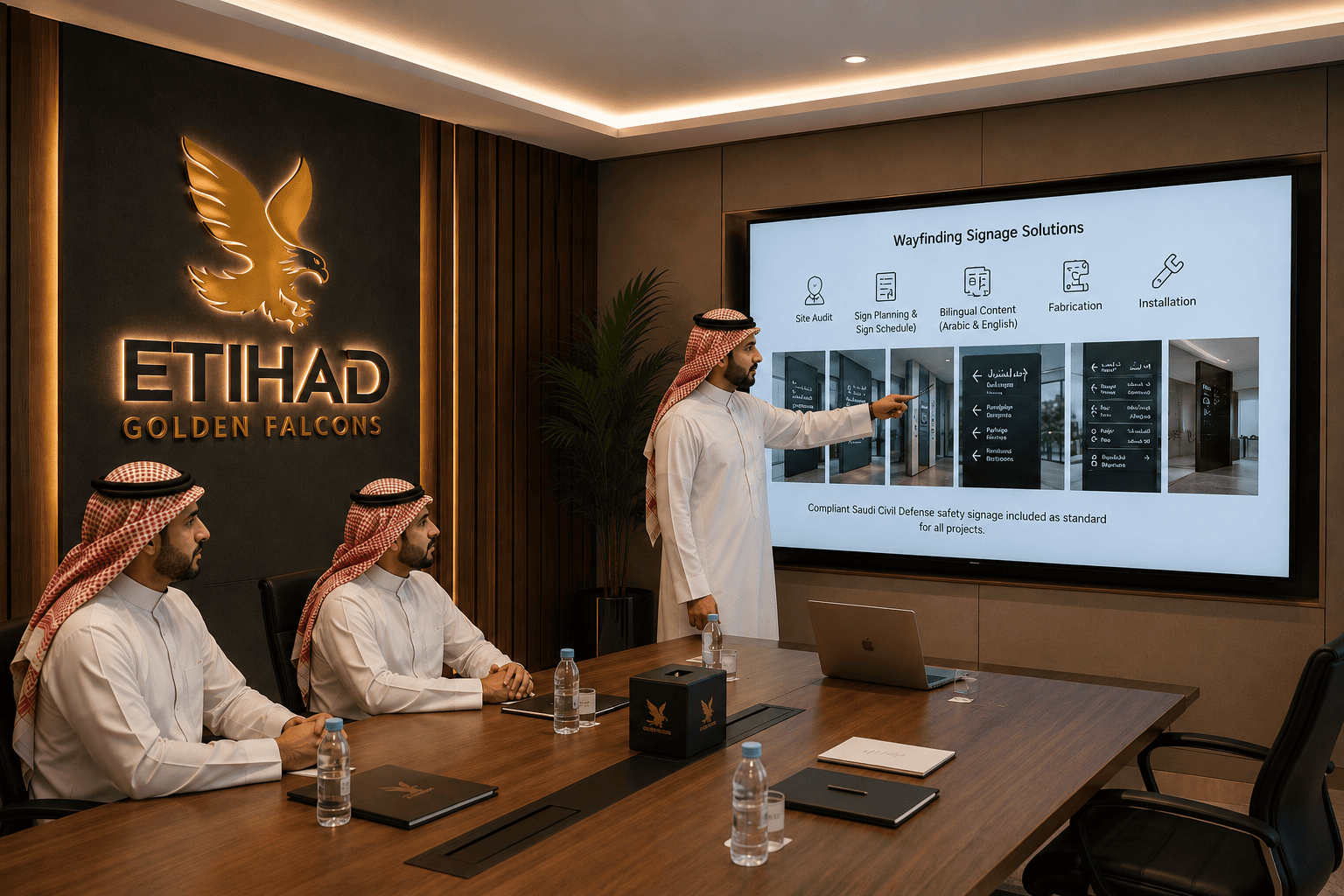
Etihad Golden Falcons designs and installs wayfinding signage systems for commercial, corporate, hospitality, healthcare, and institutional facilities across Riyadh. We manage the full process: site audit, sign schedule development, bilingual Arabic and English content, material specification, fabrication, and installation. And our systems include compliance with Saudi Civil Defense safety signage as standard.
Every project starts with a site visit. Our team walks your facility, identifies every decision point that needs a sign, and gives you a clear scope and cost before any production begins.
FAQs
Wayfinding signage is a coordinated system of signs that helps people navigate a building or facility without assistance. It includes directional signs that point people toward their destination, identification signs that confirm their location, informational signs that answer common questions, and mandatory safety signs that meet Saudi Civil Defense requirements. A facility without adequate wayfinding signage adds unnecessary friction to every visitor’s experience and places a recurring burden on staff to answer basic navigation questions.
It is not always a legal requirement but it is a practical requirement for any facility serving a mixed Arabic and English-speaking audience — which includes most commercial, corporate, hospitality, healthcare, and government facilities in Riyadh. A wayfinding signage system that only part of your visitor population can navigate is not functioning correctly for your environment.
Timeline depends on the size and complexity of the facility and the scope of the programme. A small office fit-out with a basic sign set can be completed in two to four weeks from site audit to installation. A large facility with hundreds of signs requires more time for design development, sign schedule approval, and production. The design and client approval phase typically takes one to three weeks before fabrication begins.
Yes, Etihad Golden Falcons manages the complete wayfinding signage programme: site audit, sign schedule development, bilingual content, design, material specification, fabrication, and installation. We do not only produce signs from client-supplied artwork.
Contact our team to discuss your facility’s requirements, and we will advise on the full scope and cost of the programme.