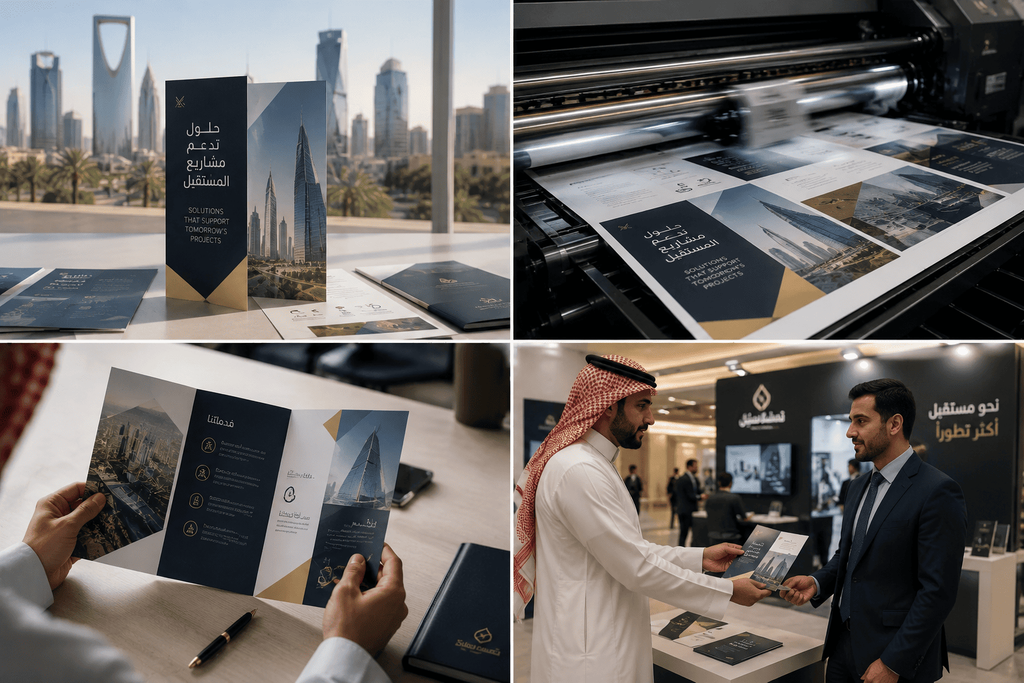
Brochure printing is the production of a folded, multi-panel print piece designed to carry a business’s message, services, or offering in a format a reader can hold, flip through, and keep. It covers corporate profiles, property launches, product catalogues, and exhibition handouts alike.
Each fold type is built for a different job. A bi-fold is built for a quick, single-message handout. A tri-fold is built to carry a full company profile in a compact size. A gate fold is built for a premium reveal, the kind used at a luxury property launch. A z-fold is built for a sequential, step-by-step read. Together, they cover most of what a business in Riyadh needs from a printed brochure.
Material planning matters at every scale. A 50-piece handout for a single meeting needs the same right specification as a 5,000-piece campaign run. The quantity changes. The requirement does not. Getting this right is a core part of brochure printing, regardless of whether the run is small or large.
This guide covers the main types of brochure folds and materials, how to match one to your business need, sizing, cost, and what to check before production begins.
What Types of Brochures Can Be Printed in Riyadh?
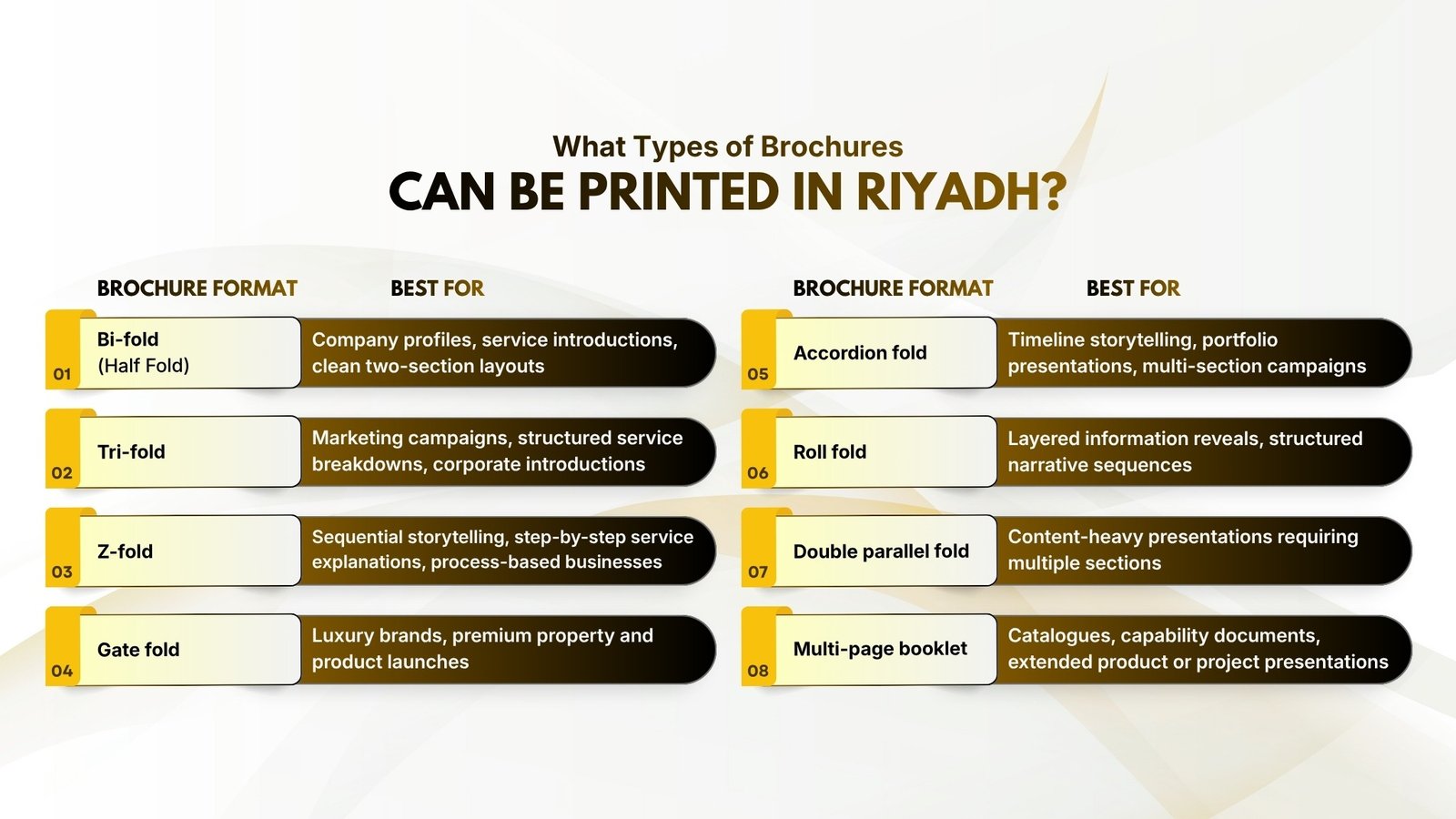
| Brochure Format | Best For |
| Bi-fold (Half Fold) | Company profiles, service introductions, clean two-section layouts |
| Tri-fold | Marketing campaigns, structured service breakdowns, corporate introductions |
| Z-fold | Sequential storytelling, step-by-step service explanations, process-based businesses |
| Gate fold | Luxury brands, premium property and product launches |
| Accordion fold | Timeline storytelling, portfolio presentations, multi-section campaigns |
| Roll fold | Layered information reveals, structured narrative sequences |
| Double parallel fold | Content-heavy presentations requiring multiple sections |
| 4-fold / 4-panel | Extended content requiring more structure than a tri-fold |
| Multi-page booklet | Catalogues, capability documents, extended product or project presentations |
| DL brochure | Rack display, mailing, compact professional formats |
| A3 folded | Wide-format presentations, maps, project overviews |
| Die cut brochure | Brand-led designs where the brochure shape carries visual impact |
Bi-fold Brochure Printing
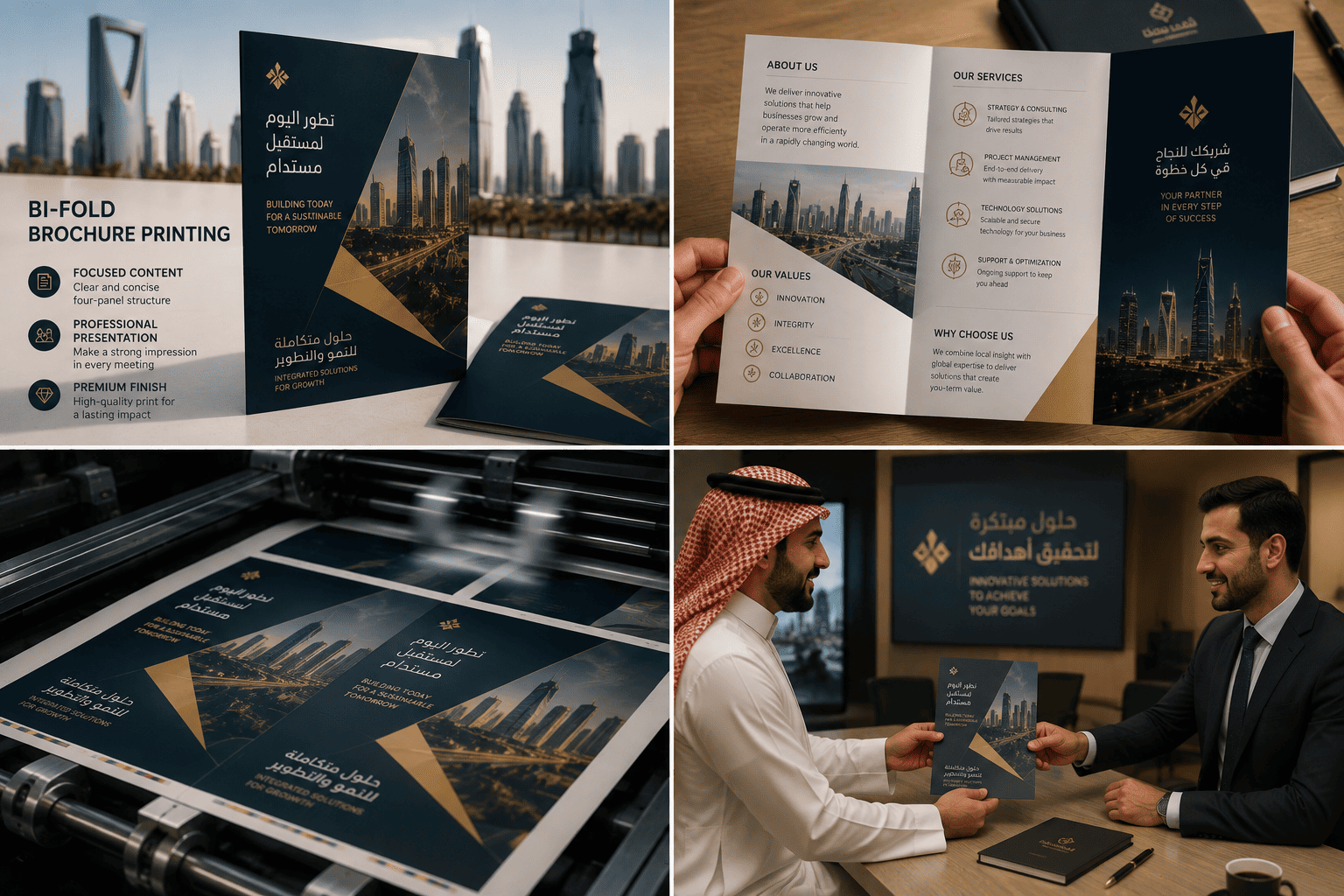
A bi-fold gives you four panels from a single sheet — front cover, inside left, inside right, and back. It is the cleanest structure for focused content: a company overview, a single service introduction, or a high-level summary that does not need more space than two inside panels can hold.
Use bifold brochure printing if you are:
- Presenting a company profile or capability overview at a client meeting
- Introducing a single service or product line with supporting imagery
- Producing a clean, straightforward format that does not require complex content organisation
Tri-fold Brochure Printing
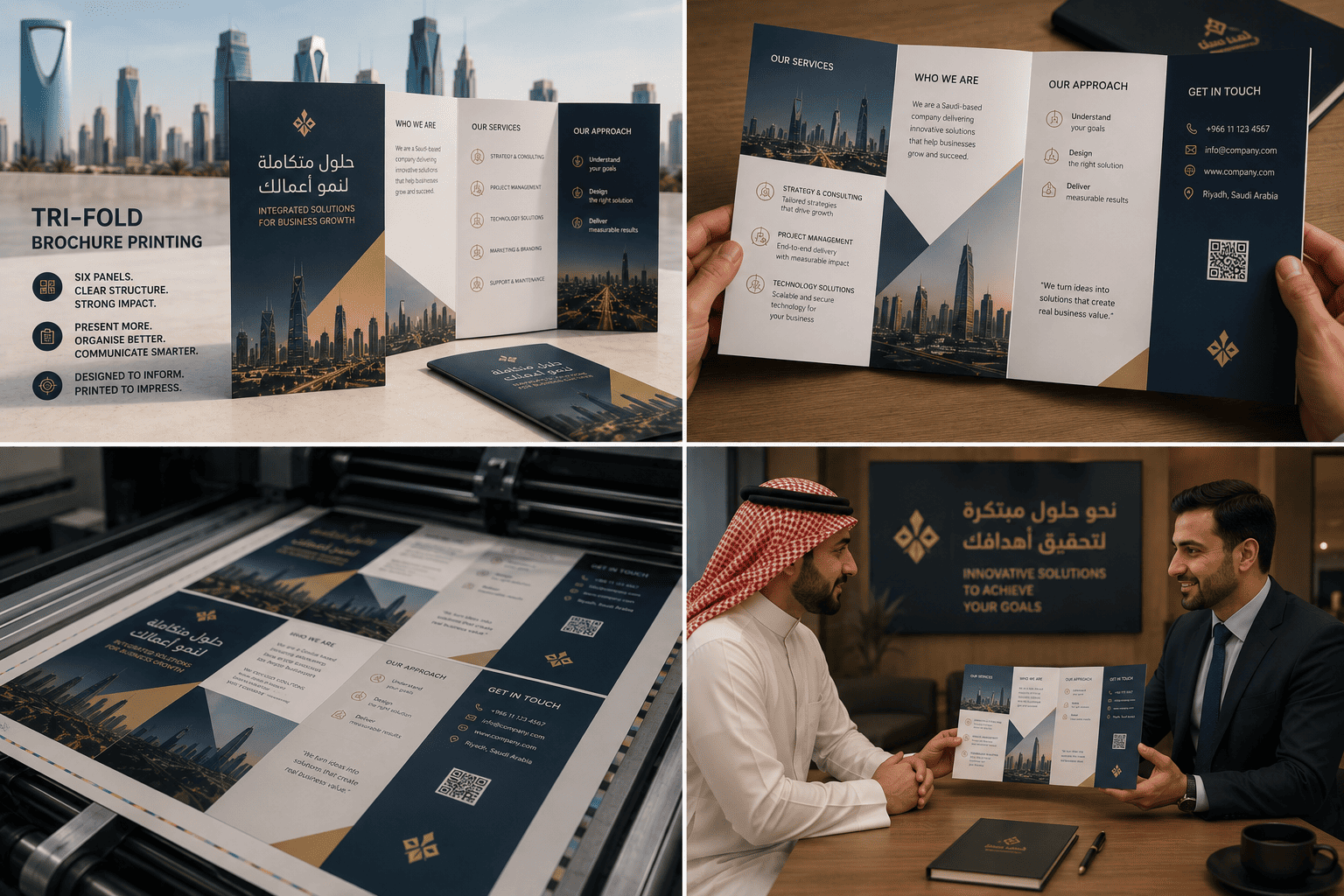
The tri-fold is the most widely used brochure format for a reason. Six panels give you enough structure to organise content into distinct sections — introduction, service breakdown, supporting detail, and call to action — without the complexity of a multi-page booklet.
Use trifold brochure printing if you are:
- Running a marketing campaign covering multiple services or product categories
- Producing a corporate introduction that needs to cover background, services, and contact in one piece
- Creating a format that fits standard display racks and envelopes for mailing
Z-fold Brochure Printing
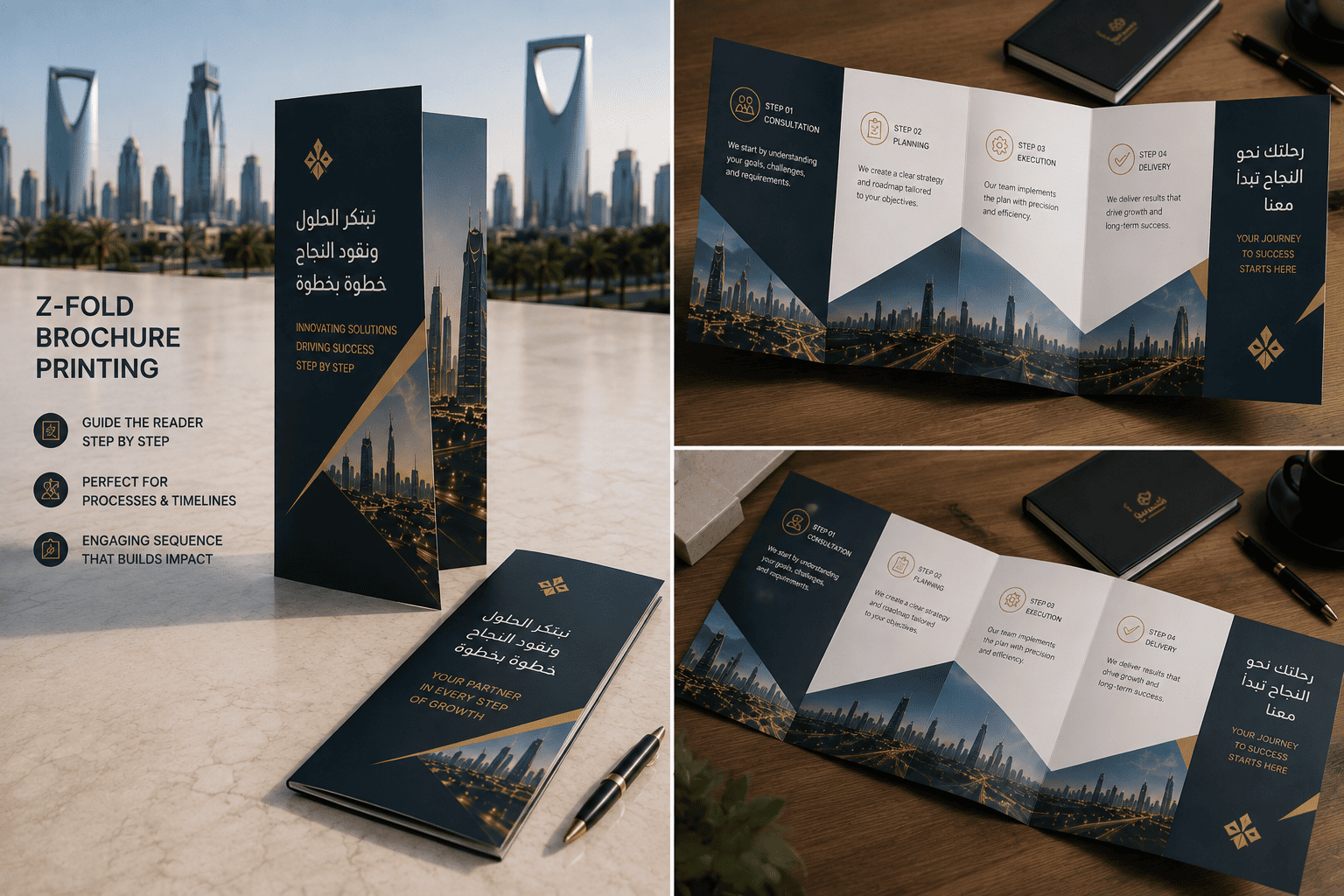
A Z-fold opens in a zig-zag rather than all at once, which gives the designer control over how information is revealed. The reader moves through it in a sequence — which works well for process-based content, step-by-step explanations, or campaigns where the message builds from one section to the next.
Use Z-fold brochure printing if you are:
- Explaining a service or process that has a natural sequence of steps
- Producing content where the order in which information is encountered matters
- Looking for a format that stands out from standard bi-fold and tri-fold structures
Gate Fold Brochure Printing
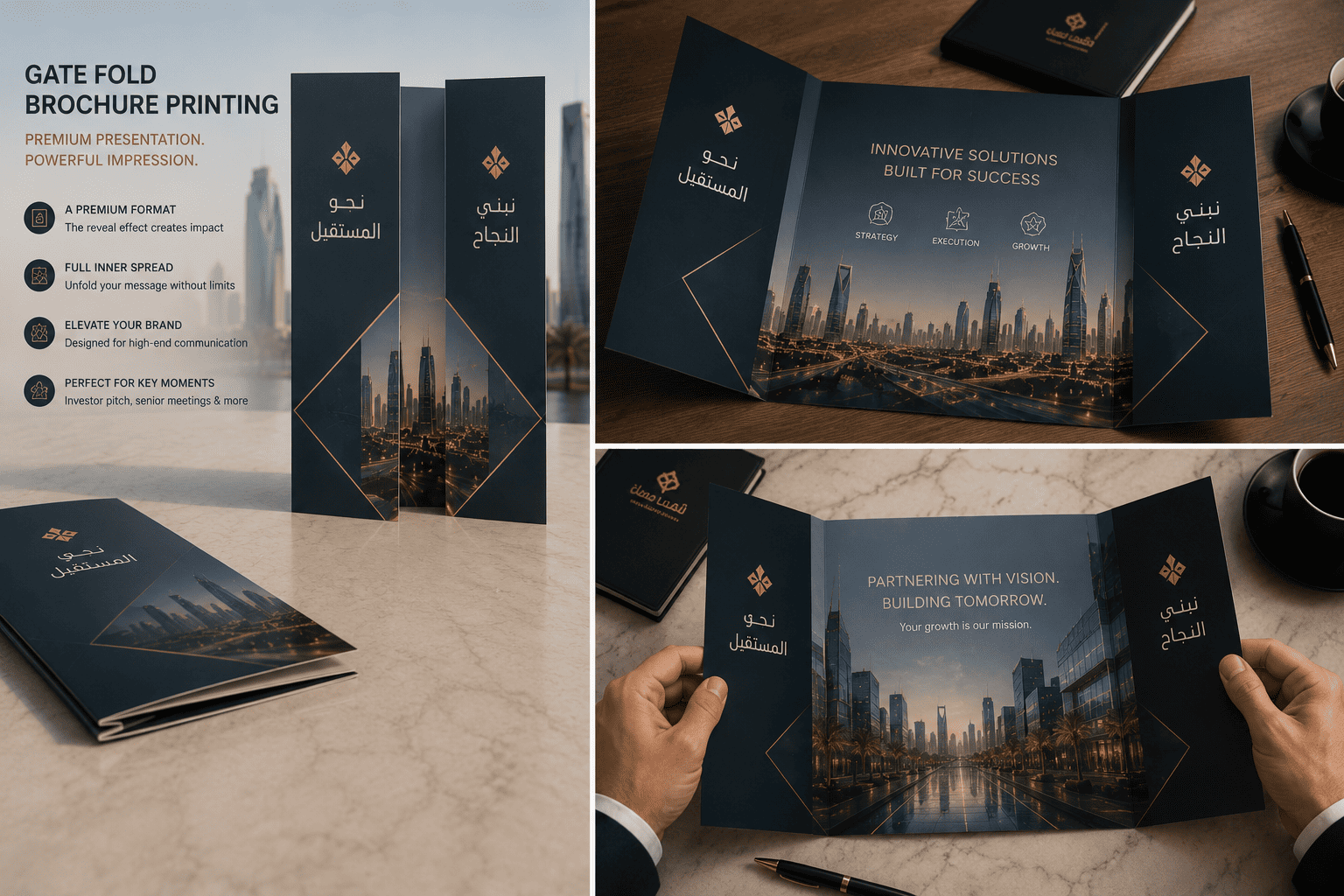
A gate fold has two outer panels that open inward to reveal a full inner spread. It is a premium format — the act of opening it is part of the presentation. The reveal effect makes it well-suited to high-end brand communication where the physical experience of handling the brochure is as important as the content inside.
Use gate fold brochure printing if you are:
- Presenting a luxury product, high-end property, or premium service where physical impression carries weight
- Producing a brochure for an investor presentation or senior client meeting
- Looking for a format where the cover and inner spread work together as a single visual statement
Accordion Fold Brochure Printing
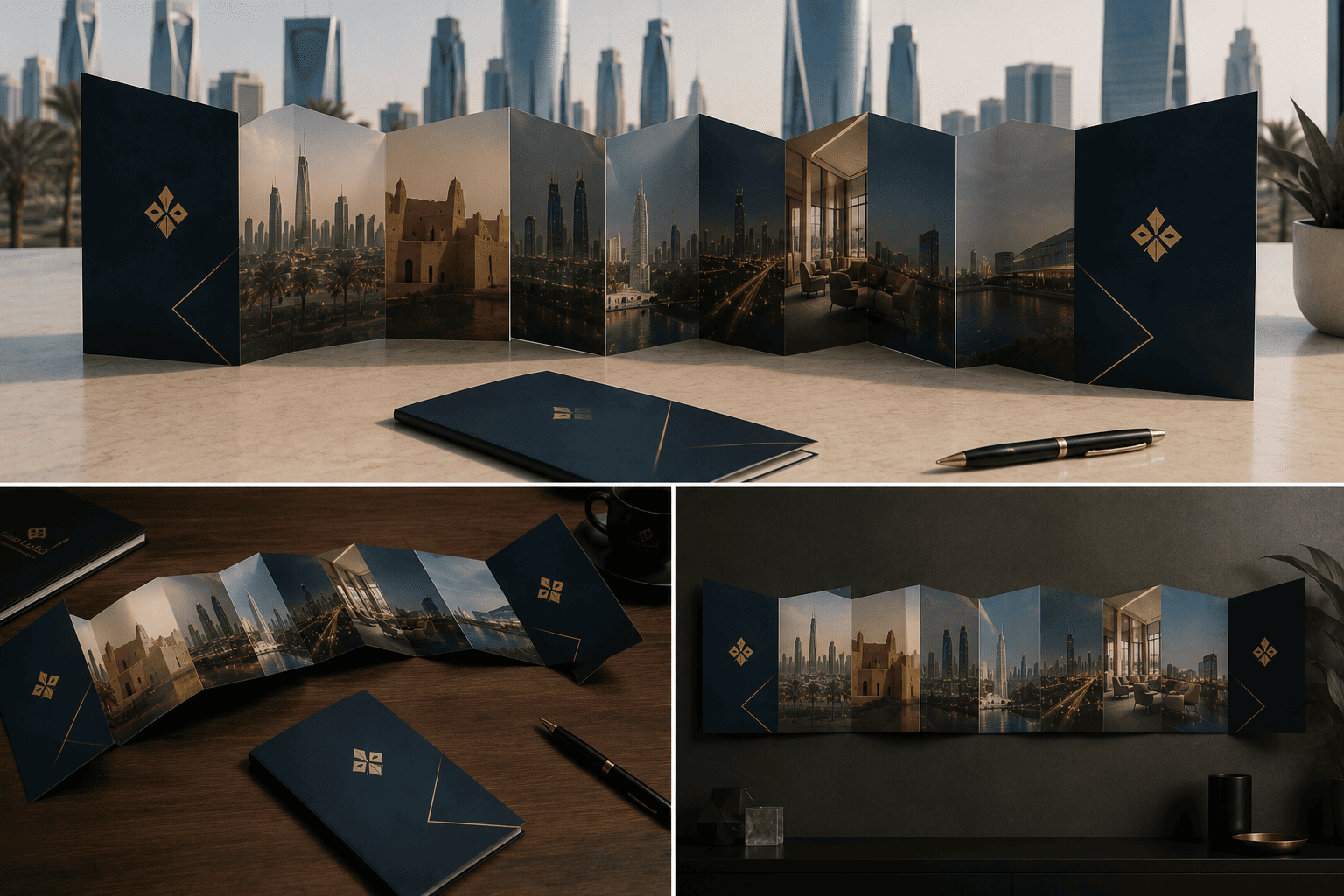
An accordion fold expands into a continuous sequence of panels, each connected to the next. It suits content that benefits from being read as a visual sequence — a project timeline, a portfolio of work, a campaign with multiple stages, or a comparison across several options.
Use accordion fold brochure printing if you are:
- Presenting a timeline, process, or narrative that flows from left to right
- Producing a portfolio piece that needs to display multiple images or projects in sequence
- Looking for a format that can be pinned to a wall or displayed flat as a visual piece
Multi-page Booklet & Saddle-stitched Brochures
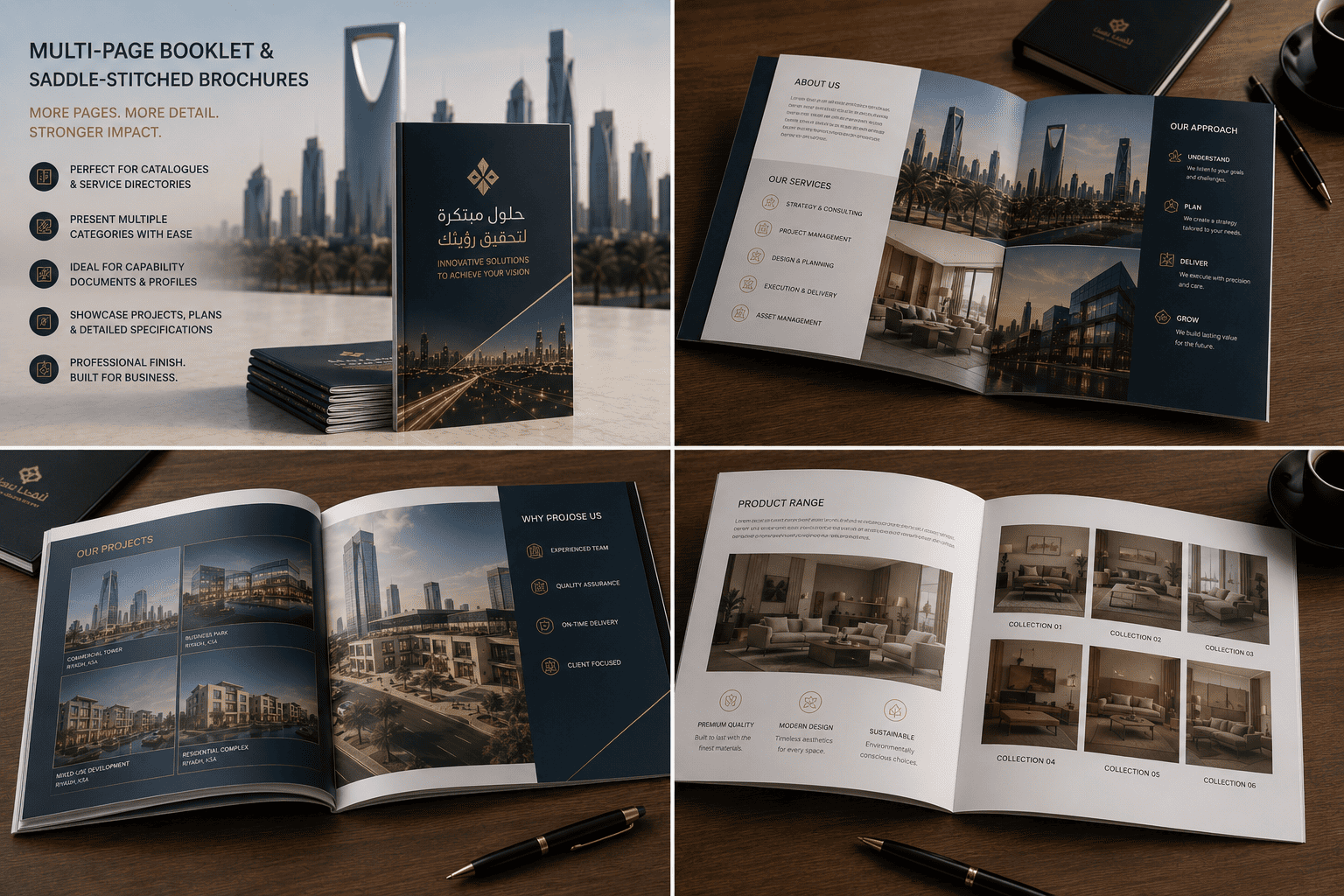
When the content volume exceeds what any folded format can hold, a multi-page brochure or saddle-stitched booklet is the right structure. Catalogues, capability documents, property brochures with multiple listings, and product ranges with detailed specifications all require pages rather than panels.
Use multi-page brochure printing or booklet printing if you are:
- Producing a product catalogue or service directory with more than a few categories
- Creating a corporate capability document that covers multiple practice areas or divisions
- Presenting a property development project with multiple units, floor plans, and specifications
Perfect Bound Brochures & Catalogues
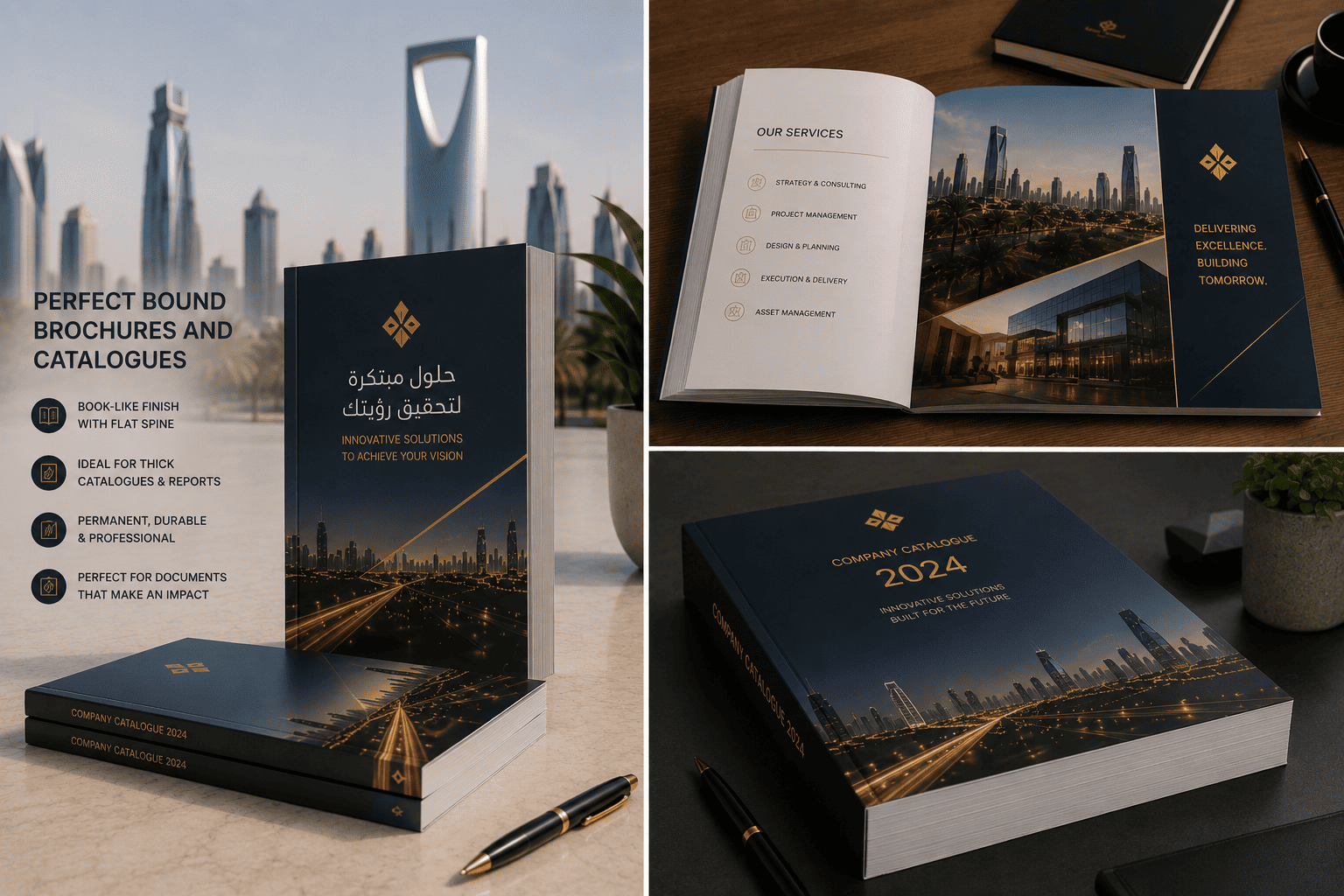
Perfect binding produces a flat spine, which makes the brochure look and function like a book. For thick catalogues, annual reports, and high-volume product presentations, perfect bound printing is the format that holds the content together in a way that saddle stitching cannot once the page count becomes significant.
Use perfect bound brochure or catalogue printing if you are:
- Producing a product catalogue with more than 40-50 pages
- Creating a document that will be kept as a reference and used repeatedly
- Presenting an annual report or corporate publication where the format needs to communicate permanence
Die Cut Brochure Printing
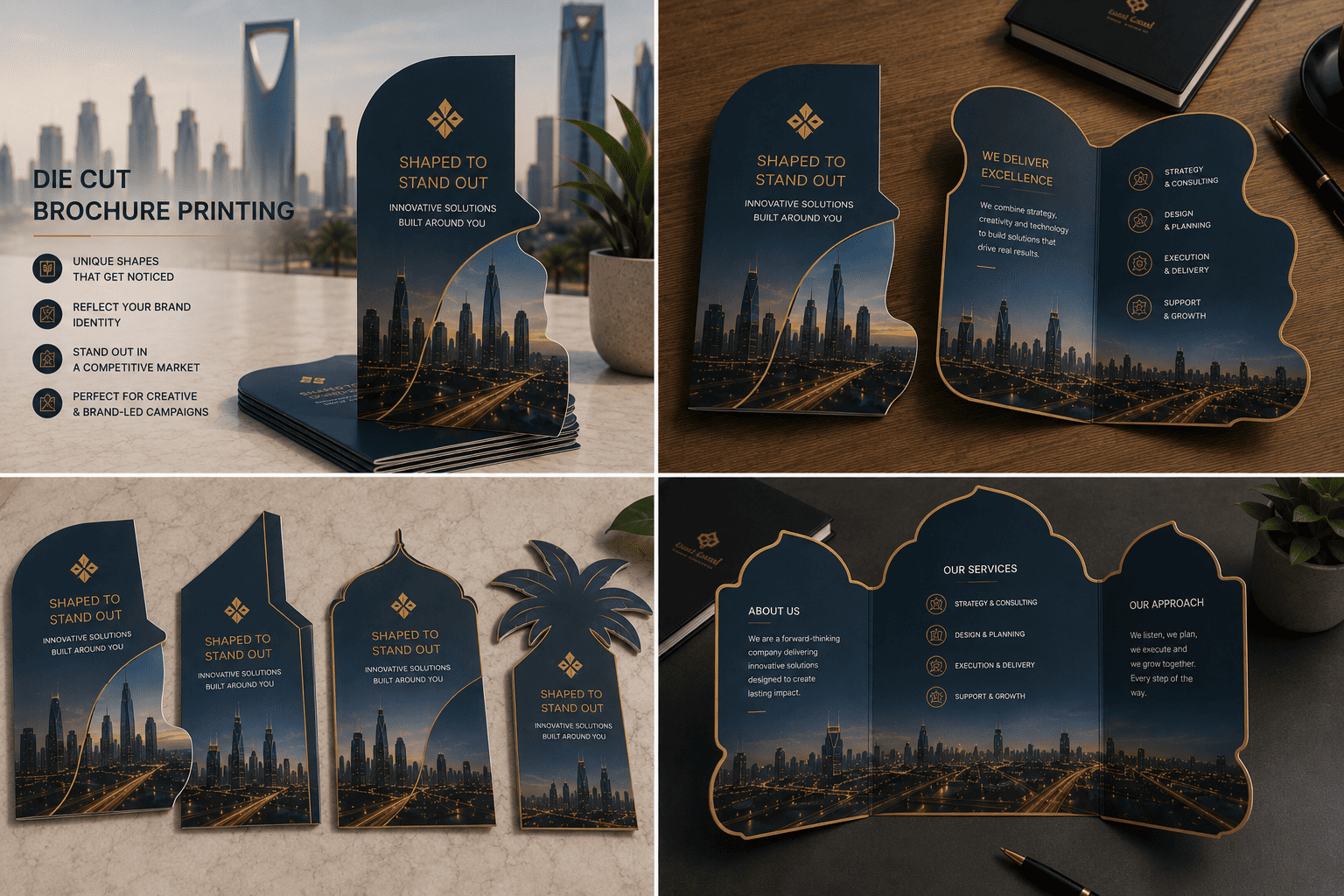
Die cut brochures are produced in shapes other than standard rectangular formats. The cut can follow the outline of a product, reflect a brand identity element, or use an unusual shape to make the brochure physically distinctive in a stack of standard formats.
Use die cut brochure printing if you are:
- Producing a brand-led brochure where the physical shape is part of the visual identity
- Looking for a format that stands apart from standard A4 and A5 presentations in a competitive environment
Why Most Brochures Fail After Design Is Approved
Design approval is only one part of getting a brochure right. The real breakdown happens during printing and finishing.
A strong design loses impact when:
- Folding is misaligned by a few millimetres — sections that do not line up are noticed immediately when the brochure is opened
- Colour shifts during print calibration — a brand that looks consistent everywhere else looks inconsistent in the brochure
- Paper stock does not match the positioning — a premium service presented in lightweight paper sends the wrong signal before a word is read
- Front and back alignment is off — text that bleeds incorrectly or imagery that does not register front-to-back is visible on every unit in the run
None of these failures are dramatic individually. Together, they produce a brochure that feels slightly wrong without the reader being able to name why, and that feeling attaches to the brand it represents. This is why small test runs through digital printing are worth doing before committing to a full batch, since catching these issues on a handful of copies costs far less than catching them across a full print run.
Materials and Finishes: What Your Brochure Is Actually Made From
Paper Stock & Weight
Paper weight affects how a brochure feels in the hand and how well it holds up to use.
Lightweight paper is right for high-volume promotional brochures that are distributed at volume and not expected to be kept long. Heavier coated stock is right for brochures that sit on desks, get handed to clients, and need to remain in good condition after repeated handling.
The correct weight depends on the format — a tri-fold brochure needs a stock that folds cleanly without cracking. A multi-page booklet needs a different inner stock from its cover. A gate fold with a wide inner spread needs a stock that lies flat when opened.
Do not select paper weight independently of the fold and format. Confirm the full specification together.
Lamination Options
- Gloss lamination — makes colours more vivid and surface sharpness stronger; best for brochures with strong visual content and photography
- Matte lamination — reduces glare, gives a more considered and premium tactile feel; best for corporate, professional services, and text-heavy layouts
- Soft-touch lamination — premium tactile surface used in high-end brochures where physical feel matters as much as visual finish; used in luxury brochure printing and high-end property presentations
Cardstock for Covers
Multi-page booklets and catalogues use a heavier cover stock than the internal pages. The cover weight needs to hold the brochure together structurally, protect the inner pages, and communicate quality at the moment of handling. Specify the cover and inner stocks separately, the right combination depends on page count, format, and how the brochure will be used. This distinction matters most in catalog printing, where page count is higher and the cover has to hold up to more repeated handling than a standard brochure.
Colour Accuracy
Colour calibration against brand references is the difference between a brochure that looks like the brand and one that looks like a version of it. For businesses with established brand colour standards, confirm colour matching is part of the production process before the run is committed. Checking brand-critical colours against print output before the full batch is produced is standard practice for professional brochure printing.
What Sizes Are Available for Brochure Printing in Riyadh?
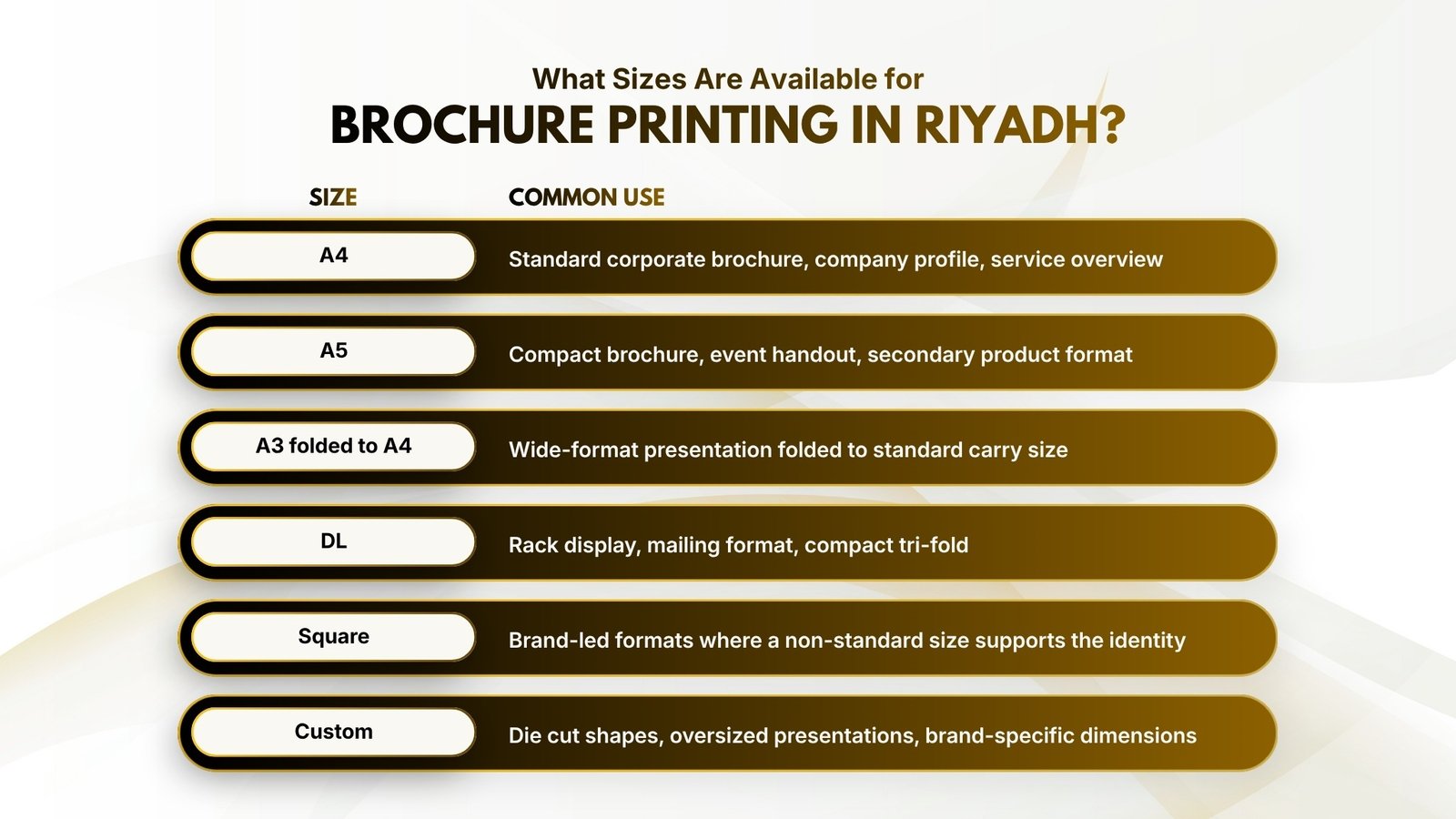
| Size | Common Use |
| A4 | Standard corporate brochure, company profile, service overview |
| A5 | Compact brochure, event handout, secondary product format |
| A3 folded to A4 | Wide-format presentation folded to standard carry size |
| DL | Rack display, mailing format, compact tri-fold |
| Square | Brand-led formats where a non-standard size supports the identity |
| Custom | Die cut shapes, oversized presentations, brand-specific dimensions |
DL brochure printing
DL is the format that fits a standard business envelope and most display racks. It is almost always produced as a tri-fold from a DL-open sheet. For businesses that mail brochures directly or display them in reception racks, DL is the practical format choice.
A3 folded brochure printing
An A3 sheet folded to A4 gives you eight panels — more content space than a standard A4 tri-fold while folding down to a size that is easy to carry and file. For project overviews, maps, and presentations that benefit from a wider format, A3 folded brochure printing is the right specification.
How Riyadh Businesses Use Brochure Printing
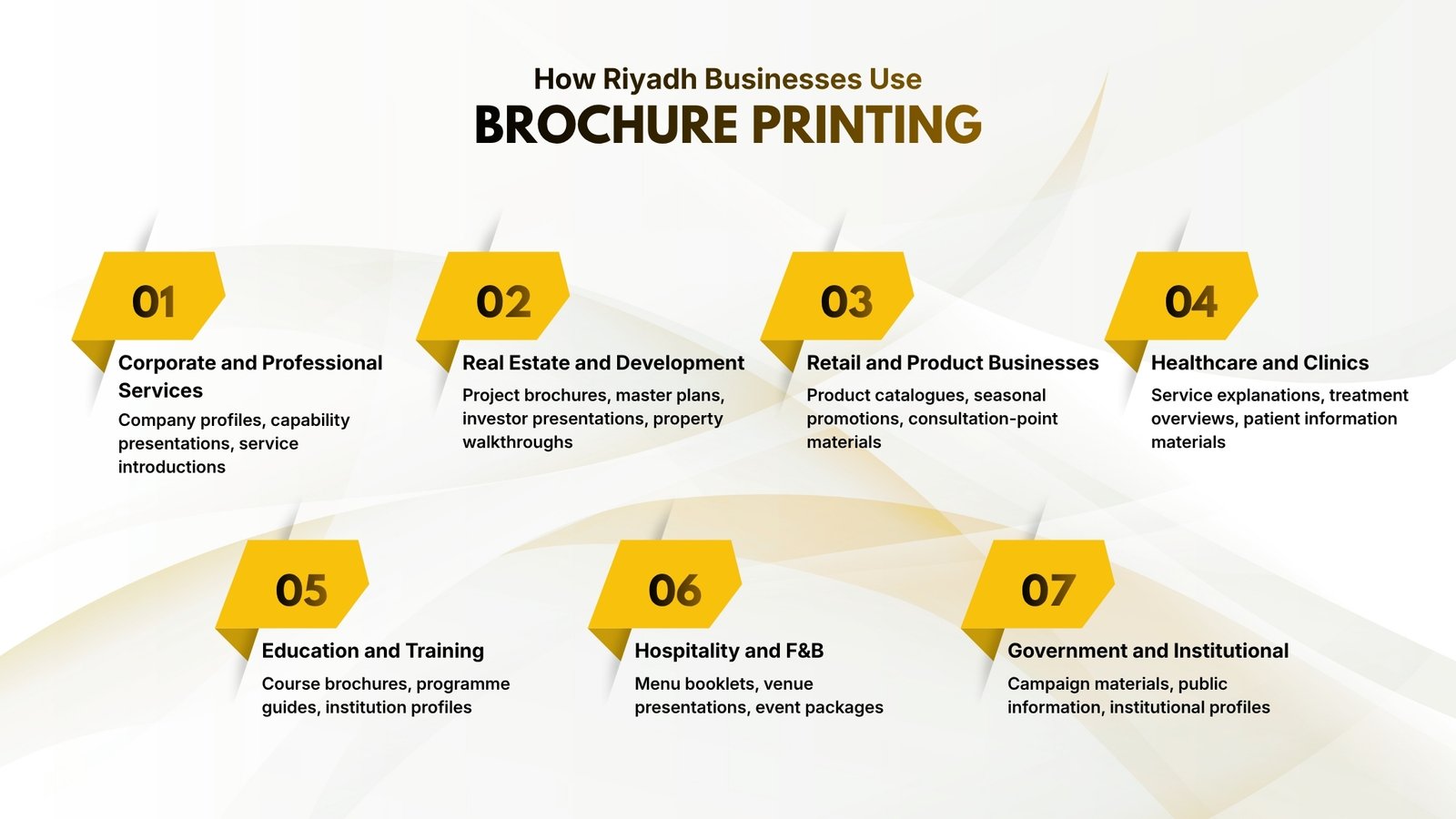
| Business Type | What They Use Brochures For |
| Corporate and Professional Services | Company profiles, capability presentations, service introductions |
| Real Estate and Development | Project brochures, master plans, investor presentations, property walkthroughs |
| Retail and Product Businesses | Product catalogues, seasonal promotions, consultation-point materials |
| Healthcare and Clinics | Service explanations, treatment overviews, patient information materials |
| Education and Training | Course brochures, programme guides, institution profiles |
| Hospitality and F&B | Menu booklets, venue presentations, event packages |
| Government and Institutional | Campaign materials, public information, institutional profiles |
Corporate & Professional Services
Your brochure is the physical version of your credentials. It sits on a decision-maker’s desk after the meeting is over and does the work your presentation cannot do once you have left the room.
Use high quality brochure printing if you are:
- Handing a company profile to a potential client at a first meeting
- Presenting a capability document to a procurement team or tender committee
- Building a brochure that will be kept and referred back to, not discarded at the end of the day
Real Estate & Development
A property brochure often carries the entire case for a purchase decision. It needs to present specifications clearly, reproduce photography accurately, and feel substantial enough to justify the value of what it represents.
Use gate fold or multi-page brochure printing if you are:
- Presenting a luxury residential or commercial development to investors
- Producing a project walkthrough that covers multiple unit types and floor plans
- Creating a brochure for an off-plan development where the printed material is the primary sales tool
Retail & Product Businesses
Product catalogue printing supports consultation-driven selling — giving customers something to hold, refer to, and take away when the conversation covers multiple options.
Use catalogue printing or multi-page booklet printing if you are:
- Producing a seasonal product range across multiple categories
- Creating a reference document for a sales team or distribution partner
- Running a campaign where the brochure supports the purchase decision after the customer has left the store
For quicker, single-message promotions rather than a full catalogue, our flyer printing guide covers the lighter-weight format that works better for short campaigns.
What Are the Most Common Brochure Printing Mistakes in Riyadh?
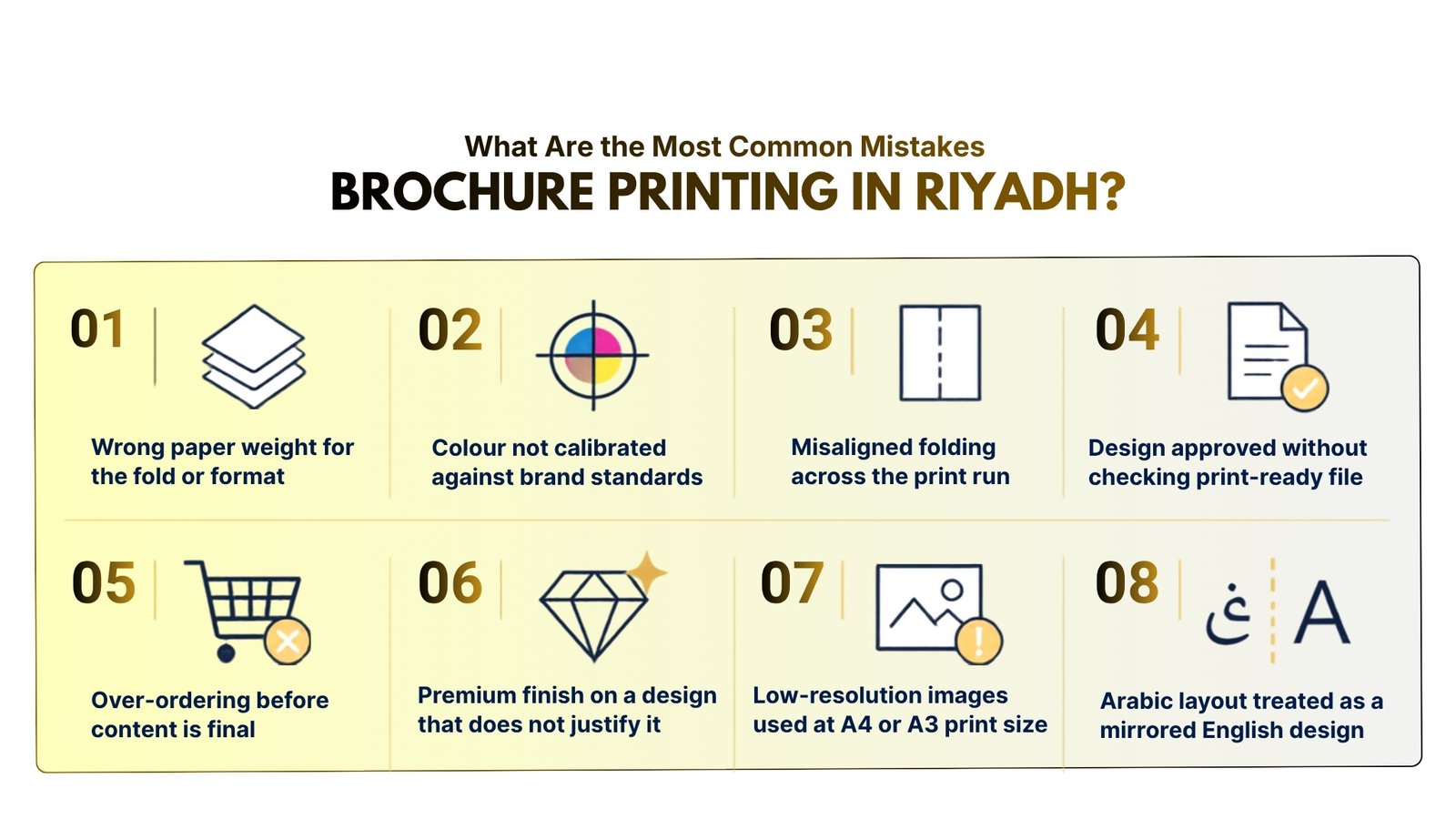
| Mistakes |
| Wrong paper weight for the fold or format |
| Colour not calibrated against brand standards |
| Misaligned folding across the print run |
| Design approved without checking print-ready file |
| Over-ordering before content is final |
| Premium finish on a design that does not justify it |
| Low-resolution images used at A4 or A3 print size |
| Arabic layout treated as a mirrored English design |
What Does Brochure Printing Cost in Riyadh?
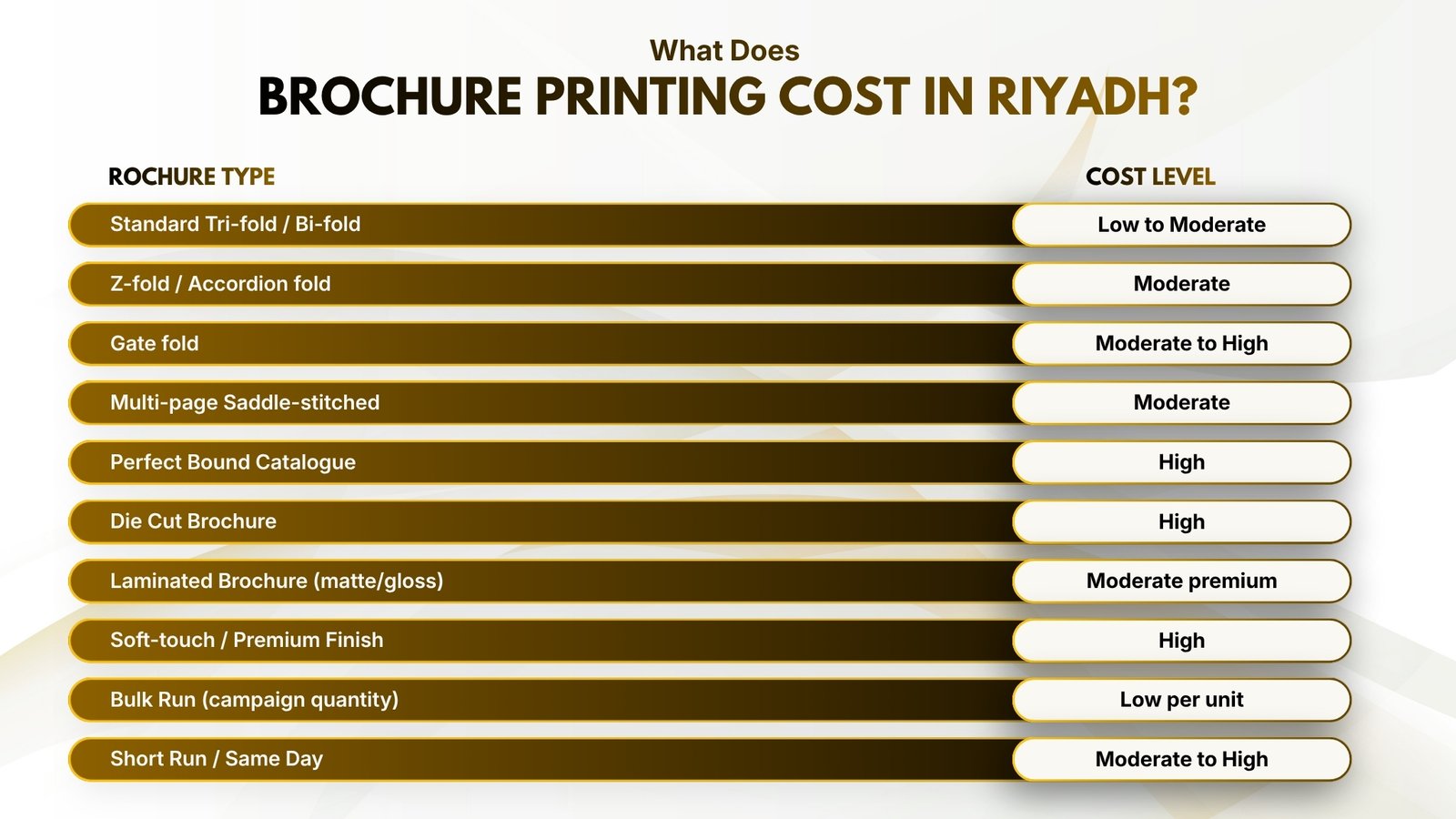
| Brochure Type | Cost Level |
| Standard Tri-fold / Bi-fold | Low to Moderate |
| Z-fold / Accordion fold | Moderate |
| Gate fold | Moderate to High |
| Multi-page Saddle-stitched | Moderate |
| Perfect Bound Catalogue | High |
| Die Cut Brochure | High |
| Laminated Brochure (matte/gloss) | Moderate premium |
| Soft-touch / Premium Finish | High |
| Bulk Run (campaign quantity) | Low per unit |
| Short Run / Same Day | Moderate to High |
Standard bi-fold and tri-fold brochures on coated stock are the most cost-efficient format for volume campaigns. Gate fold, accordion fold, and die cut brochures carry higher production costs because of setup requirements that do not scale down with small quantities.
For bulk brochure printing across a campaign or multiple branch locations, ordering the full quantity in one production run reduces per-unit cost and guarantees colour consistency across every unit. Splitting a campaign across separate smaller orders introduces colour drift and format variation that becomes visible when brochures from different batches are compared side by side.
Costs that are not always included in a base quote: artwork preparation, Arabic layout work, colour proofing, die cut setup, lamination, and delivery. Confirm the full scope before approving production.
How Etihad Golden Falcons Handles Brochure Printing in Riyadh
We begin with what your brochure needs to achieve once it’s in the reader’s hands.
Format, paper stock, lamination, fold accuracy, colour calibration, and quantity are confirmed before production starts. A tri-fold for a corporate profile calls for a different spec than a gate fold for a luxury property launch, and a bulk campaign bi-fold is different again. What we produce is shaped by what your brochure actually needs to do, not by what’s easiest to run.
Why We Keep Production In-House
We handle printing in-house. For campaigns spanning multiple branches, or for large-volume runs, that keeps colour consistent across your entire batch. Split production across suppliers or separate batches, and colour drift and fold variation creep in, visible the moment brochures are placed side by side.
Quality Checks Before It Reaches You
Fold accuracy, front-to-back registration, and colour output are checked before delivery. A brochure that looks right on screen but arrives misaligned or off-colour isn’t a finished product. It’s a reprint waiting to happen.
Ready to get your brochure printing started the right way? Message us on WhatsApp and we’ll walk you through format and quantity options for your project.
FAQs
Bi-fold and tri-fold are the most common for corporate profiles. Bi-fold suits a focused overview; tri-fold handles more structured content across distinct sections. For a more premium presentation at a senior client level, gate fold is the format that creates the right physical impression.
Yes. Multiple formats and fold types can be produced within the same production cycle if the campaign requires different formats for different audiences or uses.
Heavier coated stock — typically 170gsm or above — with matte or gloss lamination for the outer surfaces. Soft-touch lamination for premium presentations where tactile quality matters. The exact weight depends on the format and page count.
Yes. Colour calibration against brand references is part of the production process. For colour-critical campaigns, we check output against approved references before the full run is committed.
Saddle-stitched brochures are stapled through the spine — practical for booklets up to around 60 pages. Perfect bound brochures have a glued flat spine and look like a book — used for catalogues and publications with higher page counts where saddle stitching would not hold the document together reliably.
Standard bi-fold and tri-fold orders from a confirmed, print-ready file typically run one to three working days. Gate fold, accordion fold, and die cut formats take longer due to setup and finishing. Multi-page booklets and perfect bound catalogues take longer again depending on page count. Confirm your required date at inquiry — we confirm the timeline before the order is placed.
Yes. Arabic and bilingual brochures require RTL layout treatment from the design stage — not a translation applied to an English template. Column order, reading flow, text alignment, and the visual balance between Arabic and English content all need to be resolved in the design. If your artwork needs Arabic layout work, confirm this at briefing so it is built into the production timeline.
Yes, for standard formats when artwork is confirmed and print-ready, and the required material is in stock. Same day brochure printing requires early confirmation — contact us at the start of the day to confirm whether the production schedule can meet your deadline before the order is placed.