

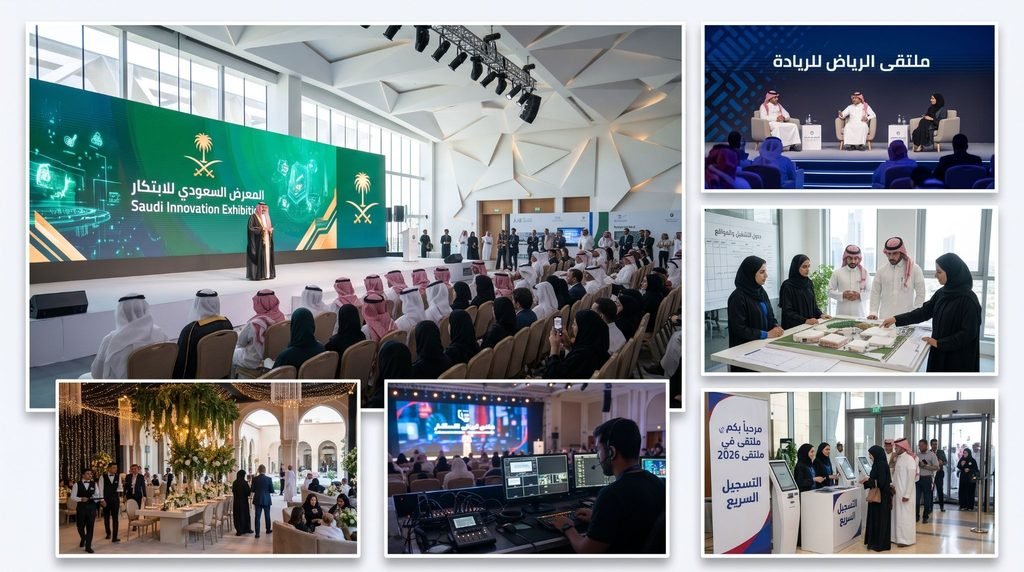
Event management services cover everything between an event idea and a finished event: planning, budgeting, venue coordination, staging, branding, on-site operations, and wrap-up. Businesses hire them because an event has many moving parts and one fixed date. A part that fails on the day fails in front of your guests.
The formats vary widely. Corporate event management covers conferences, galas, award nights, and staff events. Exhibition event management covers booths and trade shows. Product launches, hybrid events, sports events, concerts, and festivals each need their own planning and production.
Etihad Golden Falcons offers event management services across all of these formats, with one team covering planning, staging, printing, signage, and fabrication. Because we build the physical event ourselves, what you approve on paper matches what stands on site.
This guide covers the event types, what end-to-end management includes, how providers differ, how different businesses use these services, which mistakes cost the most, and what an event costs.
Why Do Event Management Services Matter for Your Business?
An event looks simple from the guest side. The doors open, the screen plays, and the speaker starts on time. Behind that sit dozens of suppliers, and each one works to a different schedule.
The stage builder finishes late. The printer waits for a final file. The lighting crew arrives before the stage is ready. Your team spends the morning of the event chasing three vendors instead of greeting guests.
A weak event costs more than its budget. Guests judge your company by what they see in two hours. A crooked backdrop, a late start, or a queue at registration tells them how you run everything else.
A managed event changes that in three ways:
- A single timeline gives the stage builder, the printer, and the lighting crew the same deadlines, so nobody waits on a file or an unfinished stage.
- One budget covers production, branding, and logistics, so you see the full cost before you approve anything.
- One point of contact answers on the day, so your team stays with your guests instead of on the phone.
What Types of Event Management Services Can You Choose From?
Every event type needs a different build, a different timeline, and a different kind of on-site control. The table below shows what sets each one apart. The sections after it explain where each fits and where it goes wrong.
| Event Type | Core Features |
| Corporate | Stage, seating, AV, registration, branded signage |
| Exhibition | Booth build, floor plan, graphics, visitor flow |
| Product Launch | Reveal staging, lighting, press area, branded set |
| Hybrid | Live venue plus cameras, streaming, online audience |
| Sports | Venue branding, spectator zones, sponsor areas |
| Concert | Large stage, sound, lighting rigs, ticketed entry |
| Festival | Multi-zone layout, vendor rows, outdoor builds |
| Sustainable | Reusable builds, low-waste print, material planning |
Corporate Event Management
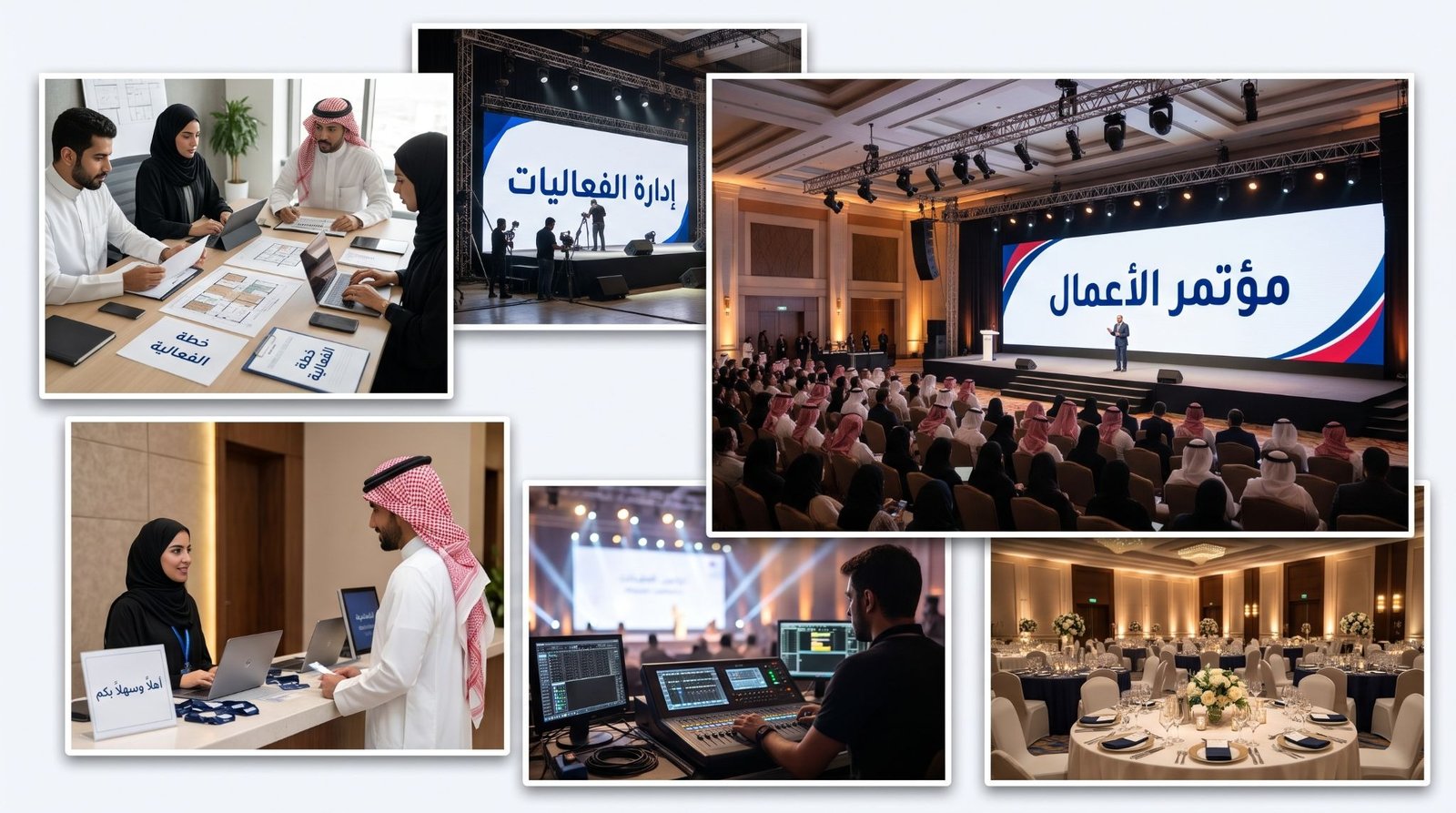
Corporate event management covers conferences, galas, award nights, annual meetings, and staff events. It sits closest to your brand, so the details carry weight: the stage backdrop, the registration desk, the printed agenda, and the directional signs. It works best when the guest list is known and the program runs to a strict clock. The common error is planning a corporate event like a casual party. Your guests expect it to start and finish on time.
Exhibition Event Management
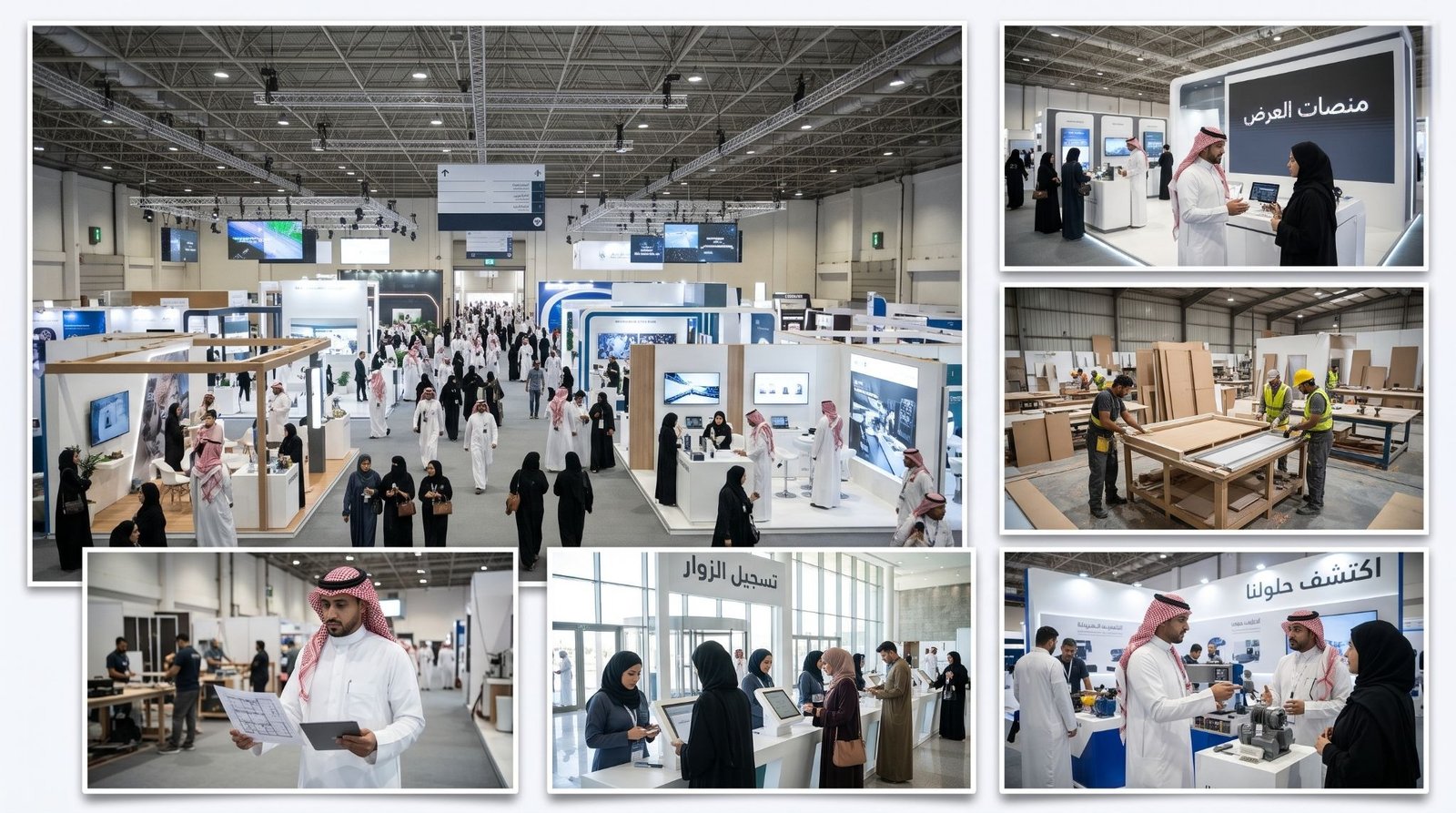
Exhibition event management covers trade shows, expos, and showcase booths. The work starts with the floor plan: where the booth sits, how visitors walk in, and where they stop. An exhibition management company then builds the booth, prints the graphics, and installs everything inside the organiser’s load-in window. The common error is designing a booth for the render and not for the aisle. A booth that looks good in a drawing but blocks foot traffic loses visitors.
Product Launch Event Management
Product launch event management builds one moment: the reveal. The stage, lighting, screen content, and press area all point at the product. A launch suits companies that have a single announcement and a defined audience of buyers, partners, or media. The common error is spreading the budget across too many extras. One strong reveal does more than ten weak features.
Hybrid Event Management
Hybrid event management runs a live event and an online audience at the same time. It adds cameras, a streaming platform, audio feeds, and a producer who watches the online viewers. It suits companies with staff or clients in several cities. The common error is filming the room and calling it a hybrid event. Online guests need their own screen content, their own sound mix, and a way to ask questions.
Sports Event Management
Sports event management covers tournaments, races, matches, and community sports days. The physical build includes pitch-side and track-side branding, spectator zones, sponsor areas, and entry signage. Etihad Golden Falcons covers the production and branding side of these events. The common error is planning the signage after the venue layout is locked, when the sponsor boards no longer fit the space.
Concert Event Management
Concert event management covers stage structures, sound, lighting rigs, ticketed entry, and backstage areas. Load-in time is short, and the stage must be ready before sound check. The common error is sizing backdrops and screens before the stage dimensions are final. Panels cut to the wrong size cost you a full reprint cycle.
Festival Event Management
Festival event management covers events that run across several days, zones, or venues: food areas, performance stages, children’s areas, and vendor rows. A festival lives outdoors, so every print and every sign must handle sun and wind. The common error is a layout with no wayfinding. Visitors who cannot find the food area or the exit leave early.
Sustainable Event Management
Sustainable event management cuts waste at the planning stage. It means reusable stage builds, backdrops without dated text, printing on recyclable material, and a plan for every item after the event ends. The common error is treating it as a label added at the end. The savings come from decisions made before production starts.
What Does End-to-End Event Management Include?
End-to-end event management means one team owns the event from the first brief to the last teardown. Some providers call it 360 event management. Event planning and management at this level covers the jobs below, in the order they happen.
Start With an Event Management Plan
The event management plan holds the goal, guest count, budget, timeline, supplier list, and risk list. It is a working document, not a proposal. Every supplier reads the same version, so the printer, the stage builder, and the AV crew all work from the same dates.
Run the Project Against a Build Schedule
Event project management tracks tasks, owners, and deadlines. Production items carry the earliest deadlines: artwork approval, print files, fabrication, and load-in time. Your approvals land on a fixed calendar, so a late decision shows up before the event and not during it.
Control Event Operations on the Day
Event operations start when the build team enters the venue. The event management team runs load-in, registration, supplier coordination, the run-of-show, and teardown. A show caller keeps the program on time. A site manager keeps the floor clear. A production lead fixes what breaks.
Plan Crowd Flow Before You Print a Single Sign
Crowd management services start with the floor plan: entry points, queue lines, barriers, seating blocks, and exits. Signs and floor graphics then follow the plan, not the other way around. Event security management covers who checks access and who responds to an incident. We do not supply licensed security staff ourselves, but we plan the layout, signage, and barrier positions around your security team and brief them with your event team.
Treat Special Events as One-Chance Projects
Special events management covers ceremonies, inaugurations, national celebrations, and VIP visits. These events do not repeat, so there is no second attempt. The team rehearses the program, tests every screen and sound feed, and keeps spare print and hardware on site.
Choose How Much to Hand Over
You do not have to hand over the whole event. Pick the level that matches your team.
- Use full end-to-end management if you are running a large or high-profile event with several suppliers and no in-house events team.
- Use production-only support if you already hold the plan and need staging, printing, signage, and fabrication from one source.
- Use on-site operations support if you run a recurring event and need extra people on the floor on the day.
How Do Event Management Companies, Agencies & Production Agencies Differ?
The names overlap, and providers use them loosely. Corporate event management companies, event planning companies, and event agencies all sell events, but they cover different parts of the work. The table shows how each one usually works.
| Provider Type | What It Usually Does |
| Event Management Company | Plans and runs the full event, often hires out the build |
| Event Planning Company | Plans venue, schedule, and logistics, often stops before production |
| Event Agency | Develops the concept and creative direction |
| Corporate Event Agency | Same as an event agency, for company events and brand programs |
| Event Production Agency | Builds stages, sets, sound, lighting, and screens |
The difference that matters most is who builds the event. Many corporate event planning companies plan well and then hand the build to subcontractors. Your printing, signage, and stage then come from several companies with separate deadlines, and one late supplier holds up the rest.
Etihad Golden Falcons runs as an event management company with its own production floor. Planning and build sit with one team, so the dates in the plan are the dates the factory works to.
Use these rules to choose:
- Pick an event management company if you want one provider to own both the plan and the build.
- Pick an event planning company if the venue already supplies staging and you need logistics only.
- Pick an event agency if you need a concept and creative direction before production starts.
- Pick an event production agency if you already hold the plan and need the physical build.
Ask every provider the same two questions: who prints your backdrop, and who builds your stage? The answers show you how many companies sit between you and the event.
How Do Different Businesses Use Event Management Services?
Every business runs events for a different reason. Below, each sector gets the formats that fit it and the problems that usually come with them.
Corporate Offices & Large Companies
Head offices, holding groups, consultancies, manufacturers, and logistics firms all run events for staff, clients, and investors.
These companies sell contracts and relationships, so an event works as a meeting held at scale. The questions come early. How many guests fit, who speaks, and how does the program stay on time? Staff events add a second problem, because attendance depends on how worthwhile the day feels.
- Annual meetings and conferences need a stage, seating plan, and registration desk that run to a fixed program.
- For client dinners and award nights, a branded gala setup with lighting and a printed program keeps the evening on brand.
- Staff days work better with zone signage and activity stations, since people move on their own and need to know where to go.
- Investor briefings suit a hybrid setup, which lets remote guests join without a second event.
Retail & Malls
Fashion brands, electronics stores, supermarkets, mall tenants, and shopping centre operators run events to pull in foot traffic.
Retail sells through footfall, so a retail event has one job: bring people in and hold them for a few minutes. Crowds build at the entrance, and a display can lose to the shop next door. Mall rules on build hours and fire access add limits on top.
- In-store launches and sales days run well with entrance activations: branded arches, queue lines, and floor graphics that send shoppers inward.
- A new store opening calls for an opening-day setup with a ribbon stage, photo wall, and branded signage.
- Mall atriums host pop-up booths that build fast and come down overnight.
- Seasonal campaigns such as Ramadan and Eid need themed décor and display builds, made once and reused across branches.
Automotive
Car dealers, dealership groups, tyre brands, and accessory retailers run launches and test-drive days.
A car launch sells a feeling before it sells a price. Guests want to see the vehicle, sit in it, and hear what sets it apart. Space is the problem, because a vehicle needs room, light, and a clear viewing line.
- Product launch events centre on a reveal stage with a turntable, lighting rig, and large screens.
- Showroom evenings use VIP hospitality zones with branded seating and signage, which separate invited buyers from walk-ins.
- On outdoor test-drive days, route signage, registration points, and shaded waiting areas protect guests from the heat.
- Dealer conferences suit a corporate event format with breakout rooms and printed materials.
Healthcare & Pharma
Hospitals, clinics, pharmaceutical companies, and medical suppliers run conferences, awareness days, and doctor briefings.
Medical audiences read content closely and have little spare time. A conference that runs late loses doctors to their shifts. Pharma events also follow strict content and display rules, so every printed panel needs approval before it goes up.
- Medical conferences need session room setups with clear signage, so doctors reach the right hall between talks.
- Awareness days work with health-camp booths that give visitors a clear route from check-in to consultation.
- Doctor briefings run by a company fit a small-format seminar with branded backdrop, screens, and printed information packs.
- At medical expos, compliant graphics and booth builds pass the organiser’s content review.
Banks & Financial Institutions
Banks, insurance companies, investment firms, and fintech companies hold client briefings, product announcements, and branch openings.
Trust sells these services, and a rough event damages it fast. Guests notice the finish of every printed item. Access control matters more here than at most events, since guest lists often include senior clients.
- A new branch opening calls for an opening ceremony setup with a branded stage, ribbon area, and entrance signage.
- Client briefings suit boardroom-style seating and presentation screens in a controlled space.
- Product announcements use a launch set with a clean backdrop and press area.
- Annual shareholder meetings need registration desks and access-controlled entries that check each attendee.
Government & Institutional
Ministries, municipalities, public bodies, and non-profit groups hold ceremonies, forums, and public awareness events.
These events carry protocol. Seating order, speaker timing, and signage follow set rules, and a mistake draws attention. National events such as National Day bring larger crowds, so crowd flow becomes the main concern.
- Official ceremonies need a protocol stage layout with VIP seating, branded podiums, and flags.
- Public awareness campaigns work as open-air event zones with shaded stands, banners, and wayfinding.
- National Day and Founding Day celebrations suit themed décor builds across the stage, entrance, and walkways.
- Forums and summits need bilingual signage and registration systems for local and international guests.
Real Estate & Developers
Developers, property agents, and project sales teams run launches and showroom events.
A property launch sells something that does not exist yet. The event has to make it feel real, so the model, the renders, and the sales desk carry the room. Buyers also need privacy to discuss money, and the layout has to allow it.
- Project launch events centre on a scale model, render walls, and a sales lounge.
- Off-plan sales days use branded booths inside malls or hotels, set up fast and cleared after.
- Groundbreaking ceremonies need a site-built stage and covered seating that handle dust and sun.
- Mall roadshows draw leads with pop-up display stands that repeat the project’s branding.
Education
Universities, schools, training institutes, and academies run open days, graduations, and career fairs.
Parents and students attend these events to decide. They ask where to go, who to meet, and what happens next. An open day with unclear routes loses enrolments to the next institution on the list.
- Open days work with wayfinding signage and registration points that guide families through the campus.
- Graduation ceremonies need a stage, seating blocks, and a printed program sized for large crowds.
- Career fairs use booth builds in a standard footprint, so every company gets the same space.
- Sports days and school festivals suit outdoor builds with shade, signage, and clear zones.
Hospitality & F&B
Hotels, restaurants, cafés, and catering companies run launches, tastings, and seasonal events.
Guests at these events arrive expecting care. The event has to feel like the venue on a good night. Space and service flow decide how many guests fit, and a crowded entrance spoils the first impression.
- Restaurant and café openings use branded entrance builds with lighting, signage, and queue lines.
- Hotel gala dinners need ballroom staging with backdrop, table branding, and menu printing.
- Tasting events suit station-based layouts with clear signage at each food counter.
- Seasonal promotions work as themed décor installations that go up before service and come down after.
Need this sorted for your next event? Message us on WhatsApp and we will walk you through it.
What Are the Most Common Event Management Mistakes?
Most event problems start weeks before the event. These are the ones we see most often.
| Mistakes |
| Booking suppliers separately with no shared timeline |
| Approving artwork late |
| Sizing backdrops before the stage is final |
| Skipping the site visit |
| Planning signage after the layout is fixed |
| Ignoring crowd flow at the entrance |
| Using indoor materials outdoors |
| Keeping no spare for key items |
| Setting a budget with no contingency |
| Hiring on price alone |
What Do Event Management Services Cost?
Event cost depends on the format, the venue, and how much we build. We quote after we know the guest count, the dates, and the site. The table shows what pushes the price of each event type up or down.
| Event Type | Cost Level | What Affects the Price |
| Corporate | Moderate | Guest count, stage size, AV, branding volume |
| Exhibition | Moderate | Booth size, custom build, graphics, show rules |
| Product Launch | Moderate-High | Set build, lighting, screens, press area |
| Hybrid | Moderate-High | Cameras, streaming platform, producers |
| Sports | Moderate | Venue size, branding area, sponsor items, days |
| Concert | High | Stage scale, sound, lighting rigs, crew size |
| Festival | High | Duration, number of zones, outdoor builds, vendors |
| Sustainable | Low-Moderate | Material choice, reuse plan, recyclable print |
A short brief and a site visit give you an exact figure. Same-day quotations are available, so you can compare before you commit.
How Does Etihad Golden Falcons Handle Event Management in Riyadh?
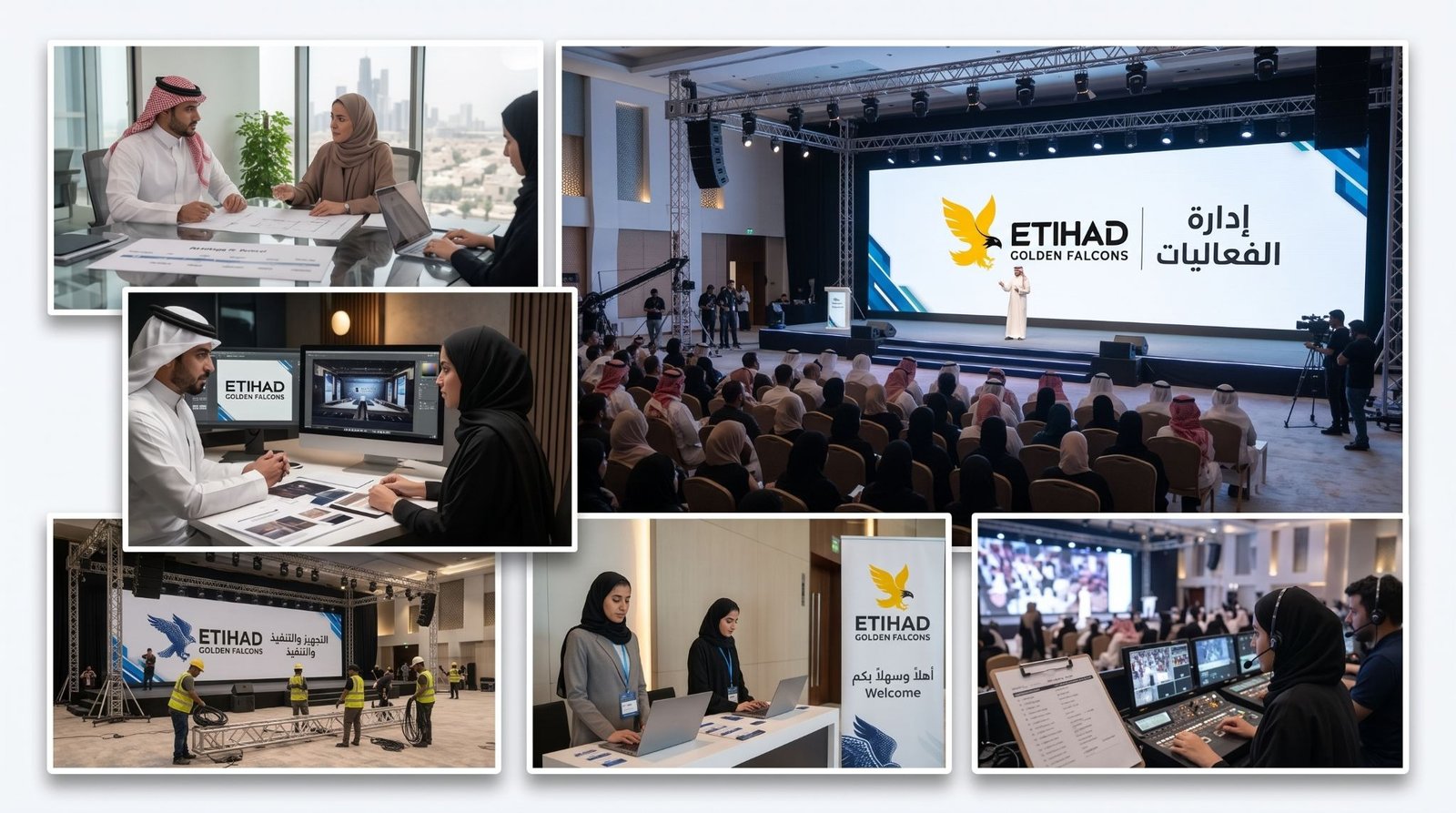
Etihad Golden Falcons runs your event as one project. We take the brief, visit the site, write the plan, and build everything your guests see: the stage, the backdrops, the print, the signs, and the décor. Our team then runs the event on site and clears the venue afterwards.
In-House Production
Stages, backdrops, banners, signage, and décor come off our own production floor. That closes the gap between an approved design and a finished panel. When a measurement changes at the venue, we rework the piece the same day instead of waiting for a subcontractor.
Fast Turnaround
Printing and signage items usually take 1 to 3 days, and you get your quotation on the same day. A late change to a backdrop or a sign does not move your event date.
Proven Experience
More than 1,000 clients across printing, signage, and events have worked with us. That experience shows in small decisions: where the registration desk goes, which material survives an outdoor day, and how early the build team loads in. We do not file your event permit with the authorities, but we tell you which approvals your format needs and which documents to prepare.
Your backdrop sets the first impression of the event. Read our guide to stage backdrop printing in Riyadh before you approve artwork.
FAQs
What do event management services include?
They cover planning, budgeting, venue coordination, production, branding, on-site operations, and teardown. The scope depends on how much of the event you hand over.
How early should you contact an event management company?
As early as you can. Four to six weeks suits most corporate events. Large exhibitions and festivals need more.
What is the difference between an event management company and an event agency?
An event management company plans and runs the full event. An event agency usually focuses on concept and creative direction.
Can you manage an exhibition booth?
Yes. We plan the floor layout, build the booth, print the graphics, and install it inside the organiser’s load-in window.
Do you handle hybrid events?
Yes. We plan the staging, screens, and camera positions together, so the live room and the online audience both get a proper view.
Do you manage sports, concert, and festival events?
Yes, on the production and branding side. We build the stages, signage, and branding, and we plan crowd routes around them.
Do you provide crowd management and security?
We handle crowd flow, not licensed security staff. We plan the entry points, barriers, and signage, and we brief your security team with your event team.
How do you get a quotation?
Message us on WhatsApp with the event type, date, guest count, and venue. You get a quotation on the same day.