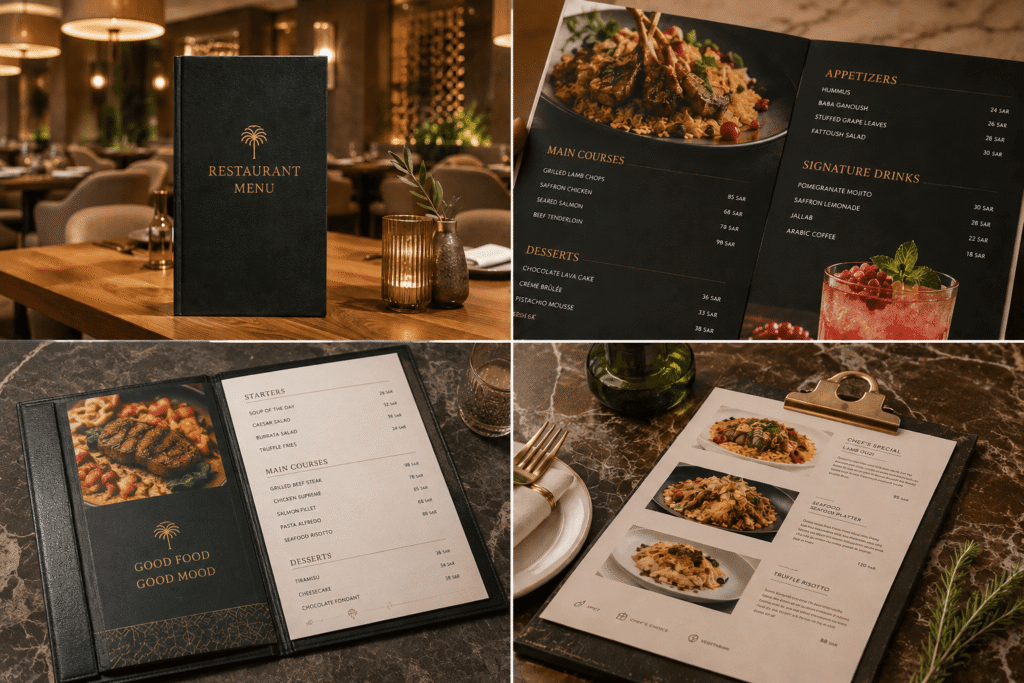
Your restaurant menu is the first thing your customer judges before they judge your food. If you are running a restaurant, café, or F&B business in Riyadh, restaurant menu printing is not a line item you tick off before opening. It is one of the few touchpoints that shapes what your customer expects from the meal before it arrives.
The weight of the paper, the sharpness of the print, whether your food photography looks vibrant or flat, whether the finish feels intentional or cheap. Most restaurant menus in Riyadh get produced through offset printing when quantities are high and colour accuracy matters, since food photography needs to hold its colour consistently across every copy on the table. Riyadh’s F&B market is getting more competitive across every segment, from casual cafés to fine dining. Getting your menu right is not about spending more on it. It is about specifying the right format, material, and finish for how your restaurant actually runs, day to day.
Riyadh’s F&B market is getting more competitive across every segment, from casual cafés to fine dining. Getting your menu right is not about spending more on it. It is about specifying the right format, material, and finish for how your restaurant actually runs, day to day.
This guide covers the formats, materials, and finishes available for restaurant menu printing in Riyadh, what fits different types of F&B businesses, what it costs, and what to check before you send your file to print.
What Types of Restaurant Menus Can Be Printed in Riyadh?
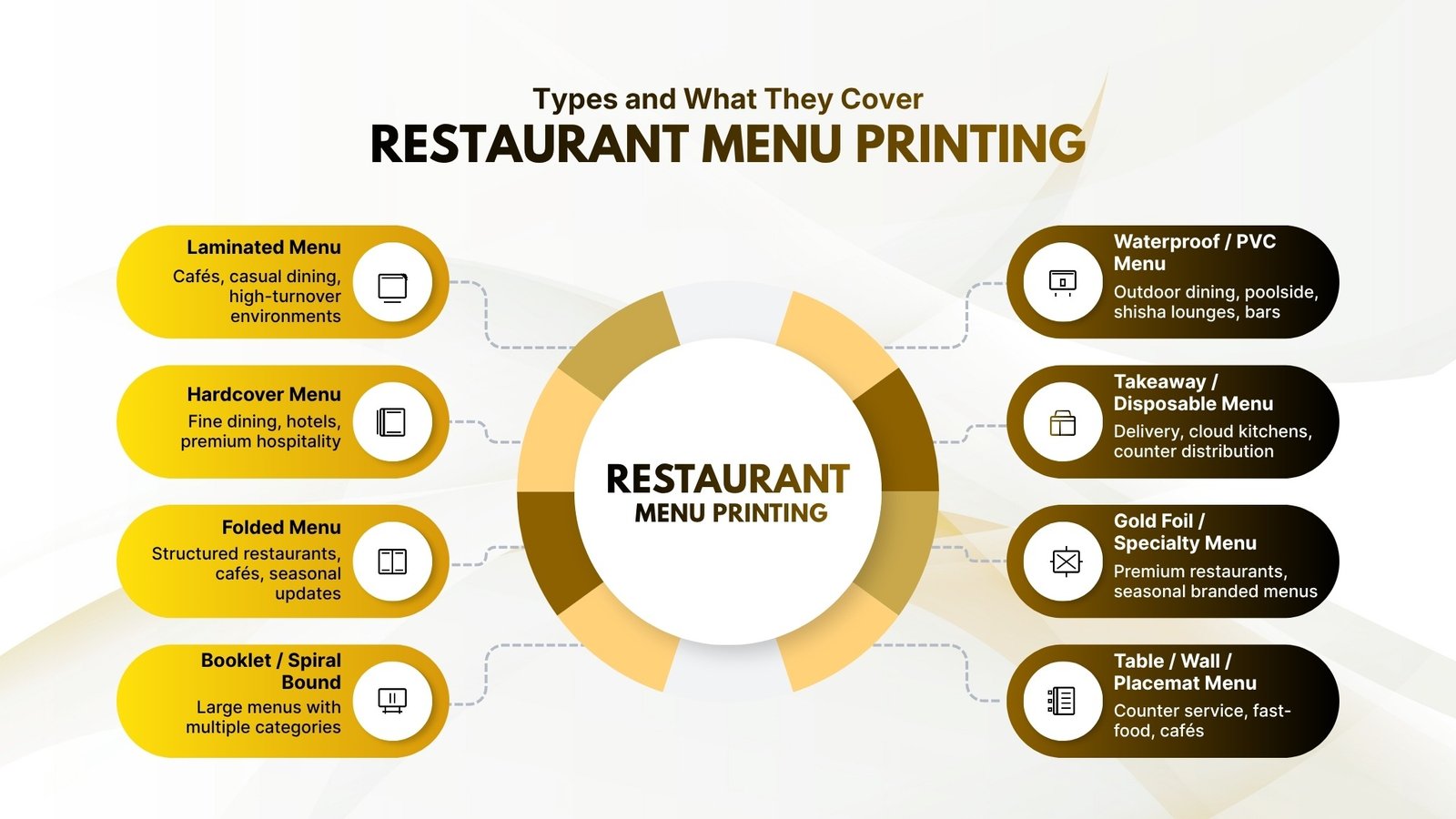
| Menu Type | Best For |
| Laminated Menu | Cafés, casual dining, high-turnover environments |
| Hardcover Menu | Fine dining, hotels, premium hospitality |
| Folded Menu | Structured restaurants, cafés, seasonal updates |
| Booklet / Spiral Bound | Large menus with multiple categories |
| Waterproof / PVC Menu | Outdoor dining, poolside, shisha lounges, bars |
| Takeaway / Disposable Menu | Delivery, cloud kitchens, counter distribution |
| Gold Foil / Specialty Menu | Premium restaurants, seasonal branded menus |
| Table / Wall / Placemat Menu | Counter service, fast-food, cafés |
Laminated Restaurant Menus
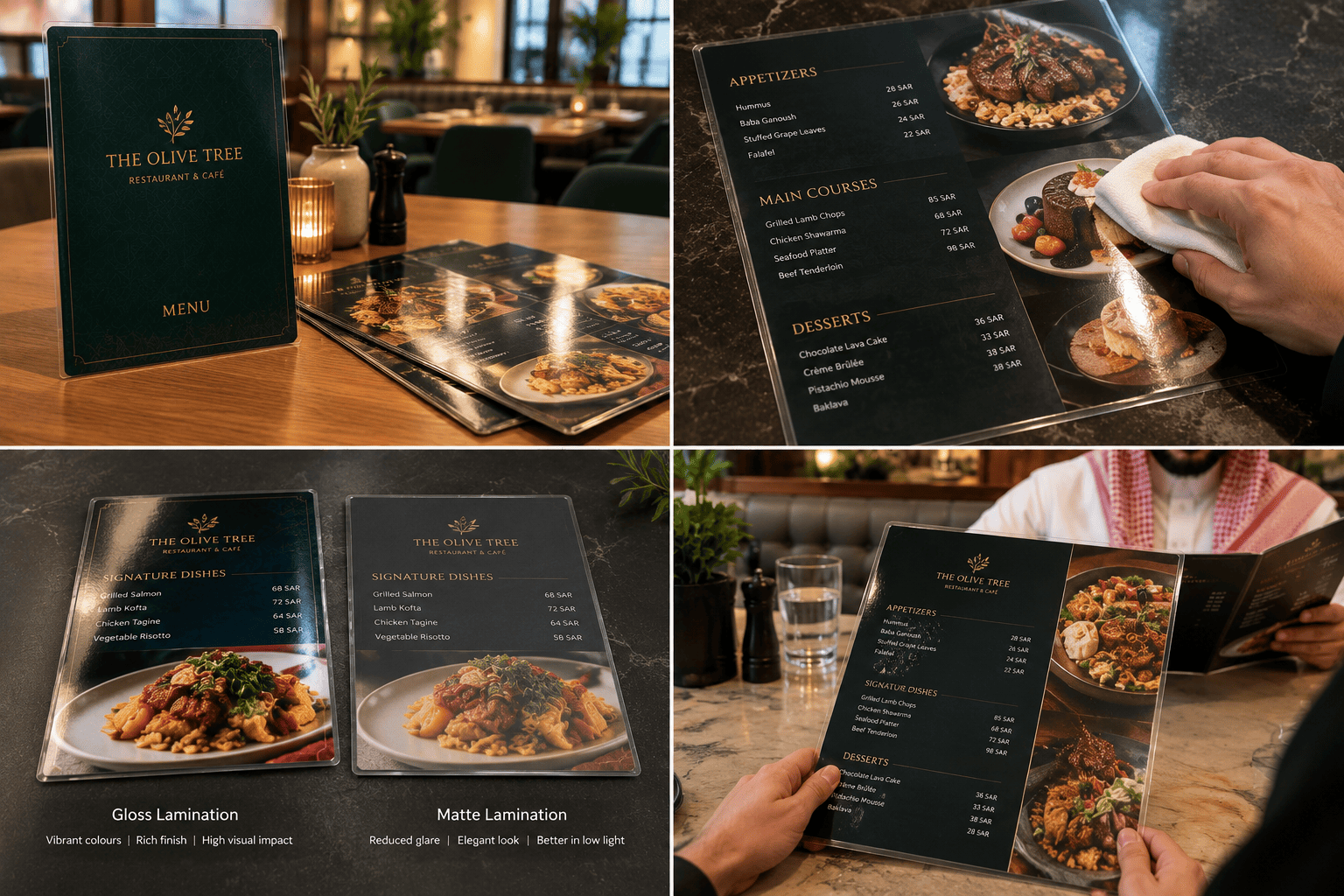
Laminated menus are the most practical format for restaurants where menus are handled repeatedly every service. The laminate layer makes the surface wipeable, protects against stains and moisture, and extends the life of the print significantly compared to unprotected paper.
Use laminated restaurant menus if you are:
- Running a café or casual dining restaurant with high daily covers
- Replacing menus frequently due to wear and staining
- Looking for the most durable everyday menu at a practical cost
Matte lamination works better in low-light or warm restaurant environments where gloss reflects too much. Gloss lamination makes food photography more vivid and suits menus with strong visual content.
Hardcover & Booklet Menus
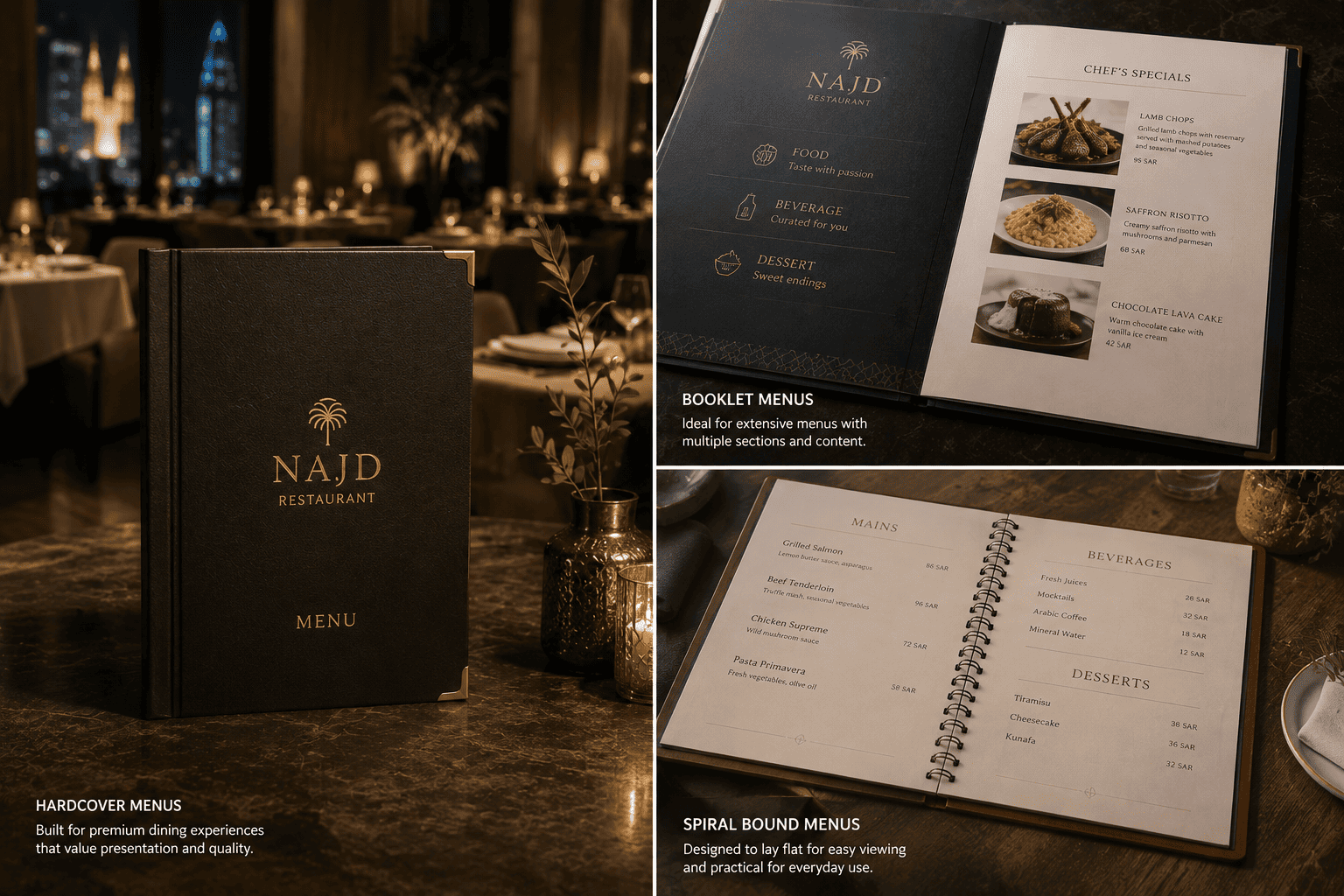
Hardcover menus are built for restaurants where the physical presentation is part of the experience — the menu arriving at the table feels deliberate and substantial. Booklet menus serve a different purpose: when the content volume is large enough that a folded or laminated format cannot contain it, a bound booklet handles the structure.
Use hardcover or booklet menu printing if you are:
- Running a fine dining, hotel, or premium hospitality venue
- Handling a menu with separate food, beverage, and dessert sections requiring multiple pages
- Presenting a menu where the physical quality signals the restaurant’s positioning
Spiral bound menu printing works for menus that need to lie flat when opened — practical in environments where the customer needs both hands free.
Folded Menus
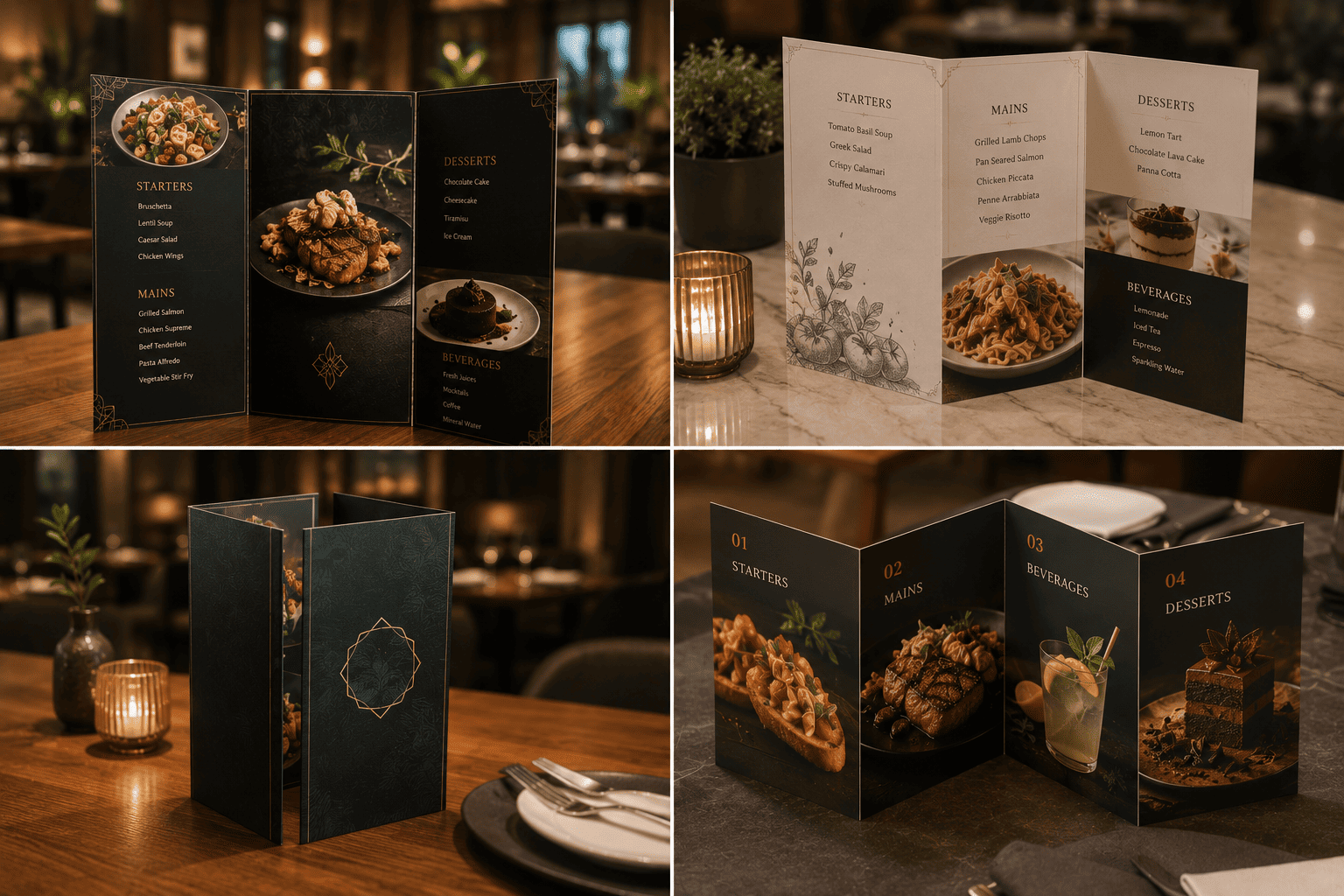
Folded menu printing gives a restaurant more content space without moving to a bound format. A bi-fold or tri-fold menu is practical for structured menus covering starters, mains, desserts, and beverages in a single piece that does not overwhelm a small table.
Popular folded formats:
- Bi-fold (half fold) — four panels, clean and simple, suits compact menus
- Tri-fold — six panels, suits structured category-heavy menus
- Gate fold — premium feel, suited to brand-led restaurant presentations
- Z-fold — unfolds in a Z pattern, useful for menus with a specific reading sequence
Use folded menu printing if you are:
- Running a casual restaurant with clearly divided food categories
- Updating your menu seasonally and need a cost-effective reprinting format
- Working with limited table space where a large open menu is impractical
Waterproof & PVC Menus
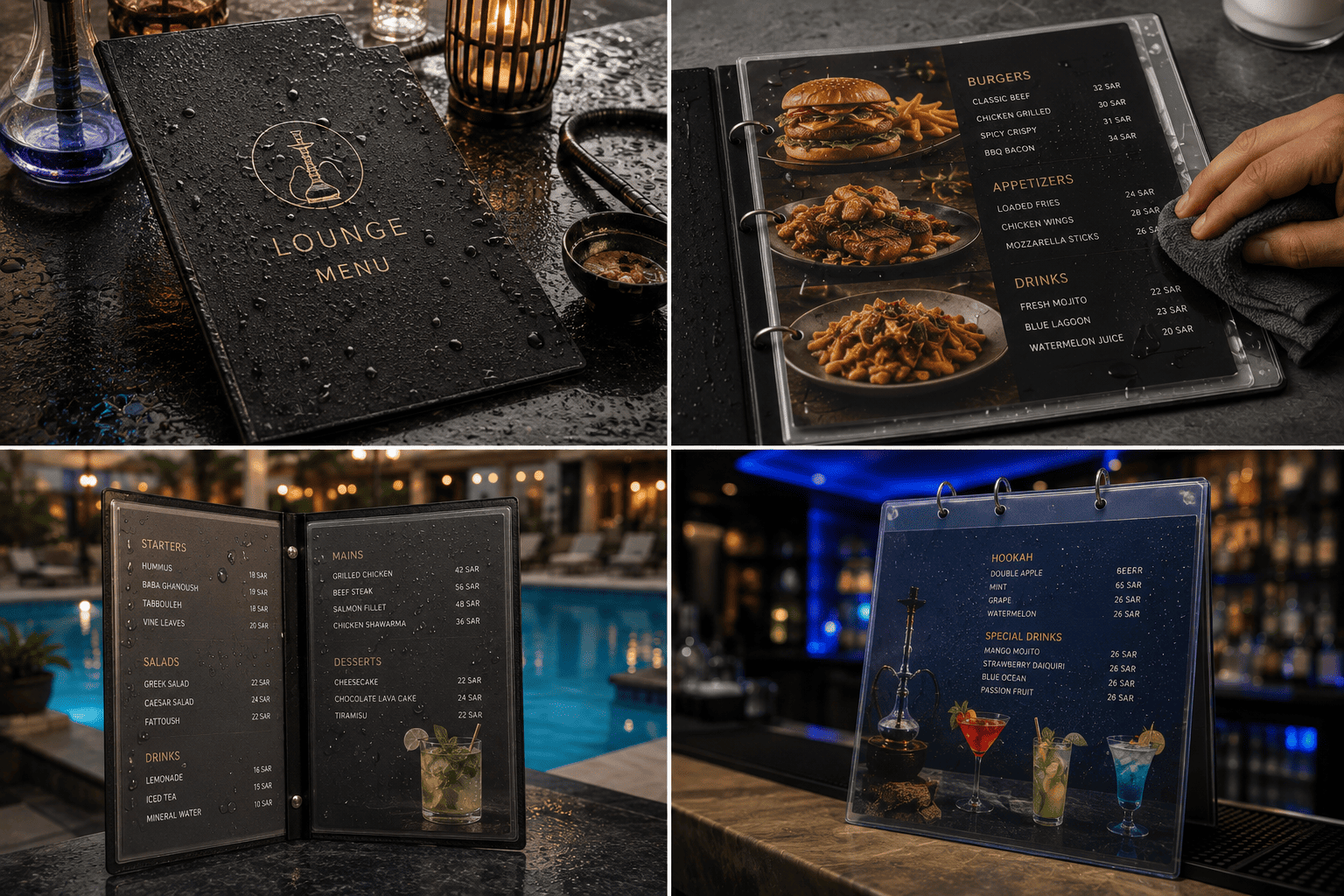
Waterproof restaurant menus and PVC menu printing are built for environments where standard paper-based formats fail quickly. Outdoor dining areas, poolside venues, shisha lounges, and high-turnover bars all create conditions where paper menus absorb moisture, tear at folds, and look worn within days.
Synthetic and PVC substrates resist water, are wipe-clean, and hold up to repeated handling without losing their printed surface.
Use waterproof or synthetic menu printing if you are:
- Operating an outdoor venue or poolside dining area
- Running a shisha lounge or bar where menus face regular liquid exposure
- In a high-volume environment where menus are handled constantly throughout the day
Wipeable menus from standard laminated card can handle light moisture. If the environment involves regular cleaning with products or exposure to standing liquid, PVC or synthetic substrate is the specification you need.
Takeaway & Disposable Menus
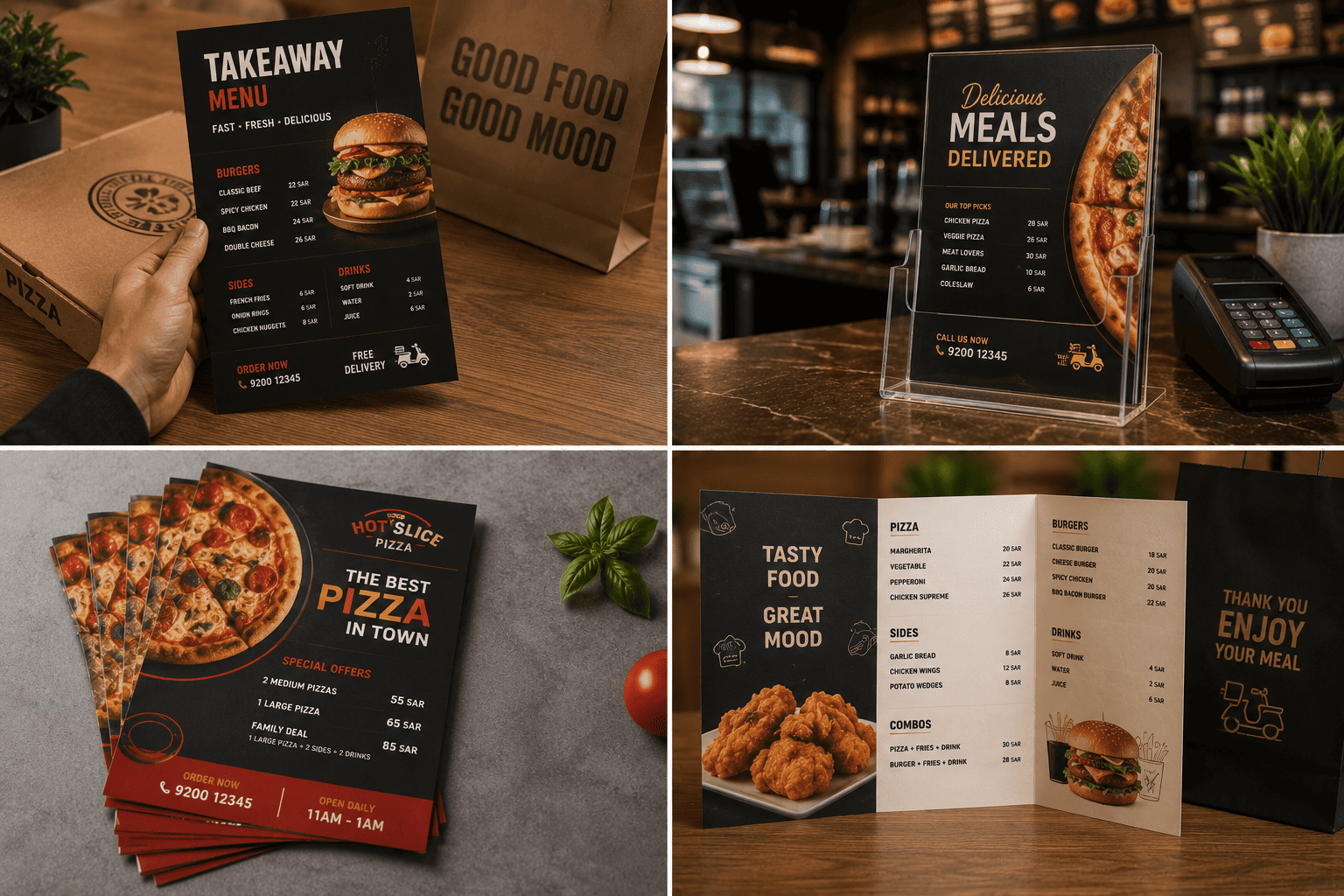
Takeaway menu printing covers the formats distributed with orders, displayed at counters, or handed out during promotional campaigns. These are not designed for repeated table use — they are designed to deliver ordering information clearly and be kept at home, included in packaging, or handed to customers on their way out.
Use takeaway menu printing if you are:
- Running a delivery-focused restaurant or cloud kitchen
- Including printed menus in packaging to drive repeat orders
- Distributing promotional offers across a local area
- Operating a franchise with consistent ordering information across multiple branches
For pizza restaurants and takeaway-focused businesses, the menu needs to communicate clearly and quickly: sizes, combinations, add-ons, and offers in a format that works in hand or on a counter. Since these runs are often smaller and updated more frequently than dine-in menus, digital printing is typically the better fit, especially when offers or pricing change between print batches.
Gold Foil & Specialty Menus
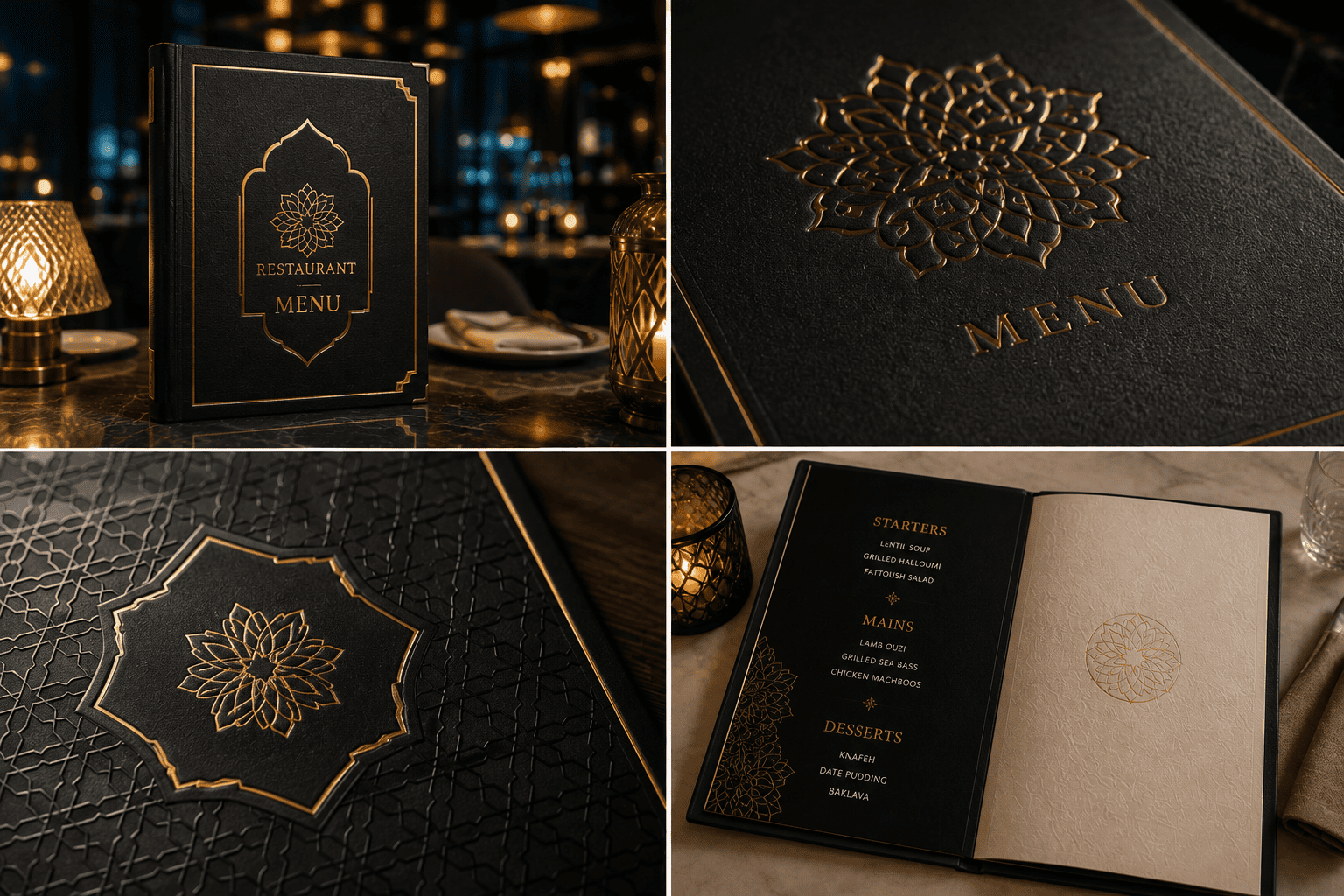
Metallic foil menu printing, gold foil menu printing, spot UV, embossing, and letterpress are premium finishing options for restaurants where the menu cover is a brand statement.
These formats work when the finish supports the brand rather than decorating a menu that does not need it. A gold foil treatment on a dark menu cover for a premium Arabic restaurant reads as intentional. The same treatment on a casual café menu reads as excessive.
Use specialty menu printing if you are:
- Running a restaurant where premium presentation is part of the positioning
- Producing a seasonal or occasion-specific menu where a premium finish is justified
- Looking to differentiate a menu cover from standard formats in a competitive dining environment
Table, Wall, & Placemat Menus
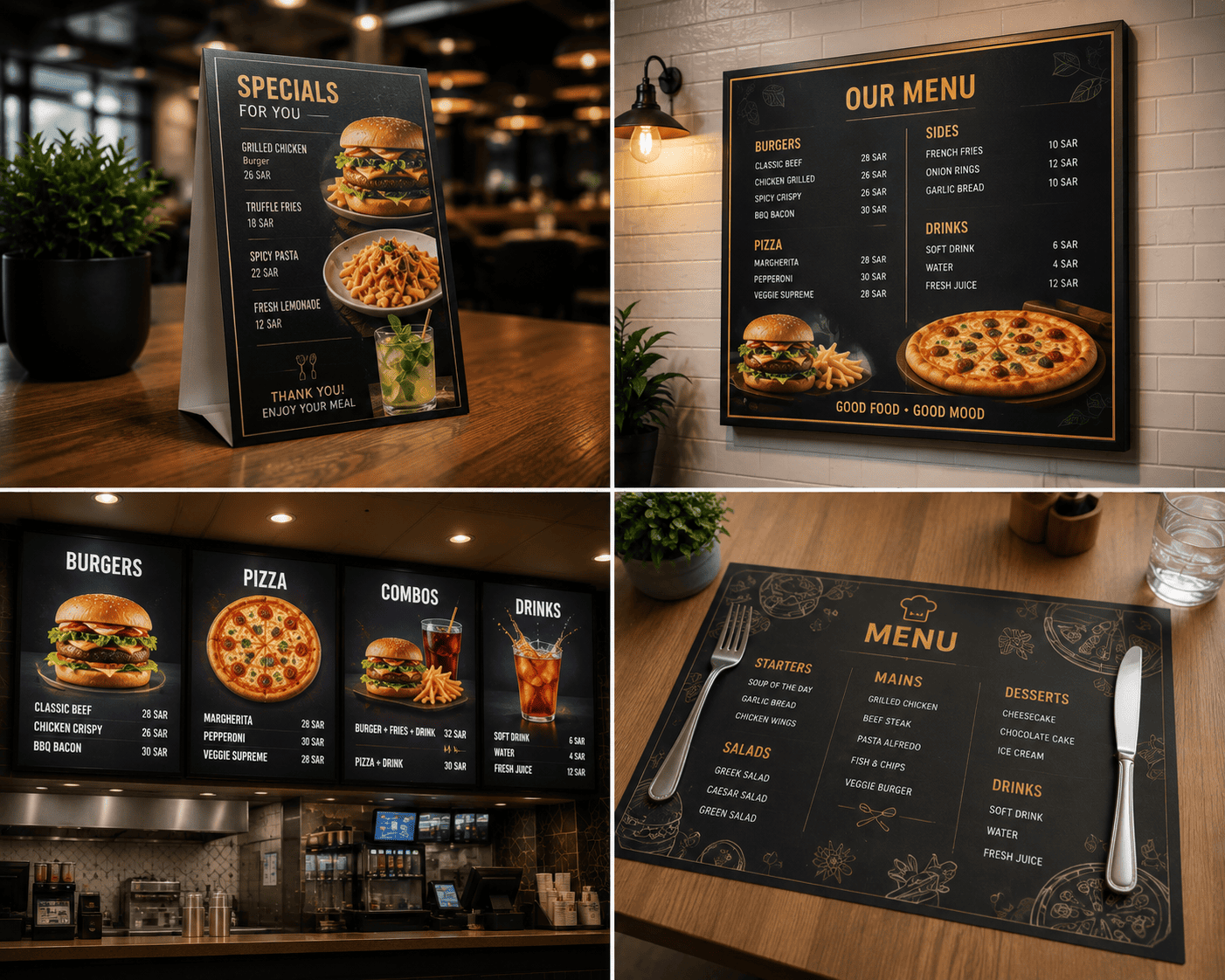
Not every menu is handed to the customer. Counter-service restaurants, cafés, and fast-food businesses use table menus, wall menu printing, backlit menu board printing, and placemat menu printing to display offerings without a physical handover.
These formats are practical for high-turnover environments where managing physical menus per customer is operationally impractical, and where the customer reads the menu from a fixed position rather than browsing it.
Restaurant Menu Printing Process Explained
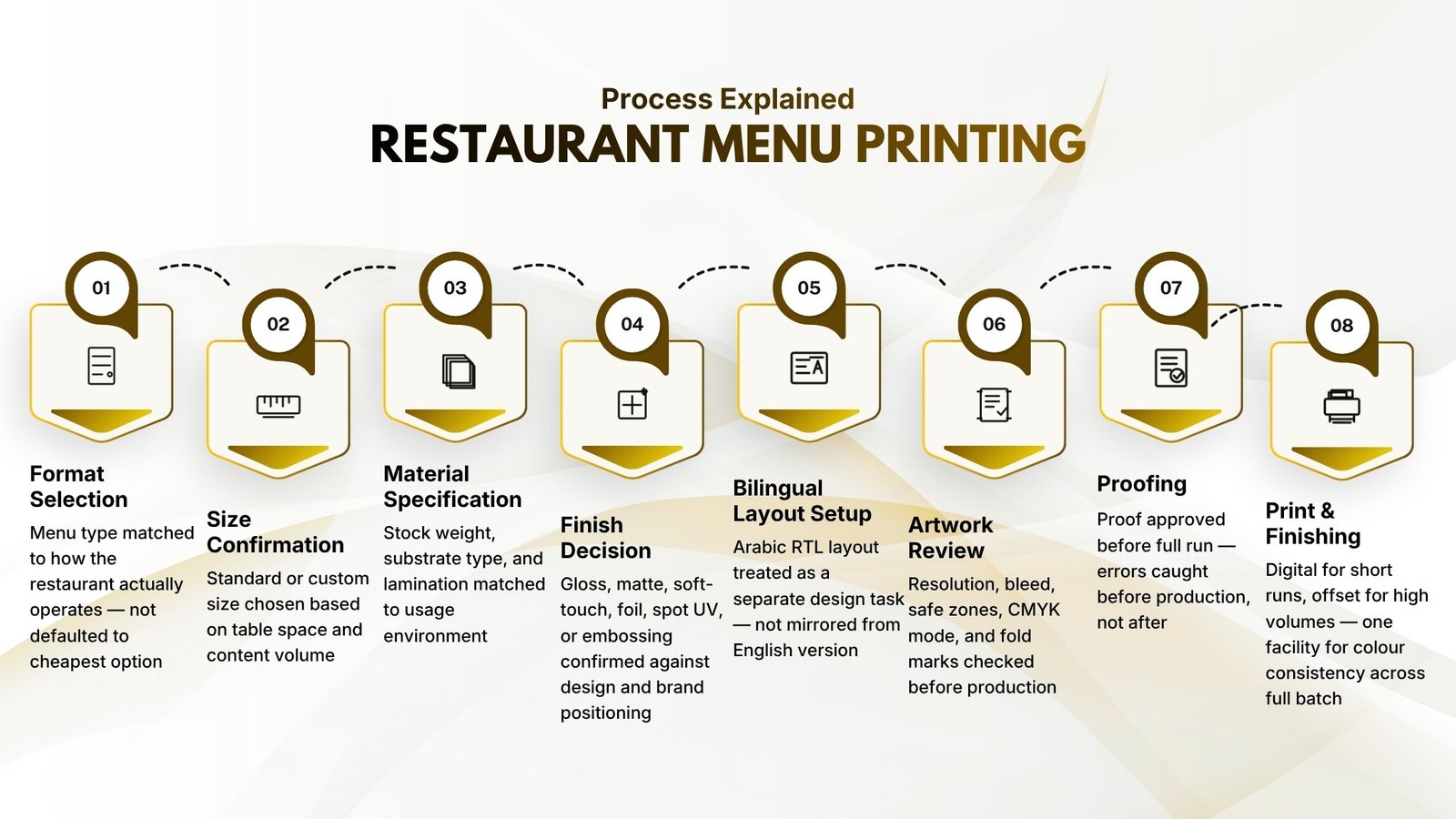
| Stage | What Happens |
| 1. Format Selection | Menu type matched to how the restaurant actually operates — not defaulted to cheapest option |
| 2. Size Confirmation | Standard or custom size chosen based on table space and content volume |
| 3. Material Specification | Stock weight, substrate type, and lamination matched to usage environment |
| 4. Finish Decision | Gloss, matte, soft-touch, foil, spot UV, or embossing confirmed against design and brand positioning |
| 5. Bilingual Layout Setup | Arabic RTL layout treated as a separate design task — not mirrored from English version |
| 6. Artwork Review | Resolution, bleed, safe zones, CMYK mode, and fold marks checked before production |
| 7. Proofing | Proof approved before full run — errors caught before production, not after |
| 8. Print & Finishing | Digital for short runs, offset for high volumes — one facility for colour consistency across full batch |
Materials and Finishes: What Your Menu Is Actually Made From
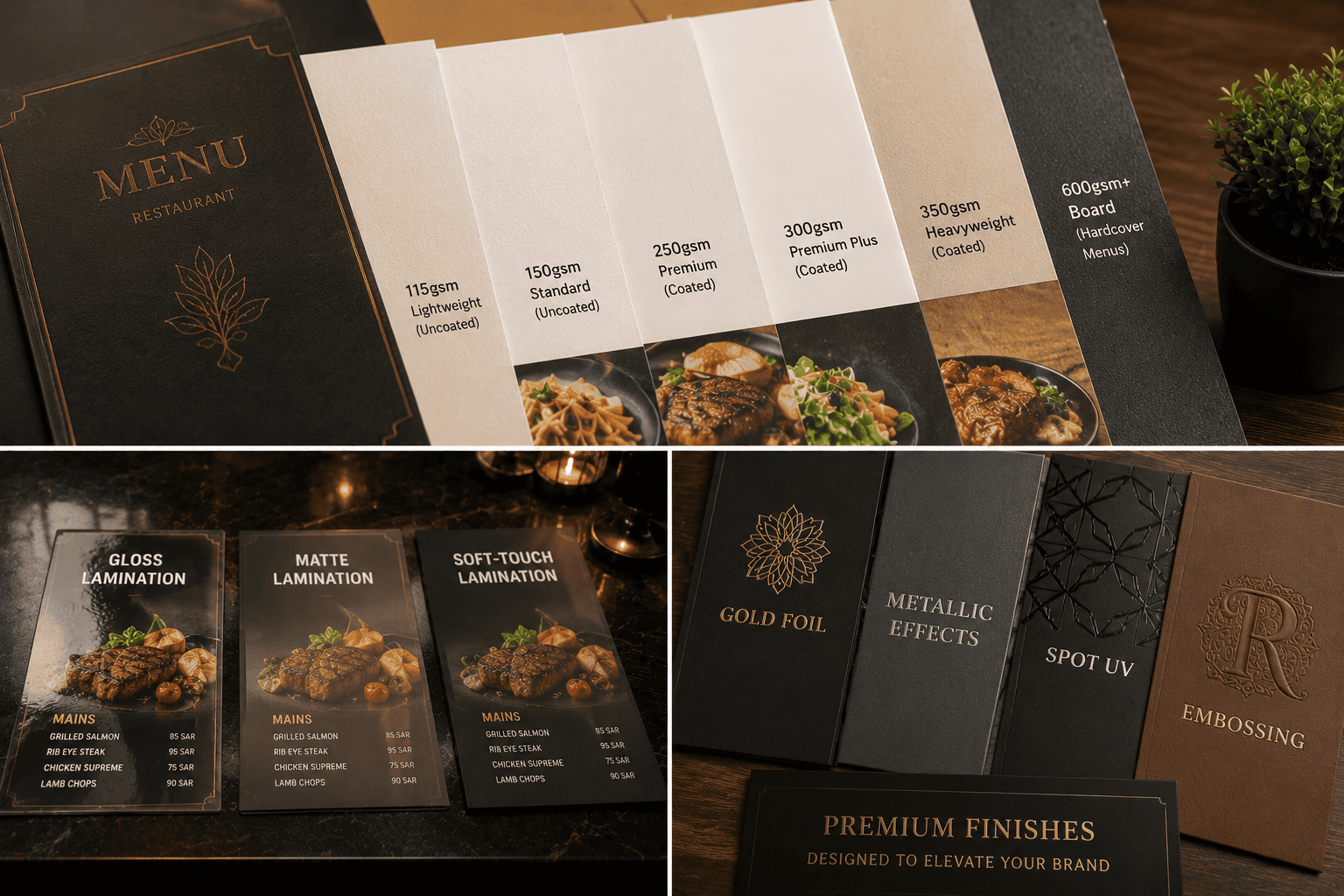
Paper Stock & Weight
Paper weight affects how a menu feels in the customer’s hand and how well it holds up to use.
Lightweight paper is right for disposable menus and takeaway leaflets. Heavier coated stock is right for customer-facing menus that are handled repeatedly. The correct weight depends on whether the menu is a single sheet, folded, laminated, multi-page, or constructed with a hardcover.
Do not select paper weight independently of the rest of the menu specification. A laminated menu and an unlaminated menu need different base stocks. A folded menu needs a weight that creases cleanly and does not crack at the fold. A hardcover menu needs a board-weight inner combined with a cover construction that holds its form. The right stock follows from the full specification — not the other way around.
Lamination Options
- Gloss lamination — makes colours and food photography appear more vivid; best for menus with strong visual content
- Matte lamination — reduces glare under restaurant lighting; works well for text-heavy menus and environments with warm or low light
- Soft-touch lamination — premium tactile surface used when the physical feel of the menu matters as much as the visual finish; commonly used in fine dining and hotel menus
Waterproof & Synthetic Materials
Waterproof menu stock provides resistance to liquid, tearing, and repeated cleaning that standard laminated paper cannot match in demanding environments. Synthetic substrates are fully waterproof, not just water-resistant — the difference shows up in shisha lounges and outdoor settings within the first week.
Premium Finishes
- Gold foil — applied to specific elements such as the restaurant name or logo on the cover; not the full surface
- Metallic effects — broader surface treatment for menus where the cover design is built around the metallic finish
- Spot UV — gloss coating applied selectively over a matte surface; highlights specific design elements without making the whole surface glossy
- Embossing — raises a design element from the surface; works for restaurant names, logos, and brand marks on hardcover menus
Use these finishes where they serve a specific purpose in the design. A premium finish applied across a menu that was not designed for it adds cost without adding value.
What Are Common Sizes Available for Restaurant Menu Printing in Riyadh?
| Format | Common Use |
| A4 | Standard everyday menu size for most restaurant formats |
| A5 | Dessert menus, drinks lists, compact café menus |
| A3 | Large menus, wall displays, folded formats with more content |
| A4 folded (bi-fold) | Four-panel folded menu from an A4 open sheet |
| A3 folded (tri-fold) | Six-panel folded menu with more content space |
| Custom sizes | Brand-led restaurants where a non-standard format supports the design |
Custom menu sizes work when they serve a practical purpose — a narrow format for a small café table, a square menu for a premium brand. A custom size chosen purely for differentiation without a practical reason adds production cost and can make the menu awkward to store and handle.
How Different F&B Businesses in Riyadh Use Restaurant Menu Printing
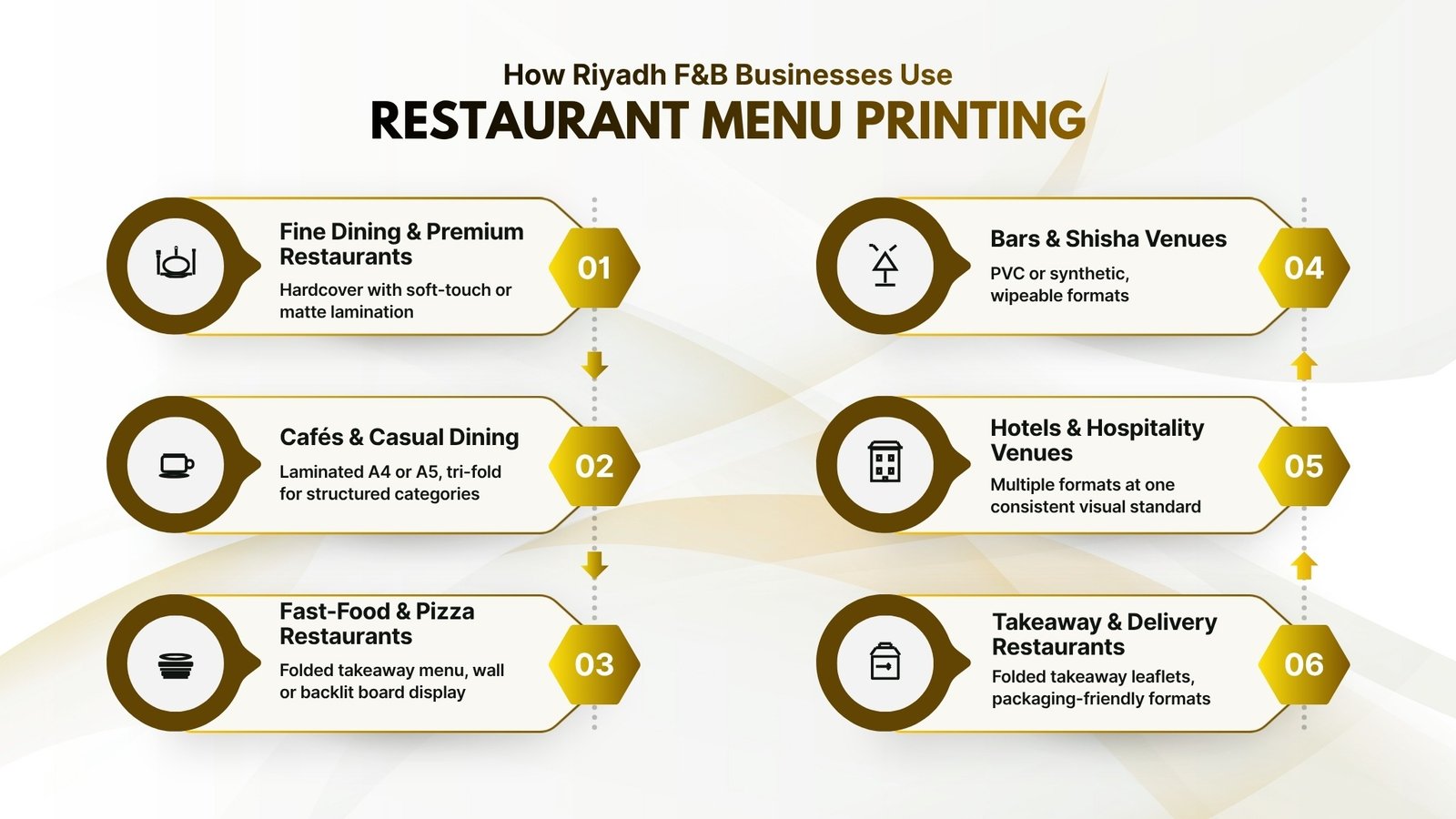
| F&B Business Type | Recommended Format |
| Fine Dining & Premium Restaurants | Hardcover with soft-touch or matte lamination |
| Cafés & Casual Dining | Laminated A4 or A5, tri-fold for structured categories |
| Fast-Food & Pizza Restaurants | Folded takeaway menu, wall or backlit board display |
| Bars & Shisha Venues | PVC or synthetic, wipeable formats |
| Hotels & Hospitality Venues | Multiple formats at one consistent visual standard |
| Takeaway & Delivery Restaurants | Folded takeaway leaflets, packaging-friendly formats |
Fine Dining & Premium Restaurants
Your menu is part of the experience from the moment it arrives at the table. It needs to feel as intentional as everything else the customer encounters.
- Hardcover menu printing with premium board and binding for the main menu
- Soft-touch or matte lamination for a refined tactile finish
- Gold foil or spot UV on the cover for brand-specific finishing
- Arabic and English bilingual layout with correct RTL treatment throughout
- Seasonal reprinting managed without disrupting the rest of the menu specification
Cafés & Casual Dining Restaurants
You need menus that hold up to daily use, are easy to update when prices or dishes change, and do not look worn after a week of service.
- Laminated restaurant menus in A4 or A5 for table use
- Tri-fold menu printing for structured category coverage in a compact format
- Matte lamination where lighting is warm and gloss creates unwanted reflection
- Daily specials as separate inserts that do not require full menu reprinting
Fast-food & Pizza Restaurants
Your menu needs to communicate quickly. Sizes, combinations, add-ons, and offers need to be clear at a glance — whether the customer is reading at a counter, picking from a wall display, or holding a takeaway leaflet.
- Pizza menu printing with enough panel space for full size and topping combinations
- Folded takeaway menu printing for counter display and delivery inclusion
- Wall menu printing or backlit menu board printing for fixed counter display
- Bulk menu printing for multi-location franchise operations where consistency across every branch is required
If you are running across multiple locations, the entire print run needs to be produced in one batch. Colour drift between separate production runs for different branches makes the brand look inconsistent.
Shisha Venues
Your menus face liquid, heat, repeated handling, and regular surface cleaning. Standard paper-based formats will not hold up.
- PVC menu printing or synthetic menu printing for full waterproof resistance
- Wipeable menus that can be cleaned between customers without the surface degrading
- Bar menu printing in formats that work on smaller surfaces and in low-light reading conditions
Hotels & Hospitality Venues
You need several different menu formats operating at the same visual standard simultaneously — restaurant menus, bar menus, in-room dining menus, banquet menus, and placemat menus all need to belong to the same visual system.
- Hardcover or booklet menus for the main restaurant
- Laminated menu cards for bar and casual dining areas
- Placemat menu printing for counter or buffet dining formats
- Consistent finish, colour, and material specification across every format so the brand reads as unified across all dining areas
Takeaway & Delivery-focused Restaurants
Your menus leave with the customer and need to work at home, in an office, or inside a delivery bag. The purpose is repeat ordering — make the ordering information clear, keep the brand present, and make the menu easy to keep.
- Takeaway menu printing in folded formats that fit inside packaging without bulk
- Takeaway leaflet printing for local area distribution campaigns
- To-go menu printing with clear category structure and ordering information
- High-volume print runs where per-unit cost is the primary consideration
Getting the Arabic and Bilingual Layout Right
Arabic and English menus are not the same menu translated and placed side by side. They require a separate layout approach from the start.
Arabic reads right to left. That affects column order, alignment, page flow, price placement, and typography across every page. A folded menu in Arabic does not open the same way as the English version. A table of prices does not align the same way. Running numbers in Arabic context requires specific handling that English layout does not.
If your menu has bilingual content and the Arabic layout was set up as a direct mirror of the English version, it will look wrong to an Arabic reader regardless of how accurate the translation is.
Confirm Arabic RTL layout is being handled as a separate design task, not as a translation applied to an English template. Menu printing is just one part of a wider print strategy most F&B businesses in Riyadh end up needing, learn more in our guide for printing services in Riyadh for how menus fit alongside packaging, promotional materials, large-format printing, and other print needs for restaurants and other businesses.
What Are the Most Common Restaurant Menu Printing Mistakes in Riyadh?
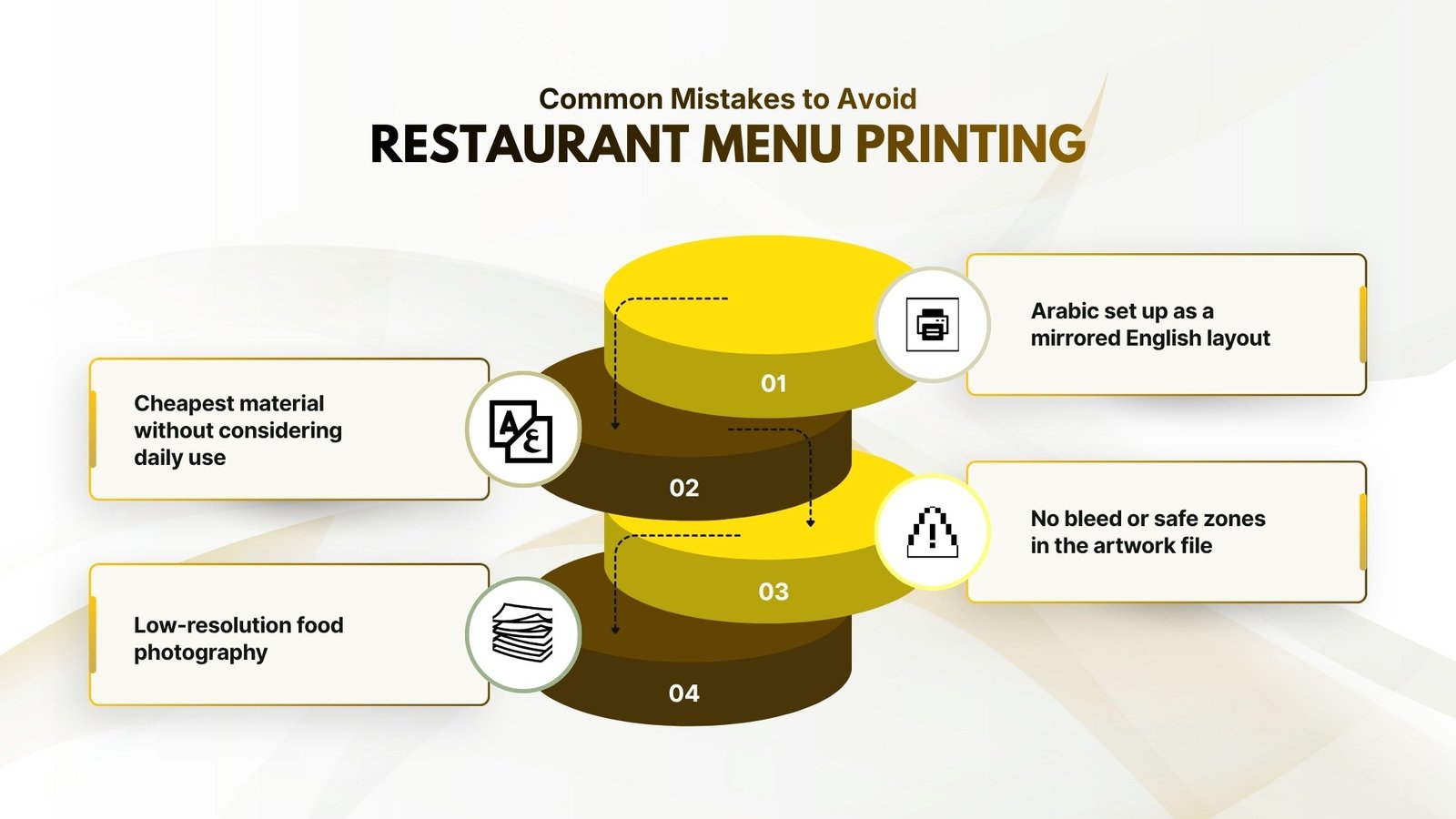
| Mistake | What It Costs You |
| Cheapest material without considering daily use | Frequent reprinting that costs more than a durable spec would have |
| Low-resolution food photography | Images that look soft or pixelated at print size |
| Arabic treated as a mirrored English layout | A bilingual menu that reads incorrectly to Arabic customers |
| No bleed or safe zones in the artwork file | Content trimmed during production |
| Over-ordering before prices are finalised | Expensive reprints after a menu or price change |
| Premium finishes on a design that does not need them | Added cost with no visible return |
| Format too large for the table size | Menus that are awkward to hold and dominate the table |
| Artwork sent the day before the opening | No time for proofing or corrections |
| No proof requested before a large run | Errors discovered after full production |
What Does Restaurant Menu Printing Cost in Riyadh?
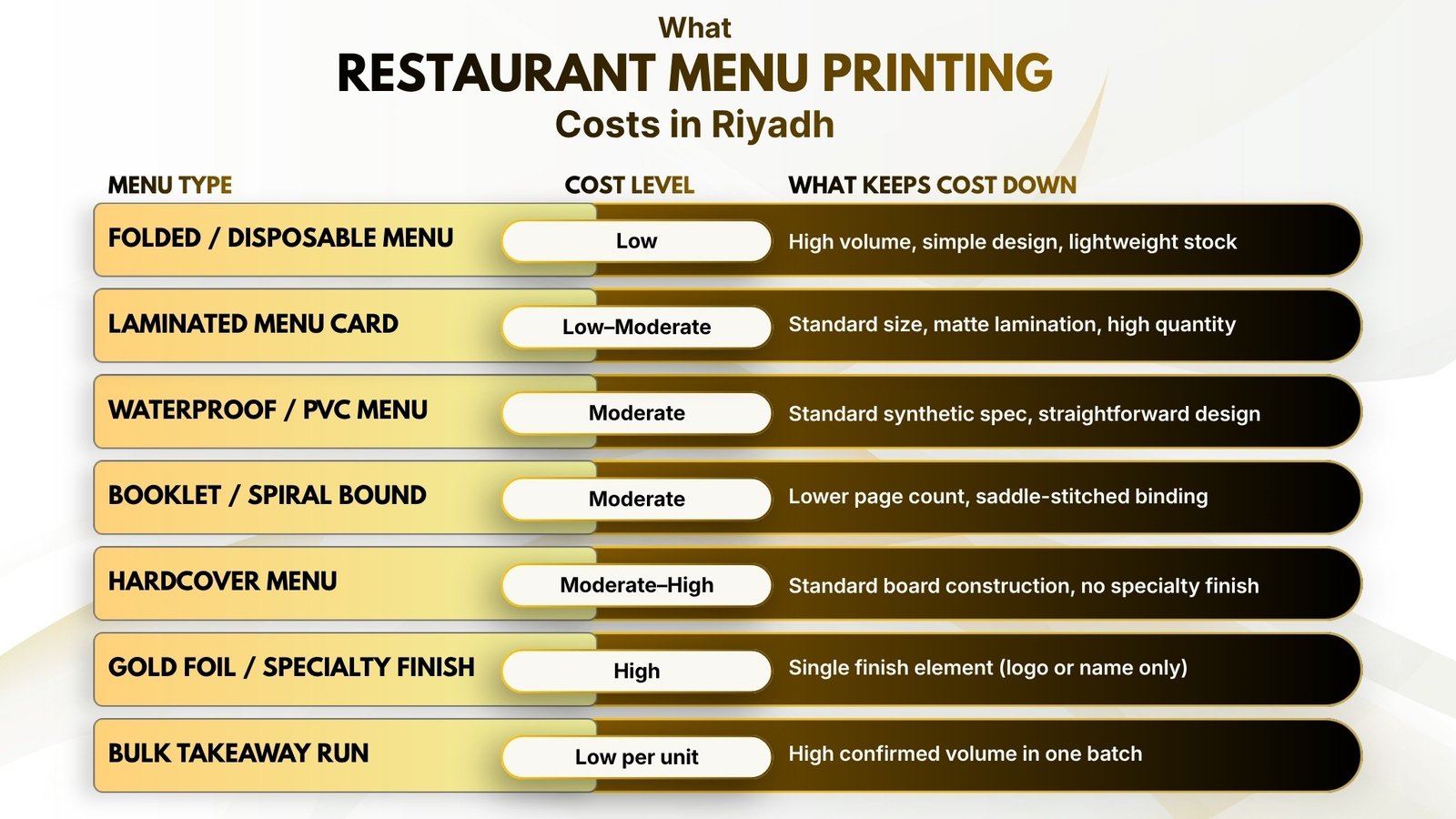
| Menu Type | Cost Level | What Keeps Cost Down |
| Folded / Disposable Menu | Low | High volume, simple design, lightweight stock |
| Laminated Menu Card | Low–Moderate | Standard size, matte lamination, high quantity |
| Waterproof / PVC Menu | Moderate | Standard synthetic spec, straightforward design |
| Booklet / Spiral Bound | Moderate | Lower page count, saddle-stitched binding |
| Hardcover Menu | Moderate–High | Standard board construction, no specialty finish |
| Gold Foil / Specialty Finish | High | Single finish element (logo or name only) |
| Bulk Takeaway Run | Low per unit | High confirmed volume in one batch |
Basic folded and laminated menus cost less than hardcover or waterproof formats. Foil, embossing, specialty materials, and custom construction increase cost at every stage of production.
Digital menu printing is more cost-efficient for smaller quantities and updates. Offset menu printing becomes more economical at larger print runs. The crossover point depends on the format — confirm at quotation stage.
Do not over-order if prices or dishes are likely to change soon. A large run at a low per-unit cost is only an economy if the whole quantity gets used.
Costs restaurants often do not plan for: menu design, Arabic layout work, photography corrections, proofing, urgent production, delivery, premium finishing, and reprinting after a price or menu change.
How Etihad Golden Falcons Handles Restaurant Menu Printing in Riyadh
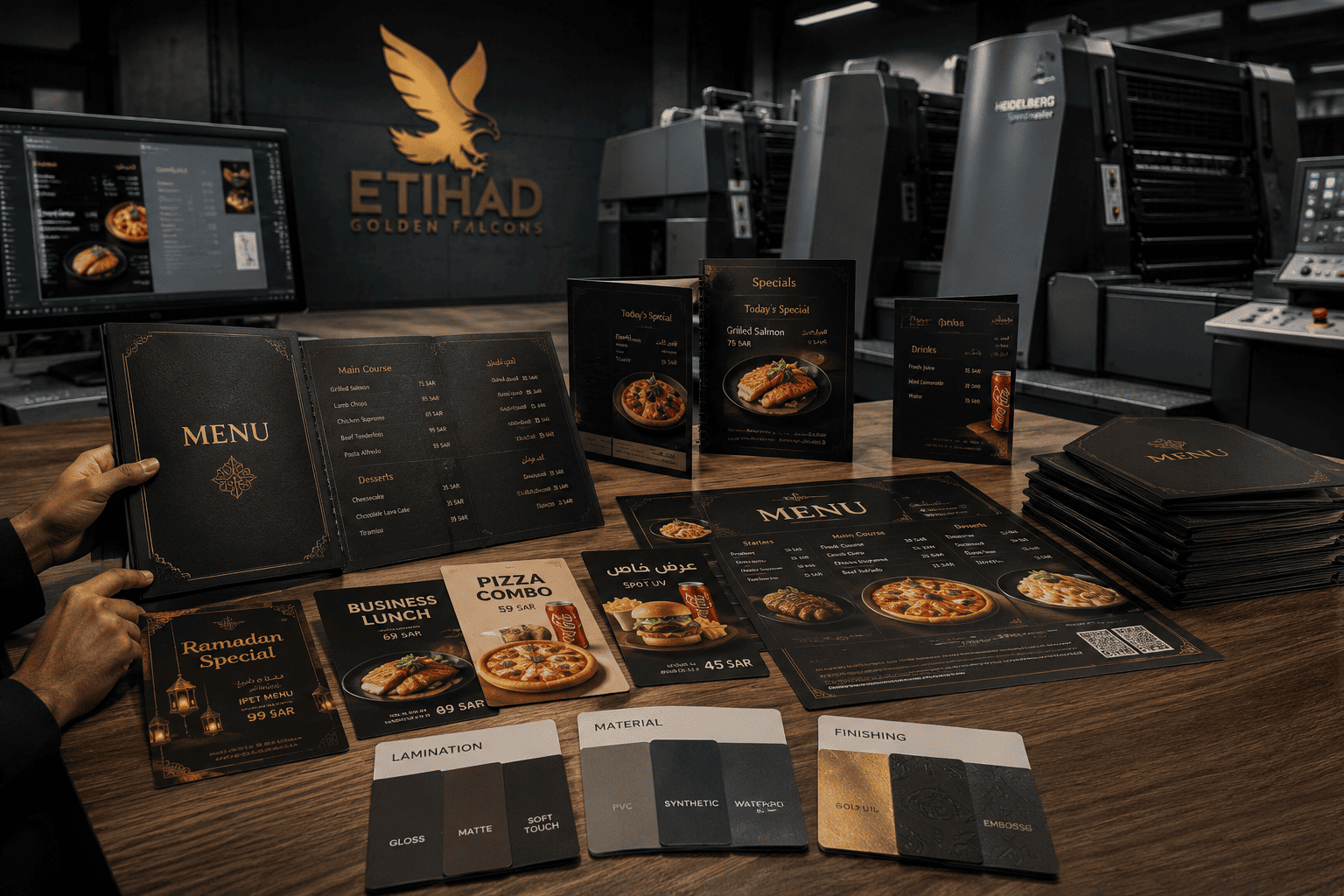
We start with how the menu will actually be used, not with what the design looks like on screen. Format, material, lamination, finish, bilingual layout, and quantity are all confirmed before production begins. A menu for a fine dining restaurant has a different specification from a menu for a shisha lounge, and both have a different specification from a bulk takeaway leaflet run. What gets produced is determined by what your restaurant actually needs, not a standard template applied to every order.
Production and Quality Control
Printing is handled in-house. For large runs covering multiple branches, that matters, colour consistency across the full batch is only guaranteed when production runs through one calibrated facility, not split across suppliers. Arabic and English bilingual menus are handled with correct RTL layout from the design stage. If your artwork is not print-ready, we review it before production so problems with file format, resolution, bleed, margins, or Arabic layout are caught before they become expensive corrections after printing.
Turnaround You Can Plan Around
Same-day menu printing and next-day delivery are available when your artwork is confirmed and print-ready. If you are opening a restaurant or launching a campaign, tell us your deadline at inquiry. We confirm the production timeline before your order is placed, not after.
If your menu needs a format change, a bilingual layout, or a faster turnaround than your last supplier could manage, get in touch and we’ll confirm exactly what your restaurant needs. Message us on WhatsApp to get started.
FAQs
Laminated menus for most casual dining and café environments. PVC or synthetic menu printing for venues where menus face liquid, outdoor conditions, or repeated cleaning with products. Wipeable laminated card handles light moisture — synthetic substrate handles sustained exposure. The right choice depends on your environment.
Yes. Arabic bilingual menus require RTL layout treatment from the design stage — column order, text alignment, page flow, and price placement all need to be set up correctly for Arabic, not mirrored from the English version. Confirm bilingual requirements at briefing so the layout is handled correctly from the start.
Lamination adds a protective film over standard printed paper — it resists light moisture and surface wear. Waterproof and PVC menus are printed on synthetic substrate that is fully water-resistant, tear-resistant, and wipe-clean. If your menus face regular liquid exposure or cleaning, lamination alone is not sufficient.
Simple digital menu jobs run one to two working days from a confirmed, print-ready file. Same-day menu printing and next-day options are available when the artwork is ready and the material is in stock. Hardcover menus, specialty finishes, and large volume runs take longer. Confirm your required date at inquiry so the timeline is confirmed before production is committed.
Yes. Metallic foil menu printing, spot UV, and embossing are all available. These finishes work best when the design was built for them — a foil treatment on the restaurant name or logo on a dark cover reads correctly. The same finish applied broadly across a design that was not built for it adds cost without adding quality.
High-resolution print-ready PDF. Images should be at sufficient resolution for the final print size — what looks sharp on screen at small size is often not sufficient when enlarged to A3 or full menu dimensions. Files should include correct bleed, safe margins, CMYK colour mode, and folding marks where relevant. If your file is not print-ready, we will review it before production.
Yes. Digital menu printing handles small quantities efficiently. For larger volumes, offset menu printing typically reduces per-unit cost. The right approach depends on your quantity, format, and whether the menu is likely to change in the near term. Confirm the full scope at inquiry.
Yes. If your menu needs layout work, Arabic RTL setup, image preparation, bleed and safe zone corrections, or file format adjustment before it can go to print, we handle that before production begins. Confirm design requirements at inquiry so the time is built into the schedule.