

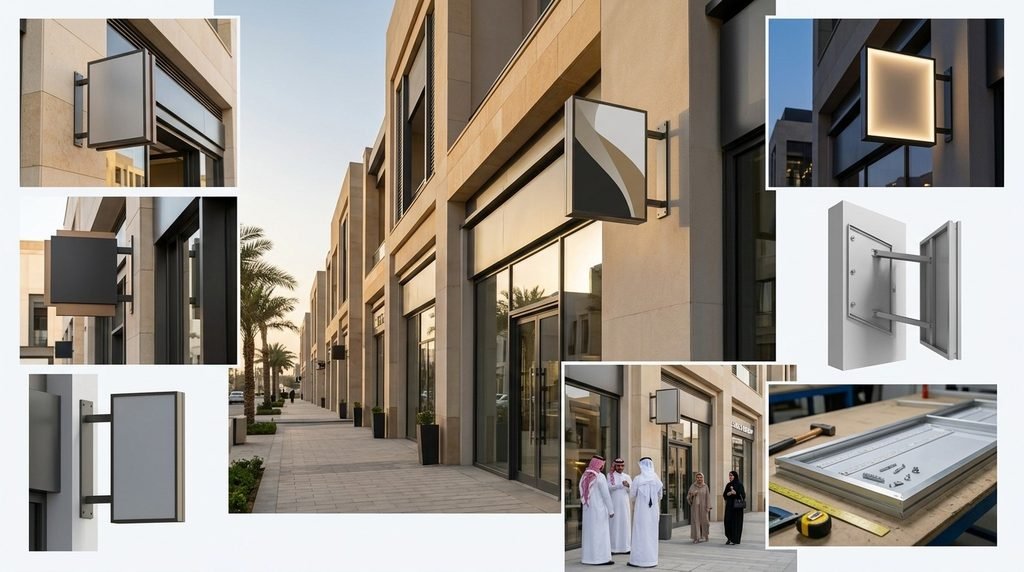
A blade sign is a sign mounted perpendicular to a building face, projecting outward instead of sitting flat against the wall. Drivers and pedestrians read it from the side, not head-on. That’s the entire reason it exists: it works where a flat storefront sign gets lost in a row of shared facades or set-back entrances.
Offices, retail units, clinics, and corporate buildings across Riyadh use blade signs to solve one specific problem. Visibility from a distance and from an angle, on streets where the building’s face doesn’t do the job on its own.
Get the size, the bracket, or the illumination wrong and the sign either disappears from the street it was built to catch, or it draws a compliance notice before it draws a single customer.
Why a Blade Sign Has to Work From Every Angle
A tenant on the third floor of a mixed-use building gets one sign. It has to work for a car passing at 60 km/h. It has to work for a pedestrian glancing sideways on the sidewalk below. It has to work in daylight and after sunset. Fail any one of those, and the sign is dead weight on the wall.
This is what separates a blade sign from a simple storefront sign. A flat sign only has to work for someone already facing the building. A blade sign has to work for someone who is passing it, from either direction, often without slowing down. That changes almost every decision that follows, from size to material to whether it’s lit.
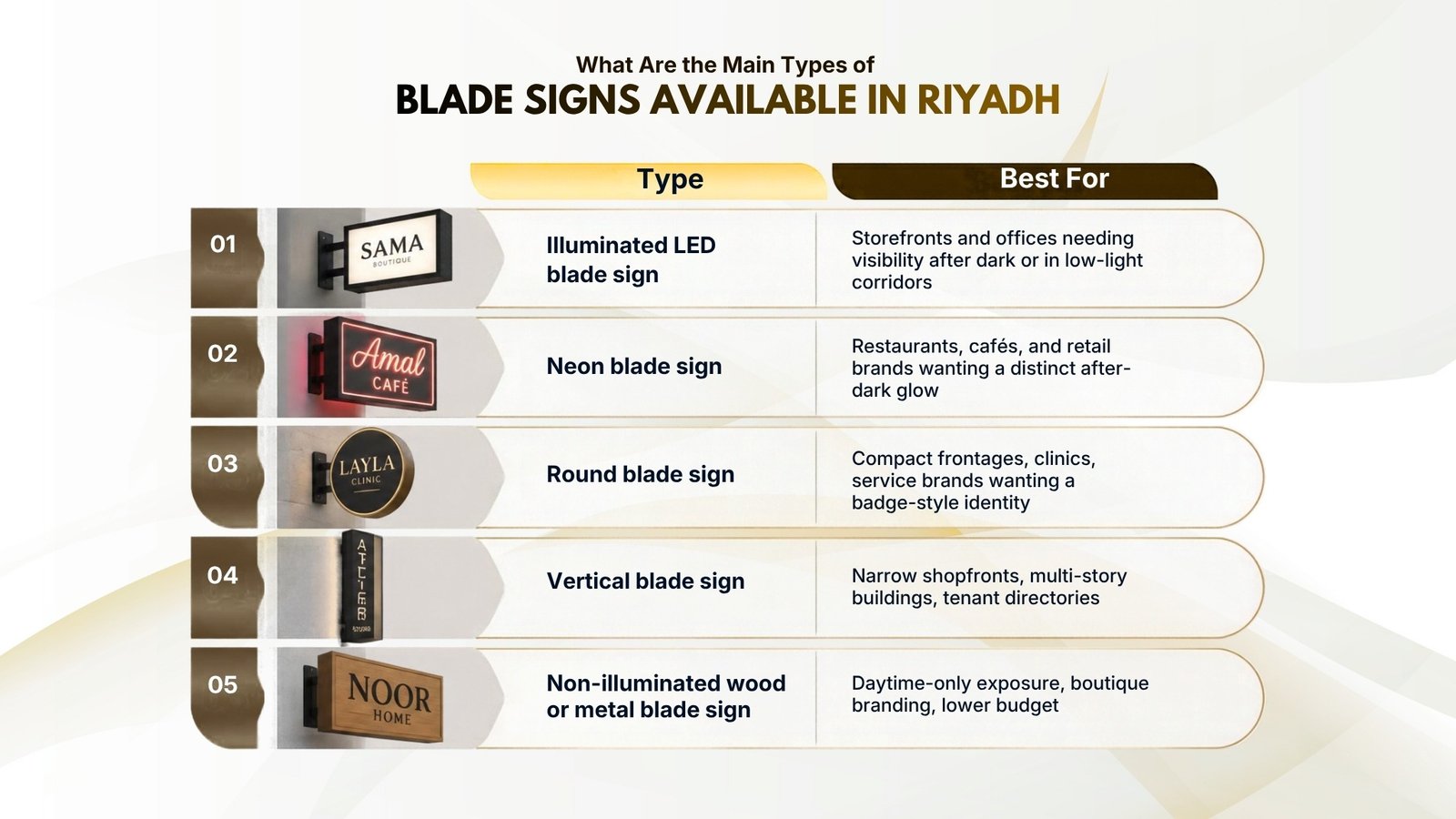
What Are the Main Types of Blade Signs Available in Riyadh
| Type | Best For |
| Illuminated LED blade sign | Storefronts and offices needing visibility after dark or in low-light corridors |
| Neon blade sign | Restaurants, cafés, and retail brands wanting a distinct after-dark glow |
| Round blade sign | Compact frontages, clinics, service brands wanting a badge-style identity |
| Vertical blade sign | Narrow shopfronts, multi-story buildings, tenant directories |
| Non-illuminated wood or metal blade sign | Daytime-only exposure, boutique branding, lower budget |
A blade sign is not a single product. Each type behaves differently depending on the building, the street it faces, and how much of the day it needs to work.
Illuminated LED Blade Signs
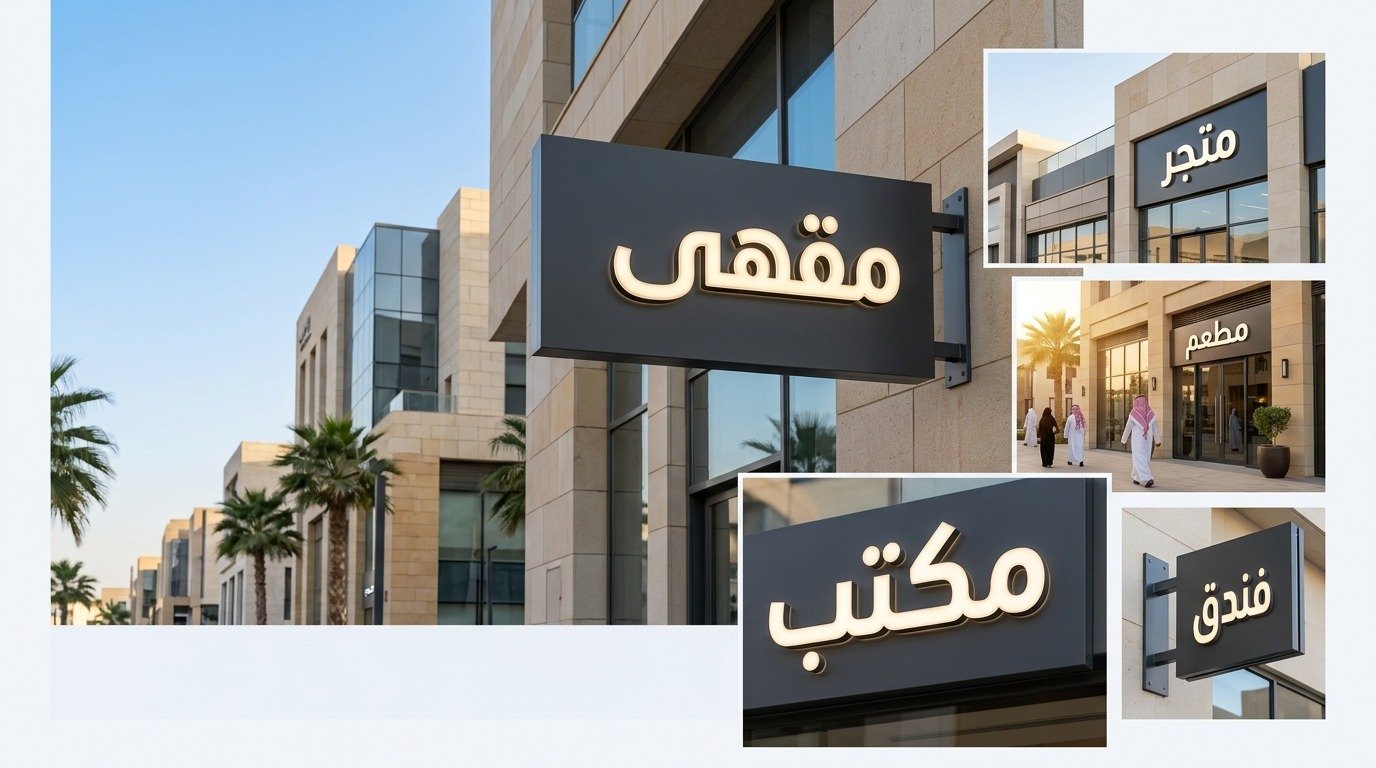
An LED blade sign lights the sign face or its edge from the inside, using low-power diodes built into the panel. It’s the standard choice for any business that needs to be seen after sunset, which in Riyadh’s commercial districts is most of the evening trading hours for retail and F&B.
Choosing a non-illuminated sign for a location with meaningful evening footfall is one of the more common mistakes businesses make. The sign works fine during the day, then goes dark exactly when a large share of passing traffic is on the street.
Neon Blade Signs
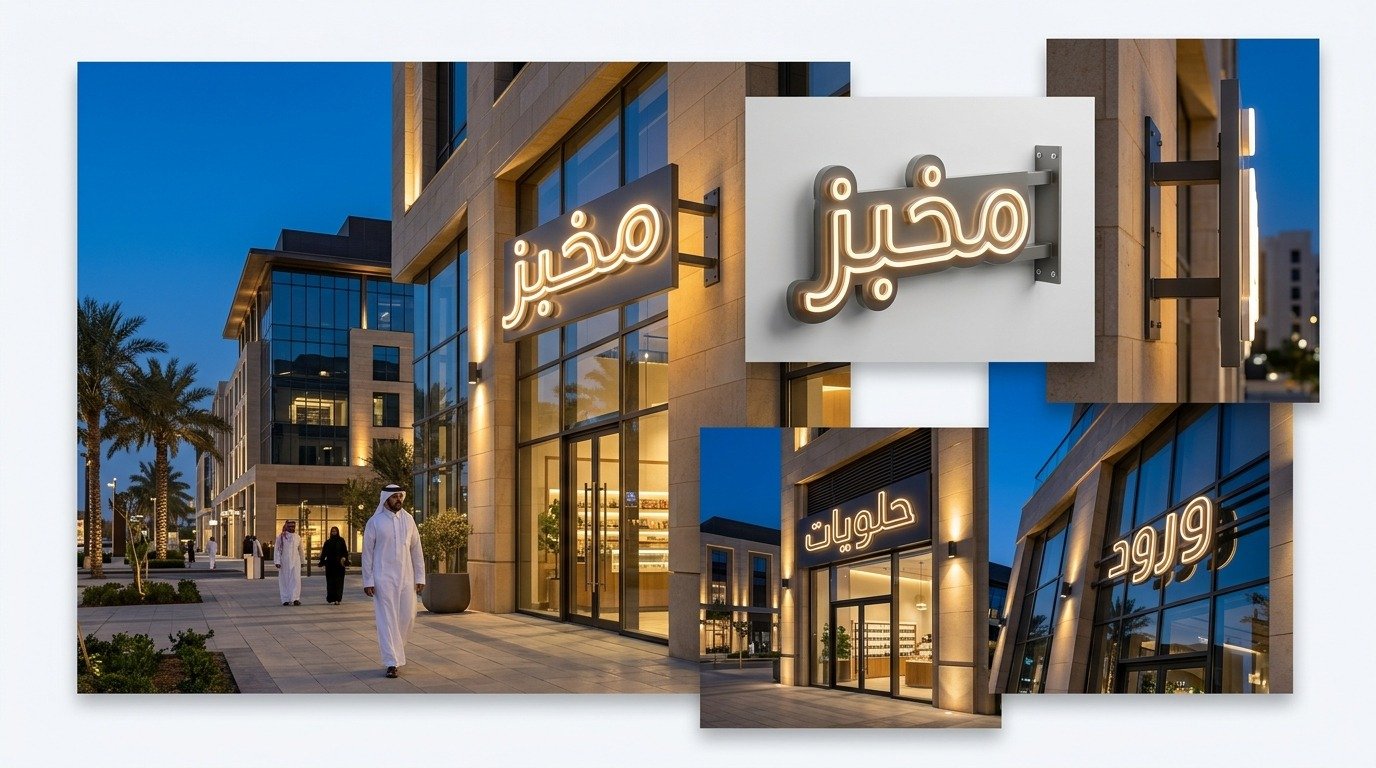
Neon uses gas-filled glass tubing (or an LED-neon hybrid for lower maintenance) to produce a distinct, warm glow rather than the flatter, even light of standard LED. Restaurants, cafés, and retail brands building a specific visual identity tend to choose neon over LED specifically for that character, not for brightness or cost, since neon typically costs more to install and maintain than LED.
Round Blade Signs
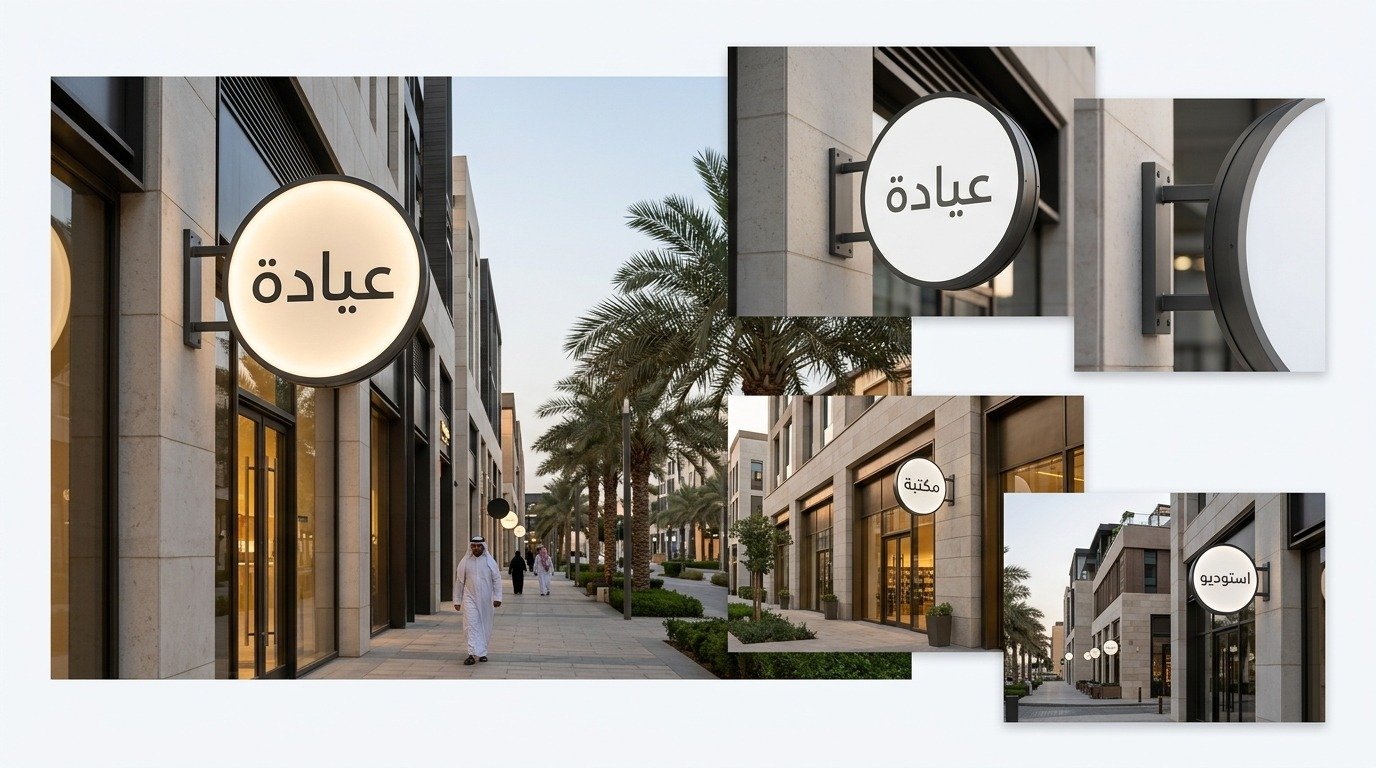
A round or circular blade sign reads as a badge rather than a rectangle, and it’s a common choice for clinics, boutique service brands, and any business trying to project a compact, distinct identity rather than a long horizontal panel. The shape also suits narrow mounting points where a rectangular sign would look oversized for the wall.
Vertical Blade Signs
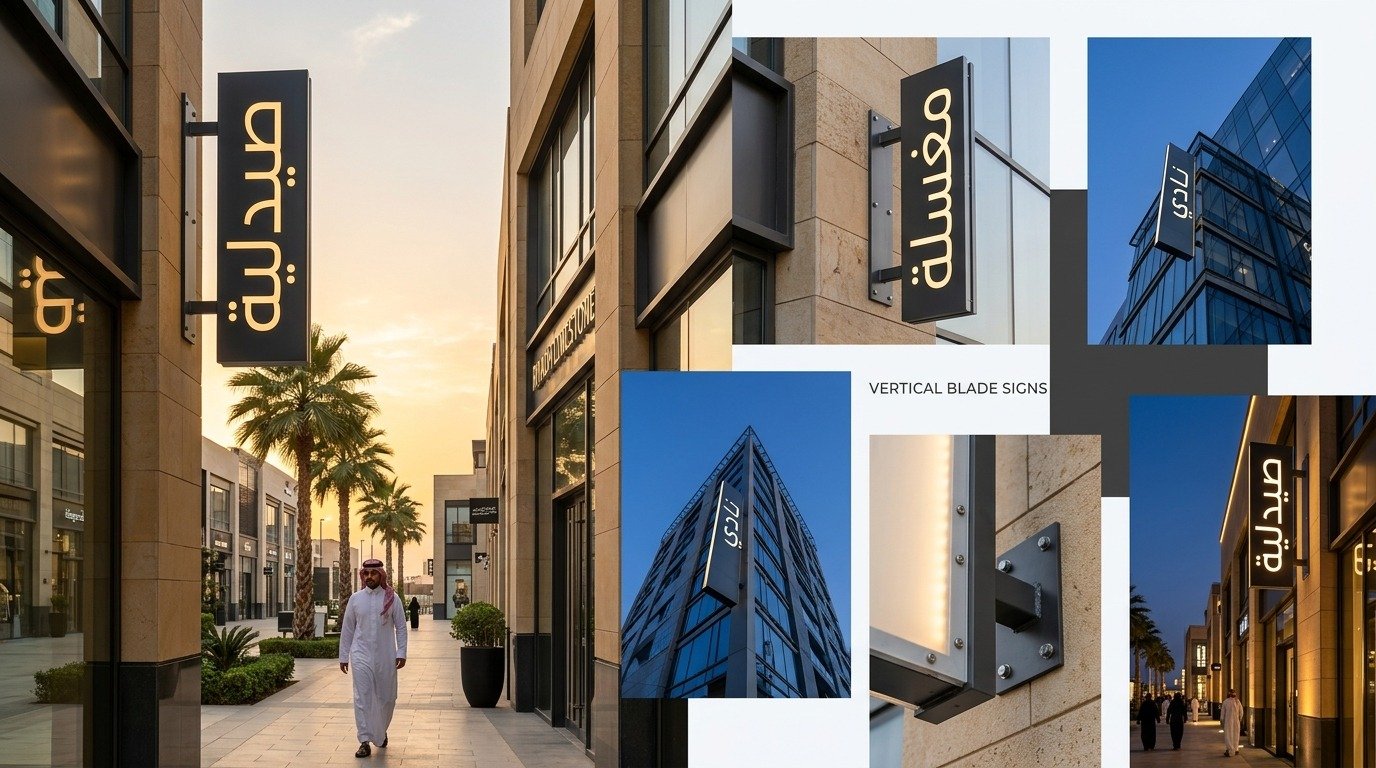
A vertical blade sign runs top to bottom instead of side to side, which makes it the standard choice for narrow shopfronts and multi-story buildings where wall width is limited but height isn’t. Multi-tenant office towers use vertical blade signs for building directories, stacking tenant names down the sign face instead of across it.
Non-Illuminated Wood or Metal Blade Signs
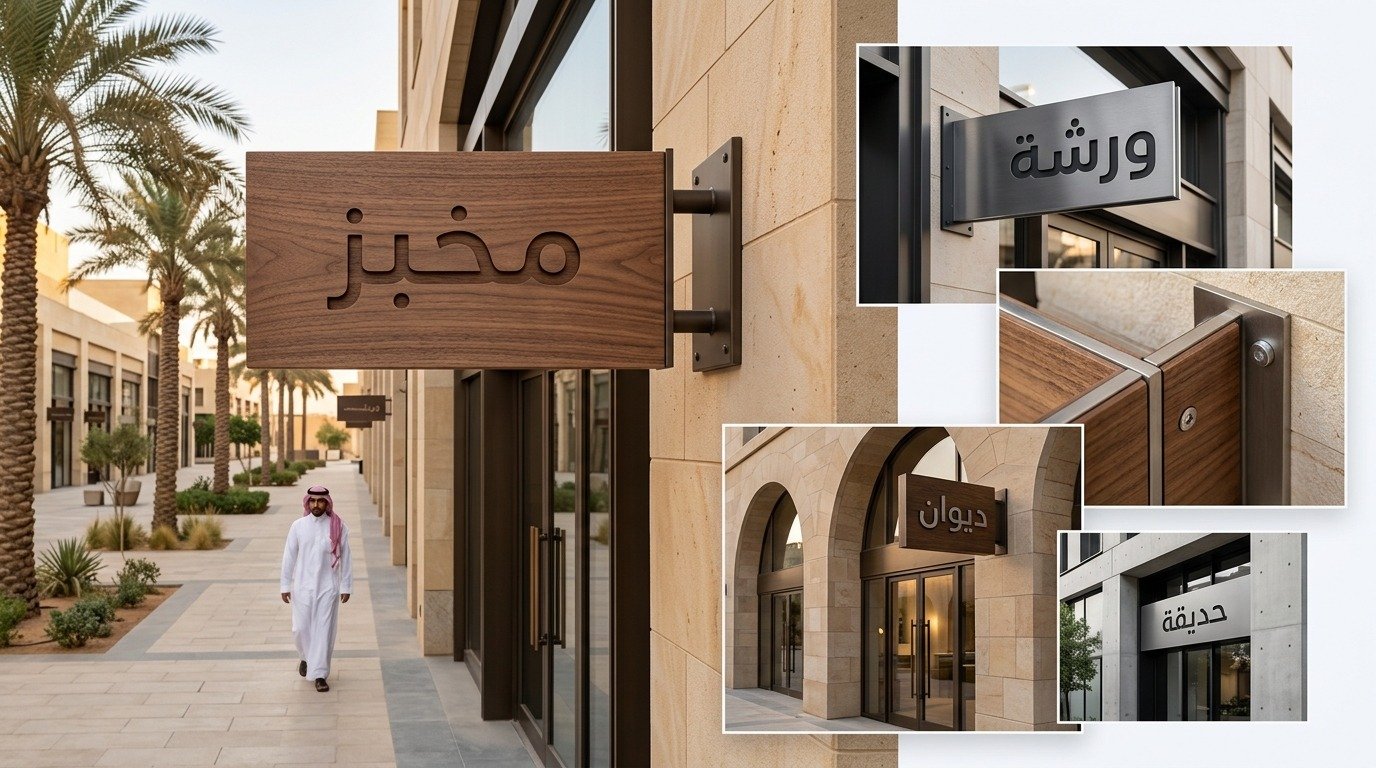
A non-illuminated blade sign has no built-in light source and relies entirely on street lighting or daylight to be read. It’s the right call for businesses with no meaningful evening exposure, or for boutique brands where a wood or matte-metal finish carries more of the identity than brightness does. It’s also the lowest-cost option in the category, since there’s no wiring, driver, or power connection involved.
Material & Mounting Considerations
- Use aluminum or powder-coated metal if the sign is exterior, faces direct sun, or needs to survive Riyadh’s summer heat without warping.
- Use illuminated acrylic if you need even light diffusion at night and a clean, modern face rather than exposed neon tubing.
- Use wood only for interior or covered exterior placements, where it won’t take direct weather exposure.
- Use a wall-mounted arm bracket for most exterior installations, and a ceiling-hung bracket for interior corridor or mall placements where there’s no wall to project from.
- Use a double-sided panel whenever the sign faces a two-way street. A single-sided blade sign on a two-way street only reaches half the traffic passing it.
Where Can You Use Blade Signs for Your Business in Riyadh?
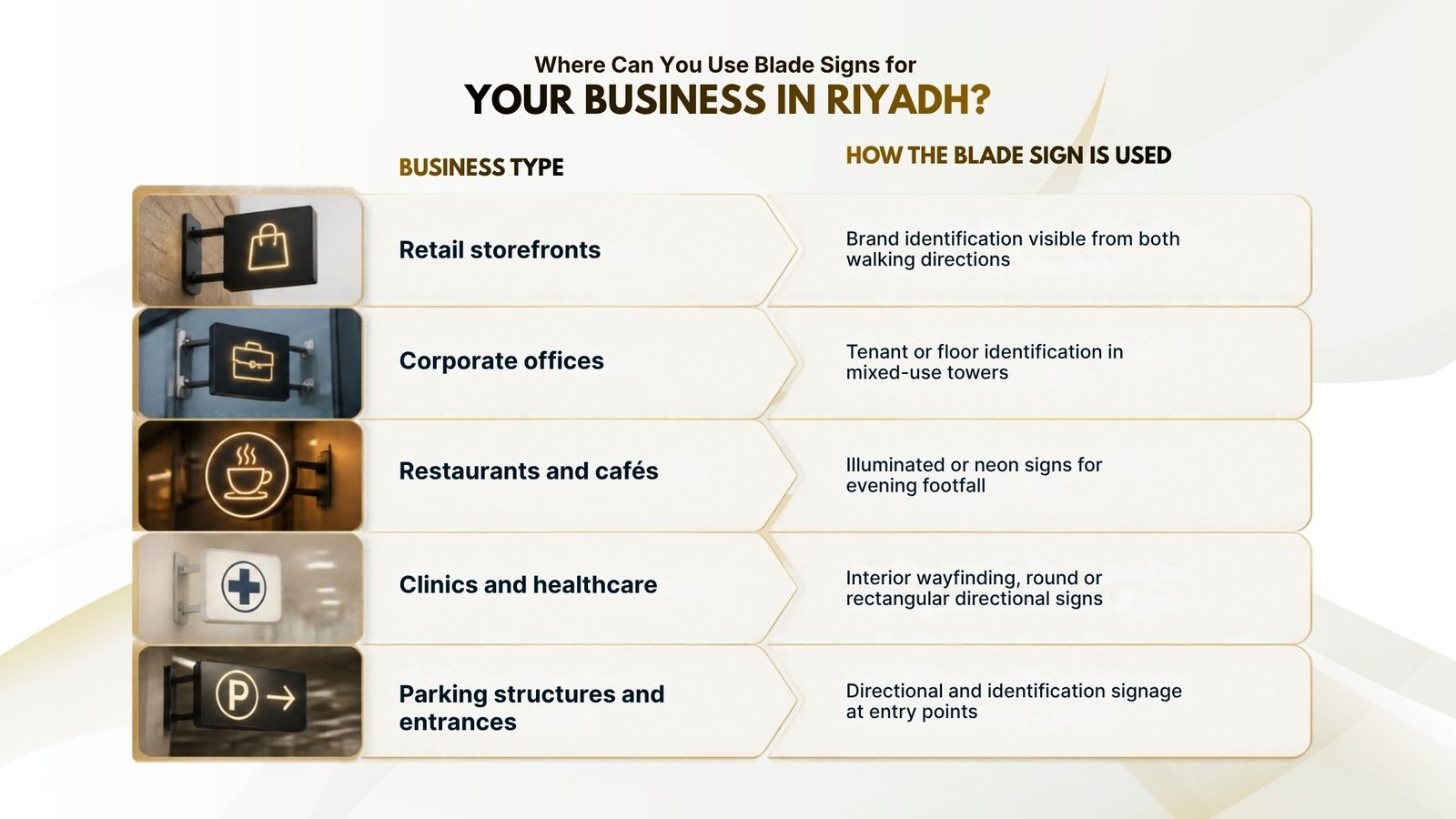
| Business Type | How the Blade Sign Is Used |
| Retail storefronts | Brand identification visible from both walking directions |
| Corporate offices | Tenant or floor identification in mixed-use towers |
| Restaurants and cafés | Illuminated or neon signs for evening footfall |
| Clinics and healthcare | Interior wayfinding, round or rectangular directional signs |
| Parking structures and entrances | Directional and identification signage at entry points |
Different businesses need different blade sign types. Below is where each one actually fits, and what it does once it’s mounted.
Retail Storefronts
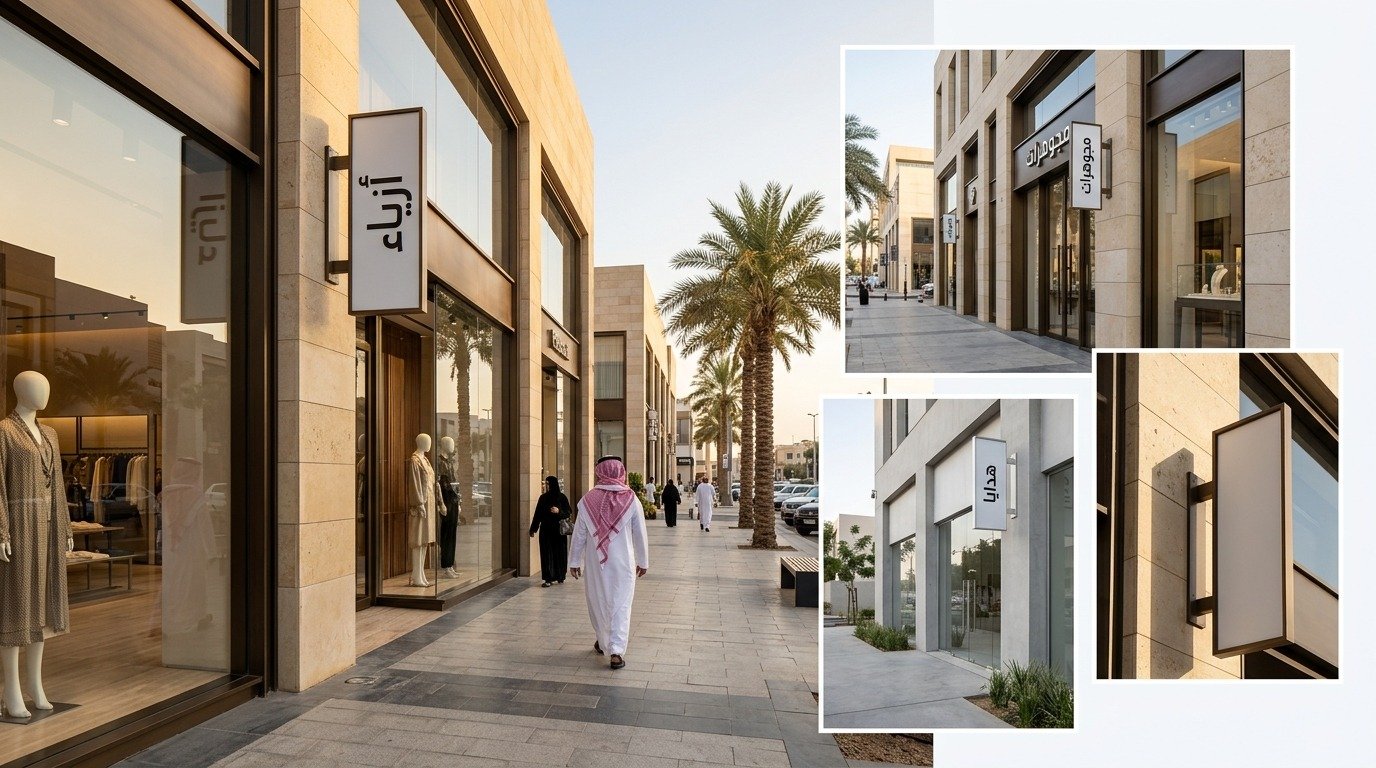
Fashion outlets, electronics stores, and independent retail units on shared commercial streets all compete for the same passing attention.
- For your storefront, you can install a vertical or illuminated LED blade sign to catch pedestrians and drivers approaching from either direction, not just people already facing your entrance.
- If your unit sits in a row of similar shopfronts, a round or custom-shaped blade sign gives you a distinct silhouette instead of blending into the row.
Corporate Offices & Mixed-Use Towers
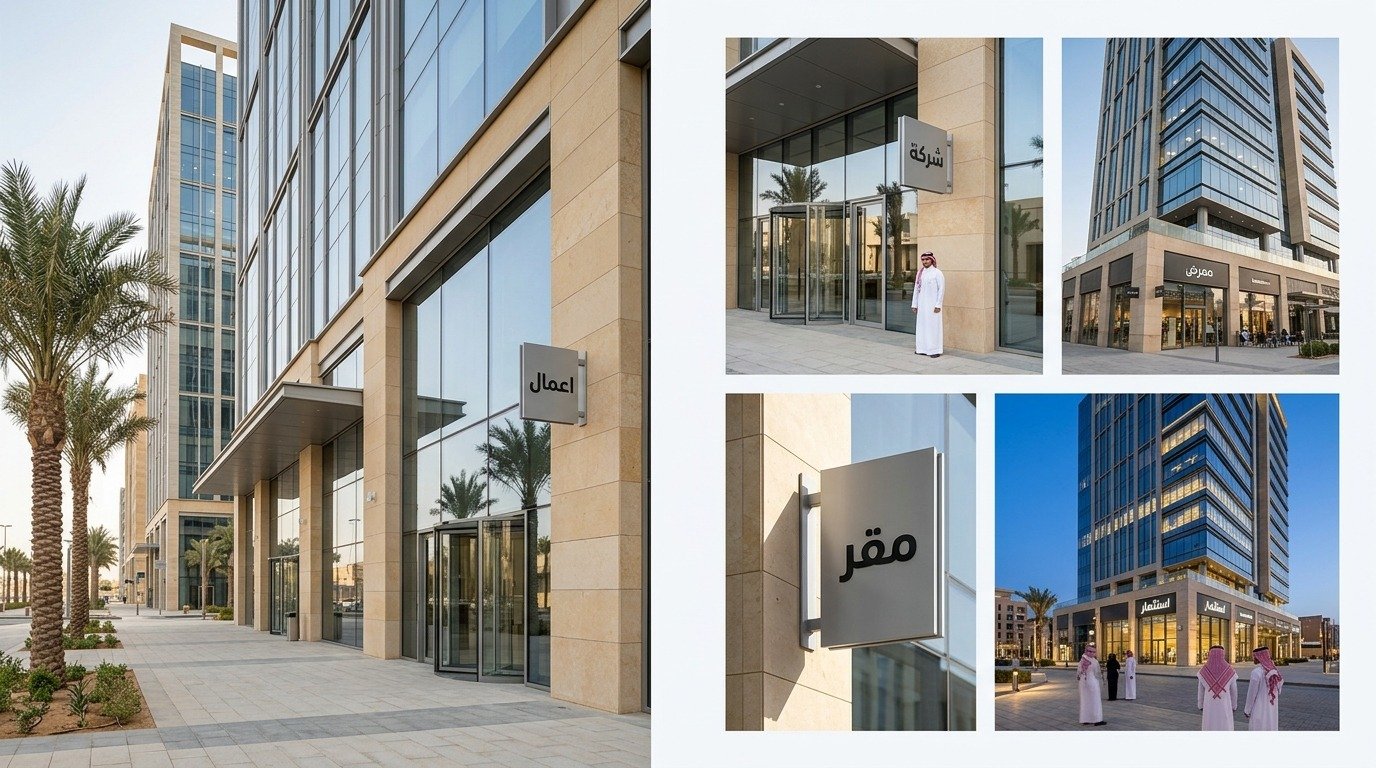
Law firms, consultancies, and multi-tenant office buildings all need visitors to find the right floor or suite without asking at the ground-floor desk.
- For your building entrance, you can install a vertical directory-style blade sign listing tenants by floor, so visitors self-navigate before they reach reception.
- For your own suite, a non-illuminated metal or acrylic blade sign identifies your business without adding unnecessary lighting cost to a space with limited evening traffic.
Restaurants & Cafés
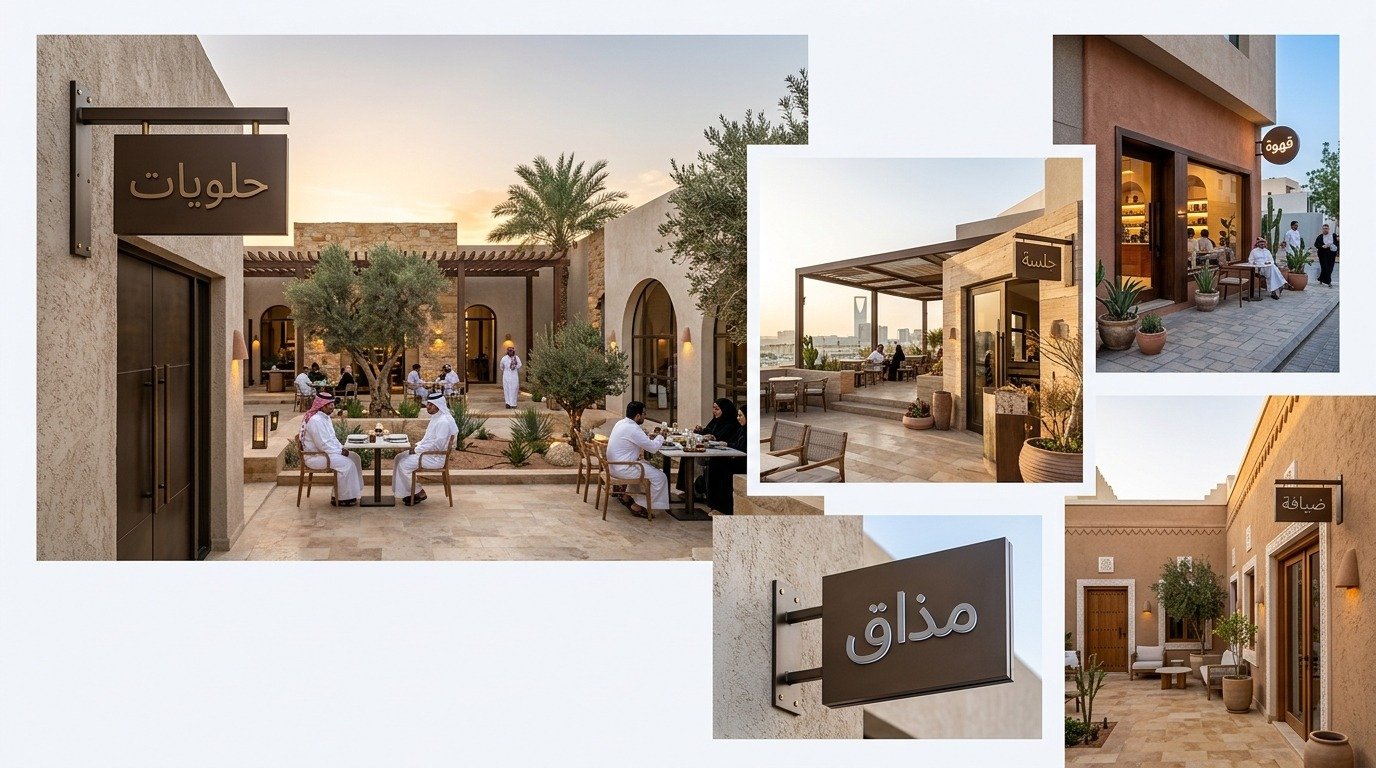
Cafés, casual dining spots, and F&B brands depend on evening footfall as much as daytime traffic.
- For your entrance, you can install a neon or LED illuminated blade sign to stay visible and on-brand well after sunset, when a large share of your covers walk in.
- If you’re on a two-way street, a double-sided blade sign puts your name in front of traffic coming from both directions instead of just one.
Clinics & Healthcare Facilities
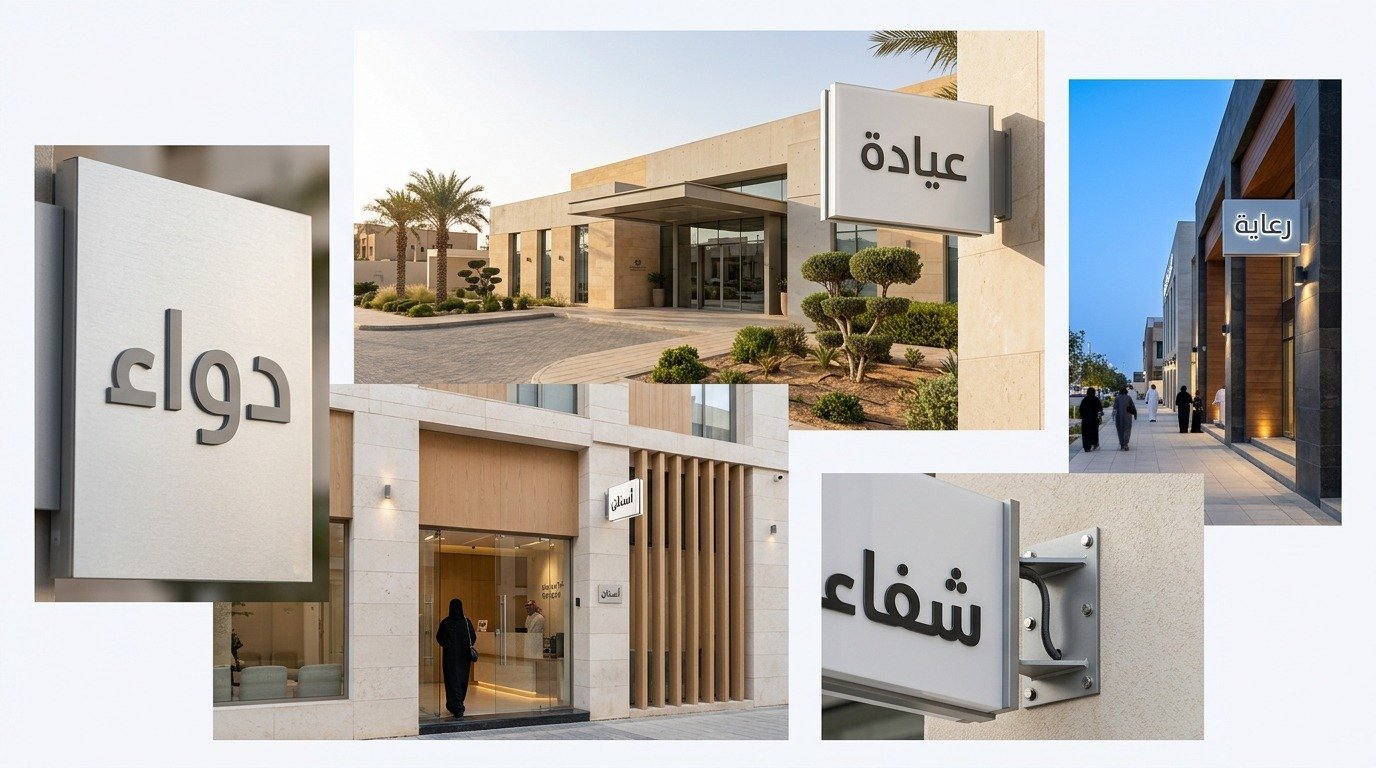
Clinics, diagnostic centres, and small medical practices need to be locatable quickly by patients who may be arriving unfamiliar with the building.
- For your entrance, you can install a round or rectangular illuminated blade sign so patients can identify the practice from the street without walking the full building face reading door plaques.
- For interior corridors, a hanging blade sign works as a directional cue toward specific departments or suites, reducing how often staff get stopped for directions.
Parking Structures & Entrances
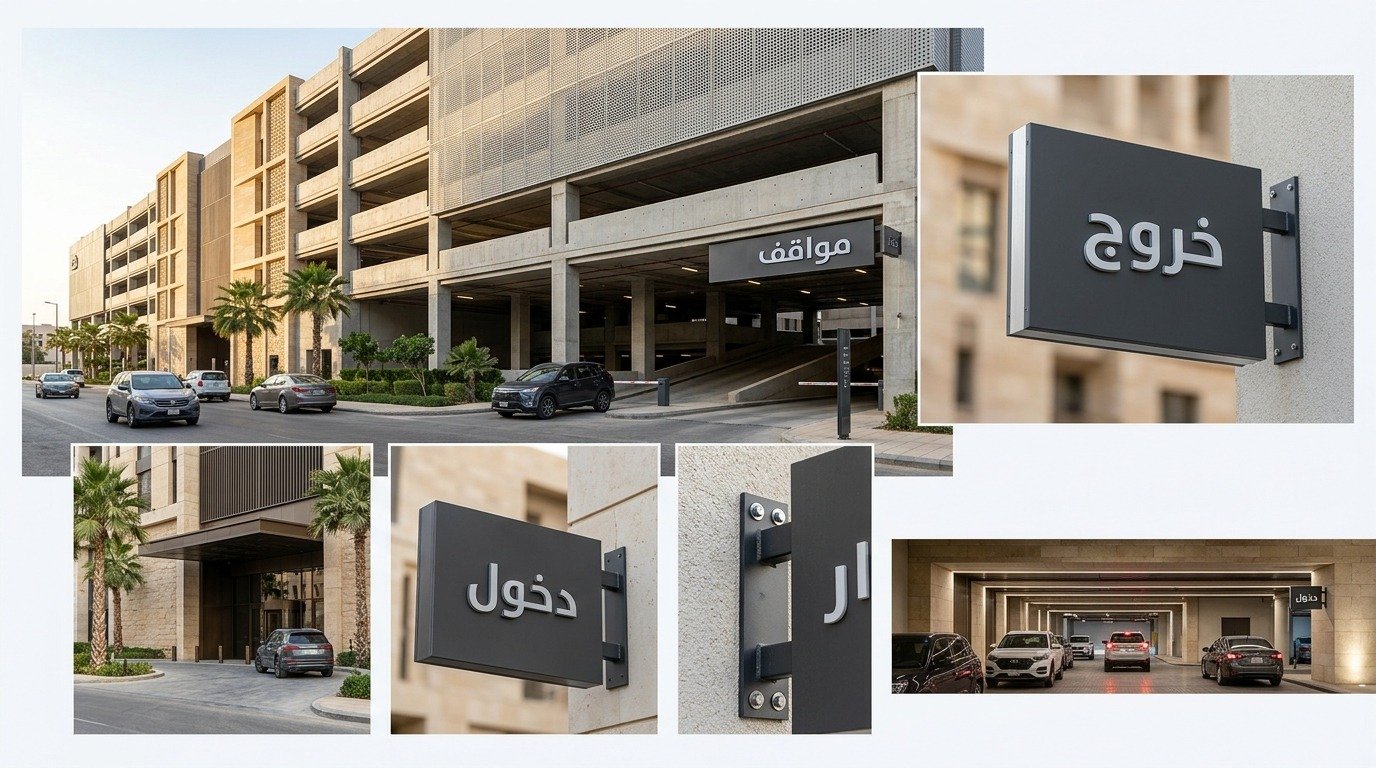
Parking facilities attached to malls, offices, and mixed-use developments deal with drivers trying to identify entrances at speed.
- For your entry and exit points, you can install a parking blade sign mounted high enough to be read from a moving vehicle, cutting down on missed turns and blocked entrances.
Need this sorted for your storefront or office building? Message us on WhatsApp, and we’ll walk you through it.
What a Blade Sign Costs in Riyadh
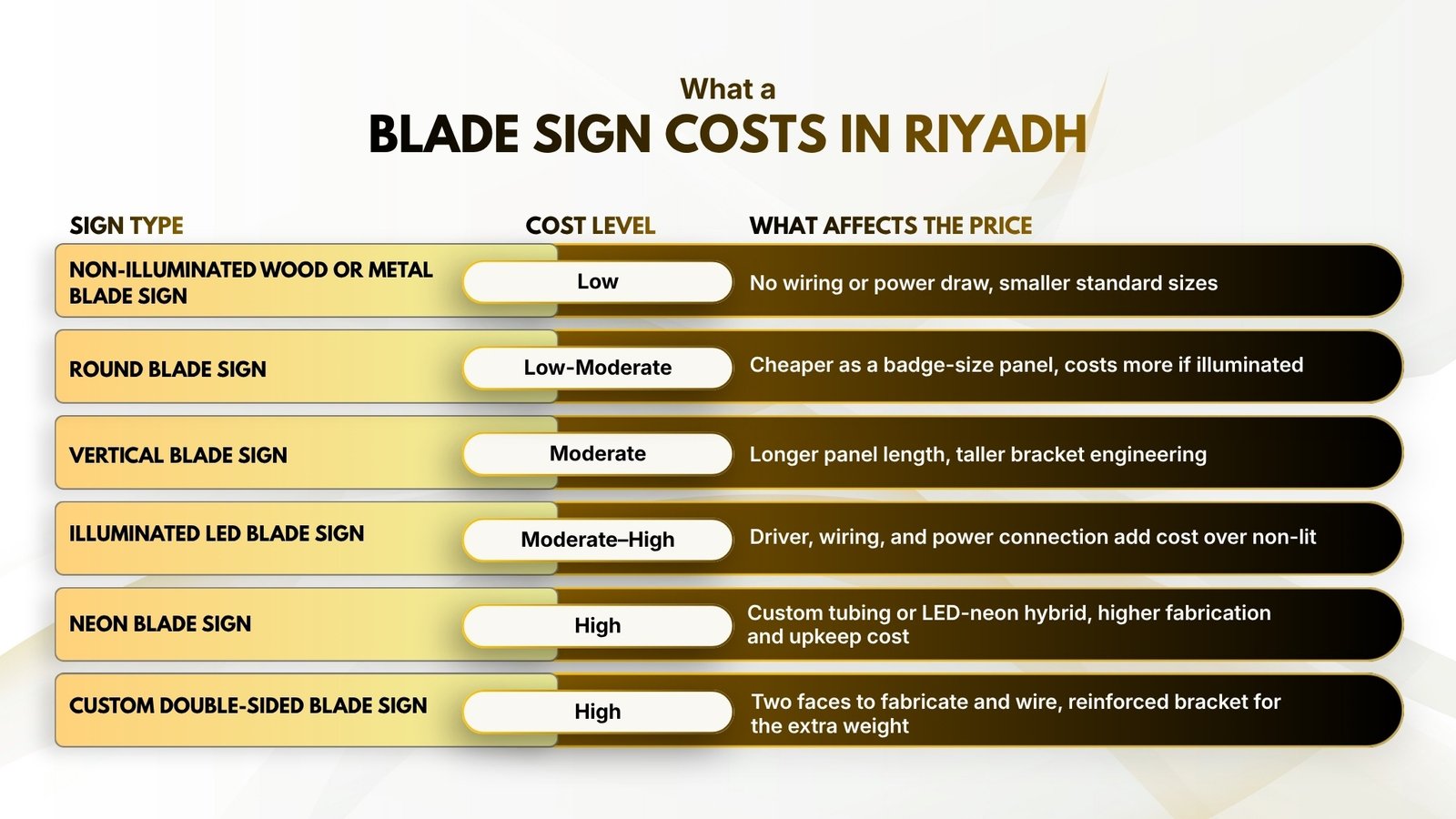
| Sign Type | Cost Level | What Affects the Price |
| Non-Illuminated Wood or Metal Blade Sign | Low | No wiring or power draw, smaller standard sizes |
| Round Blade Sign | Low-Moderate | Cheaper as a badge-size panel, costs more if illuminated |
| Vertical Blade Sign | Moderate | Longer panel length, taller bracket engineering |
| Illuminated LED Blade Sign | Moderate-High | Driver, wiring, and power connection add cost over non-lit |
| Neon Blade Sign | High | Custom tubing or LED-neon hybrid, higher fabrication and upkeep cost |
| Custom Double-Sided Blade Sign | High | Two faces to fabricate and wire, reinforced bracket for the extra weight |
What Are the Most Common Mistakes Related to Blade Signs
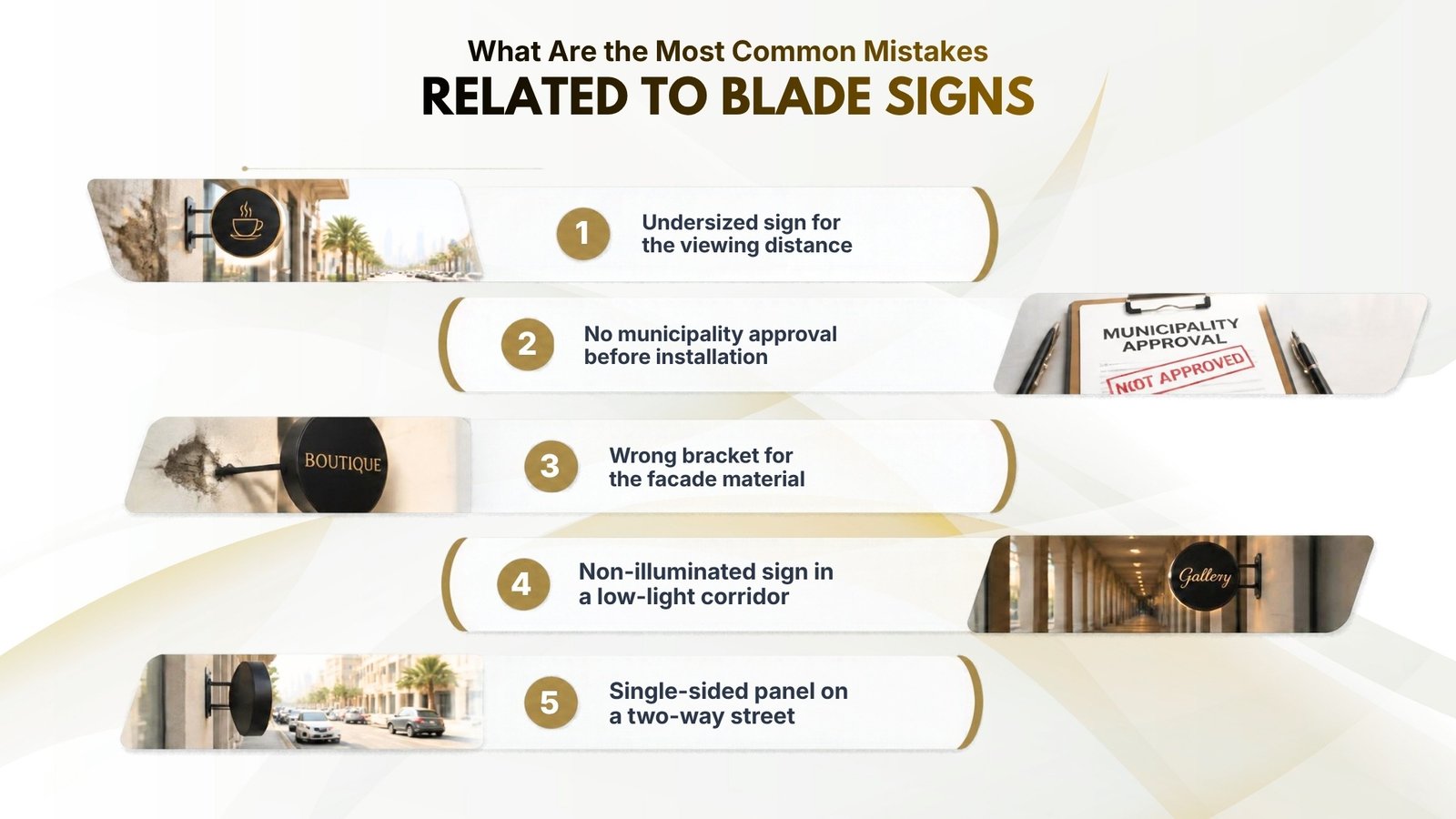
| Mistakes |
| Undersized sign for the viewing distance |
| No municipality approval before installation |
| Wrong bracket for the facade material |
| Non-illuminated sign in a low-light corridor |
| Single-sided panel on a two-way street |
How Etihad Golden Falcons Handles Blade Signs in Riyadh
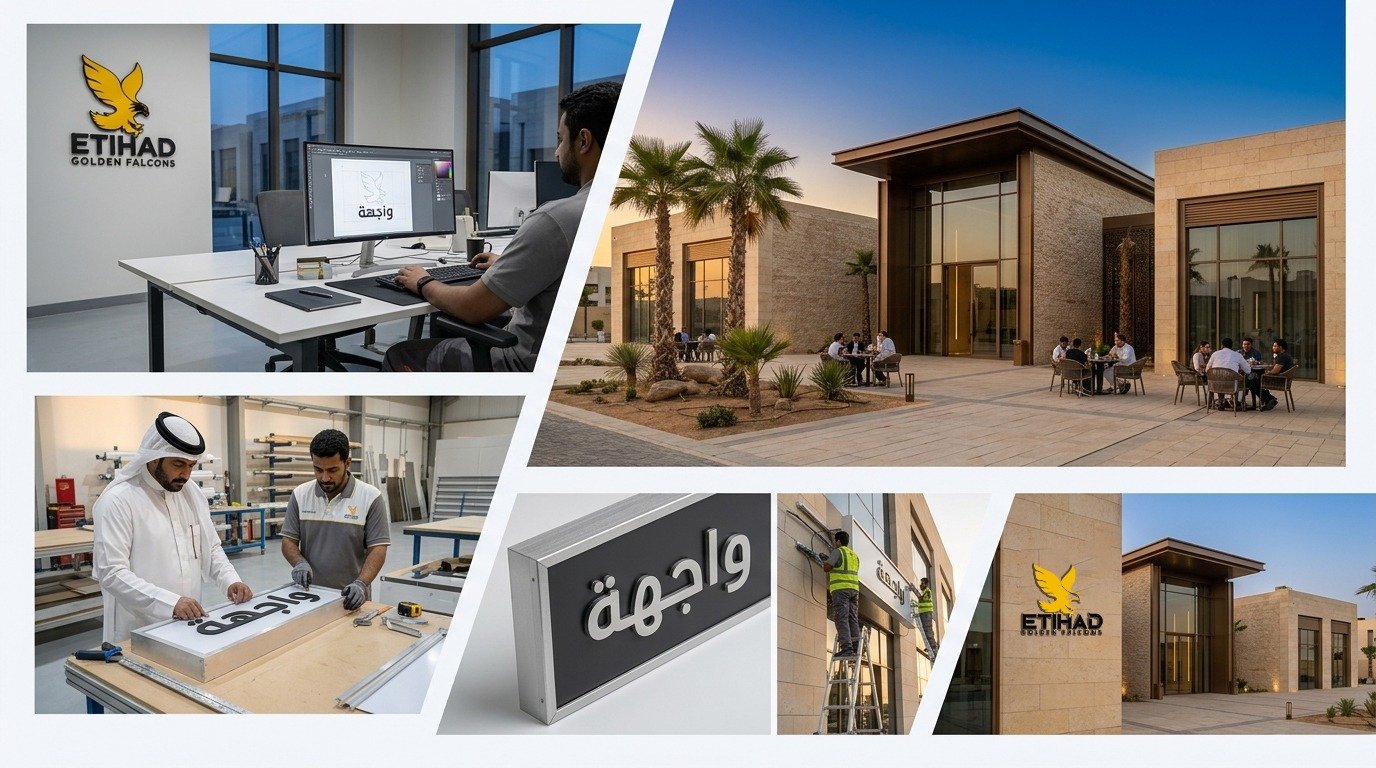
Every facade holds weight differently. A concrete ledge, a glass curtain wall, and a stone frontage each need a different bracket approach. We measure the mounting point before we fabricate, not after, so the bracket matches the wall it’s going on rather than a generic size.
We Handle the Drawings and Specs
We don’t file your municipality approval for you. What we do is prepare the technical drawings, dimensions, and material specs that your approval submission needs, and tell you exactly what has to go in front of the authorities before installation. Most delays on blade sign projects come from incomplete submissions, not rejected ones.
We Test the Angle Before We Install It
We check the sign’s readability from both directions of approach, at the actual mounting height, before it goes up permanently. A sign that looks right on a design file can still read wrong once it’s twelve feet off the ground on a moving street.
We Keep Illumination In-House From Fabrication to Wiring
LED and neon work goes through the same production floor as the sign body. That means one team is responsible for the whole unit, not a sign shop handing wiring off to a separate electrical subcontractor who never saw the design.
FAQs
A blade sign is a sign mounted perpendicular to a building face rather than flat against it, so it’s readable from the side by pedestrians and passing traffic instead of only head-on.
Yes, projecting signage over a public walkway or facing a street typically needs Balady approval before installation. We prepare the drawings and specs that submission requires and tell you exactly what to file.
A storefront sign sits flat against the building and only works for someone already facing it. A blade sign projects outward and stays readable from an angle, which is what makes it work on streets with set-back or shared facades.
Yes. LED and neon are the two common illumination methods, chosen based on whether you want a clean modern glow or a more distinct vintage-style effect.
Timelines depend on the approval process and the sign’s complexity, but fabrication itself typically runs on a short turnaround once specs and materials are confirmed.
Aluminum and powder-coated metal handle direct sun and heat without warping. Wood is better kept to interior or covered placements.
Most facades can support a blade sign with the right bracket. We assess the mounting surface first, whether it’s concrete, glass, or stone, and fabricate the bracket to match.