

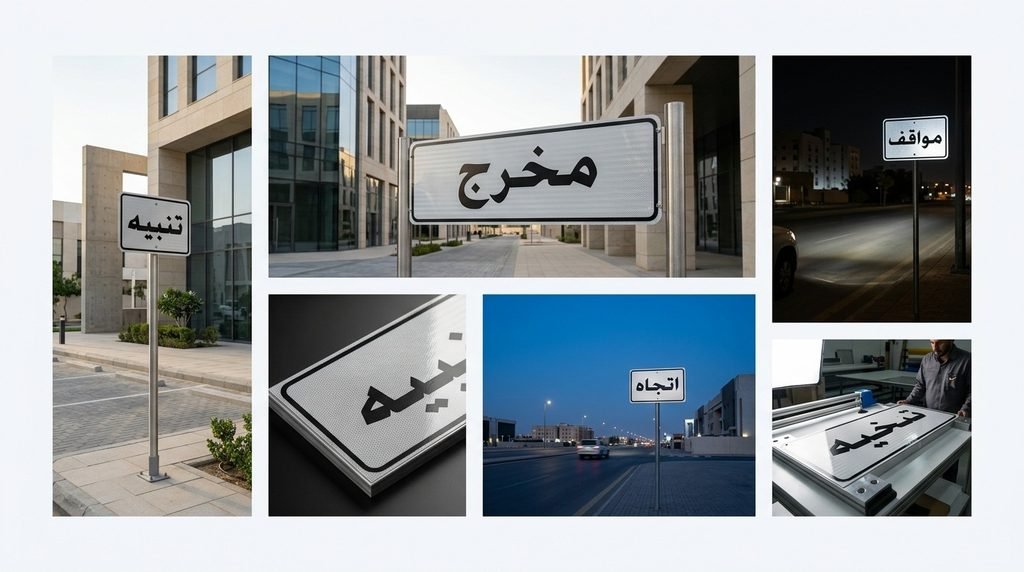
Reflective signs return light from headlights straight back to the driver. They do not glow and they do not need power. The surface is made of glass beads or tiny prisms that bounce the beam back along the path it arrived on.
Reflective signs in Riyadh cover road and traffic signs, street names, building numbers, exit routes, warning boards, parking signs, posts, and vehicle graphics. Anything a driver or visitor must read after dark is a candidate.
A printed sign without reflective sheeting is flat at night. The text is there, but the eye cannot find it until the car is almost on top of it. A reflective sign answers the headlight from a long way off. A flat one does not.
Why Reflective Signs Matter After Dark
Public road signs follow government specifications. Private roads, compounds, car parks, and industrial sites follow the specification of the developer or the operator. In both cases the rule is the same: the sign must be readable at the speed people actually drive.
Picture a driver looking for your gate at 9 pm. The sign is flat vinyl. They slow down to read it. The car behind brakes. They miss the entry and loop back through the next junction. It happens again the next night.
Three things decide whether a reflective sign works. The first is the sheeting grade. The second is the angle of the sign to the road. The third is how clean the face stays. Riyadh dust cuts reflectivity fast when nobody wipes the sign.
Types of Reflective Signs Available in Riyadh
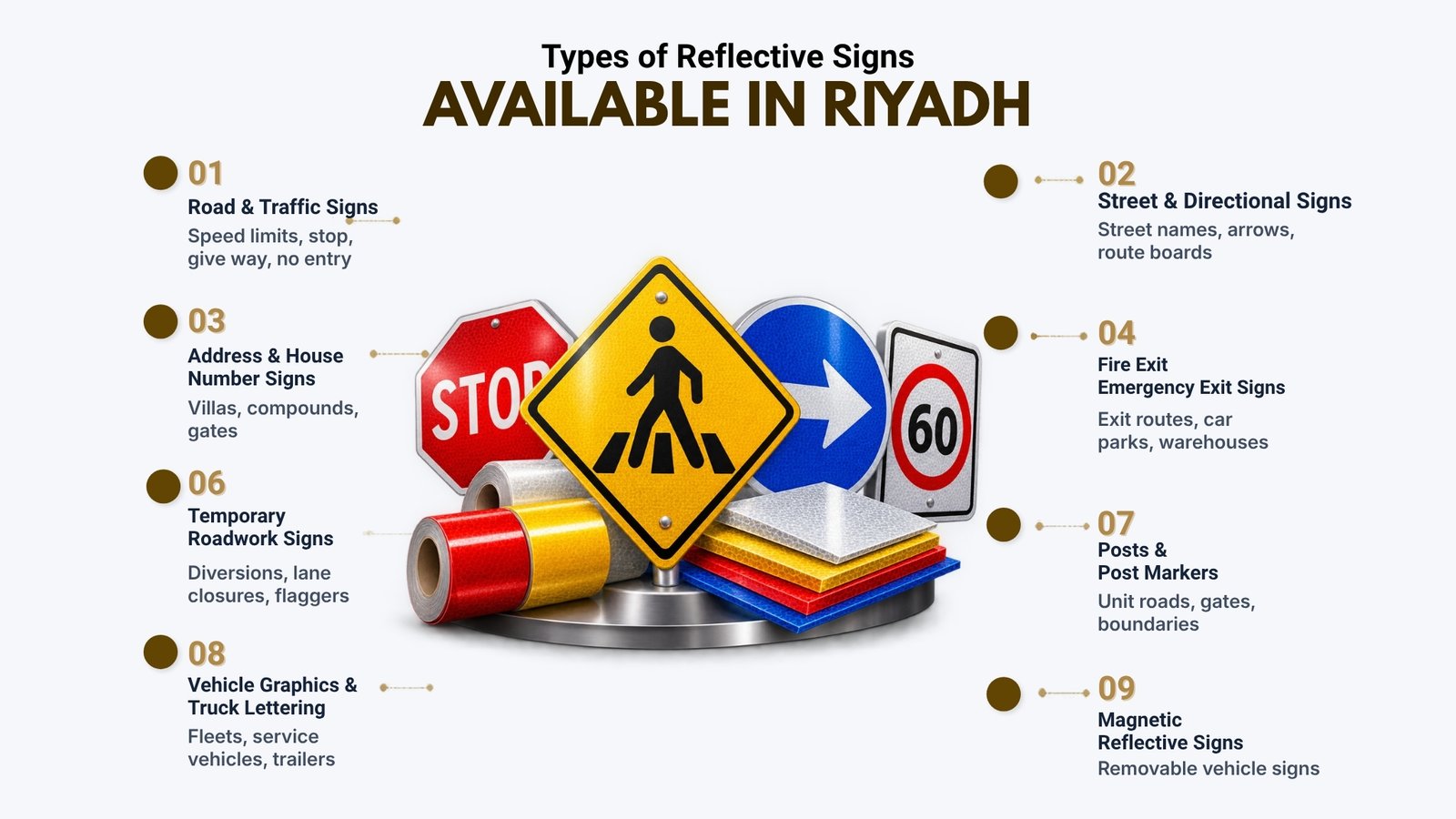
Each type does a different job. The table gives the overview. The sections below it explain where each one fits.
| Type | Typical Use |
| Road & Traffic Signs | Speed limits, stop, give way, no entry |
| Street & Directional Signs | Street names, arrows, route boards |
| Address & House Number Signs | Villas, compounds, gates |
| Fire Exit & Emergency Exit Signs | Exit routes, car parks, warehouses |
| Warning, Caution & Parking Signs | Hazards, bends, restricted zones |
| Temporary Roadwork Signs | Diversions, lane closures, flaggers |
| Posts & Post Markers | Unlit roads, gates, boundaries |
| Vehicle Graphics & Truck Lettering | Fleets, service vehicles, trailers |
| Magnetic Reflective Signs | Removable vehicle signs |
Road & Traffic Signs
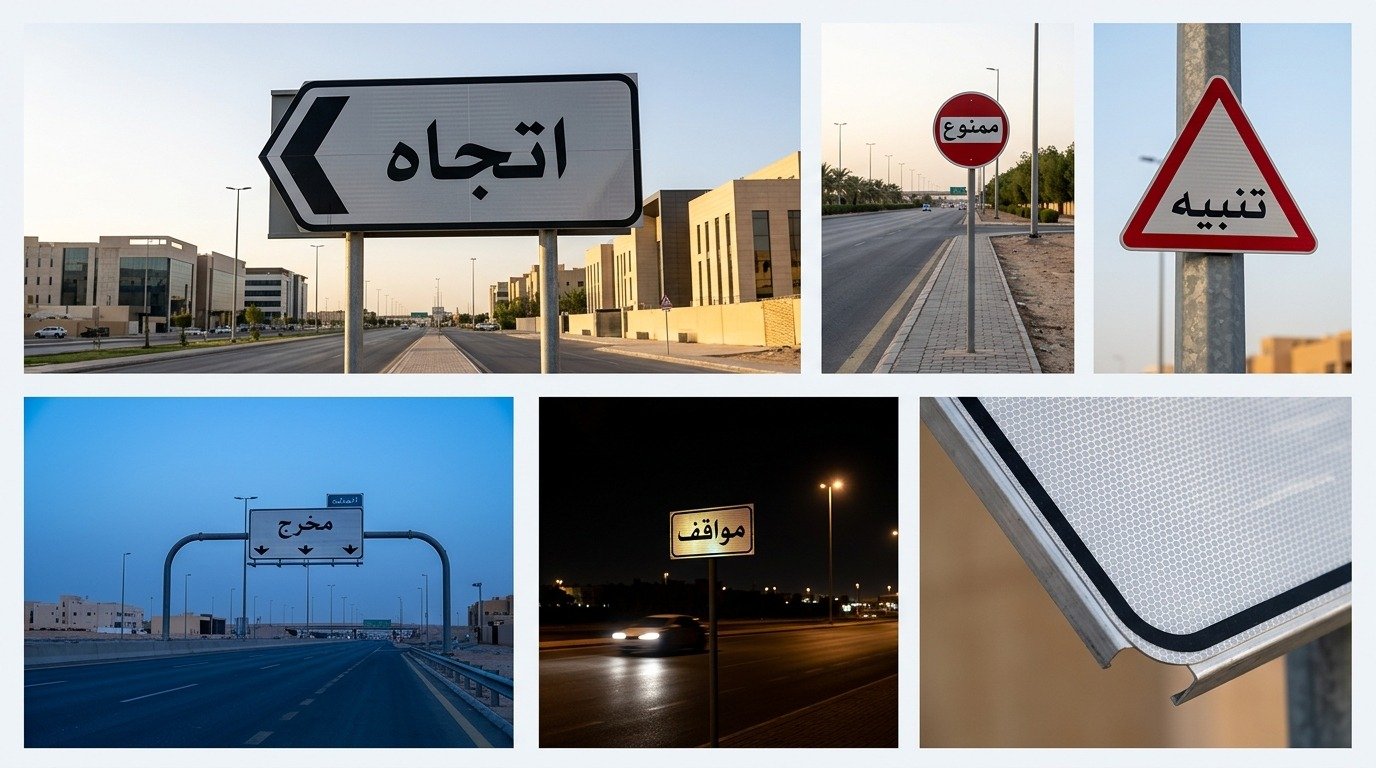
Reflective road signs and reflective traffic signs cover speed limits, stop signs, give way, and no entry boards. They are aluminum panels faced with high-intensity or prismatic sheeting, so shape and colour read from a distance. A reflective stop sign must be seen early enough for the driver to brake. The common mistake is choosing a low grade for a fast road. It looks fine at noon and weak at night.
Street & Directional Signs
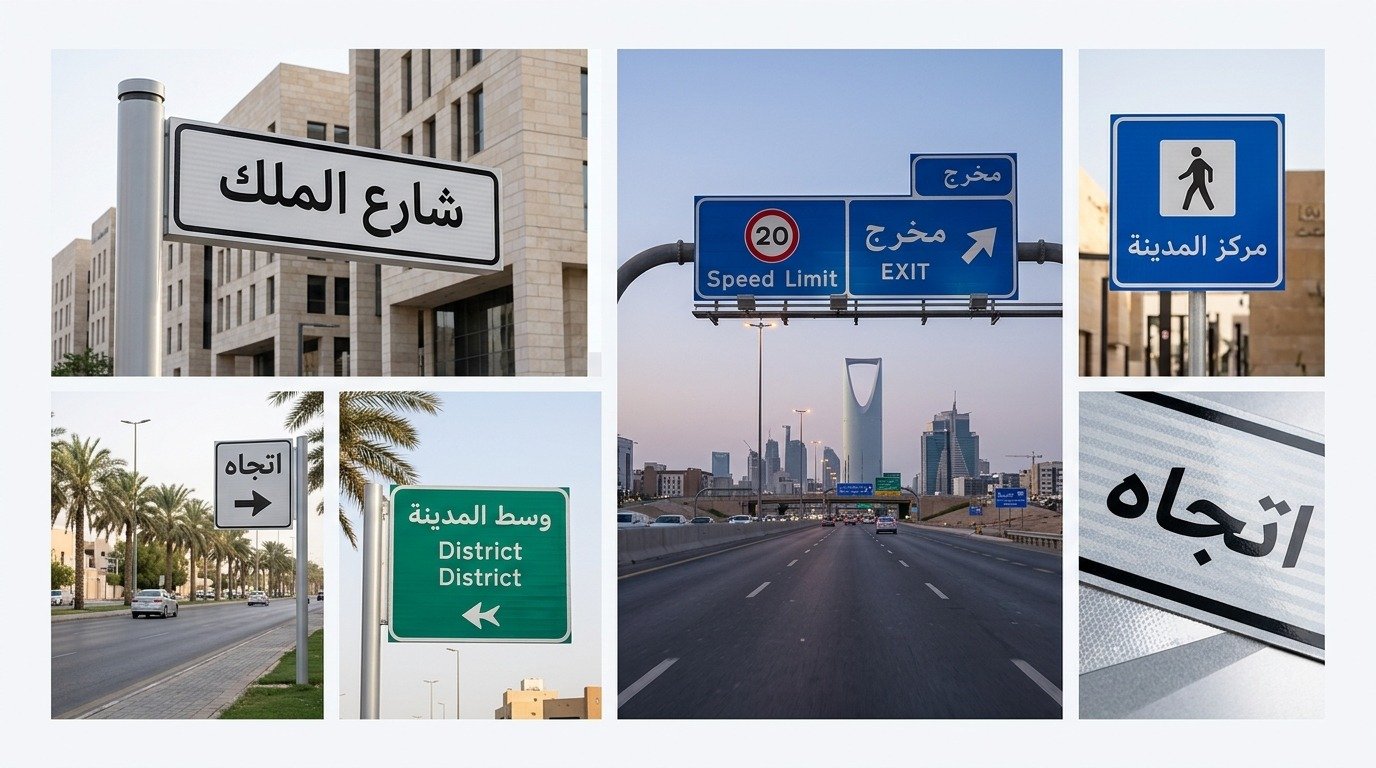
Reflective street signs name roads, blocks, and junctions. Custom reflective street signs match a compound or district style while keeping the sheeting grade high. Reflective directional signs, reflective arrow signs, and reflective directional arrows point drivers to entrances, parking levels, and drop-off zones. Text that is too small for the approach speed is the usual failure.
Address & House Number Signs
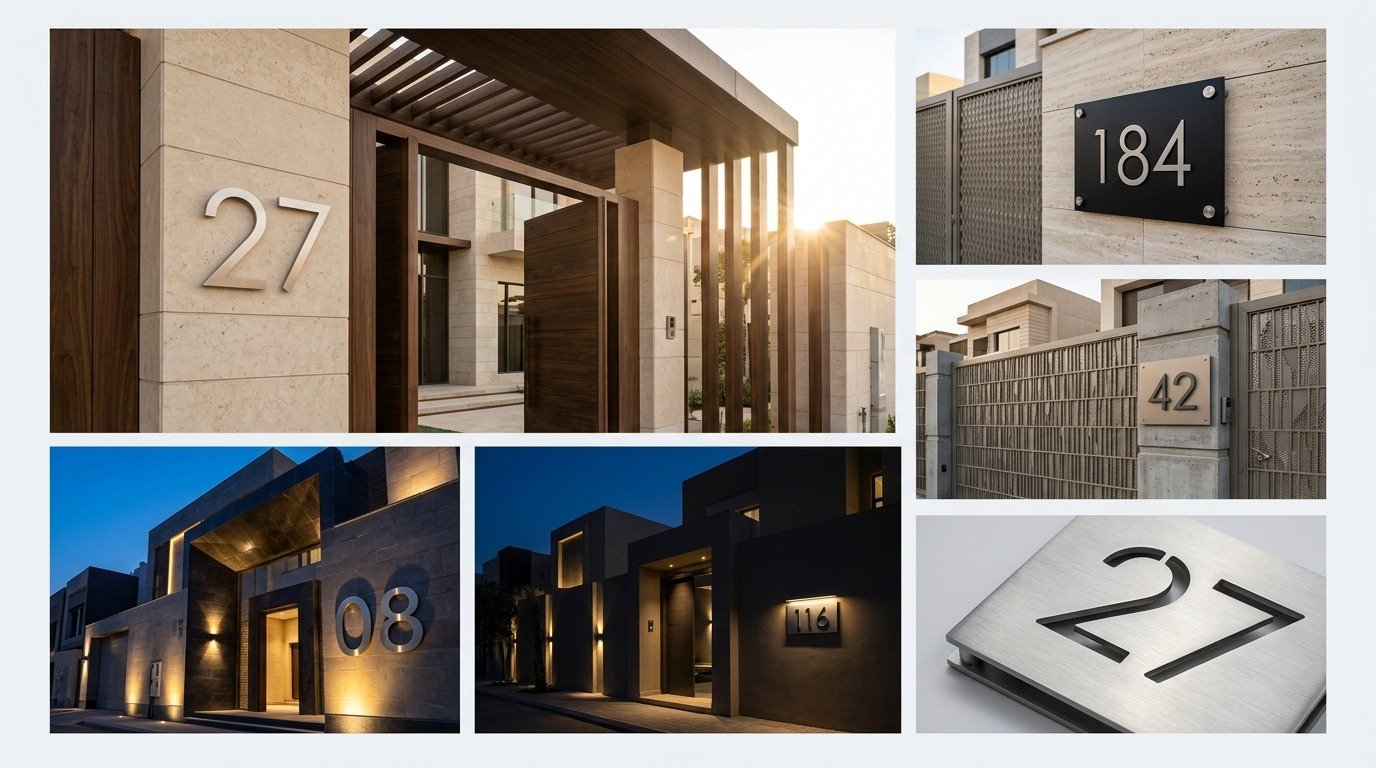
A reflective address sign lets delivery drivers, visitors, and responders read your number from the street. Reflective house number signs suit villas. A reflective address plaque suits a gate or boundary wall. Reflective street number signs and reflective address markers work for compounds with many units. Double-sided versions read from both directions of travel. The mistake is character height. If you cannot read the number from the kerb at night, the sign is too small.
Fire Exit & Emergency Exit Signs
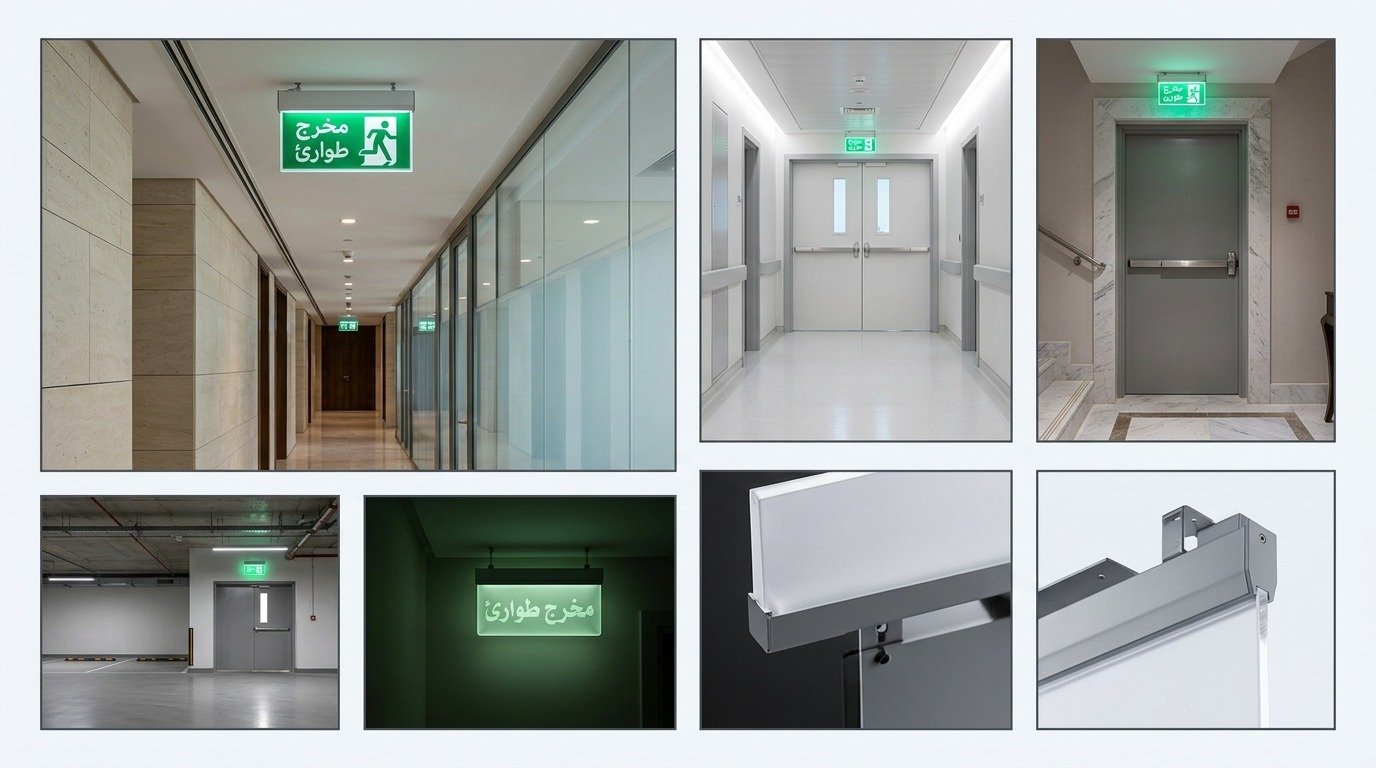
Reflective exit signs, reflective fire exit signs, and reflective emergency exit signs work only when light hits them. Headlights in a car park or a torch in a stairwell will do it. A power cut with no light source leaves them dark. Use them in car parks, warehouses, and service corridors where vehicles or torches light the sign. Where Civil Defense requires illuminated or photoluminescent exit signs, a reflective sign supports them. It does not replace them.
Warning, Caution & Parking Signs
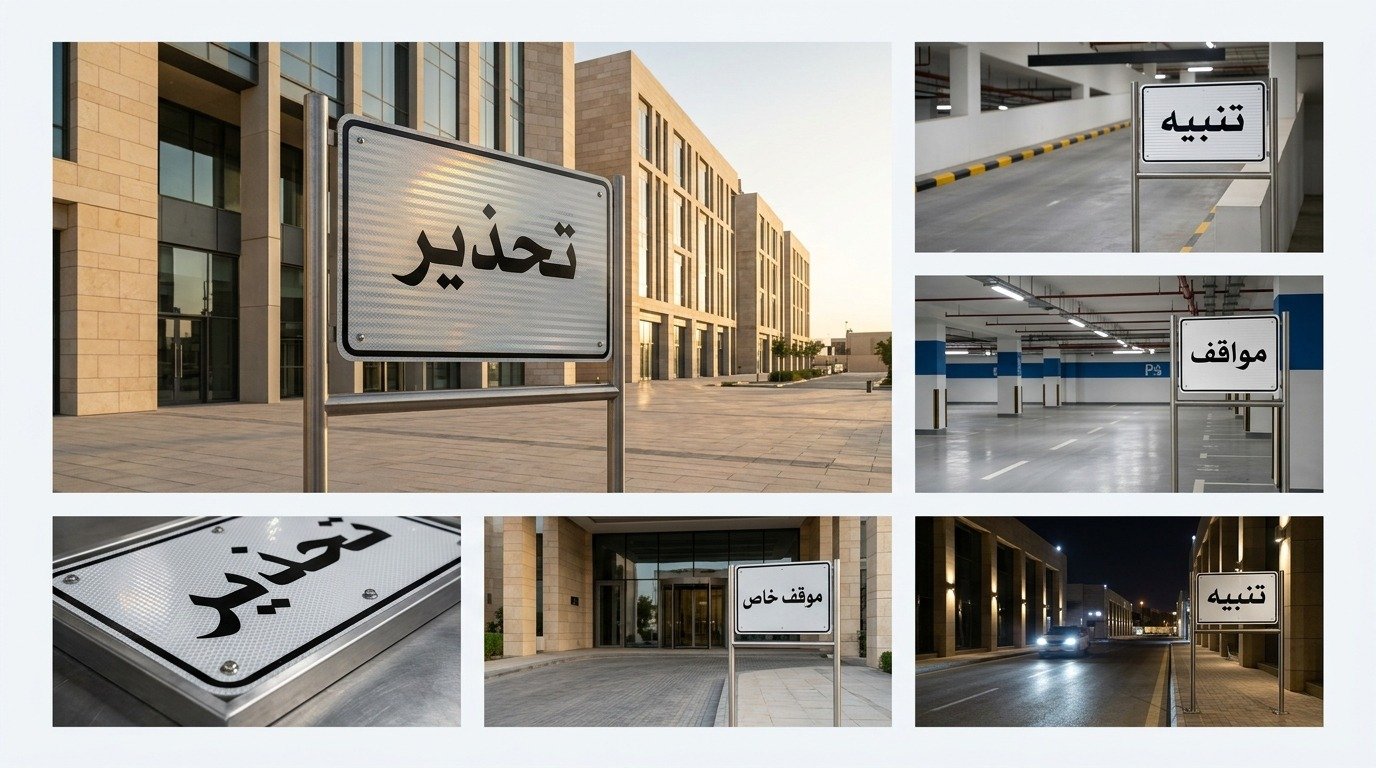
Reflective warning signs and reflective caution signs mark hazards, bends, and restricted areas. Reflective chevron signs line sharp curves so drivers read the road shape early. Reflective no parking signs anxd reflective parking signs control bays, fire lanes, and loading zones. A reflective oversize load sign warns following drivers. Yellow reflective signs and fluorescent road signs stand out in dust and low light. Mixing sheeting batches in one set of signs creates visible colour differences.
Temporary Roadwork Signs
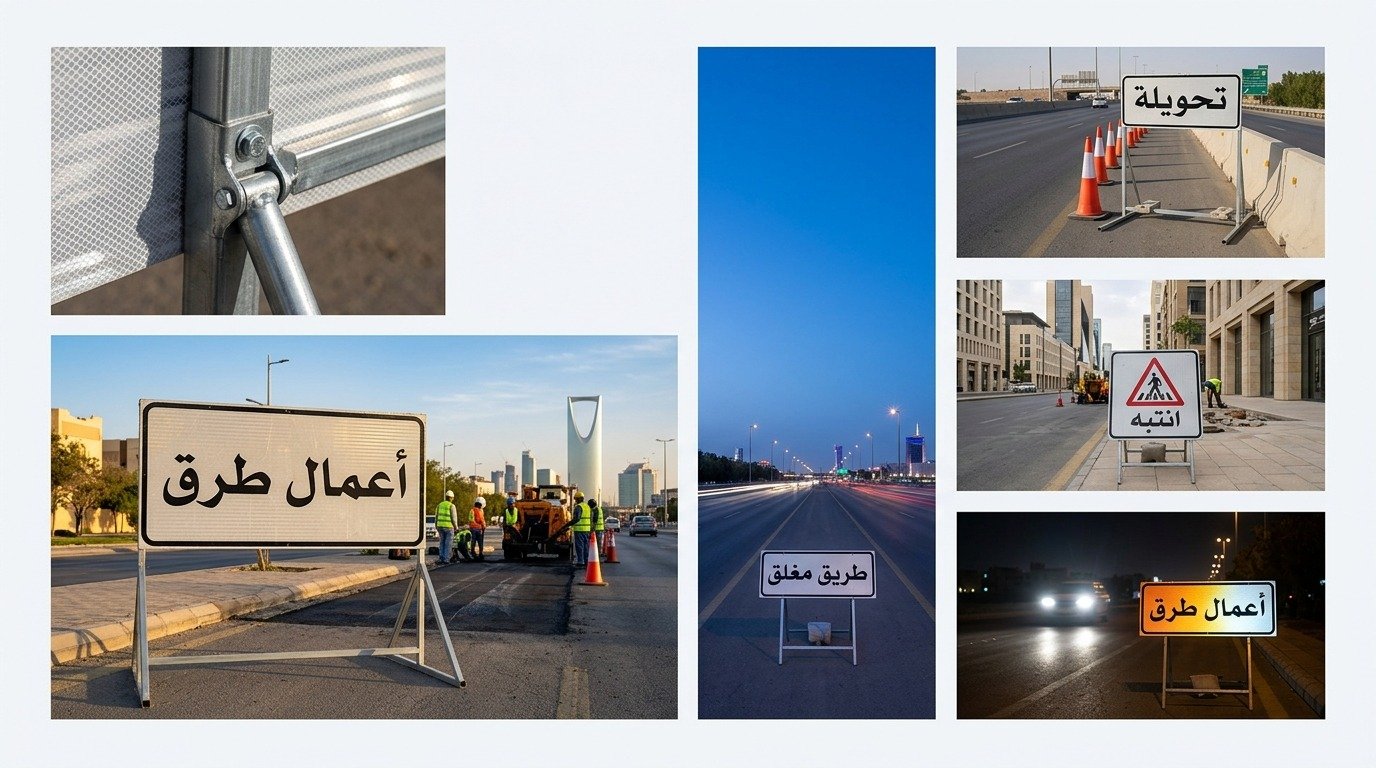
Reflective roll up traffic signs and reflective roll up signs fold into a vehicle and go up in minutes. Stop slow paddles with reflective faces keep flaggers visible at night. Reflective coroplast signs suit short jobs only. They warp in heat and do not last a long project. Use aluminum when the work runs for months.
Posts & Post Markers
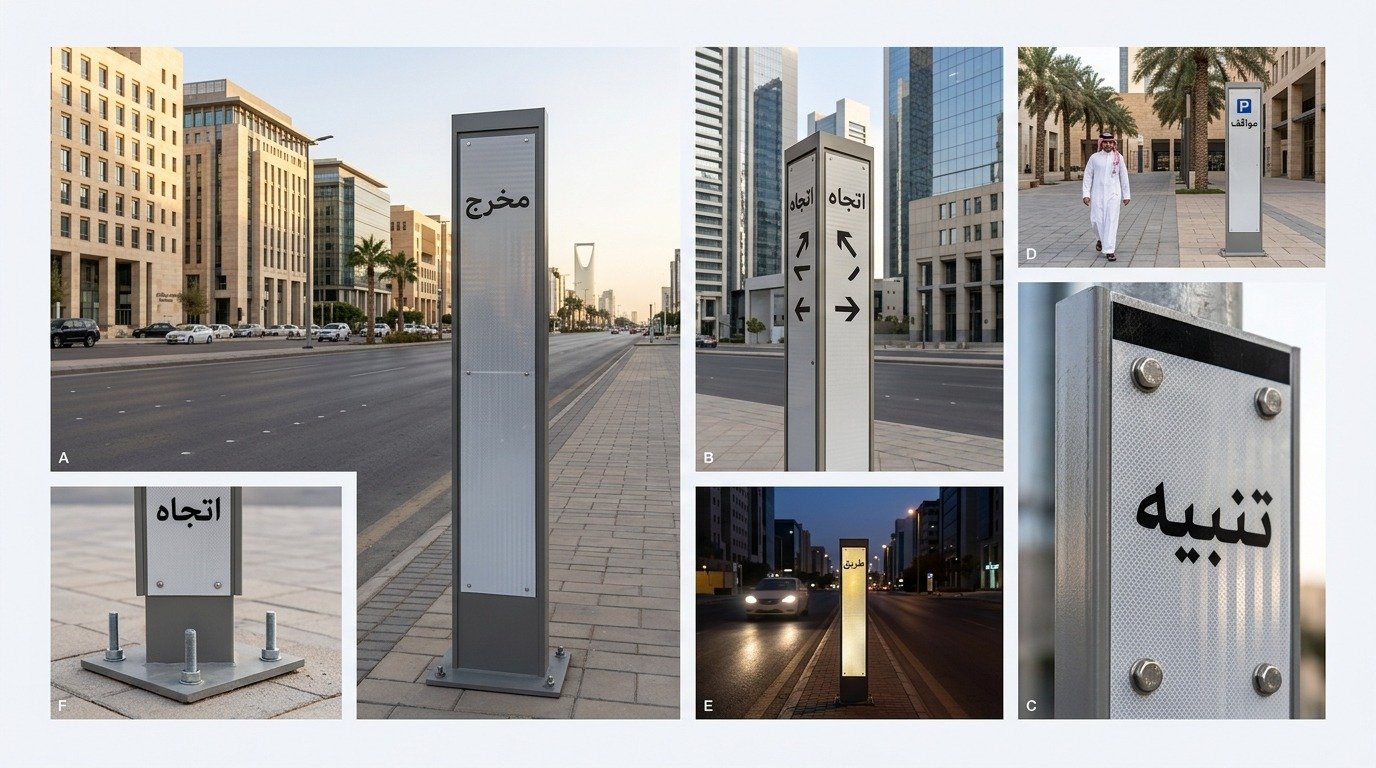
Reflective posts and reflective post markers outline roads, gates, and boundaries where there are no streetlights. Reflective road posts and traffic reflector posts show the edge of the road before the driver reaches it. Post height matters. A marker set too low disappears behind sand and vegetation.
Vehicle Graphics & Truck Lettering

Reflective vehicle graphics put your fleet name and number where headlights find them. A reflective vehicle wrap covers rear and side panels of service vehicles. Reflective truck lettering and reflective lettering for vehicles suit cab doors and trailer sides. Truck reflective signs on the rear panel warn following traffic. Printed colour over reflective vinyl reduces brightness, so we cut text and symbols in solid colour.
Magnetic Reflective Signs
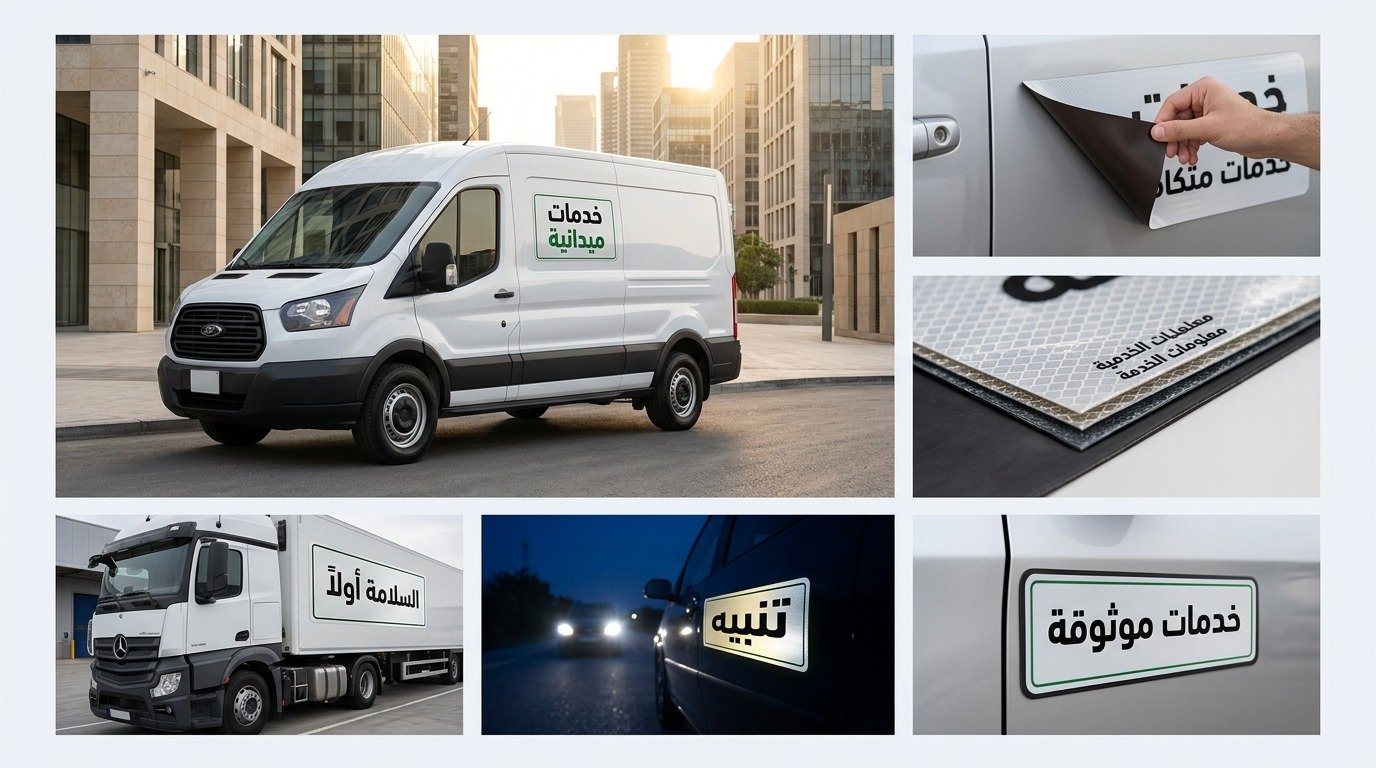
Reflective magnetic car signs and reflective magnetic vehicle signs suit vehicles that change jobs, drivers, or contracts. They go on and come off in seconds. Clean the panel under the magnet regularly. Trapped dust and moisture mark the paint.
Materials & Sheeting Grades for Reflective Signs
Reflectivity comes from the sheeting. The substrate decides how long the sign stays straight and flat.
| Material | Best For |
| Engineer-grade sheeting (ASTM D4956 Type 1) | Low-speed private roads |
| High-intensity sheeting | Compounds, mixed traffic |
| Prismatic sheeting (ASTM D4956 Type XI) | Fast roads, junctions, curves |
| Aluminum panels | Permanent signs |
| Reflective coroplast | Short-term signs |
| Reflective vinyl graphics | Vehicles, lettering, decals |
| Reflective tape | Edges, posts, safety stripes |
Use engineer-grade sheeting if you are:
- Marking a private road with low speeds and good street lighting
- Putting up signs for a short project
Use high-intensity sheeting if you are:
- Signing a compound with mixed traffic and limited lighting
- Replacing signs that have already faded
Use prismatic sheeting if you are:
- Signing a fast road, slip road, or roundabout
- Needing visibility from wide angles on curves
Prismatic reflective vinyl holds brightness at wider viewing angles than the lower grades. High-intensity prismatic vinyl sits between the two for most commercial sites.
Reflective vinyl printing needs one decision up front. Printed colours sit over white sheeting as a transparent layer and reduce brightness. Use print for large artwork. Use cut vinyl for text and symbols that must stay bright. Non reflective vinyl is flat at night, so keep it for daytime-only graphics.
Aluminum thickness also matters. Thin reflective aluminum signs flex on tall posts and warp in wind. Reflective metal signs on posts need a panel thickness matched to size.
Where Reflective Signs Work: Industries, Properties & Public Spaces
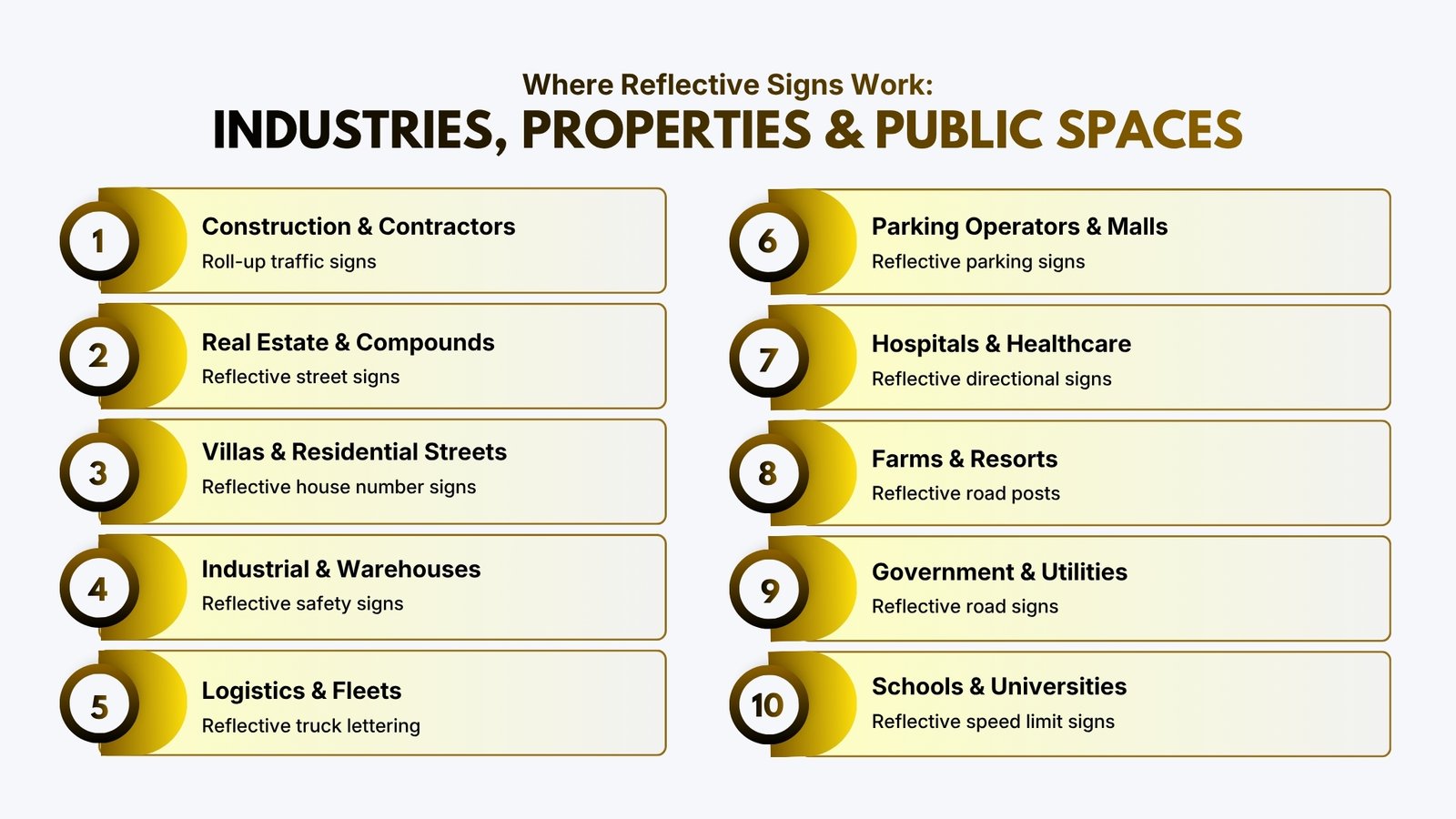
Different sites need different signs. Below is where each type fits and what it does once it is up.
| Business Type | Best-Fit Product |
| Construction & Contractors | Roll-up traffic signs |
| Real Estate & Compounds | Reflective street signs |
| Villas & Residential Streets | Reflective house number signs |
| Industrial & Warehouses | Reflective safety signs |
| Logistics & Fleets | Reflective truck lettering |
| Parking Operators & Malls | Reflective parking signs |
| Hospitals & Healthcare | Reflective directional signs |
| Farms & Resorts | Reflective road posts |
| Government & Utilities | Reflective road signs |
| Schools & Universities | Reflective speed limit signs |
Construction, Roadworks & Contractors
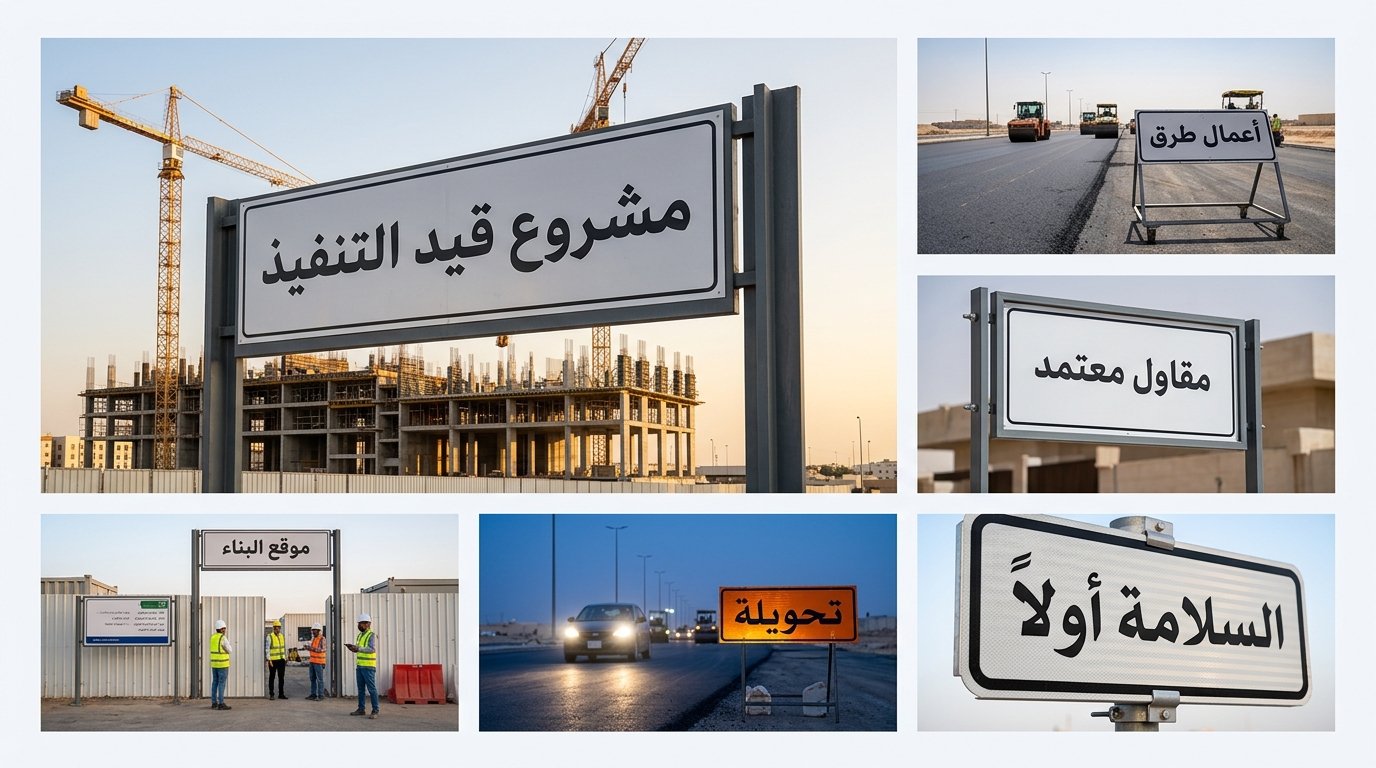
Road contractors, building contractors, utility crews, and site managers all work beside live traffic.
Your crew starts before sunrise or finishes after dark. Drivers reach the work zone at full speed, and what they see in the first few seconds decides whether they slow down. How do you warn them early enough? How do you mark a diversion that changes every week? How do you keep a flagger visible at 2 am?
A fixed sign cannot answer those questions, because the work zone keeps moving. Signs for this sector must go up fast, come down fast, and still read from a distance.
- For site entrances, haul routes, and diversions, you can use roll-up traffic signs. They fold into a vehicle, go up in minutes, and move when the work moves. A reflective face means drivers read the warning well before the first cone.
- For lane closures and one-way working, you can use stop slow paddles with reflective faces. The flagger holds the message, and the reflective face keeps it readable when headlights are the only light on the road.
- For the site boundary and gate, you can mount reflective warning signs that tell passing drivers where trucks enter and exit. Trucks turning into a site after dark are easy to miss without them.
Real Estate, Compounds & Gated Communities
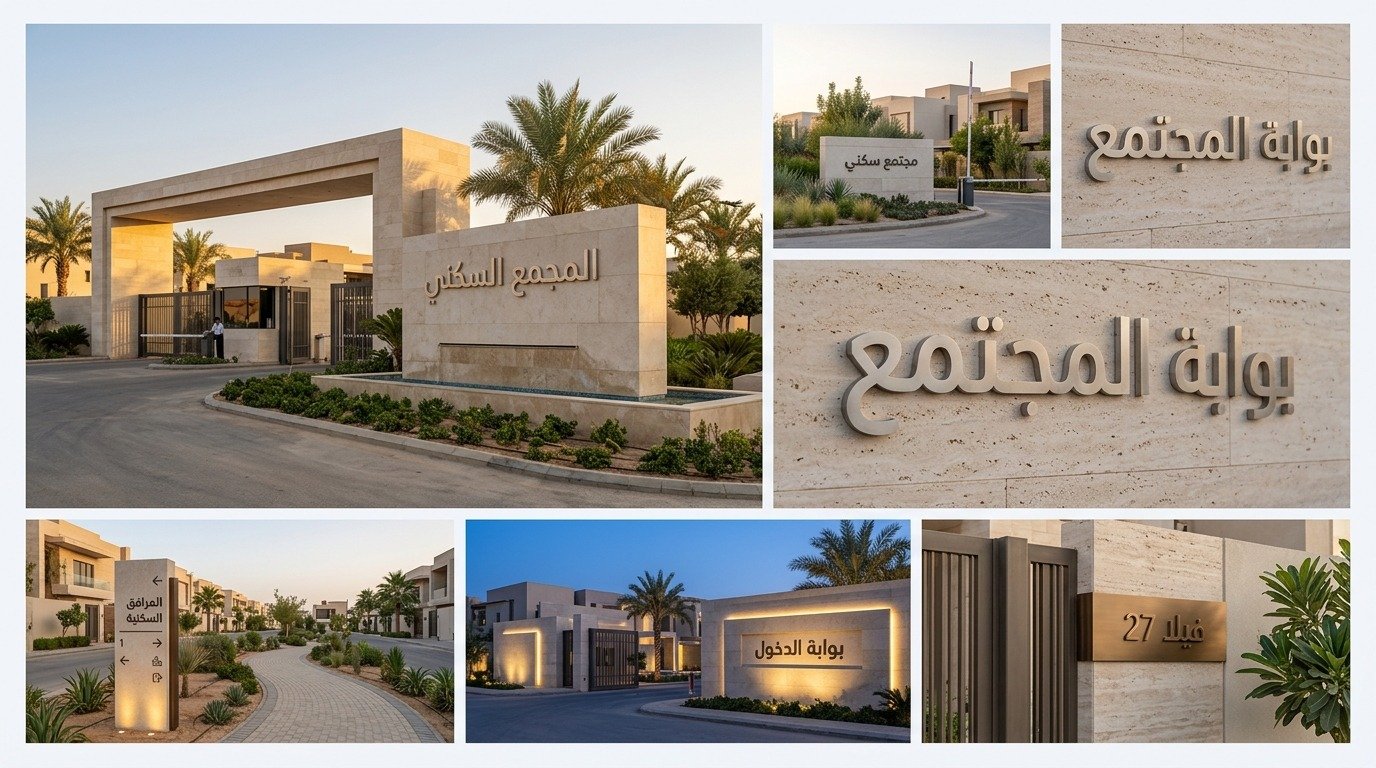
Developers, property managers, owners’ associations, and residential compound operators all run internal road networks.
A compound has its own roads, but not always a streetlight at every junction. Residents know where they are going. Delivery drivers, visitors, maintenance crews, and guests do not. They ask: which block is this? Which way is the clubhouse? Is this road one-way?
When signs fail after dark, those questions go to the guard at the gate. Then the calls go to the management office. Good signs answer the questions before anyone asks.
- For internal roads and junctions, you can install reflective street signs that name each road and block. A visitor finds the right turn from the driver’s seat, without stopping to check a phone.
- For sharp bends, T-junctions, and cul-de-sac ends, you can add reflective chevron signs. They show the road shape early, which matters where a driver who does not know the road arrives too fast.
- For speed control, you can place reflective speed limit signs at entries and near play areas. The limit stays readable at night, not only in daylight.
Villas & Residential Streets
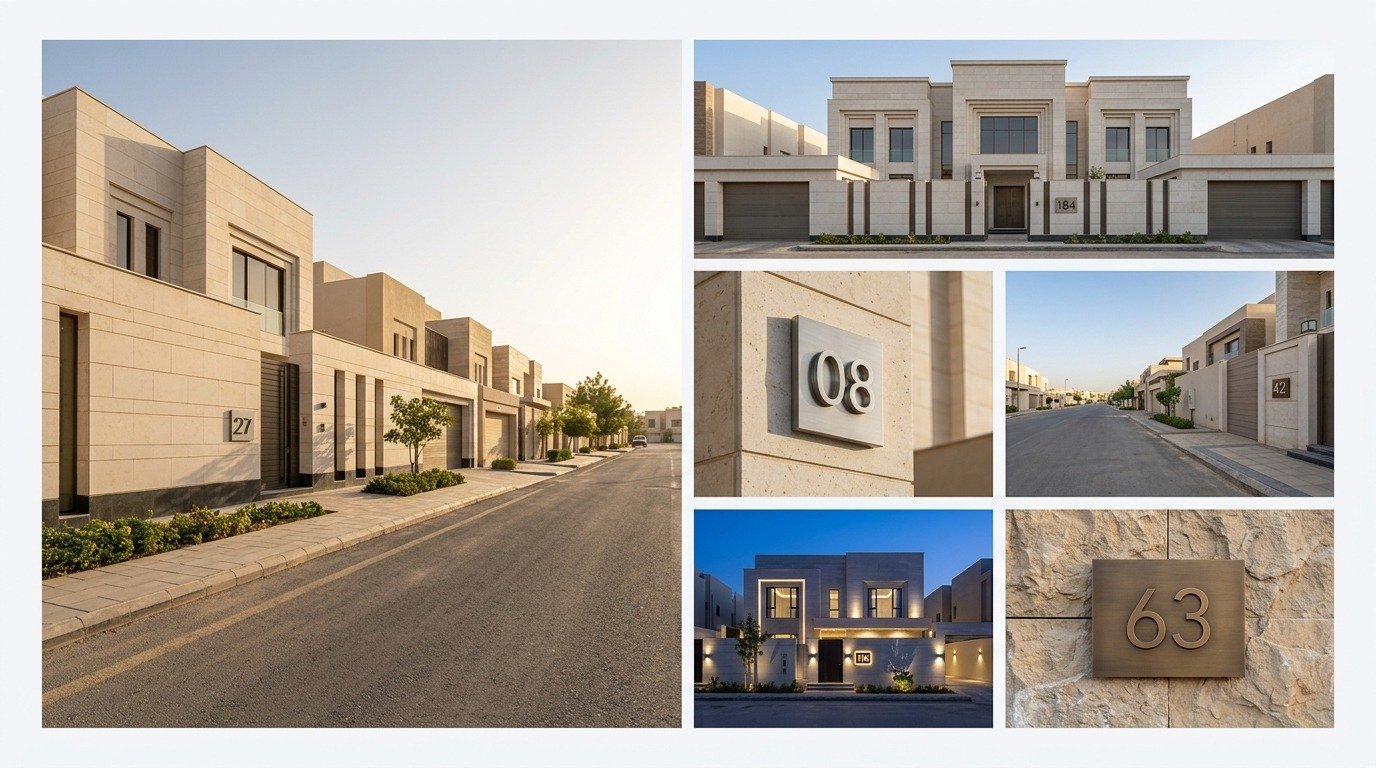
Villa owners, landlords, and family compounds all share one problem: visitors cannot find the house.
You have probably taken the call. “I am outside, which one is yours?” Delivery drivers circle the street. Ride-hailing drivers stop at the wrong gate. Guests arrive late and annoyed. On a street with weak lighting, a painted number on a wall is invisible until the car is level with it.
A house number has one job. It must be readable from a slow-moving car, in the dark, from the street side. Most numbers fail that test.
- For the gate or boundary wall, you can install reflective house number signs. The number lights up under the driver’s headlights, so they confirm the house from the car without stopping.
- For streets with two-way approach or poor lighting, you can use a double sided reflective address sign. It reads from both directions, so it works whichever way the driver arrives.
- For corner villas and long boundary walls, you can mount a reflective address plaque at the corner. The driver sees the address before reaching the gate.
Industrial Zones, Factories & Warehouses

Factory owners, plant managers, warehouse operators, cold store operators, and safety officers all manage yards that never fully stop.
Forklifts, trailers, and reversing trucks share one yard. Shifts run through the night. Lighting is patchy between buildings. Where do trucks stop? Where do people walk? Who gives way at the junction? Where is the nearest extinguisher when that bay is dark? If you are the safety officer, you may also be asked to show that the yard is clearly marked.
Signs that disappear after dark leave drivers and walkers guessing. Guessing in a yard with moving vehicles ends badly.
- For yard junctions, loading bays, and pedestrian crossings, you can install reflective safety signs. They read under truck headlights, so drivers see the rule before they reach the hazard.
- For extinguisher points near vehicle routes, you can fit reflective fire extinguisher signs. A worker finds the point quickly even when overhead lights are off or blocked.
- For one-way flows and reversing areas, you can use reflective arrow signs. They keep trucks moving in the intended direction on every shift.
Logistics, Transport & Fleet Operators
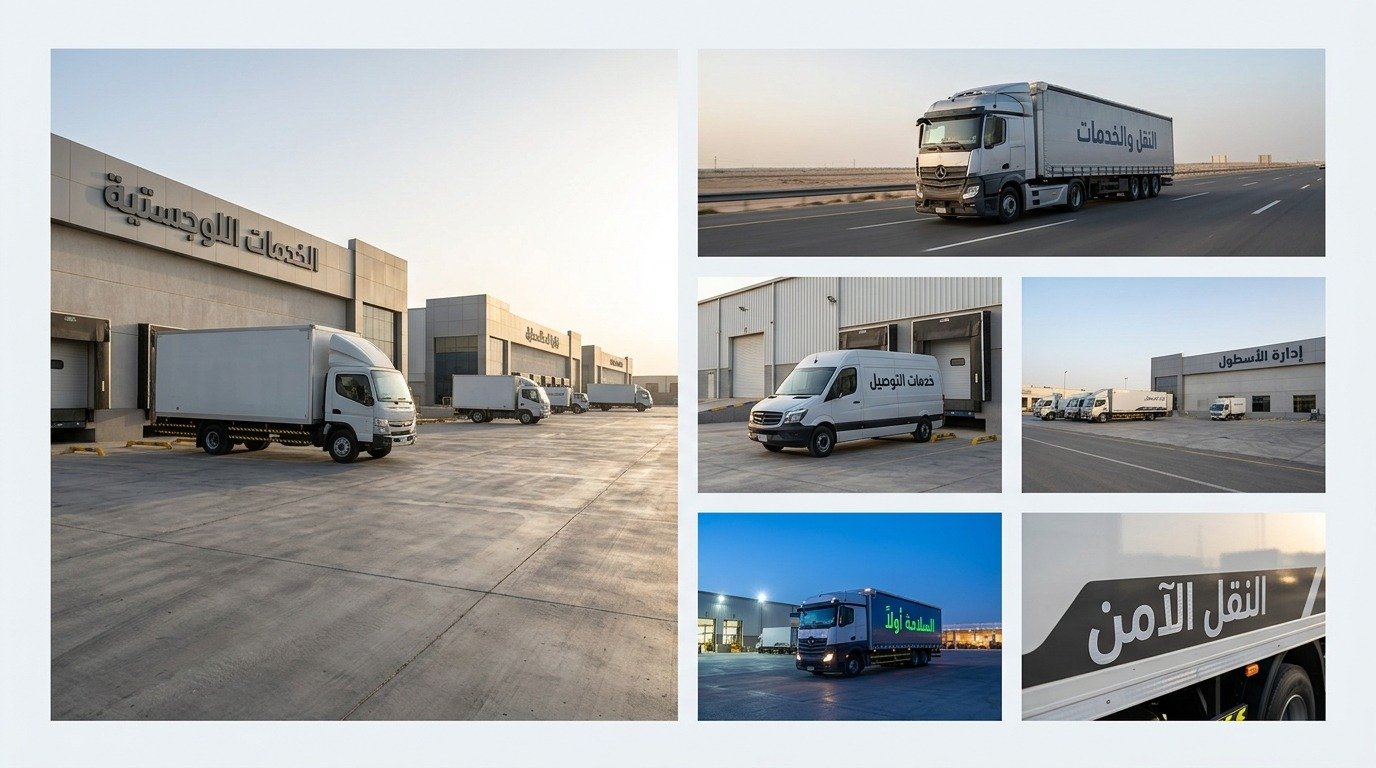
Courier firms, haulage companies, car rental fleets, and bus and delivery operators put dozens of vehicles on the road every night.
Fleet owners ask practical questions. Can other drivers see my truck from behind at night? Can a customer read the fleet name and number at the roadside? Can the guard at a depot gate identify my vehicle in the dark? A slow or stopped truck at night is hard to judge from behind. A vehicle with no reflective markings is also a moving brand that disappears when the sun sets.
Reflective markings answer both problems. They show other drivers the size and position of the vehicle. They keep your name and number readable.
- For cab doors and trailer sides, you can apply reflective truck lettering. Cut vinyl keeps full brightness, so the fleet name, number, and contact stay readable under headlights and at depot gates.
- For rear and side panels, you can use a reflective vehicle wrap. It outlines the vehicle, so following drivers judge size and distance sooner.
- For rental or hired vehicles that change contracts, you can use reflective magnetic car signs. They go on and come off in seconds, so the vehicle is marked for the job without a permanent graphic.
Parking Operators, Malls & Retail Centres
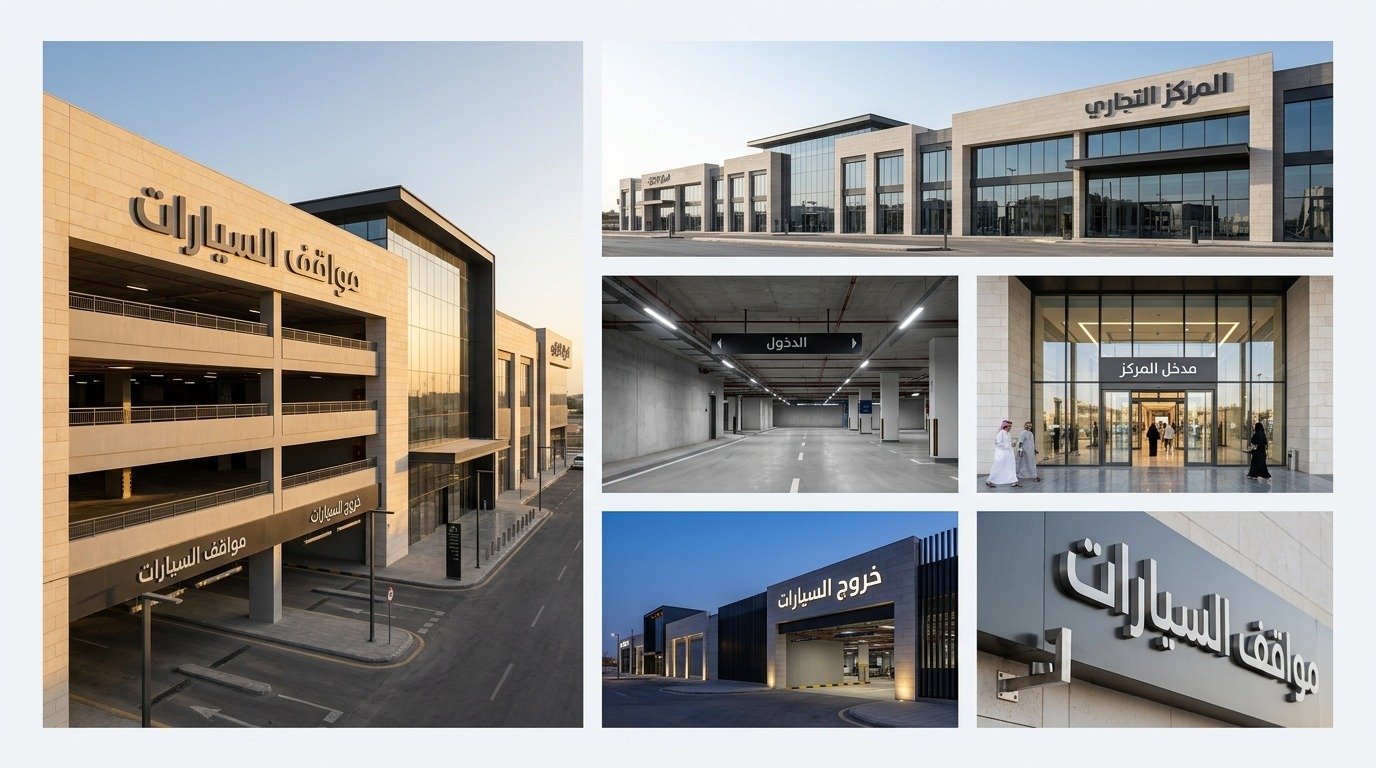
Mall managers, car park operators, hypermarket owners, and event venue teams all handle heavy evening traffic.
Evening peak is the hard hour. Cars queue at the ramp. Drivers are tired, and some do not know the building. They ask: where is the entrance? Which level has space? Which lane is the exit? Can I park here? When signs are hard to read, drivers enter the wrong lane, stop at the ramp to look, and block the cars behind them. Fire lanes and loading bays fill with parked cars because nobody could read the restriction.
- For entries, ramps, and level changes, you can install reflective parking signs with arrows and level numbers. Drivers read them from the lane and keep moving.
- For fire lanes, loading bays, and drop-off zones, you can mount reflective no parking signs. A driver cannot follow a rule they could not see, so a visible sign also supports enforcement.
- For exit lanes and ramp ends, you can add reflective arrow signs. They keep the flow in one direction and reduce wrong-way entries.
Hospitals & Healthcare
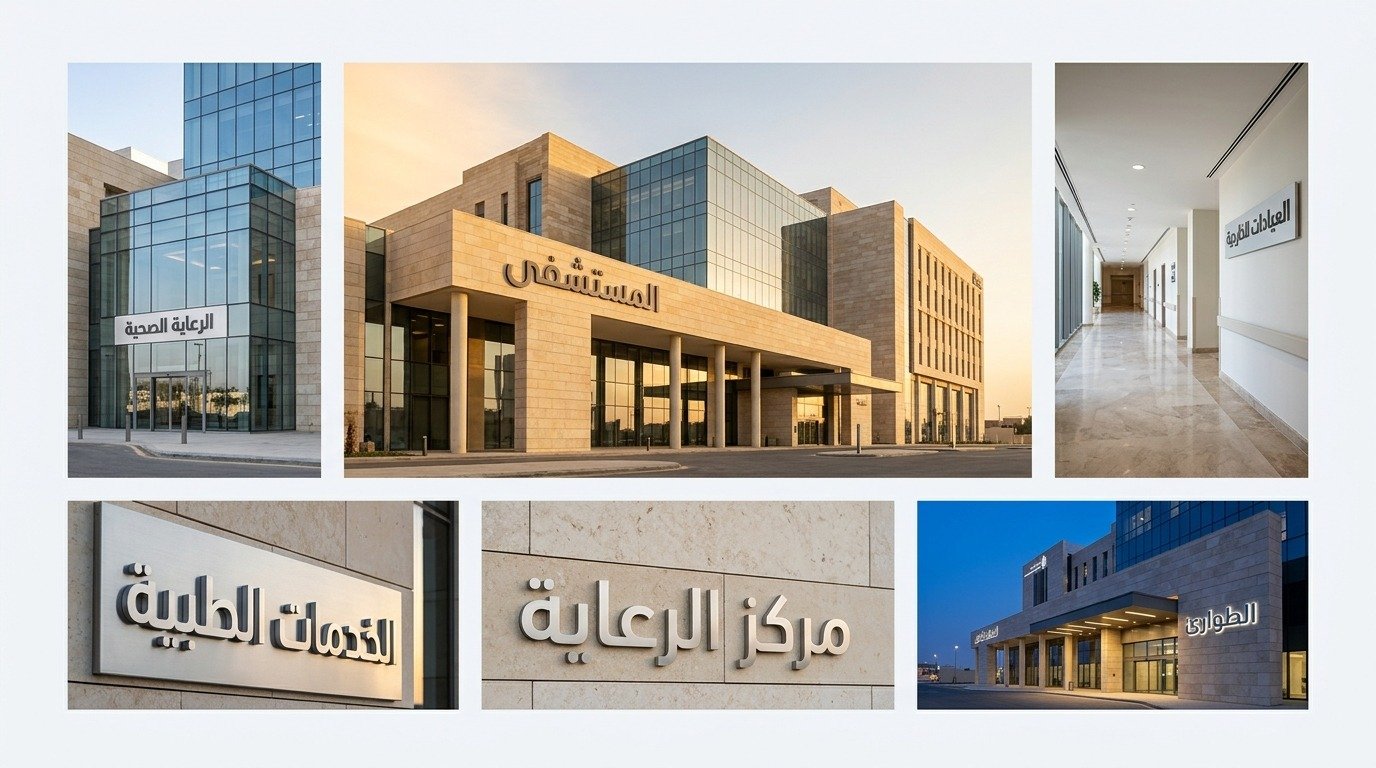
Hospitals, clinics, medical centres, and ambulance services all have visitors who arrive stressed and in a hurry.
A visitor reaching the hospital at 3 am does not want to read a map. They want to know one thing: which entrance is emergency? Ambulance drivers need a clear route, and a wrong turn costs minutes. Staff cars, visitors, and ambulances often share the same access roads. If the signs are weak, people circle, stop, and ask security.
The signs must be simple, early, and readable from a moving car.
- For approach roads and junctions, you can use reflective directional signs that point to emergency, outpatient, and parking. The driver chooses the right lane before the junction, not after it.
- For staff, visitor, and ambulance bays, you can install reflective parking signs. They separate the flows, so a visitor does not park where an ambulance needs to turn.
- For the ambulance bay and emergency entrance, you can mount reflective no parking signs. The route stays clear, and the restriction is readable in the dark.
Farms, Resorts & Rest Houses
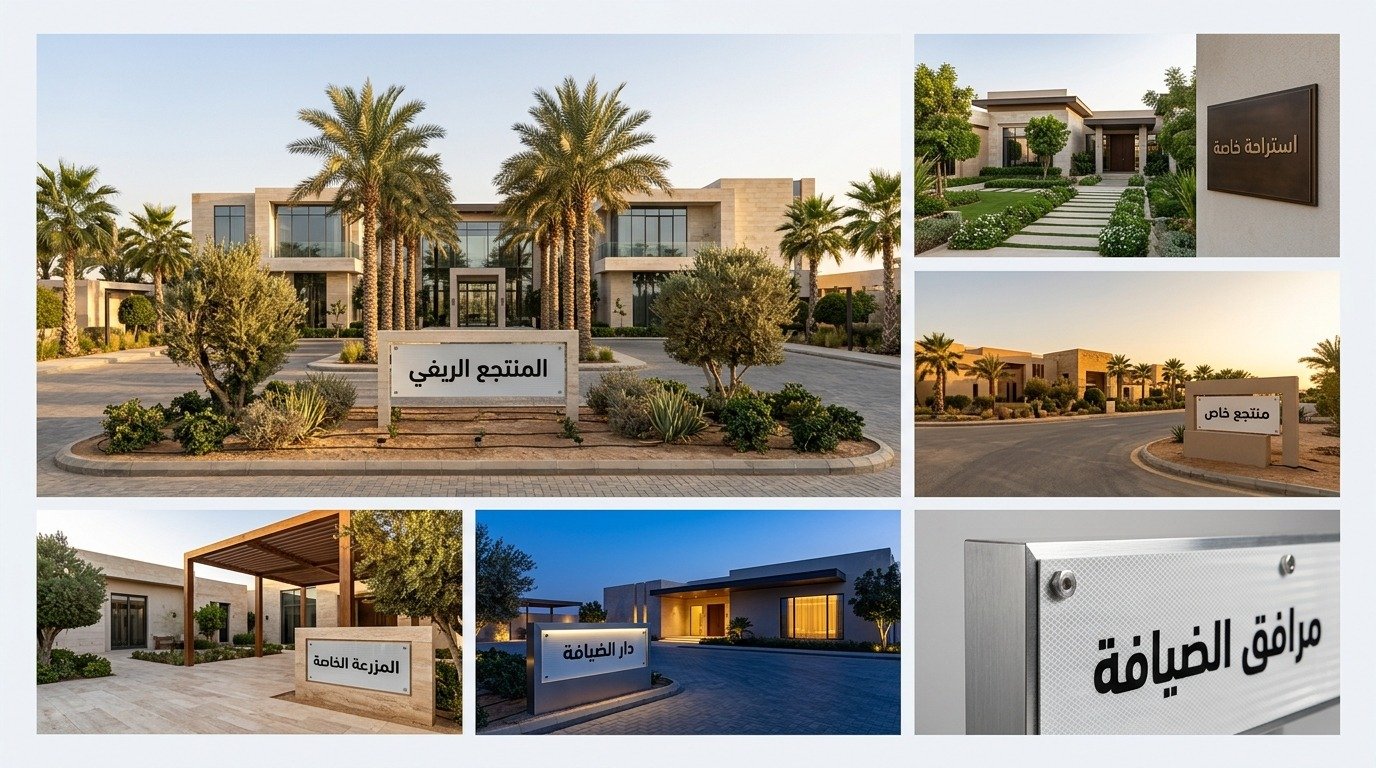
Farm owners, resort operators, rest house owners, and private estate managers all depend on long private roads outside the city grid.
Your guest is driving at night on a road with no streetlights and sand at the edge. Will they find the turn-off from the highway? Will they stay on the track? A missed turn can mean a long detour. Guests phone for directions, and delivery drivers give up. The first sign guests see sets their view of the place.
- For unlit access roads, you can line the edge with reflective road posts. The driver sees the road edge before reaching it, so they stay on the track.
- For the highway turn-off and the entrance, you can mount a reflective sign board with the property name. Use a high grade of sheeting, because drivers read it at highway speed.
- For forks in the track, you can add reflective arrow signs. Guests choose the right branch without stopping to call.
Government, Municipal & Utilities
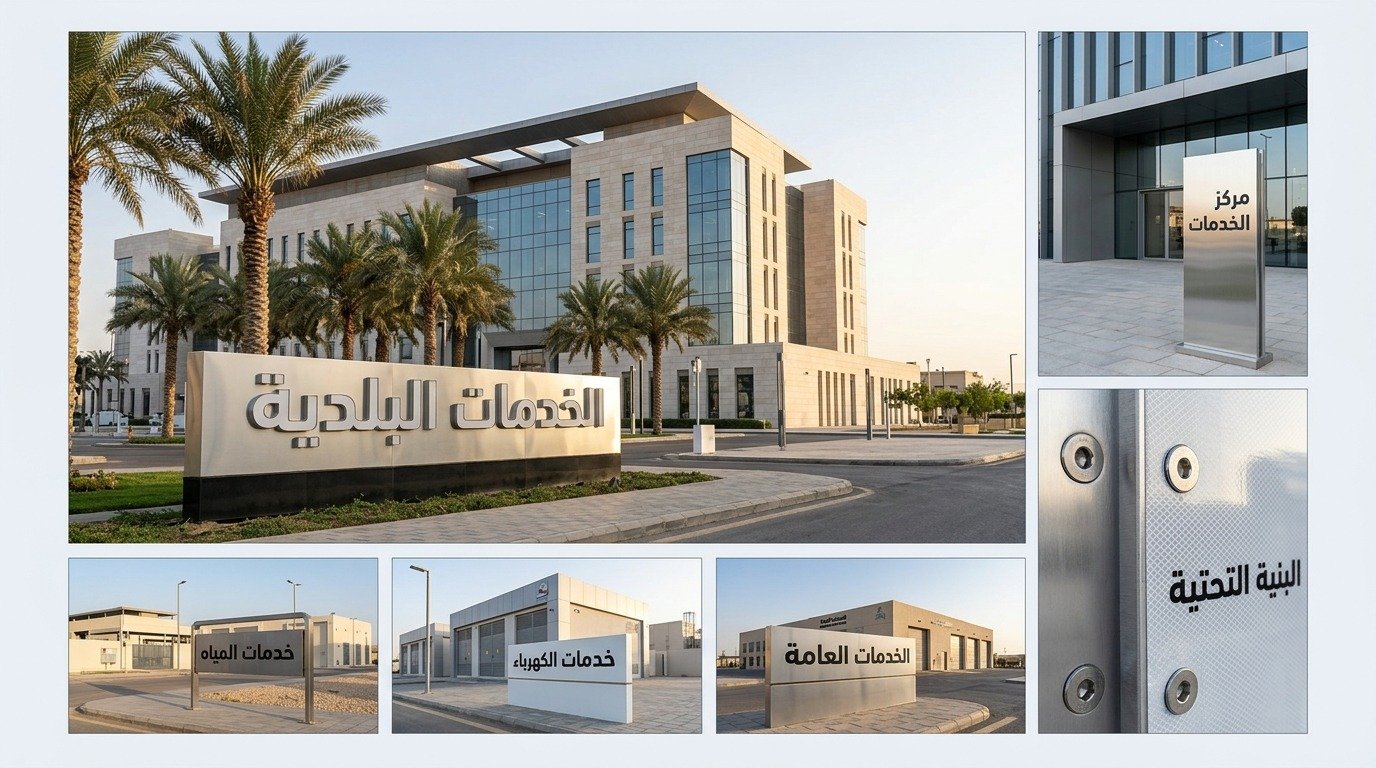
Municipal contractors, suppliers to road authorities, and utility operators sign public roads and restricted sites.
Your questions are different. Does this sign meet the authority’s specification? Which sheeting grade does the tender ask for? Will the colour match across 200 signs? Will the batch pass inspection? Procurement teams care about documentation and consistency, because one mismatched sign set can fail a whole delivery.
- For junctions and speed zones, you can install reflective road signs built to the specification the authority asks for. Sheeting grade, size, and panel thickness are stated on the quote.
- For substations, pump stations, and work zones, you can use reflective warning signs. They stay readable when the area is unlit and keep unauthorised drivers away.
- For districts and public facilities, you can order reflective street signs in one sheeting batch. Colour and brightness match across the full set.
Schools, Universities & Campuses
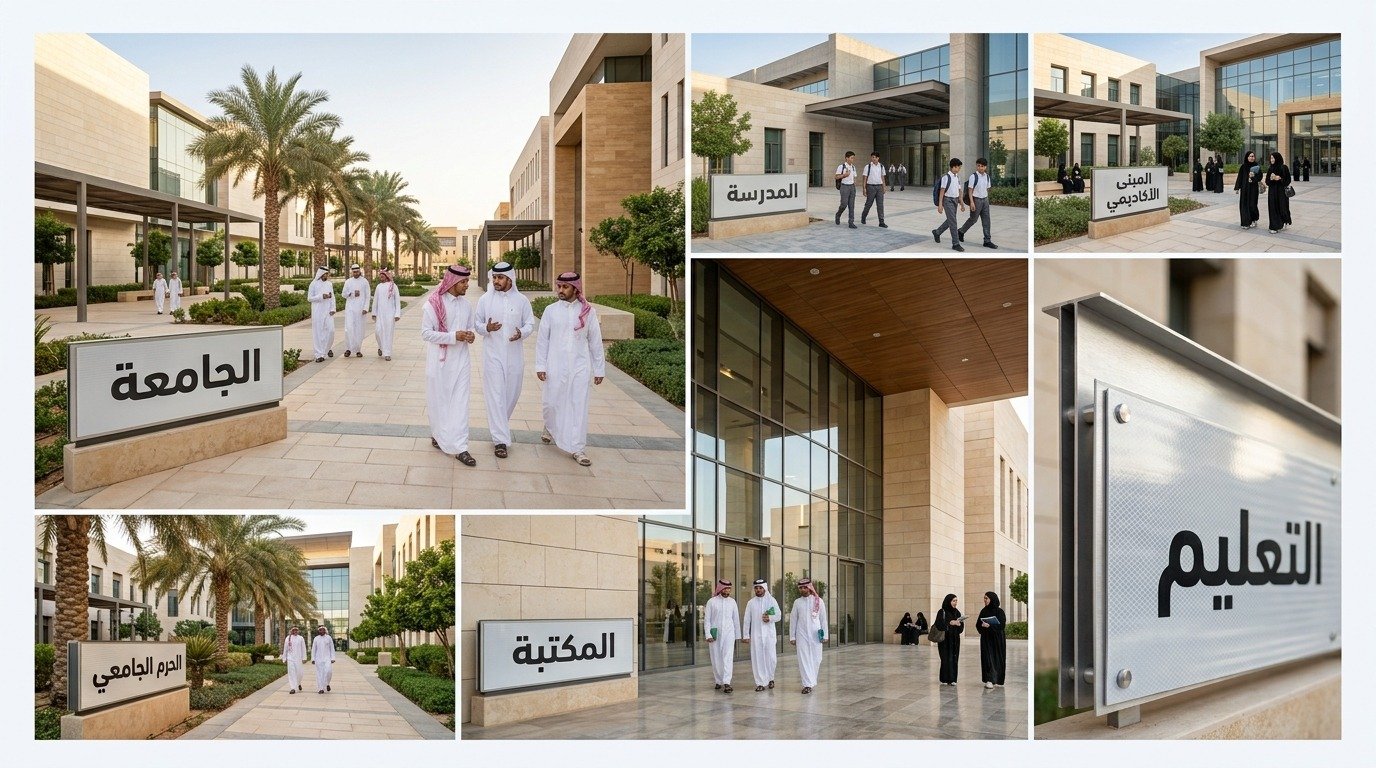
Private schools, universities, training centres, and campus facility managers all run slow traffic around many pedestrians.
Parents and bus drivers arrive in the same ten minutes. Students cross roads between buildings. Evening classes and winter afternoons end in the dark. Are drivers slowing at the gate? Where do buses and parents queue? Can a visitor find the admin block? When signs are weak, drivers speed up between queues and miss the crossing.
- For the school gate and campus roads, you can install reflective speed limit signs. Drivers see the limit early and slow before the crossing.
- For pickup and drop-off lanes, you can add reflective directional arrows. Queues stay in order, and buses and cars stay apart.
- For pedestrian crossings and building entrances, you can mount reflective caution signs. Drivers expect people on foot before they see them.
Most Common Mistakes When Buying Reflective Signs
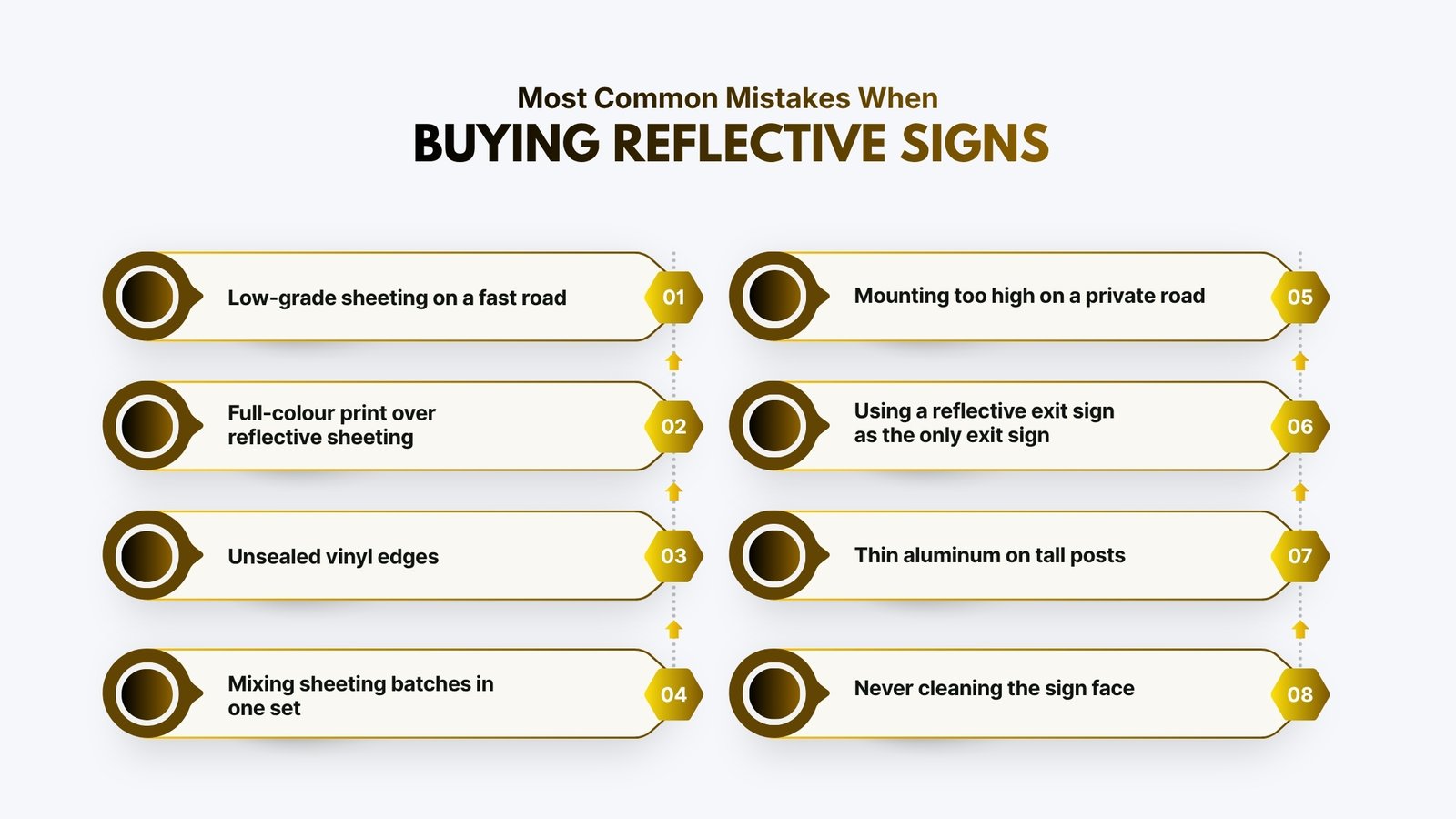
| Mistakes |
| Low-grade sheeting on a fast road |
| Full-colour print over reflective sheeting |
| Unsealed vinyl edges |
| Mixing sheeting batches in one set |
| Mounting too high on a private road |
| Using a reflective exit sign as the only exit sign |
| Thin aluminum on tall posts |
| Never cleaning the sign face |
What Reflective Signs Cost in Riyadh
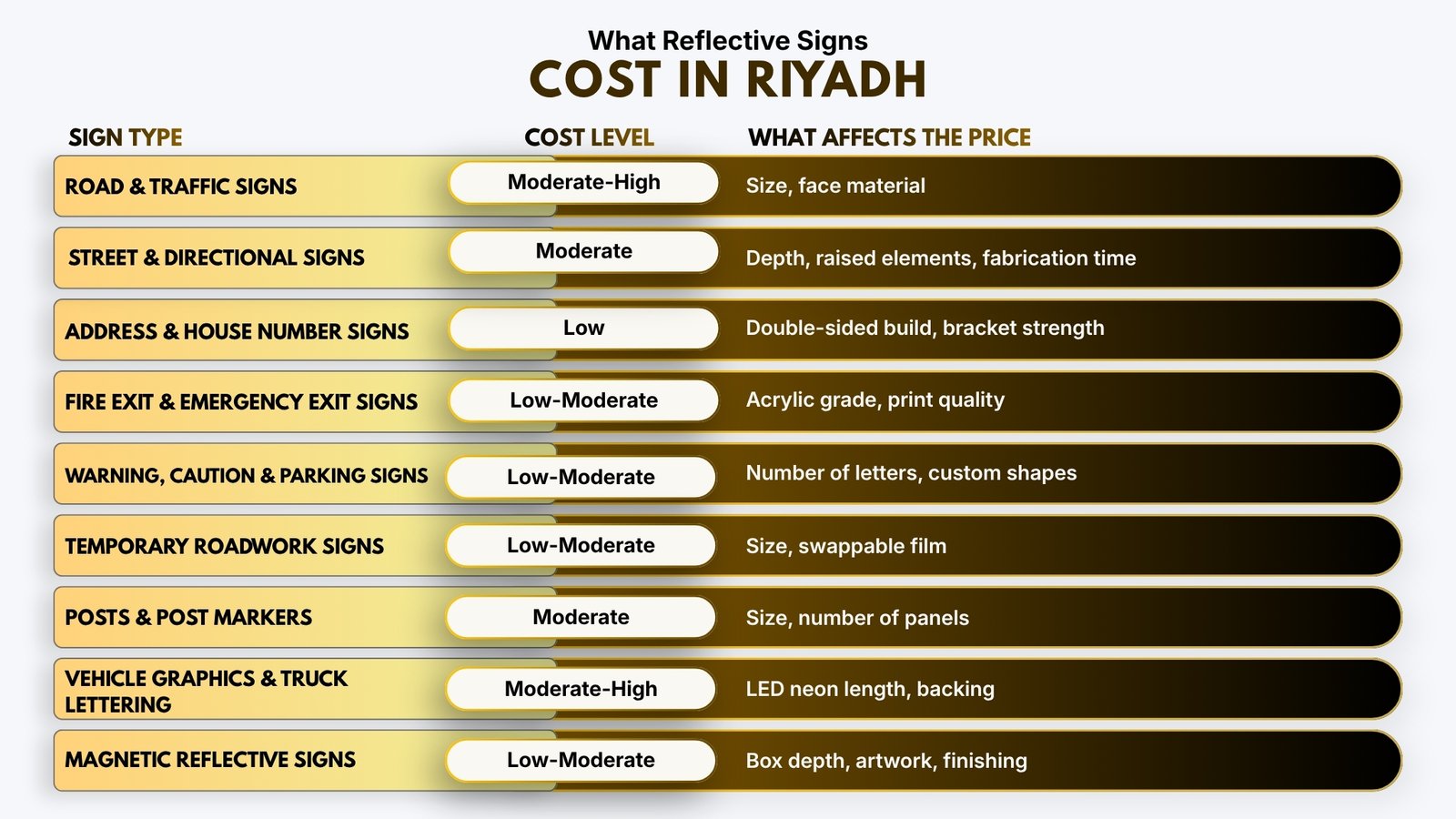
Price depends on sheeting grade, panel size, and quantity. The table shows how each type compares.
| Sign Type | Cost Level | What Affects the Price |
| Road & Traffic Signs | Moderate-High | Sheeting grade, size, panel thickness, posts |
| Street & Directional Signs | Moderate | Size, panel count, sheeting grade |
| Address & House Number Signs | Low | Size, double-sided, character count |
| Fire Exit & Emergency Exit Signs | Low-Moderate | Quantity, size, backing material |
| Warning, Caution & Parking Signs | Low-Moderate | Size, fluorescent sheeting, quantity |
| Temporary Roadwork Signs | Low-Moderate | Material, frame, reuse |
| Posts & Post Markers | Moderate | Post height, material, quantity |
| Vehicle Graphics & Truck Lettering | Moderate-High | Fleet size, vehicle area, sheeting type |
| Magnetic Reflective Signs | Low-Moderate | Size, magnet thickness, sheeting grade |
How Etihad Golden Falcons Handles Reflective Signs in Riyadh
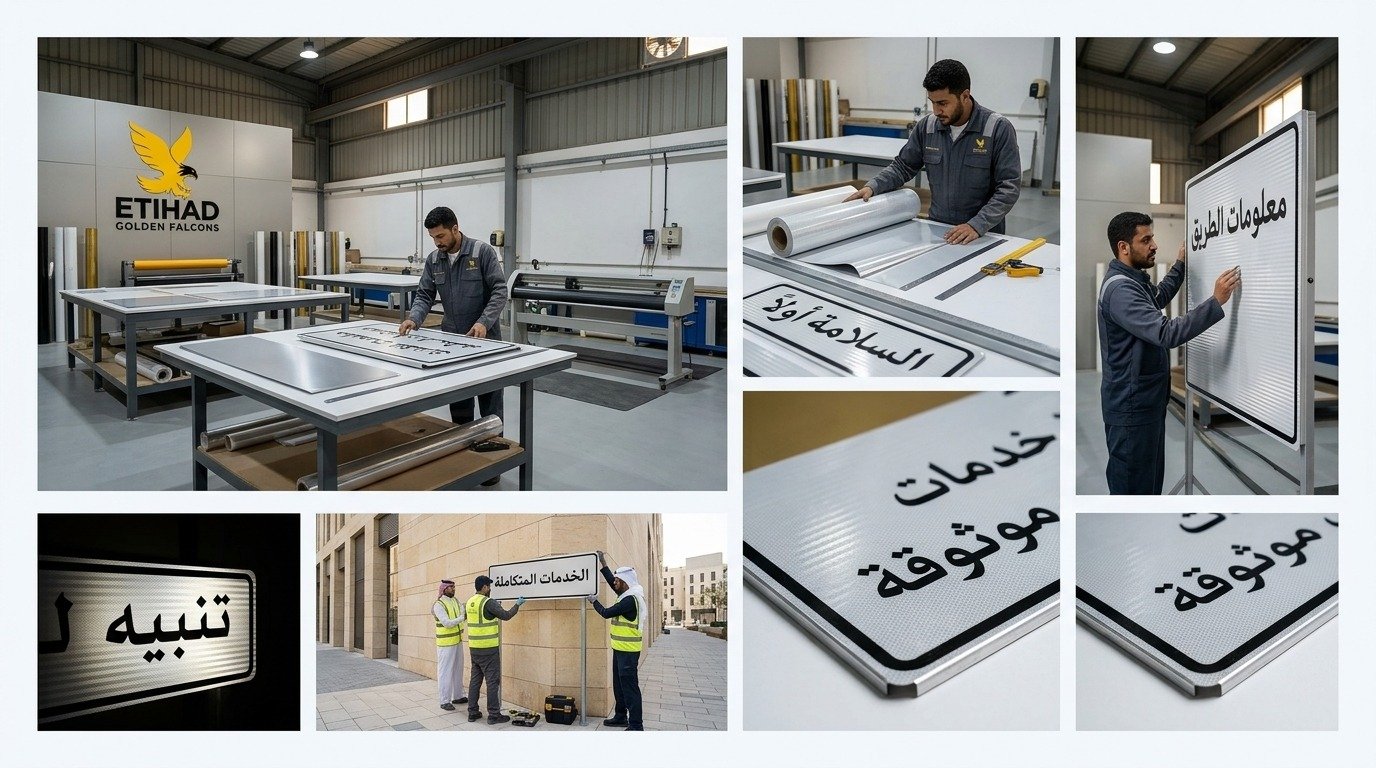
Etihad Golden Falcons runs reflective sign production under one roof, from sheeting selection to installation.
We Start With the Road, Site or Vehicle, Not the Artwork
Before we pick sheeting, we check the speed of traffic, the street lighting, and the mounting height. A sign for a lit city street and a sign for a dark farm road need different grades.
We Match the Sheeting Grade to the Job, Not to the Cheapest Roll
Engineer grade, high-intensity, and prismatic sheeting each suit a different road. We tell you which one your site needs and why. If a lower grade is enough, we say so.
We Cut and Print In-House for Consistent Colour
Cut vinyl keeps text and symbols at full brightness. We keep each sign set on one sheeting batch so colours match across the project. In-house production also means a change on your side does not wait on a supplier.
We Fabricate Panels and Posts In-House
Panel thickness, edge sealing, and post fixings are set before production starts. That prevents flexing in wind, lifting edges, and posts that lean after the first season.
We Install to Your Site Conditions, Not a Standard Template
We set mounting height and angle for how traffic actually approaches the sign. Installation is part of the job, not a handover to a third party.
We Prepare the Details for Approval, Not the Approval Itself
We do not issue Ministry of Transport, municipality, or Civil Defense approval. We do give you the drawings, dimensions, and sheeting specification those submissions ask for, so you walk into the review with the right documents.
If your signs vanish after dark or keep failing inspection, that is the conversation to start. Message our team on WhatsApp to go through your site.
FAQs
What is a reflective sign?
A reflective sign is faced with retroreflective sheeting that returns headlight beams to the driver. It does not produce light.
What is the difference between reflective and non reflective vinyl?
Reflective vinyl has glass beads or prisms that return light. Non reflective vinyl is flat at night.
Which sheeting grade should I choose?
Choose engineer grade for low-speed private roads. Choose high-intensity for compounds. Choose prismatic, such as ASTM D4956 Type XI, for fast roads and junctions.
Do reflective signs work without a light source?
No. They need headlights or a torch. In a power cut with no light, they stay dark.
Can you make custom reflective signs?
Yes. We make custom reflective signs in any size, text, and symbol, on aluminum or other substrates.
Do you handle municipality approval?
We do not file it for you. We prepare the drawings, sizes, and sheeting details the submission needs.
Can you print on reflective vinyl?
Yes. Printed colours reduce brightness, so we cut text and symbols in solid vinyl where full brightness matters.