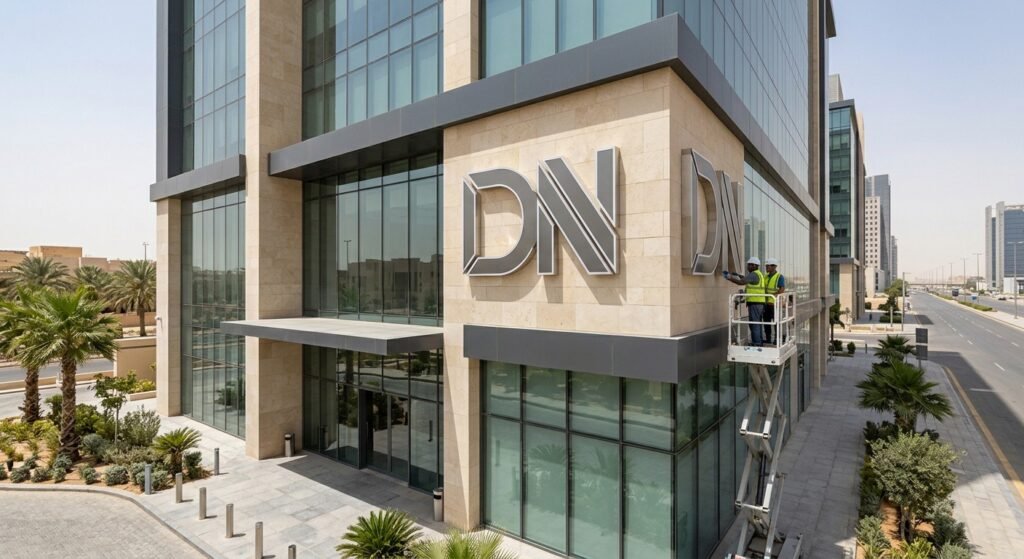
3D letter signage is dimensional lettering, individual letters or a logo built with physical depth, mounted on a building facade, entrance, or reception wall to identify a business at a distance or up close. It works across every type of commercial building: a corporate tower identifying itself from the road, a retail frontage standing out on a crowded street, a lobby confirming a visitor is in the right place, a multi-tenant building giving each occupant their own visible identity.
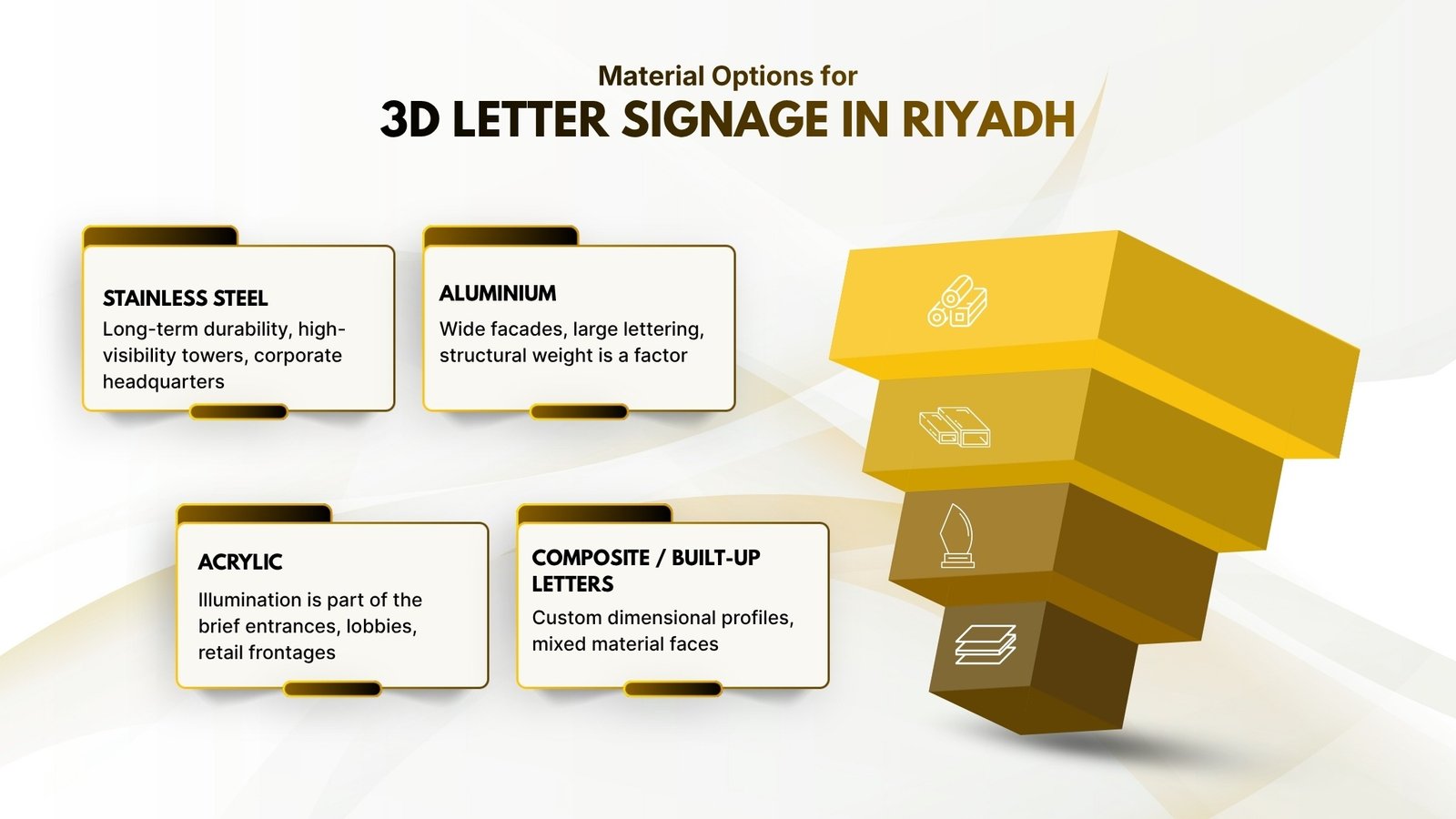
There are multiple material options for 3D letter signage: stainless steel, aluminium, acrylic, and composite built-up letters. Each material performs differently under Riyadh’s heat, sun, and dust, and the right choice depends on where the signage is placed and what it needs to do, on a rooftop facade, at a reception desk, or lit up after dark.
3D & fabricated letter signage needs to be specified for Riyadh’s outdoor conditions from the start. Signage fabricated without this in mind starts showing it within months, colour shifts, warped edges, fixings loosening under heat expansion, and once it starts degrading, it affects how the entire building is read from the outside. This guide covers the main material options, what makes 3D letter signage perform on a Riyadh building, where it’s used, what it costs, and what planning a proper installation involves.
What are the Most Common Material Options for 3D Letter Signage in Riyadh?
| Material | Best For |
| Stainless Steel | Long-term durability, high-visibility towers, corporate headquarters |
| Aluminium | Wide facades, large lettering, structural weight is a factor |
| Acrylic | Illumination is part of the brief — entrances, lobbies, retail frontages |
| Composite / Built-Up Letters | Custom dimensional profiles, mixed material faces |
Most businesses evaluate 3D signage based on how it looks in a sample or a render. The material choice shows its real value somewhere between the first year and the third.
In Riyadh, the same signage behaves differently depending on heat exposure, wind load, and how directly sunlight hits the surface across the day. Some materials hold their shape and finish for years. Some start changing within months. The decision made at fabrication stage determines what the building looks like three years from installation, not just on handover day. This is true of outdoor signage generally, not just 3D letters, but the dimensional format makes material choice even less forgiving since every surface and edge is exposed.
Stainless Steel
Stainless steel holds its form under sustained heat and wide daily temperature swings. The surface does not lose sharpness over time, which matters on large facades where every detail is read from road distance.
This is the right material when 3D letter signage is expected to perform for years without visible wear, and when the visual finish — brushed, mirror-polished, or powder-coated — needs to stay consistent across those years. For high-visibility commercial towers and corporate headquarters, stainless steel 3D metal signs carry the long-term brand representation that lighter materials cannot sustain.
Aluminium
When custom 3D signs run across wide building facades or tall elevations, weight becomes a real structural consideration — not just a design one. Aluminium handles this better than most materials. It stays lightweight while maintaining structural integrity, which reduces stress on mounting points and keeps alignment consistent over time, particularly under wind exposure.
If the facade is wide, the lettering is large, or the building height makes installation access difficult, aluminium is typically the more practical structural choice without compromising the finished visual standard.
Acrylic
Acrylic reacts to lighting in a way other materials do not. During the day it performs as a clean surface finish. At night, when paired with internal lighting or backlighting, it becomes a visibility element that holds attention after sunset.
3D acrylic signage and 3D acrylic logo signs are the standard specification for entrances, reception lobbies, and retail frontages where lighting conditions shift across the day and nighttime presence matters. If the signage needs to work as hard at 10pm as it does at 10am, acrylic with integrated illumination is the correct material direction.
Composite & built-up Letter Systems
3D built-up letters using composite materials, ABS, and aluminium cladding combinations are used where the design calls for specific dimensional profiles that single-material fabrication cannot achieve cost-effectively. These systems allow larger letter depths, more complex face profiles, and surface combinations — a metal face with an acrylic return, for example — that produce distinctive visual results on commercial facades.
What Makes 3D Letter Signage Perform Better on a Riyadh Commercial Building?
Good fabrication is necessary. It is not sufficient on its own.
3D letter signage performance depends on how it behaves once it is installed on a structure exposed to real environmental pressure — not on how it looks in the fabrication workshop. Distance, sunlight, mounting conditions, and the relationship between all three determine whether it stays readable or degrades into the background.
Letter sizing calculated for actual viewing distance
If letter sizing is not calculated for the real viewing distance from the road or parking approach, the 3D letter signage becomes visually weak from the street — regardless of material quality or finish precision.
On Riyadh’s commercial roads, buildings are read in motion. A driver approaching from distance has a few seconds of attention before the building passes. When sizing is off, even well-fabricated dimensional sign letters lose their impact because they do not register at the point of attention. Sizing decisions need to start with the actual viewing distance, not with what looks proportionate in a design file.
Surface finish and illumination across day and night conditions
Surface finish determines how the signage reads under direct sun. Some finishes reflect too much light and reduce contrast at certain angles. Others absorb heat unevenly and affect material behaviour over time. Both create readability problems during daylight hours.
At night, illumination takes over as the primary visibility factor. 3D backlit signs, LED 3D sign boards, and internally lit 3D illuminated signs all perform differently depending on how the lighting is integrated into the letter structure. Weak or uneven illumination makes 3D letter signage disappear after dark even when the physical structure is strong. A backlit 3D sign that lights inconsistently across the letter face reads as poorly maintained within months of installation.
Fixing systems engineered for heat, wind, and long-term movement
Installation is not just the act of mounting letters onto a surface.
In Riyadh conditions, heat causes materials to expand and contract across daily and seasonal cycles. Wind pressure on large facade signage creates cumulative load on fixing points. If the mounting system is not engineered for both, alignment shifts gradually — and the letters start losing uniformity even when the material itself holds up. This is one of the most common problems that appears six to twelve months after installation on 3D signage projects where the fixing system was not given the same engineering attention as the fabrication.
Where 3D Letter Signage Is Used Across Commercial Buildings in Riyadh
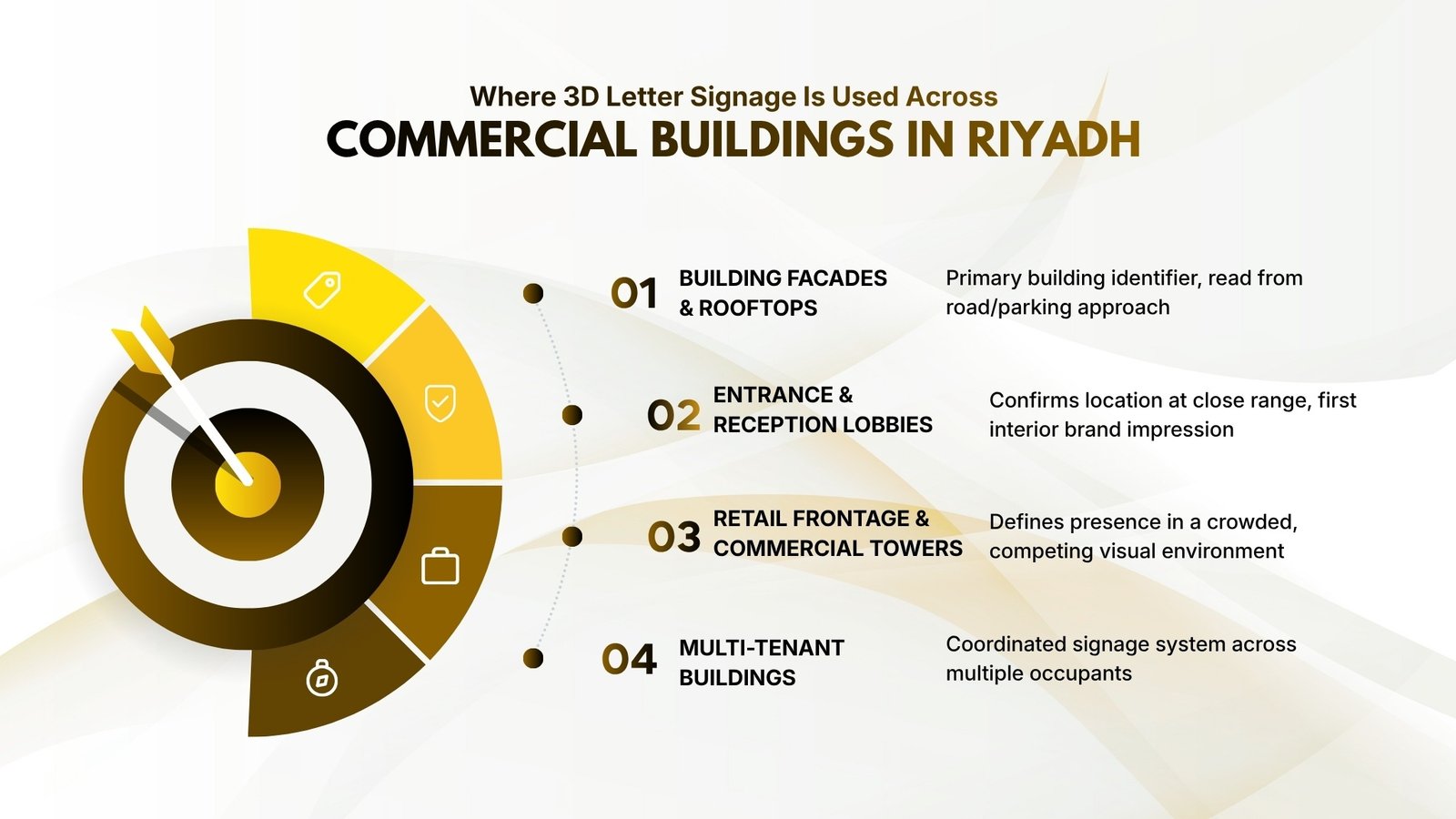
| Location | Function |
| Building Facades & Rooftops | Primary building identifier, read from road/parking approach |
| Entrance & Reception Lobbies | Confirms location at close range, first interior brand impression |
| Retail Frontage & Commercial Towers | Defines presence in a crowded, competing visual environment |
| Multi-Tenant Buildings | Coordinated signage system across multiple occupants |
3D letter signage and 3D logo signs are used wherever a building needs to be identified clearly from distance or approach — and where the signage itself is part of the brand presence rather than just a location marker.
Building Facades & Rooftop
On facades and rooftops, outdoor 3D signage works as the primary building identifier. It is read from roads, adjacent buildings, and parking approaches — usually before any other visual detail registers. Three-dimensional signs at this scale carry the building’s brand identity at the distance and speed of road-level reading. They need to perform as an asset, not just a label.
3D building signs at rooftop level face the most demanding environmental conditions of any installation type — maximum sun exposure, sustained wind load, and the highest maintenance access cost of any position on the building. Material and fixing system specification here is more consequential than at any other installation point.
Entrance & Reception Lobby
At entrances and lobbies, 3D wall signs and 3D logo wall signs confirm location and reinforce brand identity at close range. This is where visitors verify they are in the right place before moving further in. Indoor 3D signage at this touchpoint is the first interior brand impression a client or partner forms — and unlike facade signage read from a distance, it is inspected at arm’s length.
3D office signs and 3D reception signs in lobby areas serve a function different from exterior 3D letter signage. They are read from two to five metres, not twenty. Material choice, finish quality, and lighting at this scale are about detail precision, not distance readability. The same material that reads correctly on a building facade may not be appropriate for a reception wall sign that a visitor will stand next to for several minutes.
3D lobby signs are also where brand system consistency is most visible — if the reception sign does not match the exterior letter signage in finish and material language, the inconsistency is noticed even by visitors who cannot name it.
Retail frontage & Commercial Tower
On retail frontages and commercial towers, 3D shop signs and 3D storefront signs define presence in crowded visual environments. Multiple buildings compete for attention from the same road. Weak or undersized signage gets absorbed into the visual background. Custom 3D signs at retail scale need to be visible at approach distance, brand-consistent in finish, and structurally suited for constant outdoor exposure without maintenance requirements that exceed what the business can practically manage. This makes 3D letters a common addition to existing shopfront & fascia signage rather than a replacement for it, since the dimensional element adds presence on top of the base identification the fascia already provides.
3D shop front signs on retail units also need to work within any landlord or municipality constraints on dimensions and fixing methods — which in Riyadh’s commercial property market means the approval process is part of the brief, not an afterthought.
Multi-tenant Buildings & Branded Zones
Commercial towers in Riyadh often house multiple tenants, each with their own brand identity and their own right to visible identification on the building facade. This creates a specific coordination challenge: every tenant needs properly sized 3D company logo signs — but the building also needs visual coherence across all of them.
When this is not planned as a coordinated system from the outset, the facade ends up looking inconsistent — some tenants more visible than others based on who committed more budget or who installed first. Handling multi-tenant 3D letter signage as one coordinated project rather than separate individual jobs produces a better result for the building owner, the property manager, and each individual occupant.
Most Common 3D Letter Signage Mistakes to Avoid in Riyadh
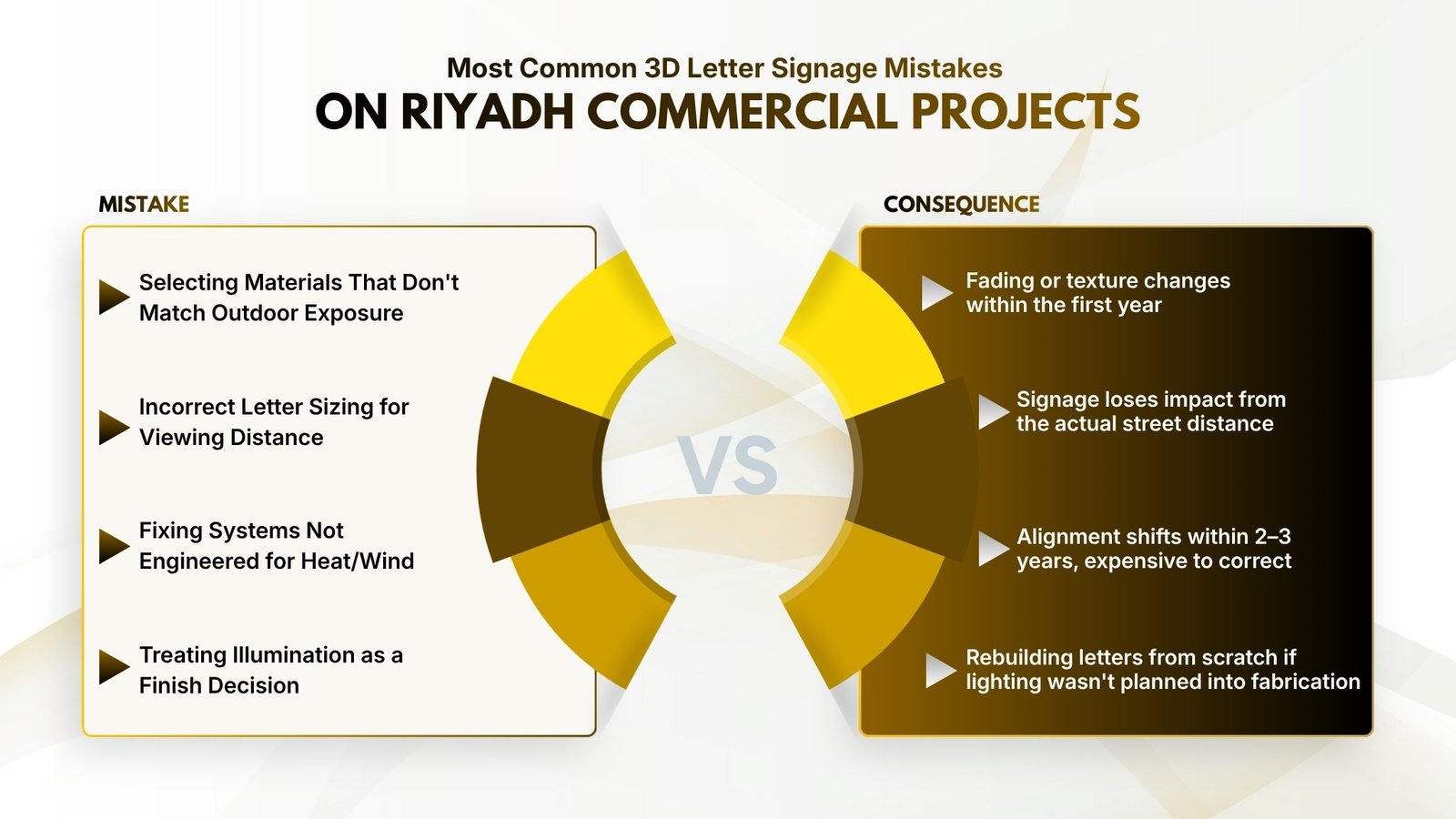
| Mistake | Consequence |
| Selecting Materials That Don’t Match Outdoor Exposure | Fading or texture changes within the first year |
| Incorrect Letter Sizing for Viewing Distance | Signage loses impact from the actual street distance |
| Fixing Systems Not Engineered for Heat/Wind | Alignment shifts within 2–3 years, expensive to correct |
| Treating Illumination as a Finish Decision | Rebuilding letters from scratch if lighting wasn’t planned into fabrication |
Municipality Approvals and 3D Signage Compliance Requirements in Riyadh
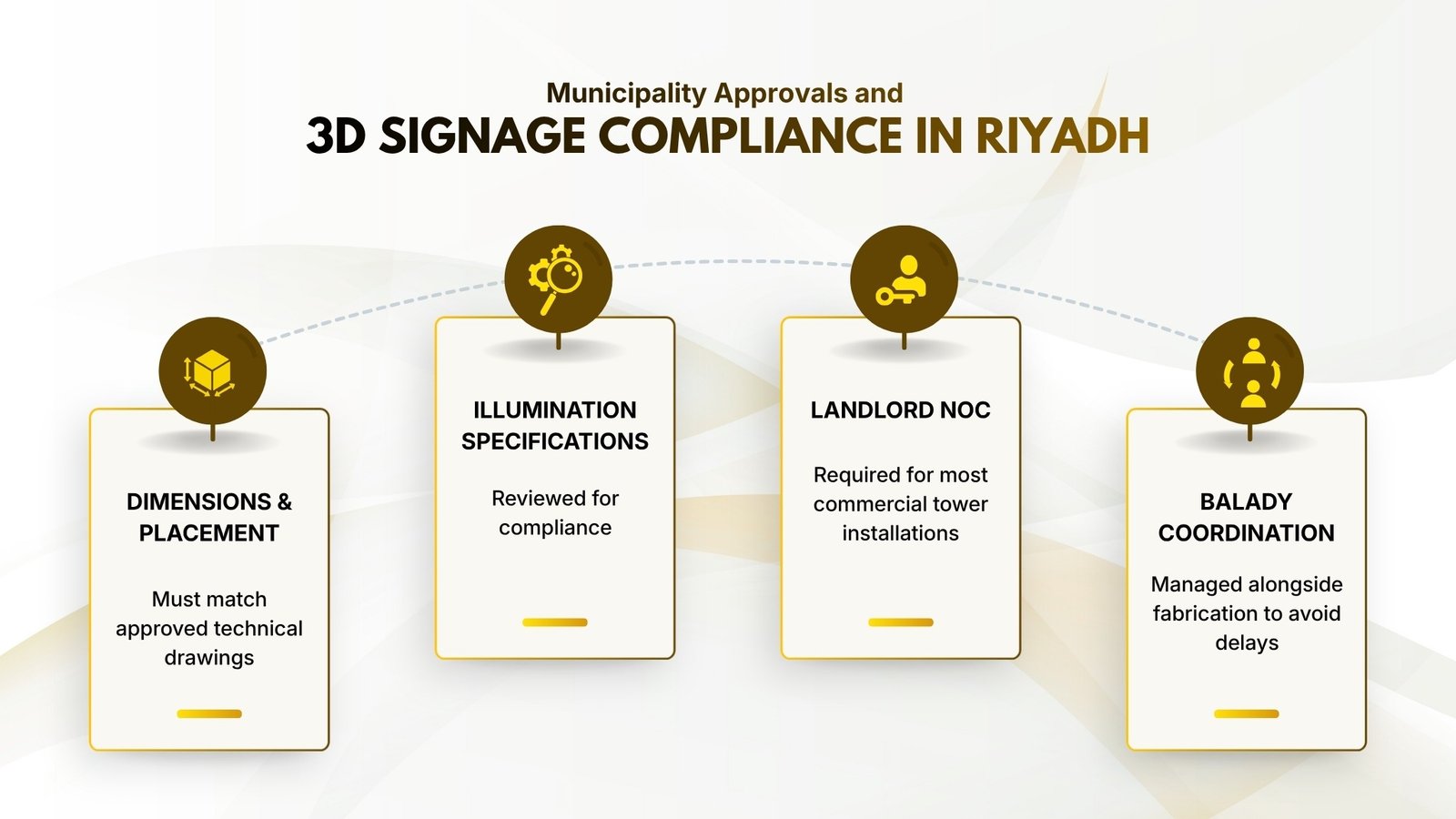
| Requirement | What’s Needed |
| Dimensions & Placement | Must match approved technical drawings |
| Illumination Specifications | Reviewed for compliance |
| Landlord NOC | Required for most commercial tower installations |
| Balady Coordination | Managed alongside fabrication to avoid delays |
Commercial 3D letter signage in Riyadh requires municipality approval before installation. This is a regulatory requirement — non-compliant signage receives removal notices, and removal after installation costs the full installation investment.
Approval requirements cover dimensions, placement on the facade, illumination specifications, and in some cases material standards for specific building types and zones. The process involves submitting technical drawings, obtaining landlord NOC in most commercial tower cases, and coordinating with the relevant Balady authority for the project location.
For businesses not familiar with the process, this is where 3D signage projects stall. Approvals take time, and starting the process late delays installation past the planned opening or launch date. It is also where projects get refused if the design does not meet local standards — meaning fabrication work completed before approval is confirmed carries the risk of producing signage that cannot be legally installed as designed. See our guide on shopfront signs for how this same approval process applies to standard fascia and shopfront installations.
What Does 3D Letter Signage Actually Cost in Riyadh?
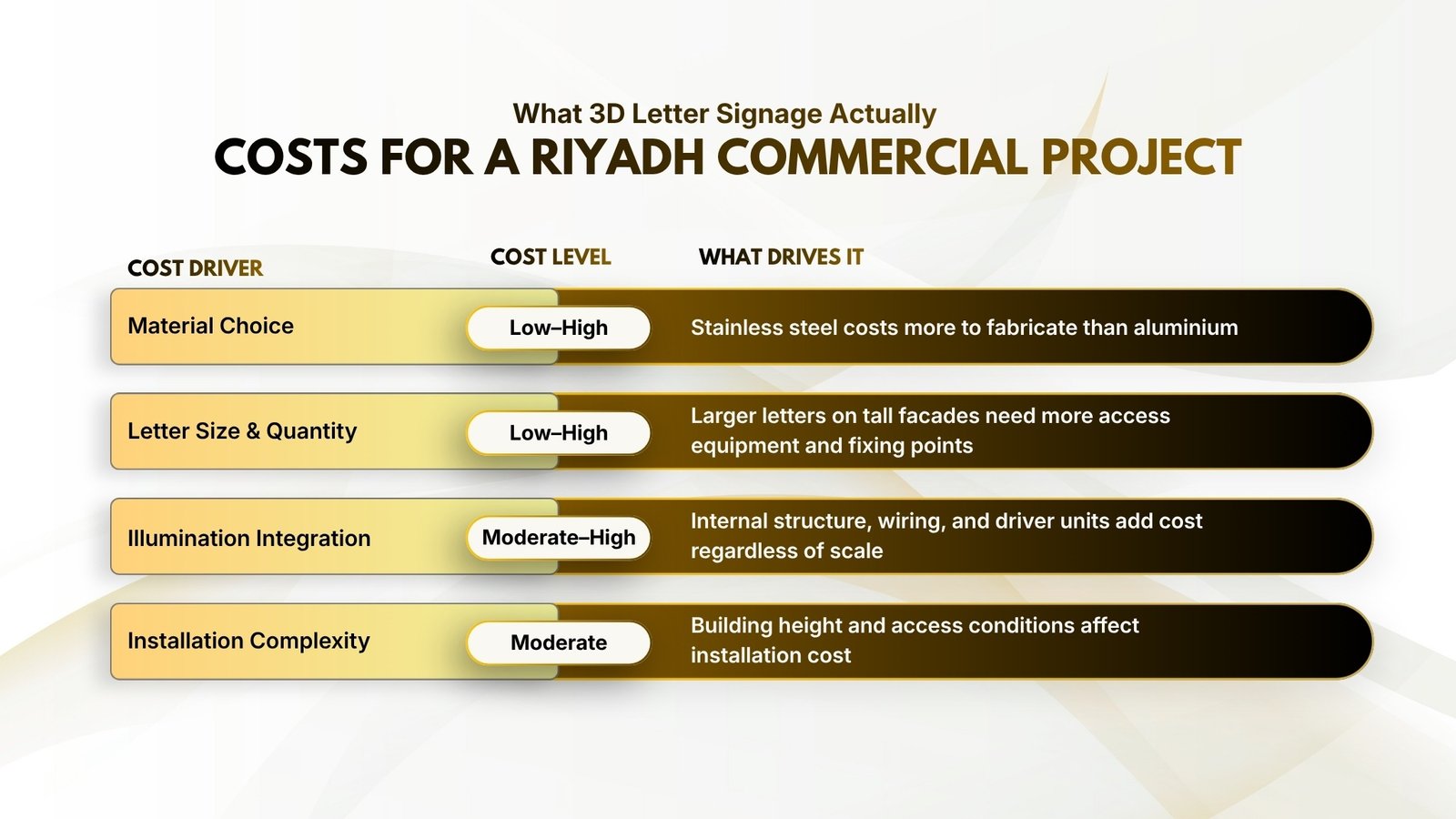
| Cost Driver | Cost Level | What Drives It |
| Material Choice | Low–High | Stainless steel costs more to fabricate than aluminium |
| Letter Size & Quantity | Low–High | Larger letters on tall facades need more access equipment and fixing points |
| Illumination Integration | Moderate–High | Internal structure, wiring, and driver units add cost regardless of scale |
| Installation Complexity | Moderate | Building height and access conditions affect installation cost |
Four things drive your cost: material, letter size and quantity, illumination, and installation complexity. They interact with each other, so per-letter pricing alone won’t tell you much about your actual project cost.
Material Is Your Biggest Variable
Stainless steel costs more than aluminium because it needs more production steps, brushing, polishing, or powder coating all add time. Aluminium is lighter but still needs precision mounting hardware on tall buildings. If you’re adding illumination to acrylic, that brings in electrical components and extra installation steps a non-illuminated sign doesn’t need.
Letter Size and Building Height Both Add Up
Larger letters on high facades mean more access equipment, more fixing points, and more installation time. Your building’s height matters just as much as the letter dimensions themselves.
Illumination Isn’t Optional Engineering
Whether you’re going for an LED sign board, a backlit sign, or internally lit acrylic, illumination adds cost regardless of scale, internal structure, wiring, driver units, and access for future maintenance. Skip this and you’re not saving money, you’re setting yourself up for a maintenance problem within the first two years.
What Actually Pushes Your Project to the Expensive End
A single-facade project with aluminium letters and no illumination sits at the lower end. A multi-facade stainless steel system with integrated LED illumination on a tall building costs significantly more. But what usually pushes your cost up isn’t the material, it’s rework, access complexity, and design changes made after fabrication has already started. If you want an accurate cost for your specific building and design, contact our experts on WhatsApp before finalising your specification.
Maintenance and Long-Term Upkeep for 3D Letter Signage in Riyadh
Installation is the start of the signage’s working life, not the end of the project.
In Riyadh’s climate, dust accumulation on 3D letter surfaces is consistent and fast. On illuminated signs, dust on acrylic panels and inside LED channels reduces light output progressively — gradually enough that you might not notice until the signage is visibly dim compared to what it looked like at installation. Periodic cleaning and lighting checks keep the system performing at the level it was built to deliver.
Surface finishes on stainless steel and aluminium hold up well under normal conditions, but impact damage, water ingress at fixing points, and oxidation at cut edges are all worth checking for on an annual basis. Catching these early is significantly cheaper than addressing them after they have developed into structural or finish problems.
For illuminated 3D letter signage, driver units and LED components have defined service lives. Knowing when components were installed, what the expected lifespan is, and when to schedule replacements avoids the situation where sections of the signage go dark without warning at the moment it matters most.
We offer post-installation maintenance for all 3D letter signage projects we fabricate and install. If something is not performing the way it should, we return and address it.
How Etihad Golden Falcons Fabricates and Installs 3D Letter Signage in Riyadh
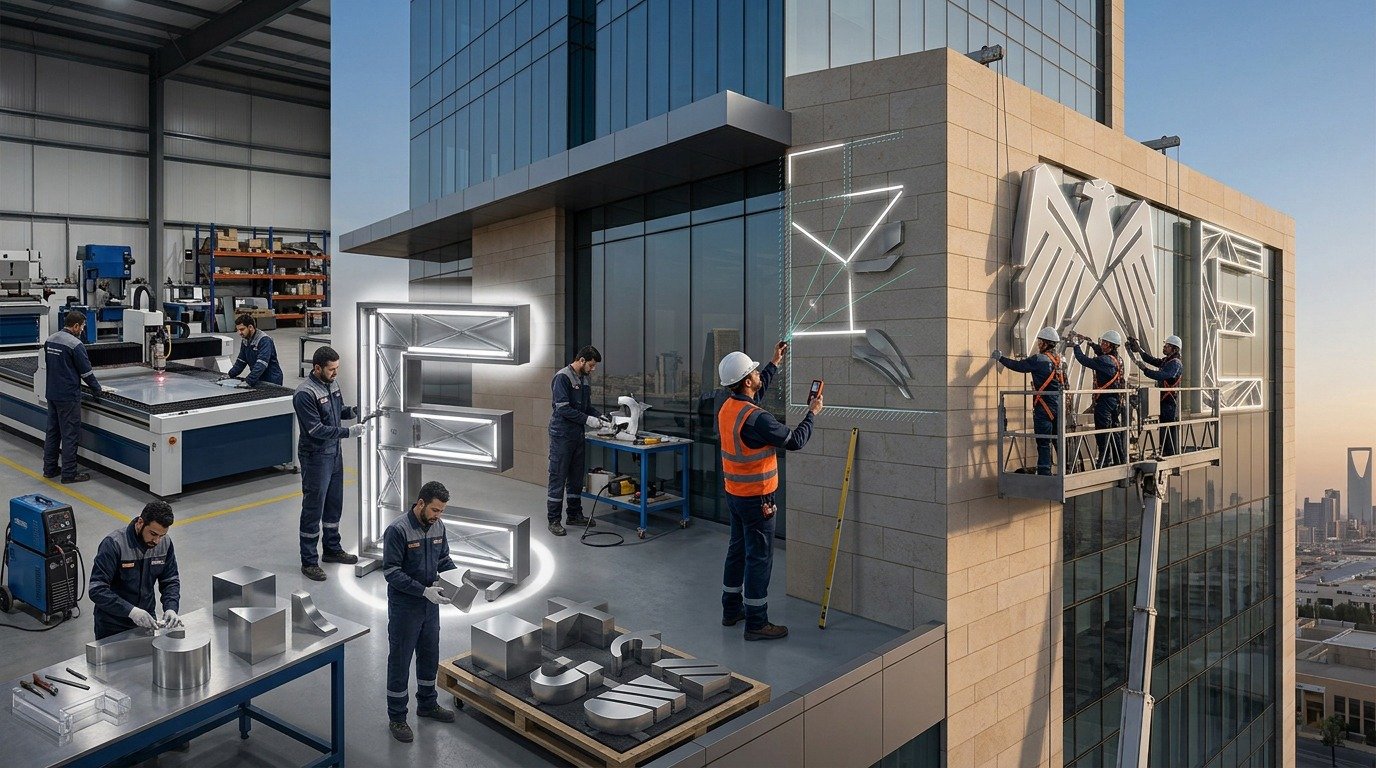
We Assess the Building Before We Design
Height, viewing distance, facade material, sun exposure, wind exposure. These are structural inputs, not design preferences, and they determine material selection, letter sizing, fixing system engineering, and illumination approach. A design that looks right in a presentation can still perform poorly on the actual building if these factors aren’t built into the fabrication specification from the start.
Fabrication Stays In-House
We control production quality, finishing standards, and timeline ourselves, without depending on subcontractors for the work that determines the outcome. Custom 3D metal signs, 3D acrylic letter sign boards, built-up letters, or fully illuminated systems, everything is produced and finished at our facility before it goes to site.
Installation Is Engineered for the Building, Not a Template
Alignment checks account for heat expansion and long-term movement. Fixing systems are engineered for the specific building and material combination. We’ve installed 3D letter signage on commercial towers, retail frontages, corporate headquarters, and multi-tenant buildings across Riyadh, and misalignment, illumination failures, and premature surface wear are exactly what this process is built to prevent.
One Engagement, Start to Finish
Municipality approval coordination, fabrication, installation, and post-installation maintenance are all handled under one engagement. You don’t manage multiple vendors or chase approvals separately while running a fit-out or opening timeline.
FAQs
Yes. Fabrication is done in-house at our facility and installation is handled by our own teams on site. You are not dealing with a design company that outsources production or an installer working from a different supplier’s fabrication, which is where accountability gaps typically appear on 3D signage projects.
Yes. Both backlit and internal illumination systems can be built into the fabrication depending on design requirements and material specification. Acrylic is the standard choice for internally lit 3D letter signage. Stainless steel and aluminium are used for backlit applications where the letter structure is opaque and the light source sits behind or within the mounting. The illumination system needs to be specified and built into fabrication from the start; it cannot be added to a non-illuminated letter after the fact.
Stainless steel and treated aluminium are the strongest performers for long-term outdoor exposure in Riyadh. Stainless steel handles heat and UV well and maintains surface finish over time without the oxidation issues that affect lower-grade metals. Aluminium is better suited for large-scale or wide-span applications where structural weight is a factor.
A standard single-facade project typically runs four to six weeks from confirmed design to completed installation, depending on material, letter size, and complexity. Projects involving municipality approvals, multi-facade coverage, or illuminated systems take longer. We confirm a project timeline at the start so your opening or launch schedule is not built around an estimate.
Yes. Finishes, colours, and surface treatments are all matched to existing brand standards. For businesses with multiple locations requiring consistent 3D letter signage across sites, we document the full specification so every subsequent project references the same production standards rather than approximating them.
We don’t handle the municipality approval process on your behalf, you submit and manage the application yourself, so you stay in full control of it. What we do is guide you through the requirements so your signage design meets municipality standards from the start. Once your approval is granted, we fabricate and install your signage exactly as per the approved specifications.