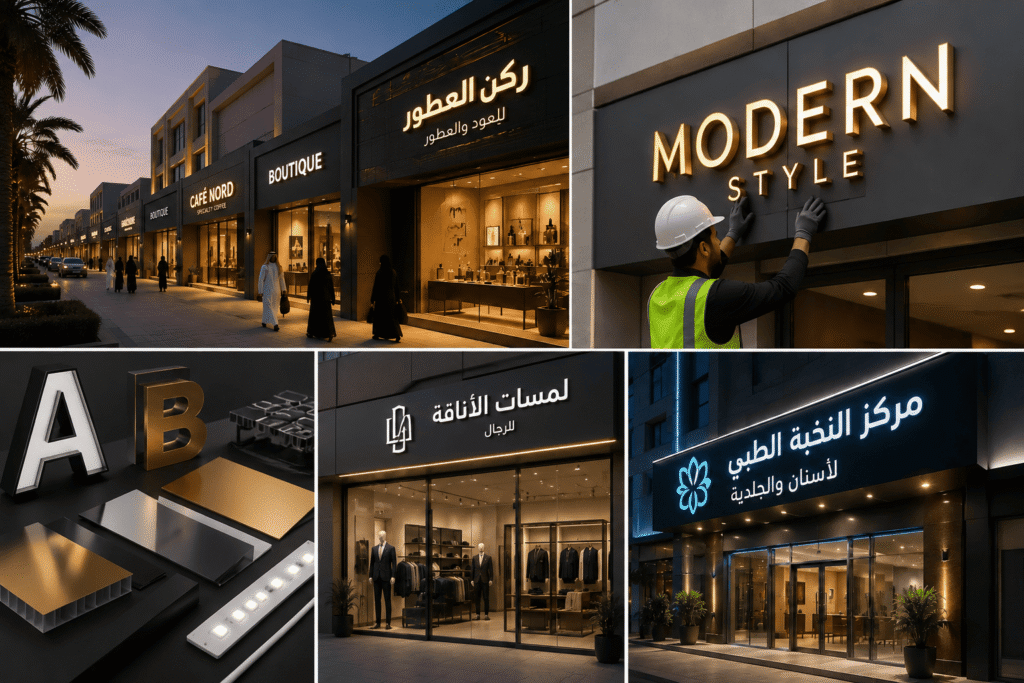
In Riyadh’s business landscape, your shopfront sign is how your business presents itself before anyone walks through the door. It needs to represent your brand clearly, be made from the right materials, and be installed correctly so it holds up over time.
But not all shopfront signs in Riyadh are the same. An illuminated sign works differently from a 3D lettering sign. A digital display serves a different purpose than a flat printed panel. Each type suits a different kind of business, a different location, and a different set of operating conditions. Choosing the wrong type does not just affect how the sign looks. It can affect how many people walk in.
Getting shopfront & fascia signage right in Riyadh also means handling the municipality permit correctly from the start. Dimensions, placement on the facade, and illumination specifications all require approval before installation. A sign that goes up without the right permits is at risk of being taken down. That part of the process needs to be planned as part of the project, not sorted out after the sign is already on the wall.
This guide covers the main types of shopfront signs available in Riyadh, what each one is suited for, how the fabrication and installation process works, and what to consider before you start.
What Are the Main Types of Shopfront Signs in Riyadh?
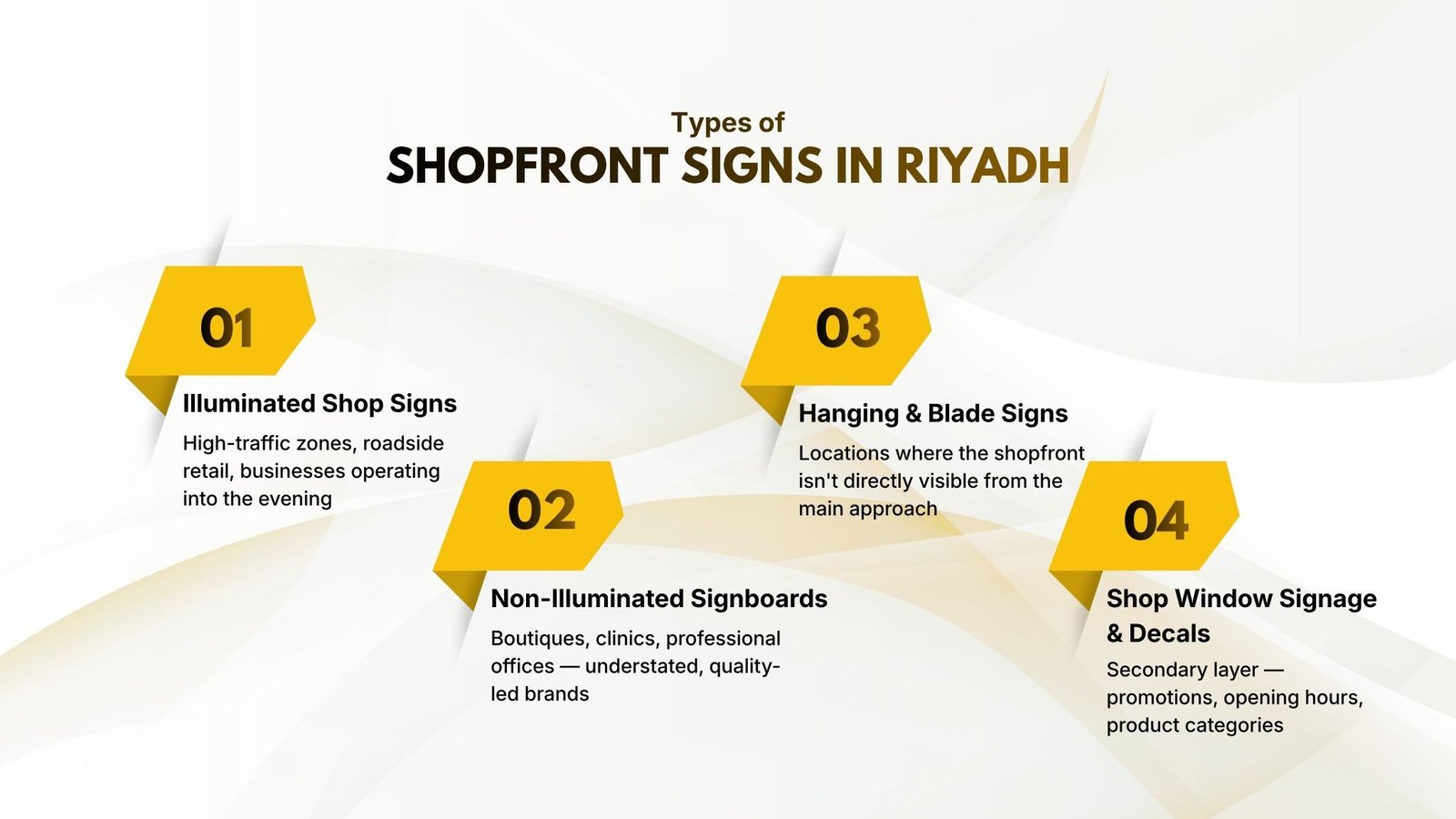
| Sign Type | Best For |
| Illuminated Shop Signs | High-traffic zones, roadside retail, businesses operating into the evening |
| Non-Illuminated Signboards | Boutiques, clinics, professional offices — understated, quality-led brands |
| Hanging & Blade Signs | Locations where the shopfront isn’t directly visible from the main approach |
| Shop Window Signage & Decals | Secondary layer — promotions, opening hours, product categories |
Your shopfront environment decides what kind of sign you need, not the other way around. Get it wrong and you end up with a sign that’s hard to see, expensive to maintain, or stuck at your local municipality waiting on an installation approval.
Illuminated Shop Signs
If your business sits in a high-traffic zone, on a roadside, or stays open into the evening, you need a sign that works day and night, not just when the sun’s out. LED signs, LED sign boards, and outdoor light boxes all fall into this category, and which format performs best for you depends on how the sign sits on your facade, how far it needs to be read from, and how bright the surrounding street already is. Illuminated signage solutions cover all three formats, matched to your facade and street conditions.
The real value here is consistency. Your brand stays visible when the light changes, when the street fills up, and when every other shop on the block is fighting for the same attention. Illuminated signs fail for predictable reasons: uneven lighting across the panel, heat damage from materials that were never rated for LED, or brightness that’s either too weak to read from a distance or too aggressive for the street it’s on. Get the fabrication right and none of that becomes your problem.
Backlit signs, front-lit acrylic letters, and recessed lightbox formats all give you a different look. A backlit sign produces a glow that works well when your brand name is the identity. A front-lit sign gives you sharper edges on the letters. A lightbox lets you display a full graphic panel with even light across the whole surface.
Non-Illuminated Signboards
If your brand’s presentation depends on material quality rather than brightness, this is your category. It’s usually the right choice for boutiques, clinics, professional offices, law firms, and premium retail, where the brief is understated and high-quality, not loud.
With no lighting to draw the eye, every detail on the sign is what people notice. A slightly off colour, a misaligned panel, or a rough edge stands out immediately because there’s nothing else competing for attention. That’s why material and fabrication precision matter most here. Acrylic panels, aluminium composite signboards, and direct-finish metal faces each give you a different look and hold up differently outdoors over time.
This works best when your shopfront already has strong ambient lighting, or when your brand needs a clean, considered look that an illuminated sign simply can’t give you without looking too commercial.
Hanging & Blade Signs
If your shopfront isn’t directly visible from the direction most people approach from, a flat facade sign won’t do the job. That’s when you need a hanging or blade sign instead.
A blade sign extends out from the building line so it’s visible from the side, whether that’s pedestrians walking the street, drivers approaching along the road, or customers moving through a covered mall corridor. In dense retail strips and shared commercial buildings where several businesses sit on the same frontage, a blade sign is often the only format that gets you noticed from an angle.
The engineering requirement here is different from a facade sign. Wind load, fixing points, and the fact that most blade signs are double-sided all need to be handled correctly at installation. A sign that moves in the wind, hangs too low, or reads unevenly from either direction isn’t doing its job.
Shop Window Signage & Decals
Window signage covers vinyl graphics, frosted film, and branded decals applied directly to your glass. It’s not a replacement for your main shopfront sign. It’s a second layer that adds information, promotions, or texture to your storefront.
You’ll typically use window decals for promotions, opening hours, product categories, or extra branding. Depending on the material, they’re temporary or semi-permanent, and they need to go on cleanly. Cheap window vinyl bubbles and misaligns within weeks, and once that happens, it’s doing your brand more harm than good.
3D Letter Signs
If your brand relies on a strong visual identity rather than just legibility, 3D letters give you a level of presence flat signage can’t match. The raised depth catches light differently throughout the day, which is why 3D letters are the default choice for premium retail, corporate offices, and any business where the shopfront needs to signal quality before a customer walks in. Material choice changes the effect completely. Stainless steel gives a sharp, industrial finish that holds up outdoors without needing illumination. Acrylic offers a softer look with more colour options. Backlit or halo-lit letters combine the dimensional effect with illumination, so the sign works on shape alone during the day and switches to a glowing outline at night.
Fabrication precision matters more here than with flat signage. Uneven letter spacing, inconsistent depth, or poor mounting shows immediately on a 3D format in a way it wouldn’t on a printed panel. See our 3d letter signage guide for a closer look at material options, lighting choices, and what drives the cost up or down.
What Does a Complete Shopfront Signage Project Include?
| Stage | What Happens |
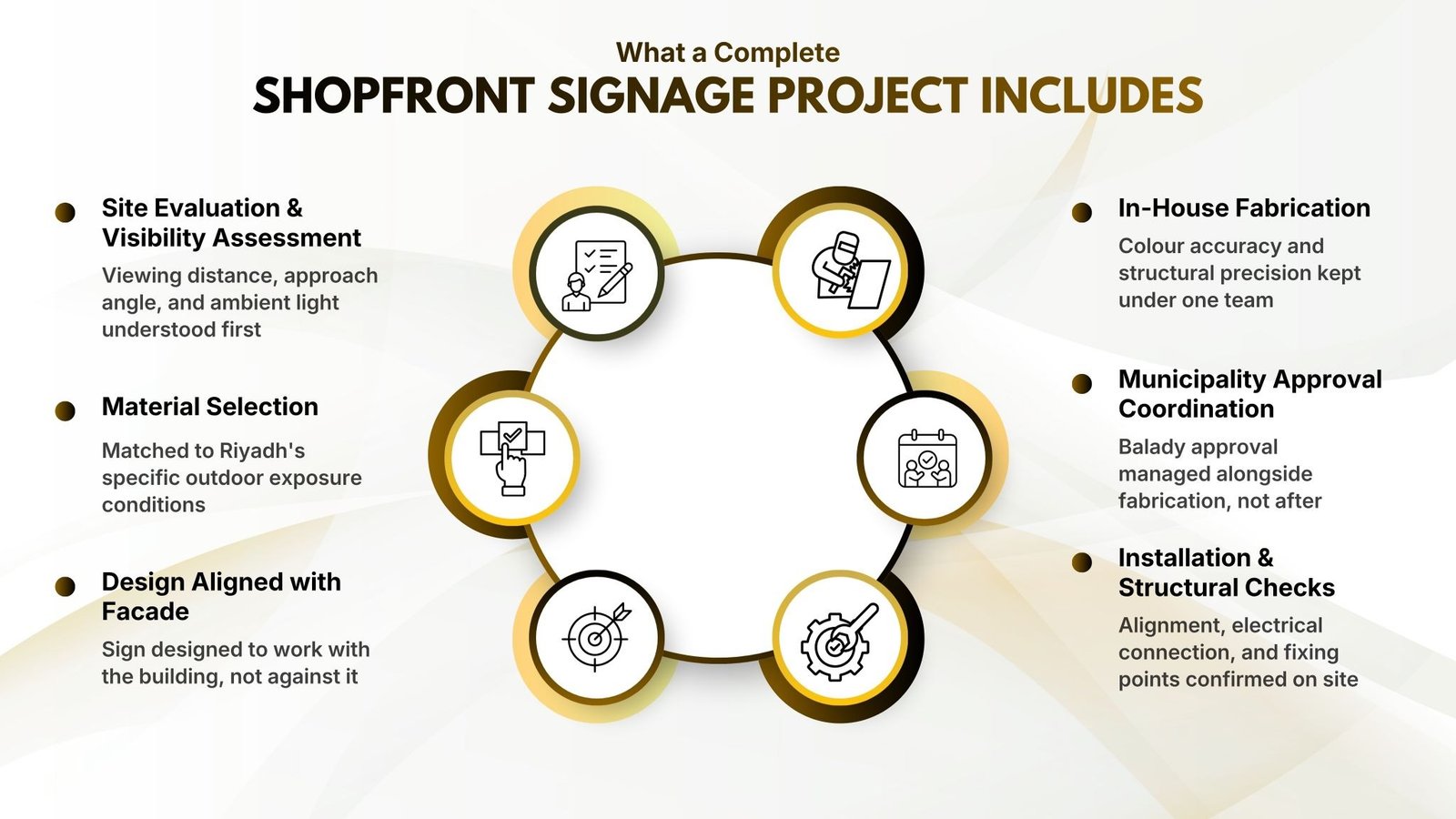
| 1. Site Evaluation & Visibility Assessment | Viewing distance, approach angle, and ambient light understood first |
| 2. Material Selection | Matched to Riyadh’s specific outdoor exposure conditions |
| 3. Design Aligned with Facade | Sign designed to work with the building, not against it |
| 4. In-House Fabrication | Colour accuracy and structural precision kept under one team |
| 5. Municipality Approval Coordination | Balady approval managed alongside fabrication, not after |
| 6. Installation & Structural Checks | Alignment, electrical connection, and fixing points confirmed on site |
A shopfront sign is not a single product. It is a process with several stages, and the quality of the outcome depends on every stage being handled correctly — not just the fabrication.
Site evaluation and visibility assessment
Before any design or material decision is made, the actual viewing conditions need to be understood. The distance from which the sign will be read, the angle of approach for pedestrians and vehicles, the ambient light levels at different times of day, and the visual context of competing signage in the immediate environment all determine what the sign needs to do — and therefore what it needs to be.
Material selection for outdoor conditions
Riyadh’s outdoor environment is demanding. UV exposure, sustained high temperatures, and dust accumulation all affect different materials differently. The material that looks correct in a sample can perform poorly on a south-facing facade in direct sun. Material selection needs to be based on the specific exposure conditions of the site, not on what is available at a given price point. This is one of the main reasons outdoor signage projects need a proper site assessment before materials are finalised, not after.
Design aligned with brand identity and facade architecture
The sign needs to work with the building it is mounted on, not fight it. Proportions, fixing positions, and visual weight all need to be resolved in the design stage so the installed sign reads as part of the storefront rather than something placed on it.
In-house fabrication with finish control
Colour accuracy, structural precision, and surface quality are all determined in fabrication. When fabrication is outsourced, control over these variables moves outside the project. In-house production keeps them within the same team responsible for the outcome.
Municipality approval coordination
For commercial shopfront signage in Riyadh, Balady approval is required in most cases. Dimensions, placement, illumination specifications, and structural fixing methods all fall under the approval scope. Managing this as part of the project — not after fabrication is complete — keeps the timeline on track and avoids the cost of producing signage that cannot be legally installed.
Installation with alignment and structural checks
The final sign is only as good as its installation. Fixing position, level accuracy, electrical connection for illuminated systems, and structural integrity at mounting points all need to be confirmed on site before the project is signed off.
Which Shopfront Sign Type Is Right for Your Business?
The sign type, material, and installation approach all change depending on what your business needs the sign to do, how customers approach your location, and what hours your operation runs. Below is how this breaks down across the main business types we work with in Riyadh.
Retail Shops and Boutiques
Retail shopfronts in Riyadh need to communicate brand tier before a customer makes the decision to stop. A boutique sign that reads as generic loses the premium positioning it was built to signal — before anyone steps inside. And in a mall corridor or commercial street where multiple retailers occupy the same visual space, the sign that communicates most clearly at distance is the one that captures the walk-in.
The sign type and fabrication need to reflect the brand level. A fast-fashion retailer and a luxury boutique have different requirements — not just visually, but in material specification, finish quality, and how the sign sits on the facade.
- Custom illuminated acrylic letter signs — individually fabricated letters with LED backlighting, mounted directly onto the facade; visible day and night with consistent brightness across all letterforms
- Precision-cut non-illuminated aluminium or stainless steel letters — brushed or polished metal finish, fixed with concealed studs; communicates premium positioning through material quality rather than illumination
- Lightbox sign boards — aluminium-framed recessed panels with printed or cut-vinyl graphic face and internal LED system; suited to retail units where the brand uses full-colour graphic identity rather than individual letterforms
- Shop window decals and vinyl graphics — printed or cut vinyl applied to glazed shopfront surfaces; used as a secondary layer for promotions, product categories, or brand reinforcement alongside the primary sign
Restaurants and Cafés
F&B businesses depend on shopfront signs to pull passing traffic during hours that extend well into the night. The sign needs to perform as well at 10pm as it does at noon — which means illumination is not a design preference in this sector, it is an operational requirement. A restaurant sign that disappears after dark loses the hours when a significant share of its revenue decisions are made.
The brief for a restaurant or café sign is usually high visibility, clear brand communication, and durability under the operating hours and outdoor conditions the sign will face every day.
- LED-integrated lightbox signs — aluminium cabinet with high-output LED system and printed or backlit graphic face; maintains even brightness across the full sign surface through long daily operating hours
- Illuminated 3D letter signs — individually fabricated letters with internal or back illumination; visible from road distance at night without the commercial appearance of a full lightbox format
- Neon-effect LED signs — flexible LED tubing formed into script or logo shapes; used for F&B brands where the aesthetic is part of the brand identity, fabricated with UV-stable casing rated for outdoor exposure
- Hanging blade signs — double-sided illuminated signs projecting perpendicular to the facade; captures pedestrian traffic approaching from both directions along a street or commercial corridor
Clinics and Professional Services
Clinics, law firms, financial consultancies, and professional service offices use shopfront signage to communicate authority and precision rather than visibility. The brief is almost always minimal and exact — the right material, the right proportions, and a finish that holds its standard over time. A clinic with a poorly finished or visually inconsistent sign loses patient confidence before the consultation begins.
Illuminated formats are sometimes appropriate for clinic signage, but the specification is different from retail or F&B — lower brightness, more controlled light distribution, and a material language that reads as clinical and precise rather than commercial.
- Non-illuminated aluminium composite sign boards — flat panel with precision-printed or vinyl-applied brand graphics; clean finish, weather-resistant surface, suited to clinics and offices where understated presentation is the brief
- Brushed metal letter signs — individually mounted stainless steel or aluminium letters in brushed finish; communicates professional positioning through material quality without illumination
- Halo-lit backlit letter signs — letters with rear-facing LED illumination that produces a glow on the mounting surface rather than front-facing brightness; maintains visibility after dark without the commercial brightness of standard illuminated signage
- Precision acrylic sign panels — cut or printed acrylic panels with concealed fixing system; suited to professional offices where the sign sits close to the entrance and is read at short range rather than from road distance
Retail Chains and Multi-Location Brands
Multi-location retail brands need a sign system that holds consistently across every site — not a design that gets reinterpreted at each new location. Colour drift, finish variation, and dimensional inconsistency between sites undermine the brand coherence that a chain’s marketing investment is built on.
This requires a documented sign specification that covers every element of the sign — material grades, finish standards, fixing methods, LED system specifications, and dimensional tolerances — so each new installation is produced and installed to the same controlled standard as the first.
- Systemised illuminated sign packages — standardised cabinet or letter sign format produced in-house from a fixed specification; every site receives the same material, the same finish, and the same lighting output regardless of when or where it is installed
- Modular sign structures — sign frames and mounting systems designed for reuse or replication across multiple locations; reduces lead time and cost on subsequent installations while maintaining dimensional consistency
- Documented brand sign specifications — full material, finish, and installation specification produced alongside the first site; used as the production reference for every subsequent location so sign quality does not depend on a designer interpreting the brief each time
- Brand-matched vinyl and graphic systems — colour-matched vinyl applied to sign faces, window surfaces, and secondary brand elements; produced from calibrated files to maintain colour accuracy across all sites
Mall and Commercial Businesses
Standalone F&B outlets in malls, commercial strips, and mixed-use developments face a specific visibility challenge: they need to be identifiable from within a busy visual environment where multiple competing brands occupy the same frontage. The sign has to work at walking pace from twenty metres away and up close at the entrance simultaneously.
- High-brightness illuminated fascia signs — LED-integrated lightbox or letter signs rated for continuous operation; brightness calibrated for the ambient light level of the specific commercial environment rather than applied as a standard specification
- Blade signs at entrance zones — double-sided projecting signs that capture pedestrian traffic approaching from both sides of the retail corridor; illuminated for night visibility in covered or enclosed commercial environments
- Window vinyl and glass branding — printed or cut vinyl on the shopfront glazing; adds brand presence and promotional content without requiring facade fixing; used as a secondary visual layer alongside the primary mounted sign
- Menu display systems at entrance points — externally mounted menu or promotional display cases integrated into the shopfront; allows customers to confirm the offering before entering without relying on digital screens that require power management in outdoor conditions
What Are the Most Common Shopfront Sign Mistakes in Riyadh?
| Mistake | Consequence |
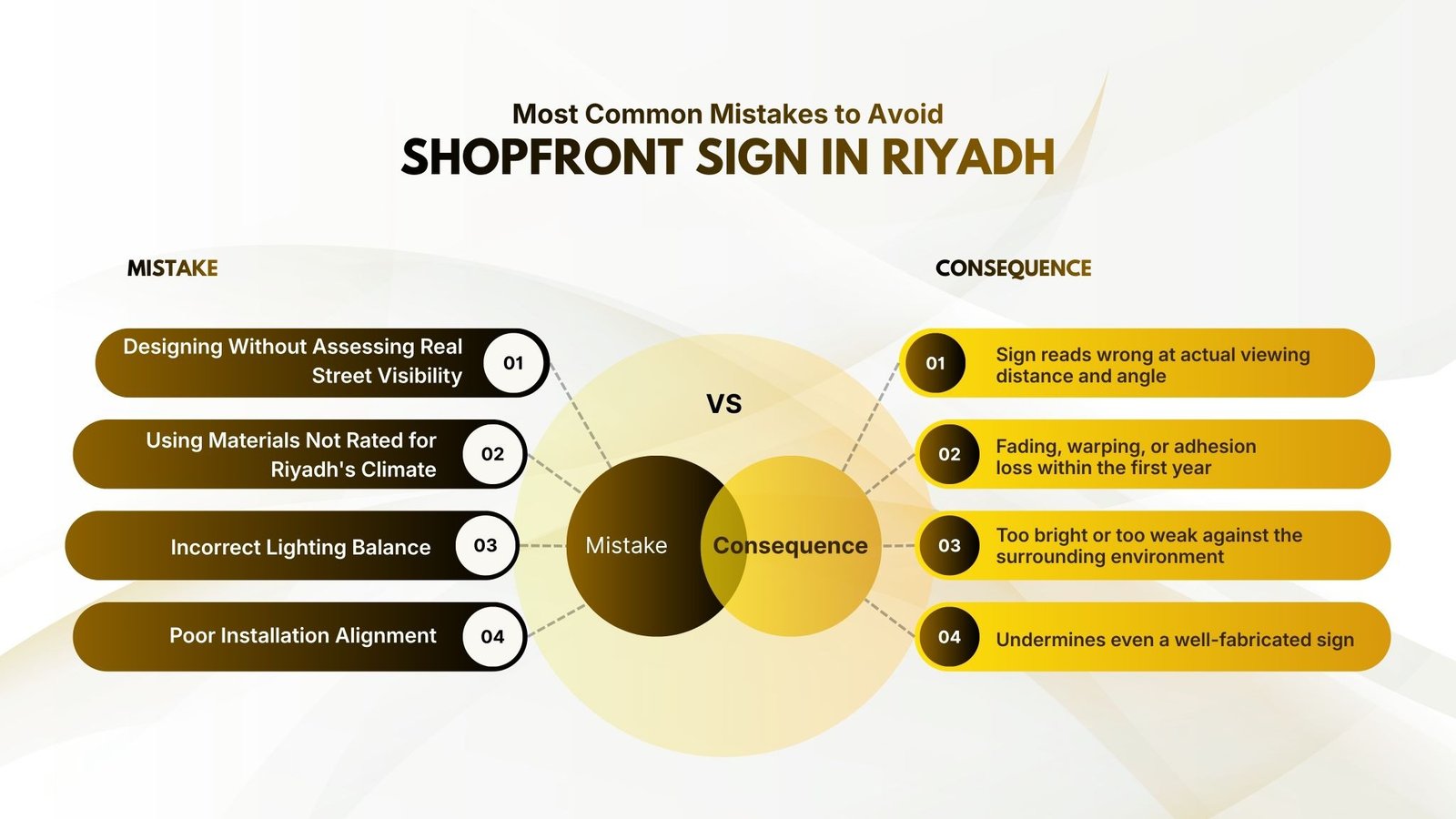
| Designing Without Assessing Real Street Visibility | Sign reads wrong at actual viewing distance and angle |
| Using Materials Not Rated for Riyadh’s Climate | Fading, warping, or adhesion loss within the first year |
| Incorrect Lighting Balance | Too bright or too weak against the surrounding environment |
| Poor Installation Alignment | Undermines even a well-fabricated sign |
What Does Shopfront Signage Cost in Riyadh?
| Cost Driver | Cost Level | What Drives It |
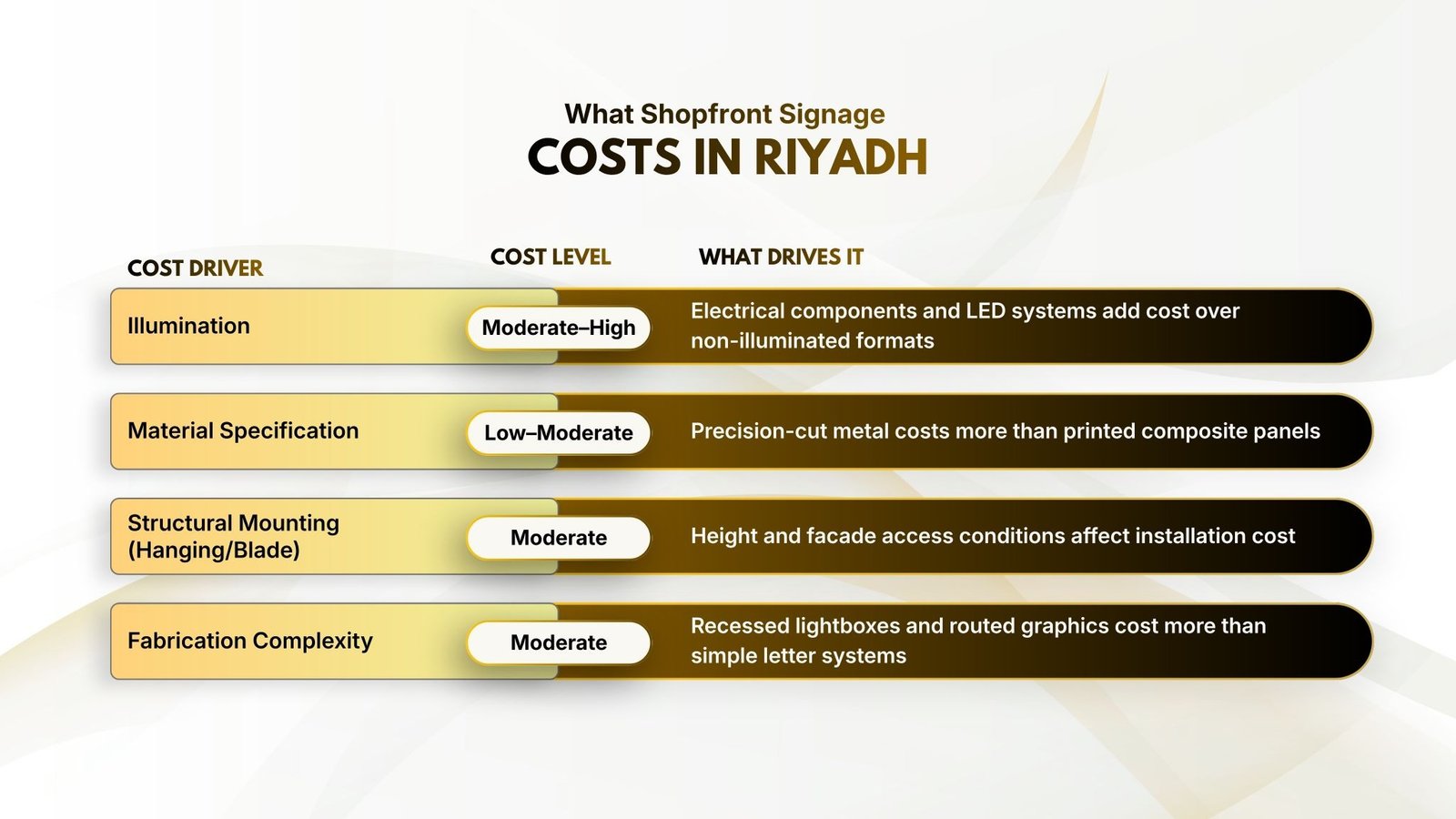
| Illumination | Moderate–High | Electrical components and LED systems add cost over non-illuminated formats |
| Material Specification | Low–Moderate | Precision-cut metal costs more than printed composite panels |
| Structural Mounting (Hanging/Blade) | Moderate | Height and facade access conditions affect installation cost |
| Fabrication Complexity | Moderate | Recessed lightboxes and routed graphics cost more than simple letter systems |
What you pay comes down to sign type, size, material, whether it’s illuminated, and how complex the installation is.
Illumination
Illuminated signs cost more upfront than non-illuminated ones, because you’re paying for electrical components, internal LED systems, and the fabrication precision that makes them work reliably. Even within illuminated formats, cost varies. A simple front-lit acrylic letter system costs less than a full recessed lightbox with routed graphics.
Material Specification
Your material choice moves the price too. A precision-cut brushed aluminium signboard costs more than a printed composite panel, but it also holds its finish far longer once it’s outdoors dealing with heat and sun exposure.
Structural Mounting (Hanging/Blade)
Hanging and blade signs are priced on the mounting requirement and how accessible the installation point is. A blade sign on a ground-floor unit installs differently, and costs differently, than one three floors up on a commercial facade.
Fabrication Complexity
The more complex the build, the more it costs. A simple letter system is cheaper to produce than a recessed lightbox or routed graphic panel, because those formats need more precision at every stage of fabrication.
The real cost risk isn’t the initial spend. It’s picking the wrong format or material and replacing it within two years because it stopped performing visually or structurally. We give you a full cost breakdown after the site assessment, before you commit to any fabrication.
How Etihad Golden Falcons Fabricates and Installs Shopfront Signs in Riyadh
It Starts With Your Site
We assess viewing distance, approach angles, ambient light, facade material, fixing positions, and municipality approval requirements before we make a single design or material decision. What we build for you comes from what your location actually needs, not a default format we apply regardless of context.
Fabrication Stays In-House
We handle fabrication in-house: material cutting, forming, surface finishing, LED integration, and quality control, all before anything leaves our workshop. Keeping production in-house is what lets us control colour accuracy, structural precision, and finish quality directly, instead of leaving it to an external supplier’s interpretation of your spec.
Municipality Approval: What We Help You Handle
We don’t file your municipality approval for you, but we make sure you’re not walking in blind. Technical drawings, compliance requirements, and what your specific sign needs to meet Balady standards are all worked out during fabrication, so you know exactly what to submit and what to fix before it becomes a delay.
Installation Is Part of the Job, Not an Afterthought
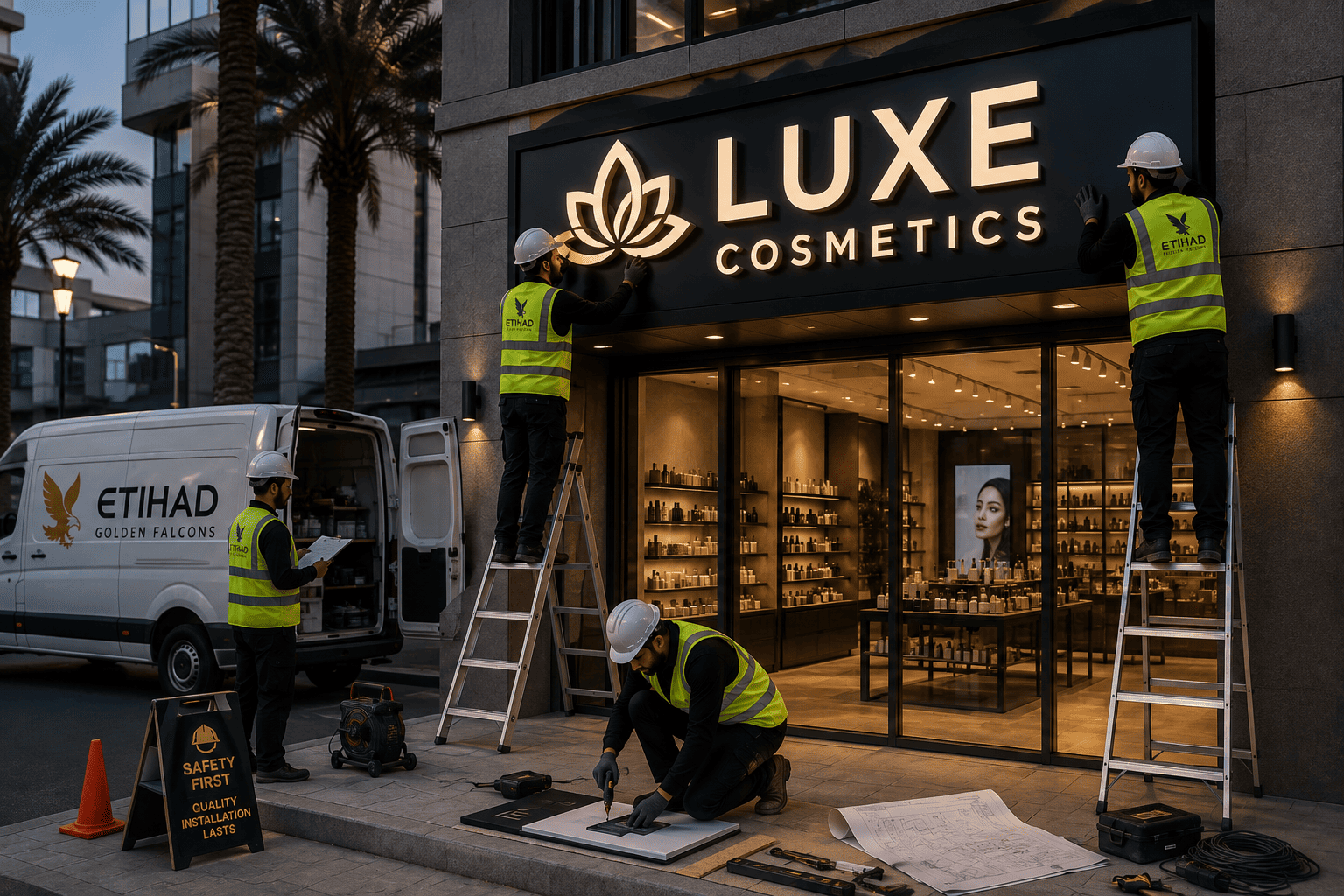
We install with our own teams. Fixing positions, alignment, electrical connections for illuminated systems, and final structural checks all get confirmed on site before we close out the project. A sign that’s fabricated well but installed carelessly performs no better than one that was made poorly, so we treat installation as the last stage of production, not an afterthought.
Whether you’re renovating an existing shopfront or setting up signage for a new business, we can get your branding aligned, your business properly represented, and your sign installed fast. Message us on WhatsApp and we’ll get started.
FAQs
Yes. Design, fabrication, and installation are all handled in-house under one engagement. You are not coordinating a design firm, a separate fabricator, and an installation contractor with different timelines and different accountability for the finished result.
Yes, when the correct LED systems and heat-rated materials are specified for the outdoor environment. Illuminated signs that fail under heat are almost always failures of material specification, not of the illumination technology itself. The right specification for a Riyadh outdoor installation is different from what is adequate in a cooler climate.
In most cases, yes. Depending on the system used, face panels, graphic elements, and lighting components can be updated without removing and replacing the full sign structure. This is worth considering at the specification stage — systems designed for future update capability cost more to build initially and significantly less to maintain over time.
A standard single-facade shopfront sign project runs two to four weeks from confirmed design to completed installation, depending on material specification, lighting complexity, and municipality approval timelines. We confirm the programme at the start of the project so your opening date is not built on an estimate.
In most commercial locations, yes. Balady approval covers dimensions, facade placement, illumination specifications, and structural fixing methods.
We won’t file it for you, but we walk you through exactly what your sign needs to meet, so you’re not stuck figuring it out on your own or delaying installation because something wasn’t submitted right.
Yes. Colour matching, finish specification, and typographic standards are all produced against your brand references. For businesses with multiple locations, we document the full sign specification so every site holds the same standard.