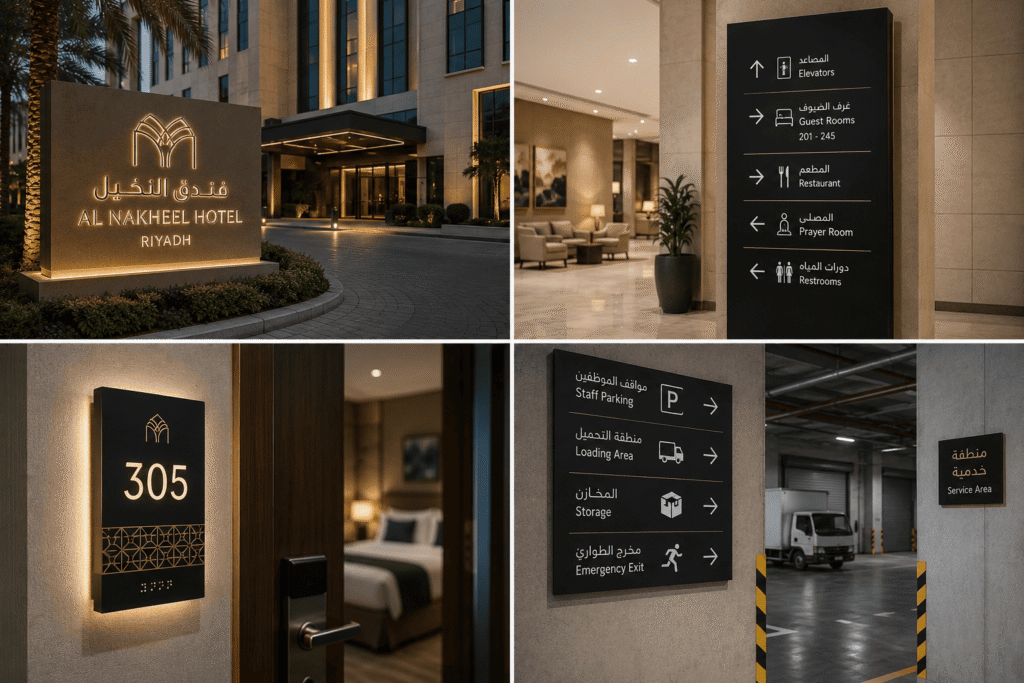
Hotel signage is the complete system of signs across a hotel; it includes entrance signs, lobby directories, directional signs, hotel room number signs, hotel door signs, restaurant and amenity markers, restroom signs, and back-of-house operational signs. In the hospitality industry, this system is often called hospitality signage, covering hotels, resorts, serviced apartments, boutique hotels, and guest houses alike.
Each type of hotel signage plays a specific role. Exterior and entrance signs establish the hotel’s identity before a guest walks in. Lobby and reception signs orient guests on arrival. Hotel wayfinding and directional signs move guests efficiently between floors and zones. Room number signs and door signs confirm each destination. Together, they are what make a hotel functional for everyone moving through it.
Good signage planning matters for every hotel operation. A boutique city hotel needs a clear, well-specified system as much as a multi-building resort does. The scale changes. The need does not. This guide covers the main types of hotel and hospitality signage, what different operations need, common mistakes to avoid, and what planning a full system in Riyadh involves.
What High-Quality Hospitality & Hotel Signage Must Deliver in Riyadh
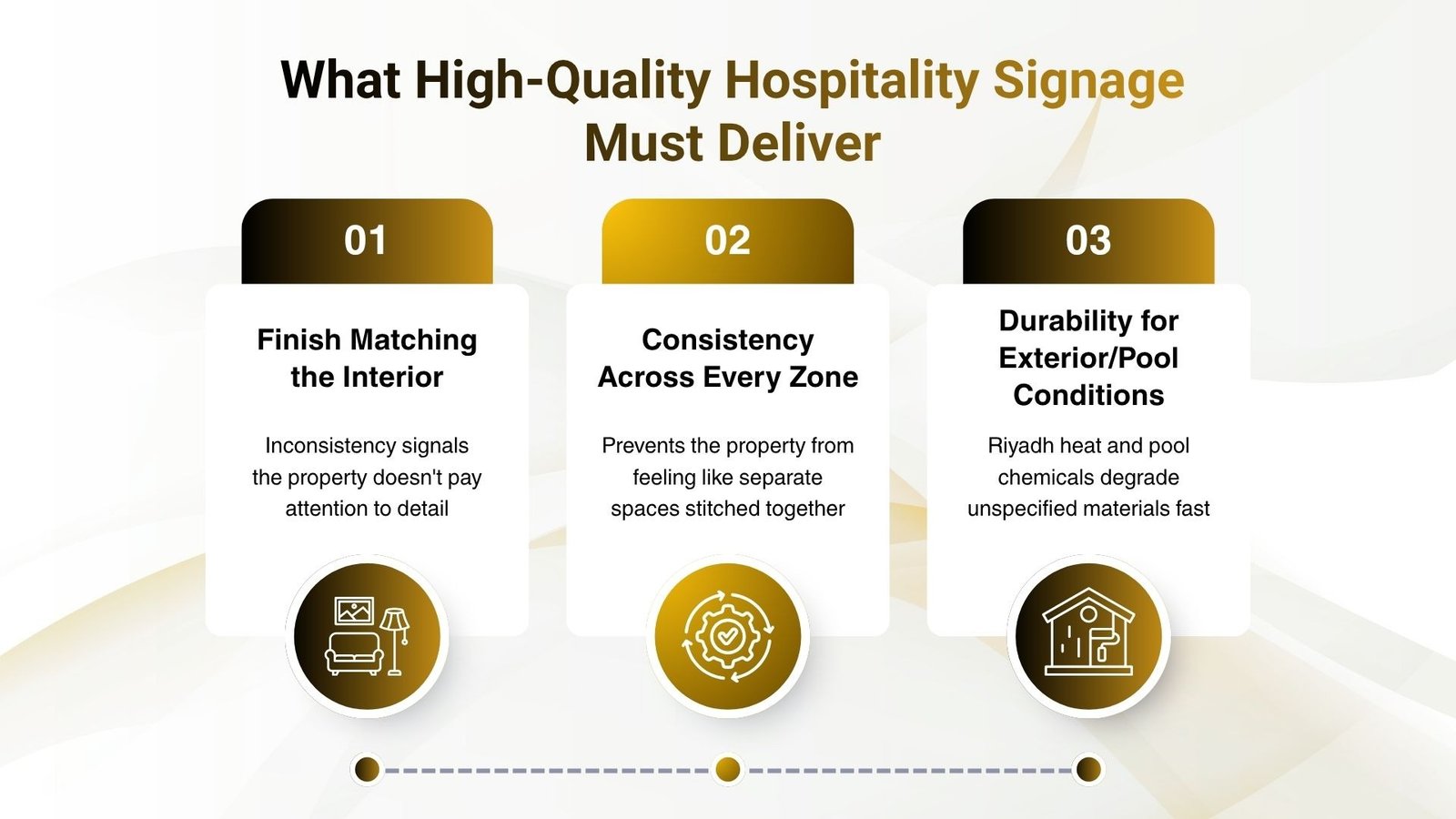
| Factor | Why It Matters |
| Finish Matching the Interior | Inconsistency signals the property doesn’t pay attention to detail |
| Consistency Across Every Zone | Prevents the property from feeling like separate spaces stitched together |
| Durability for Exterior/Pool Conditions | Riyadh heat and pool chemicals degrade unspecified materials fast |
Three things separate a well-executed hotel signage system from one that creates problems after installation. The first is material and finish quality. The second is consistency across every zone of the property. The third is durability under Saudi climate conditions for exterior and pool-area applications.
A system that gets all three right runs without issues for years. One that misses any of them creates visible problems in the exact environments where guests are paying the most attention.
Finish & Materials That Match the Interior
Hotel signage material and finish matter more in hospitality than in almost any other environment. A sign that looks slightly off next to the wall finish or feels cheap against the surrounding furniture tells guests the property does not pay attention to detail. In hospitality, that detail is the product. Guests spending a premium rate notice when something is inconsistent, even if they cannot name exactly what it is. The right material specification ensures every sign reinforces the standard the property is built to, rather than quietly undermining it.
Consistency Across Every Zone
A guest moves through multiple zones across a single stay: lobby, lift lobby, corridor, room, restaurant, gym, spa, pool area. If the signage changes character between those zones — different finishes, different quality levels, different typographic approach — the property feels like separate spaces put together rather than one designed environment. For a hotel competing at the premium end of the Riyadh market, that inconsistency costs more than the money saved by mixing suppliers or cutting specification on secondary zones. Consistency across every touchpoint is what makes the property feel like a deliberate, unified experience.
Durability for Exterior Conditions
Riyadh’s climate puts outdoor and pool-area signage under conditions that interior signs never face. Sustained heat, direct sunlight for most of the day, and pool environments that introduce moisture and chemical exposure all affect how materials perform over time. Signage not specified for these conditions starts showing wear ahead of schedule. For a hotel where the physical finish is part of what guests are paying for, a degraded sign in a visible location is not a minor maintenance issue. It is a visible signal that standards have slipped.
What Are the Main Hotel Signage Types Used in Riyadh
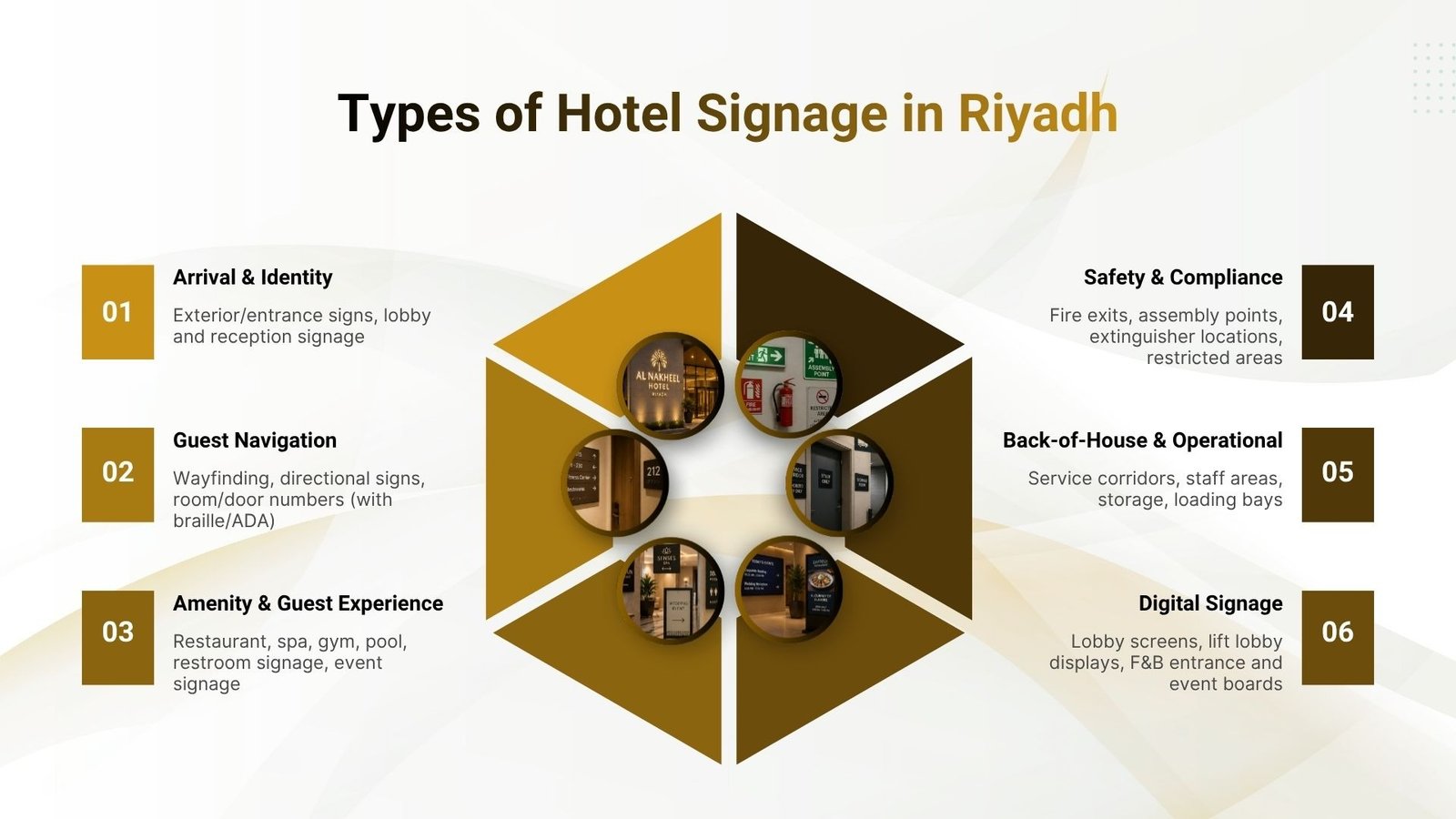
| Category | Covers |
| Arrival & Identity | Exterior/entrance signs, lobby and reception signage |
| Guest Navigation | Wayfinding, directional signs, room/door numbers (with braille/ADA) |
| Amenity & Guest Experience | Restaurant, spa, gym, pool, restroom signage, event signage |
| Safety & Compliance | Fire exits, assembly points, extinguisher locations, restricted areas |
| Back-of-House & Operational | Service corridors, staff areas, storage, loading bays |
| Digital Signage | Lobby screens, lift lobby displays, F&B entrance and event boards |
Hotel and hospitality signage is not one product. It is several sign types, each handling a different part of how guests move through and experience your hotel. Here is what each type does for your operation.
Hotel Exterior Signage & Entrance Signs
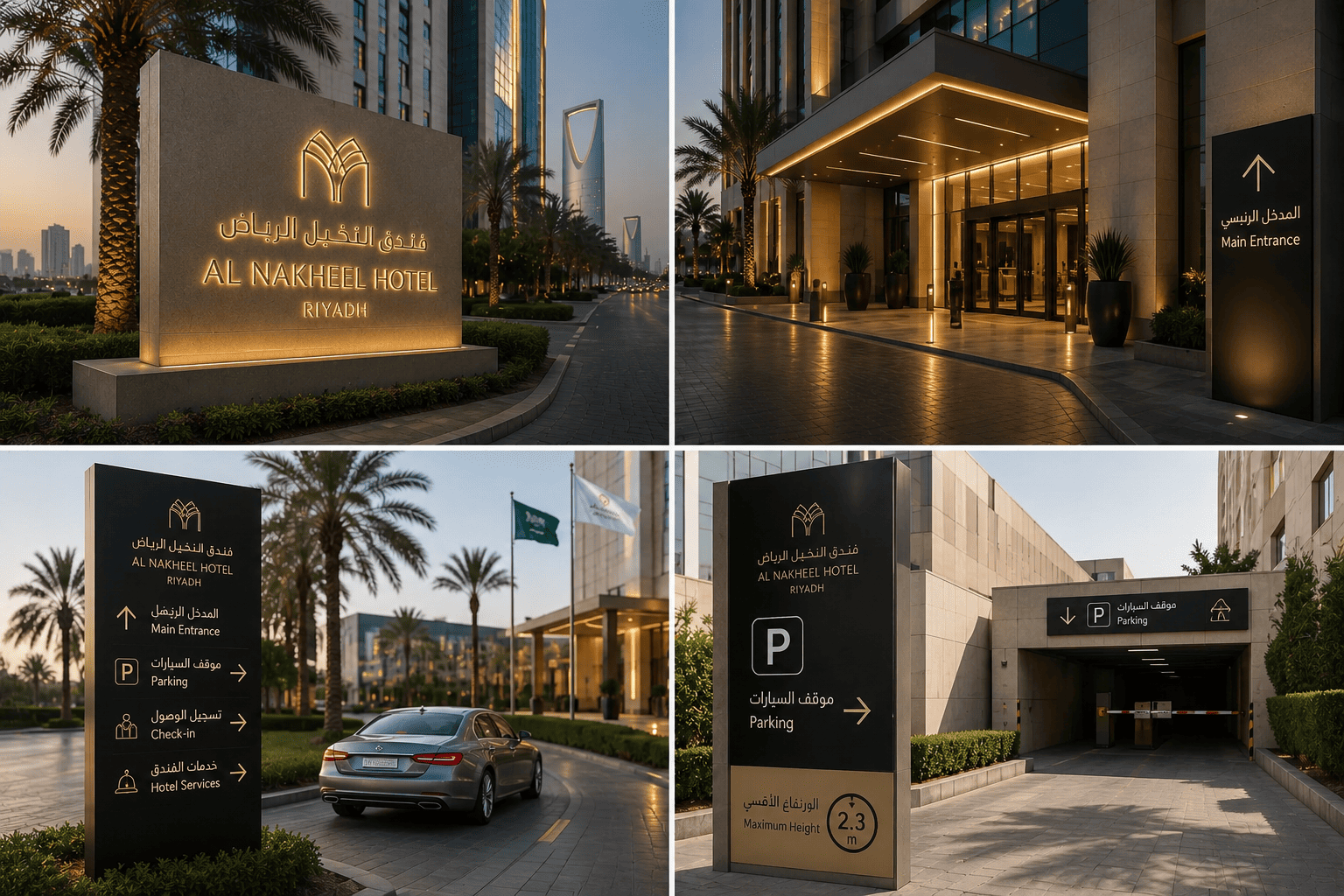
Your exterior and entrance signs are the first thing any guest reads before walking in. For hotels in Riyadh, these signs do two jobs: they confirm the building from the road and guide vehicles and guests to the right entrance. Unclear or undersized outdoor hotel signs create confusion at arrival. That is the worst point in the guest journey for a first impression to go wrong. Entrance signs set the expectation. Everything inside is judged against what the outside already communicated.
Hotel Lobby & Reception Signage
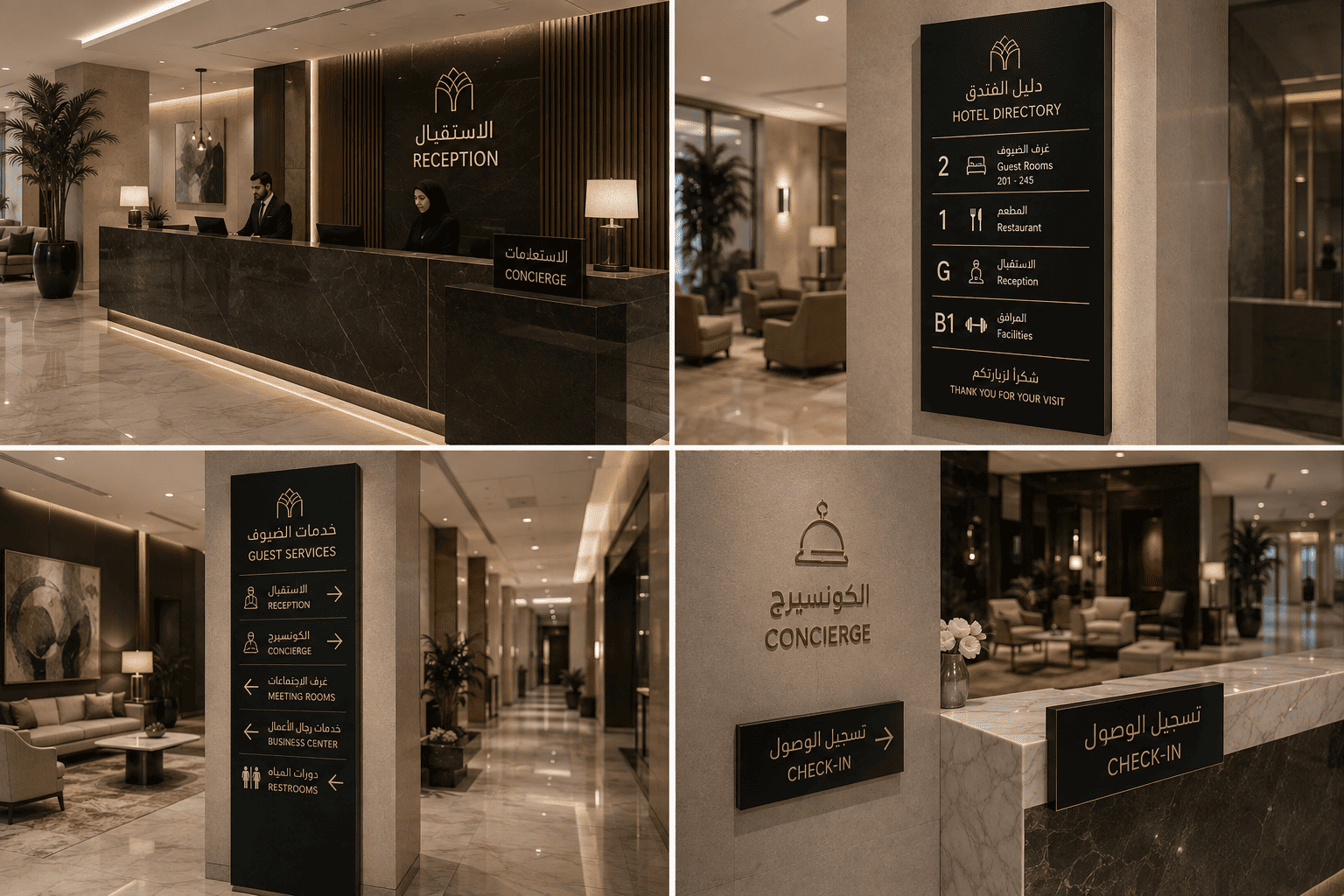
The lobby is the first interior space a guest navigates. Your reception sign needs to be visible from the entrance — not after a guest has already walked past it. Check-in counters and concierge points need clear identification. Guests arriving tired, in a hurry, or for the first time do not pause to figure out the layout. The lobby is also the most closely read space in the hotel, so material and finish standards here carry more weight than anywhere else in the building.
Hotel Wayfinding & Directional Signage
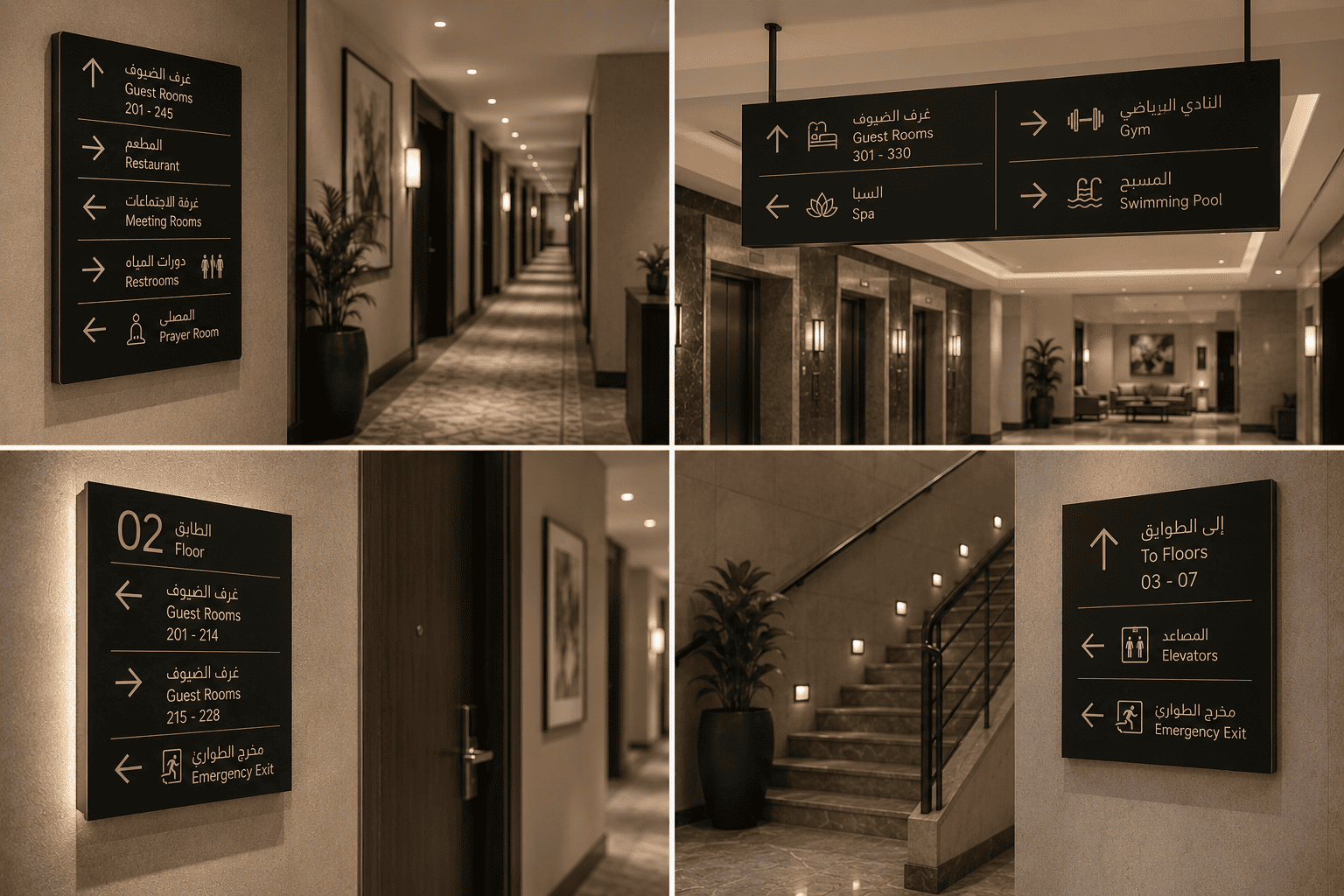
After the lobby, your hotel directional signage takes over. It moves guests between floors, across corridors, and between facilities. If directional signs are missing at key junctions or placed past the decision point, guests go the wrong way. The result is more questions at reception and more staff time spent on navigation instead of service. Hotel wayfinding signage that works correctly is the kind guests never consciously notice — because they never needed to stop and look for it.
Hotel Room Signs, Door Signs & Room Numbers
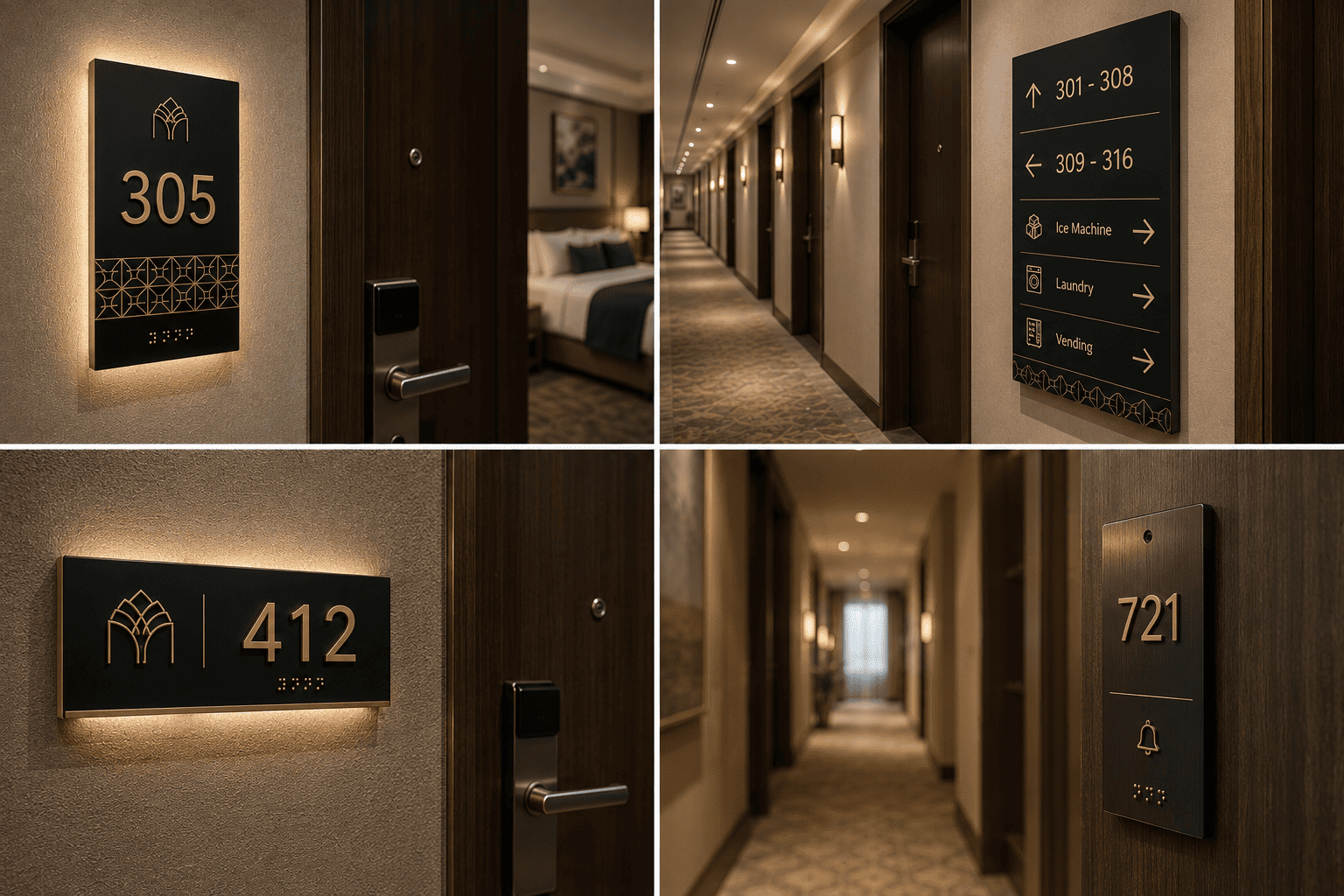
Your hotel room number signs are read up close, repeatedly, by every guest who stays. Unlike lobby or corridor signs viewed from a distance, room door signs are read at arm’s length under corridor lighting. They get touched, cleaned, and scrutinised daily. The finish needs to hold up to that level of contact and still look consistent across every floor. Custom hotel room signs matched to the corridor interior finish signal attention to detail. Signs that look like a different specification from the surrounding walls signal the opposite.
Braille & ADA Hotel Room Signs
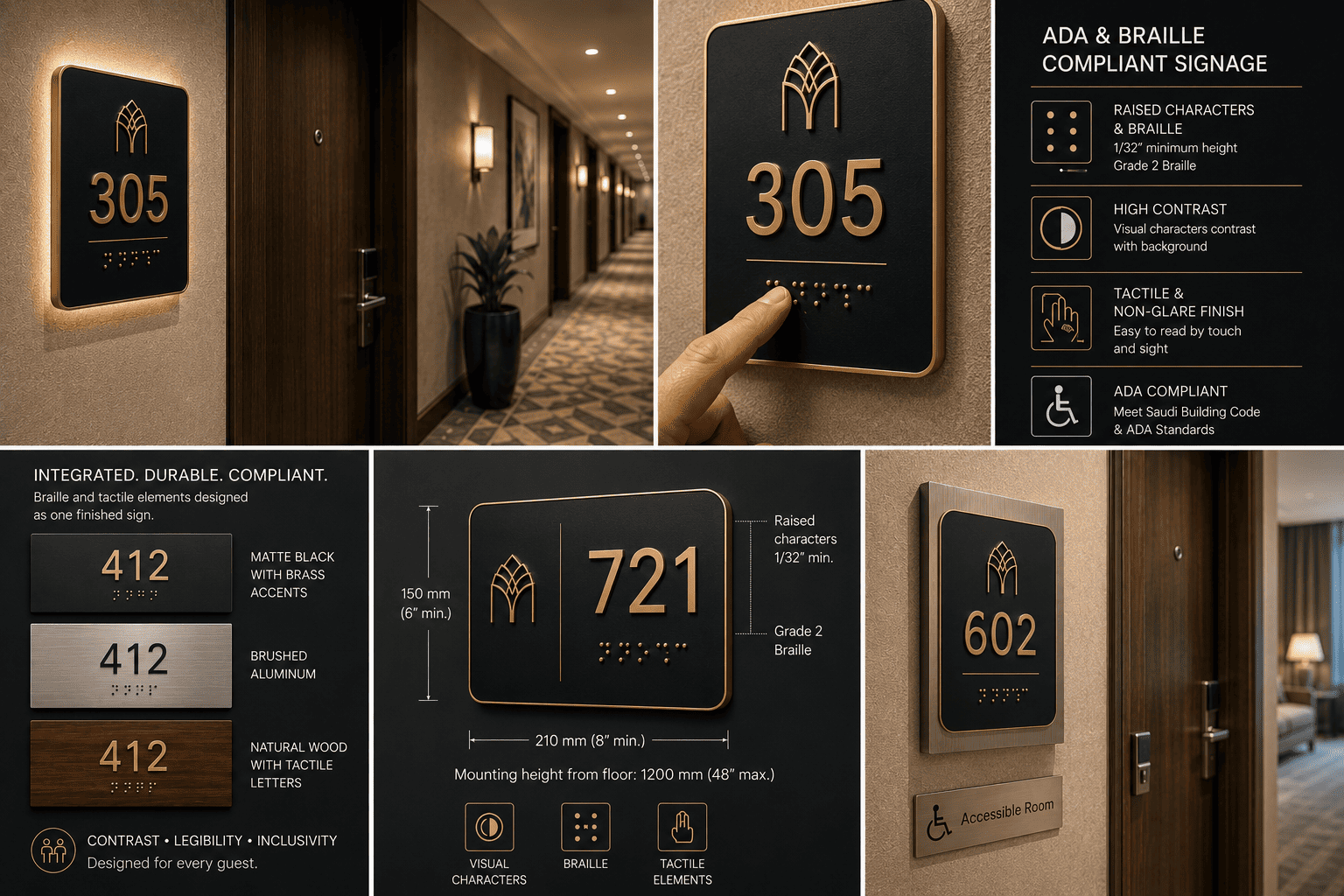
Braille hotel room number signs are a compliance requirement in Saudi hospitality projects. They are not optional and they are not an add-on. The mistake most hotel signage projects make is specifying the main room sign first and adding braille as a separate element later. The result looks exactly like that. Braille and tactile elements specified from the design stage produce a single, finished sign. Those added at the end produce a compliance patch that is visible to anyone who looks.
Hotel Safety, Event & Operational Signage
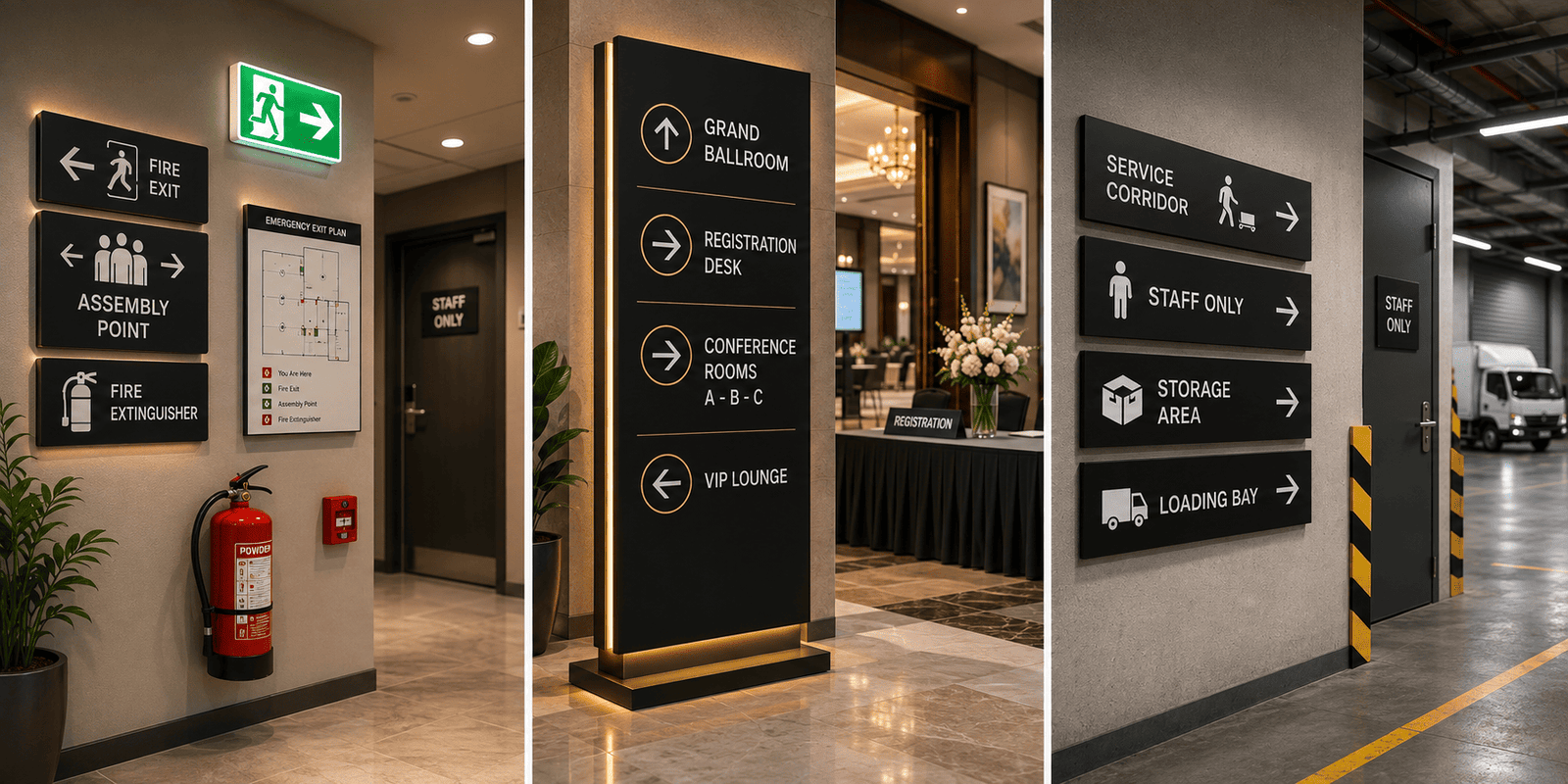
Three sign categories that are consistently underplanned in hotel projects — and the ones most likely to create operational problems after opening.
Hotel Safety Signage
Safety signs in hotels are a legal requirement under Saudi Civil Defense regulations. Fire exit routes, emergency assembly points, extinguisher locations, and restricted area markers must meet set standards for placement, colour, size, and symbol. Include them in your signage project from day one. Adding them separately after everything else is installed costs more and produces a result that never fully integrates with the rest of the system.
Hotel Event Signage
If your hotel runs conferences, weddings, or corporate events, event signage is something your team deals with regularly. Registration points, conference room identification, and directional signs for first-time event guests all need to be covered. Event guests arrive in groups, under time pressure, with no prior knowledge of your layout. Without clear signs at every decision point, they stop moving and start asking. That puts the load on your events team at exactly the moment they need to be focused on running the event.
Back-of-House & Operational Signage
Your back-of-house areas need a working signage system just as much as the guest-facing zones. Service corridors, staff-only areas, storage zones, and loading bays all need clear identification. Without it, internal movement slows down and compliance audits become harder to manage. Back-of-house signage is almost never in the original design brief. It is also almost always flagged as a problem within the first few months of the hotel opening.
Hotel & Hospitality Digital Signage
Static signs cannot update themselves. Hotel digital signage handles the content that changes daily or hourly — event schedules, F&B promotions, conference room allocation, and guest communications. Hotel lobby digital signage, lift lobby screens, and F&B entrance displays manage this in real time without reprinting anything. For hotels in Riyadh with regularly changing content, a digital layer in the signage system costs less over time than updating static signs every time something changes.
Amenity, Restaurant & Restroom Signage
Every F&B outlet, spa, gym, pool area, and facility in your hotel needs clear identification. Hotel restroom signs, restaurant entrance markers, spa directional signs, and gym identification all contribute to how easily guests navigate between amenities. When these signs are consistent with the rest of the system, the hotel feels designed as a whole. When they look like they were added separately or sourced from a different supplier, that inconsistency is visible to guests even if they cannot name exactly what feels off.
How Do Signage Requirements Differ Across Hospitality Project Types?
Not every hospitality property works the same way. The signage system has to match how guests actually use the space.
City Business Hotels
Guests move fast. They arrive, check in, go to their room, leave for meetings, return, and check out, often over compressed timescales. Signage here needs to be direct, immediately legible in motion, and optimised for decision-making speed rather than visual impact. Hotel directional signage in a city business hotel needs to answer questions before guests form them.
Leisure Resorts & Large-scale Properties
These properties are spread across larger footprints with outdoor paths, multiple buildings, and extended distances between facilities. Guests move at a different pace, but they also rely on directional signage over longer distances and across varied lighting conditions — interior, exterior, twilight, poolside.
Wayfinding at resort scale requires a layered system. Overview directories at key points, directional markers at decision junctions, and room identification at close range — all operating as a coherent system across a much larger spatial footprint than a city hotel.
Branded Serviced Apartments & Mixed-use Developments
These properties have overlapping user groups: long-stay residents, short-stay guests, and visitors to shared facilities. The signage system has to distinguish between resident and guest zones, manage shared facility access, and maintain clear separation of flows without making the environment feel divided or institutional.
Hotel renovation signage is also a consideration for mixed-use and operational properties undergoing refurbishment. Temporary wayfinding during renovation keeps guest experience intact while permanent systems are replaced or installed.
Most Common Hotel Signage Mistakes to Avoid
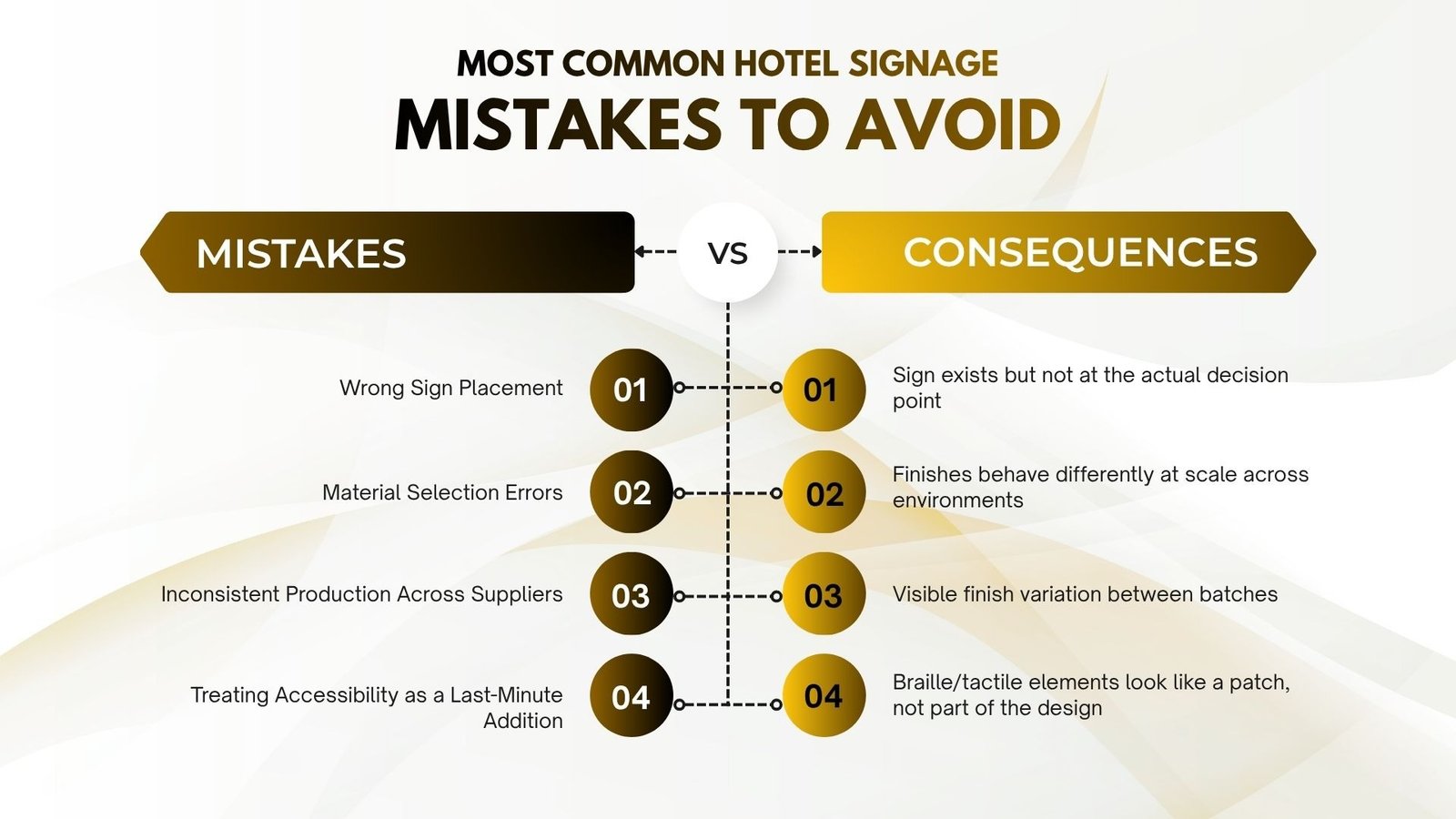
| Mistake | Consequence |
| Wrong Sign Placement | Sign exists but not at the actual decision point |
| Material Selection Errors | Finishes behave differently at scale across environments |
| Inconsistent Production Across Suppliers | Visible finish variation between batches |
| Treating Accessibility as a Last-Minute Addition | Braille/tactile elements look like a patch, not part of the design |
How Much Does Hospitality and Hotel Signage Cost in Riyadh
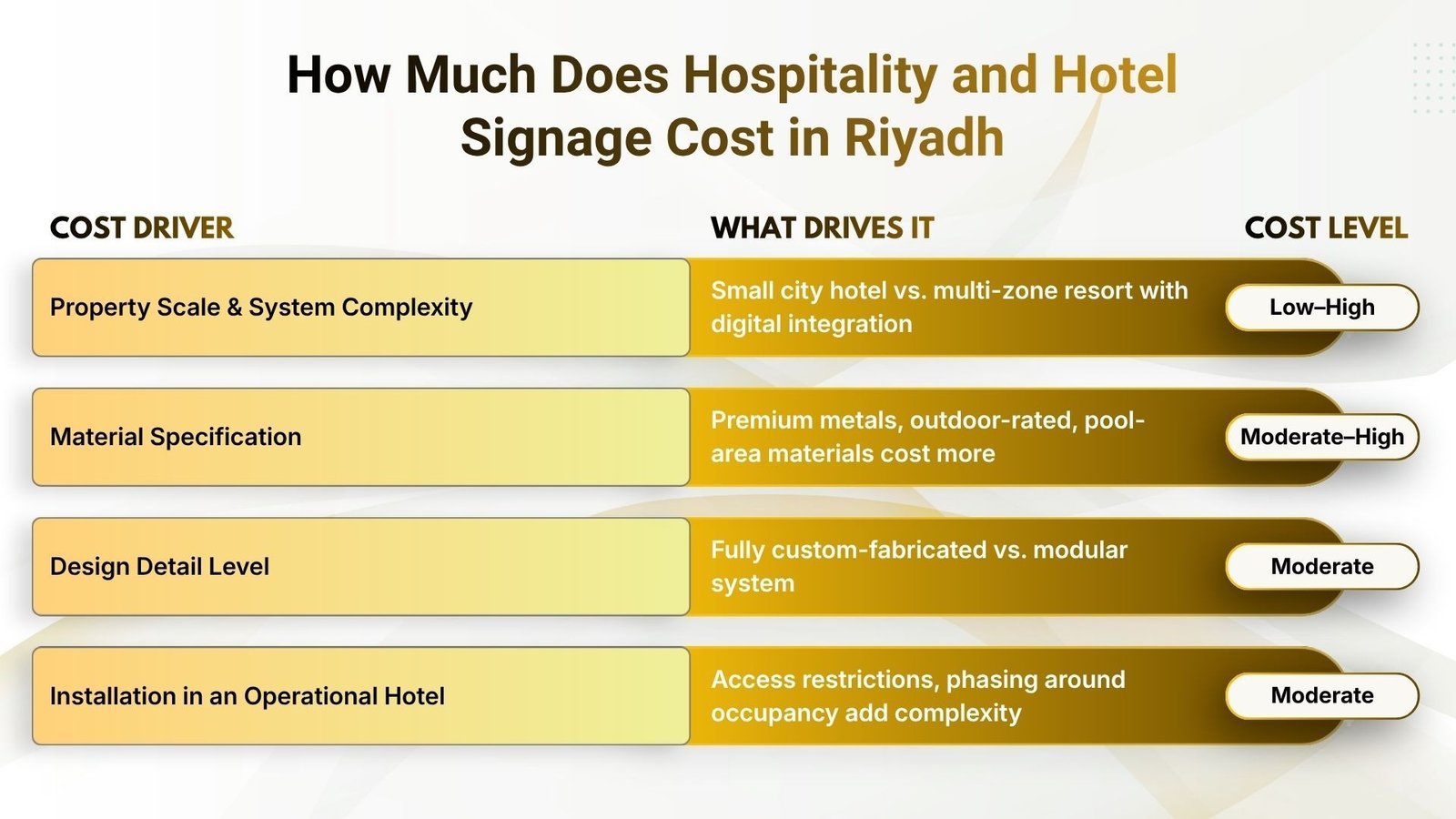
| Cost Driver | Cost Level | What Drives It |
| Property Scale & System Complexity | Low–High | Small city hotel vs. multi-zone resort with digital integration |
| Material Specification | Moderate–High | Premium metals, outdoor-rated, pool-area materials cost more |
| Design Detail Level | Moderate | Fully custom-fabricated vs. modular system |
| Installation in an Operational Hotel | Moderate | Access restrictions, phasing around occupancy add complexity |
Cost is determined by property scale, signage system complexity, material specification, and installation scope.
A small city hotel with a straightforward wayfinding system is a fundamentally different project from a multi-zone resort with exterior paths, multiple F&B outlets, pool areas, back-of-house systems, and digital signage integration. Scope drives cost more than any individual material or format decision.
Material selection is the second major cost variable. Premium finishes on hotel room door signs, high-spec metals for lobby identification, and outdoor-rated materials for exterior and pool-area applications all carry different fabrication costs. The detail level of the design system — whether every sign type is custom-fabricated or adapted from a modular system — also affects overall project cost significantly.
Installation in an operational hotel adds complexity that a new-build fit-out does not have. Access restrictions, noise limitations, phased installation around occupied rooms and active F&B outlets — these are real logistical factors that affect installation time and cost.
We give you a detailed scope and cost breakdown before any fabrication begins. For large hospitality projects, we also offer phased installation planning so the project integrates with your operational timeline.
How Etihad Golden Falcons Delivers Hotel and Hospitality Signage in Riyadh
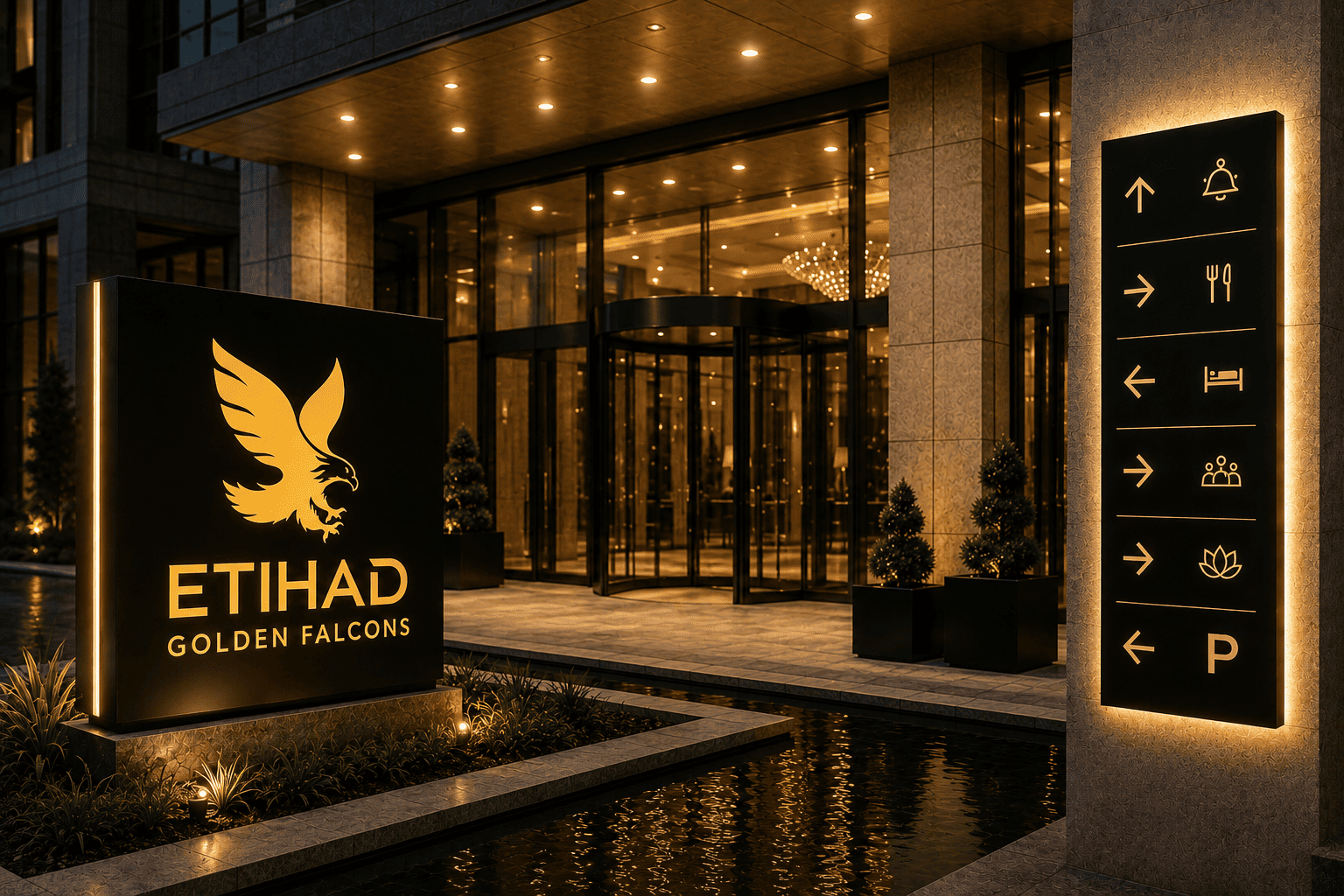
Working with a hotel sign company that understands how a hotel operates makes a visible difference in the finished result. Here is how we work on every hospitality signage project.
We Start With How Your Hotel Actually Works
Before any design or fabrication begins, we walk your hotel the way your guests do. Not from the floor plan — from the entrance. We follow the guest journey from arrival to room, identify every decision point where a sign is needed, and note where your current layout creates confusion or leaves gaps. That walkthrough is what determines where your signs go, what they say, how large they need to be, and how they need to be finished. You get a signage system built around how people actually move through your hotel, not around what looked logical on a drawing.
We Fabricate Everything In-House
For a full hotel signage project covering hundreds of individual pieces — hotel room number signs, door signs, lobby identification, exterior signs, restroom markers — finish consistency only holds when everything comes from the same production process. We handle fabrication in-house for exactly that reason. Split production across multiple suppliers is where finish variation enters a project. By the time it shows up on installed signs across the same corridor, it is too late to fix without replacing pieces. We make sure you never get to that point.
We Install Around Your Operation
For operational hotels, installation needs to work around your guests, not the other way around. We plan access, sequencing, and phasing around your occupancy levels, F&B service hours, and event schedules. Your guests do not notice the installation because we make sure they never have reason to.
For new builds, we coordinate directly with your fit-out contractors and interior designers so signage arrives and installs as part of the programme — not as a last-minute addition after everything else is finished.
Whether you’re planning a renovation or need signage for a new hotel or hospitality project, message us on WhatsApp and our experts will give you a free consultation on the complete signage system for your hotel.
FAQs
Can Etihad Golden Falcons match signage to an existing brand identity or interior design scheme?
Yes. Finishes, materials, and typographic standards are matched to the property’s design direction. For branded hotel groups, we work against the brand’s signage standards documentation. For independent properties, we develop the specification in coordination with the interior designer or fit-out team.
Do you work directly with fit-out contractors and interior designers?
Yes. We coordinate directly with project teams throughout fabrication and installation. Signage is not a standalone package delivered at the end — it is integrated into the fit-out programme from specification stage.
How is finish consistency maintained across a large hospitality project?
Production is handled in-house under controlled conditions. Every piece in the project follows the same material specification, finish standard, and quality check process. We do not split production across suppliers or batches without ensuring consistency checks are in place.
Can signage be updated or replaced after the hotel opens without disrupting operations?
Yes. Updates and replacements are handled in phases, scheduled around operational hours and occupancy. For properties that go through renovation or rebranding after opening, we manage the replacement programme so the property is never in a state where old and new signage are visibly mixed in the same zone.
How long does a full hospitality signage project take from brief to installation?
A standard city hotel project runs eight to fourteen weeks from confirmed brief to completed installation, depending on scope and material complexity. Resort-scale projects with exterior systems, digital signage integration, and multi-zone coverage take longer. We set a realistic programme at the start so your opening timeline is not built around an estimate.
Do you supply braille hotel room number signs for accessibility compliance?
Yes. Braille and tactile elements are produced and integrated as part of the standard room numbering system, not added separately. Compliance requirements are built into the design specification from the start.