
Every Riyadh business needs proper signage to become recognizable. The question is not whether you need a sign for your brand. The real question is which type is right for you, static or digital. And the honest answer is that it depends entirely on what your business needs it to do.
Digital signage in Riyadh has become part of the conversation for businesses that would not have considered it a few years ago. Screens are more accessible, and more commercial spaces are treating displays as a standard part of their fit-out. At the same time, a well-made static sign still does things a screen cannot, and in certain environments, it does them better.
This guide breaks down both options clearly so the decision is based on your actual situation, not on what’s more trendy.
What Is the Difference Between Static and Digital Signage?
Static signage is any sign where the content is fixed at the point of production. Fabricated 3D letters, printed panels, vinyl graphics, illuminated sign boxes with static inserts. The content does not change without physically replacing or reprinting the sign element.
Digital signage in Riyadh displays content on a screen: LED panels, LCD displays, video walls. It is managed through software that allows the content to be updated remotely. The content can change as frequently as needed, and a single display can show multiple messages, animations, or videos in rotation.
Both are legitimate solutions. The right one depends on how often your content needs to change and what the total cost of each option looks like over the lifespan of the installation.
How Do Static and Digital Signage Compare?
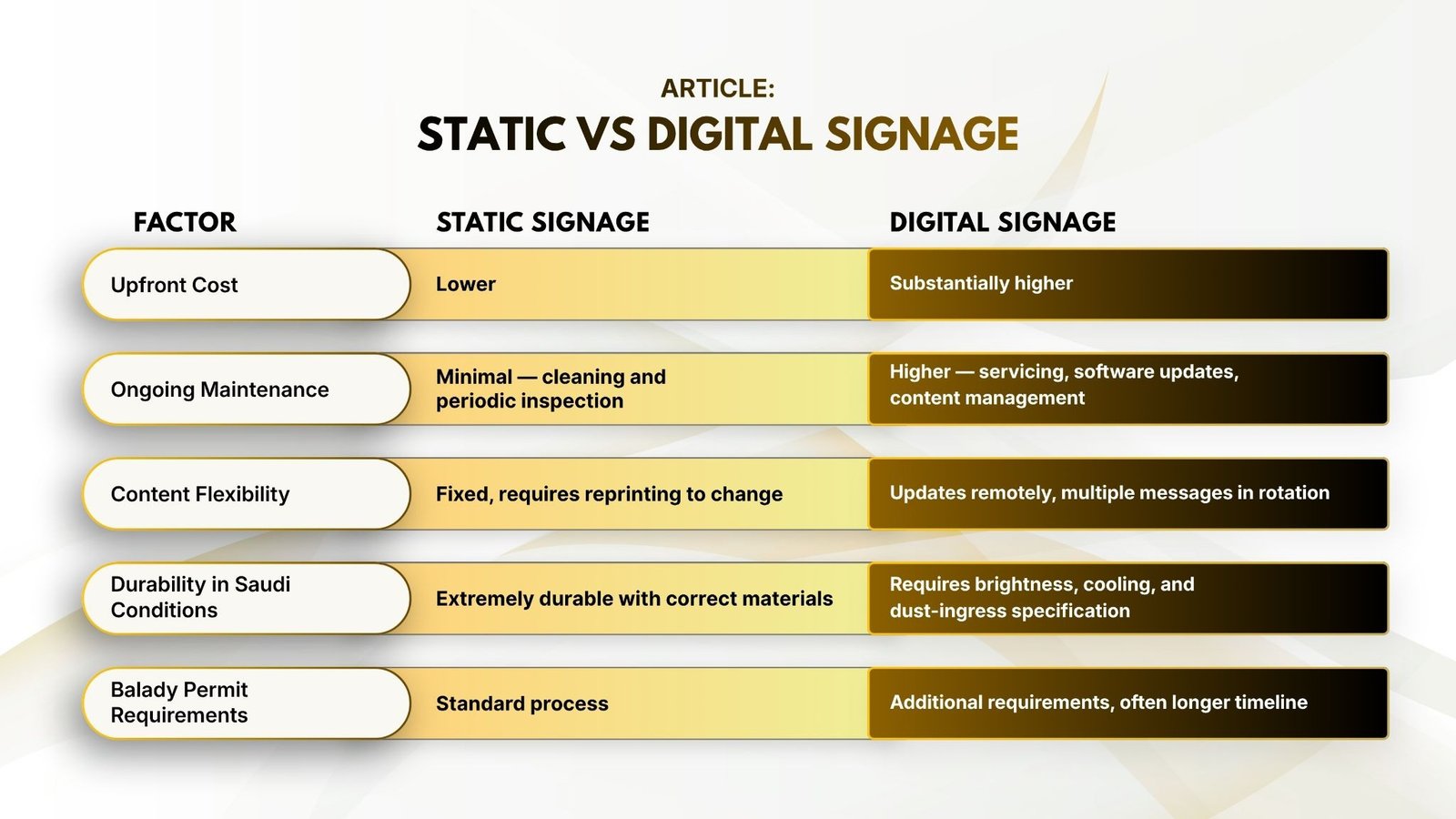
| Factor | Static Signage | Digital Signage |
| Upfront Cost | Lower | Substantially higher |
| Ongoing Maintenance | Minimal — cleaning and periodic inspection | Higher — servicing, software updates, content management |
| Content Flexibility | Fixed, requires reprinting to change | Updates remotely, multiple messages in rotation |
| Durability in Saudi Conditions | Extremely durable with correct materials | Requires brightness, cooling, and dust-ingress specification |
| Balady Permit Requirements | Standard process | Additional requirements, often longer timeline |
Upfront Cost
For most applications, static signage has a lower upfront cost. A fabricated shopfront sign, a set of directional panels, or a building fascia can be produced and installed at a fraction of the cost of an equivalent digital display installation. If shopfronts are your main focus, our shopfront signs guide breaks down pricing and options in more detail.
Digital signage in Riyadh requires screen hardware, mounting infrastructure, content management software, cabling, and installation. For a single quality outdoor LED display, the upfront investment is substantially higher than a comparable static installation.
Ongoing Maintenance
Static signage built with the right materials needs minimal ongoing maintenance. Cleaning and periodic inspection. A well-made static sign in Riyadh runs for years with very little attention or cost beyond the occasional clean after a sandstorm.
Digital signage has ongoing costs that are consistently underestimated at the purchase stage. Screens need servicing. Software needs updating. Content needs managing. In Riyadh’s heat and dust environment, outdoor LED displays require regular cleaning of vents and components to maintain thermal performance. Factor this into the total cost before comparing against static options.
Content Flexibility
The operational advantage of digital is real and significant for businesses with frequently changing content needs. Pricing updates, time-sensitive promotions, rotating campaign messages, different content at different times of day – none of this is possible with static signage without reprinting.
For businesses with stable, consistent messaging, a brand name, a logo, and a service list that does not change regularly, static signs are a better option.
Durability in Saudi Conditions
A correctly specified static sign is extremely durable in Riyadh’s climate. ACM, stainless steel, and powder-coated aluminium handle sustained heat, UV exposure, and sand without significant degradation when the right grades and finishes are used.
Outdoor digital signage like illuminated signs in Riyadh introduces additional complexity. Screen brightness must be high enough to remain readable in direct sunlight, typically 5,000 nits or above for outdoor-facing displays. Cooling systems must handle ambient temperatures that push surface temperatures of dark-coloured enclosures above 60 degrees in summer. Dust ingress is a constant risk for any electronic installation. These challenges are manageable with the right hardware specification and a maintenance programme. In contrast, indoor signage deals with other variables like ambient lighting from windows or overhead fixtures, screen glare depending on placement, and mounting constraints tied to interior wall types and ceiling heights, rather than heat, sun, or dust.
Balady Permit Requirements
Signage services in Riyadh need permits based on their location, whether they are indoor or outdoor. Both static and digital signage require Balady permits for outdoor installation in Riyadh. The permit process for digital displays can involve additional requirements around screen brightness levels, content restrictions near roads, and placement regulations. An experienced signage company handles this process as part of the project, but the timeline for digital permits is sometimes longer than static. Factor this into your project schedule.
How Are Saudi Businesses Currently Using Static and Digital Signage?
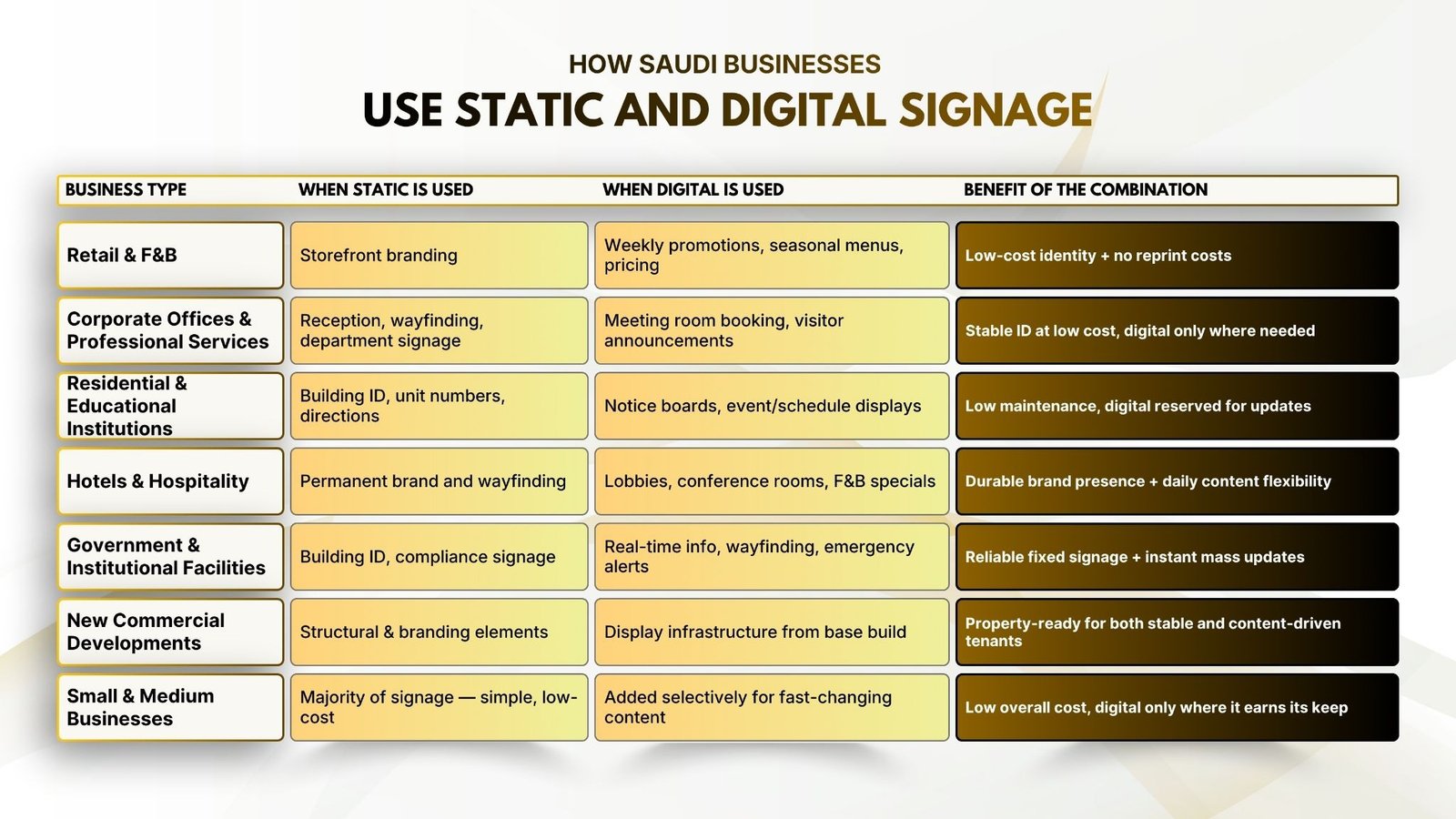
| Business Type | When Static Is Used | When Digital Is Used | Benefit of the Combination |
| Retail & F&B | Storefront branding | Weekly promotions, seasonal menus, pricing | Low-cost identity + no reprint costs |
| Corporate Offices & Professional Services | Reception, wayfinding, department signage | Meeting room booking, visitor announcements | Stable ID at low cost, digital only where needed |
| Residential & Educational Institutions | Building ID, unit numbers, directions | Notice boards, event/schedule displays | Low maintenance, digital reserved for updates |
| Hotels & Hospitality | Permanent brand and wayfinding | Lobbies, conference rooms, F&B specials | Durable brand presence + daily content flexibility |
| Government & Institutional Facilities | Building ID, compliance signage | Real-time info, wayfinding, emergency alerts | Reliable fixed signage + instant mass updates |
| New Commercial Developments | Structural & branding elements | Display infrastructure from base build | Property-ready for both stable and content-driven tenants |
| Small & Medium Businesses | Majority of signage — simple, low-cost | Added selectively for fast-changing content | Low overall cost, digital only where it earns its keep |
New commercial developments in Riyadh are increasingly being designed with digital display integration from the planning stage. Retail destinations, mixed-use towers, and premium office buildings are treating digital signage infrastructure as part of the base build rather than a tenant addition.
At the same time, static signs remain the dominant format for small and medium businesses across the city. Lower cost, simpler installation, lower maintenance burden, and no dependency on power or software make it the practical default for the majority of commercial signage applications in Riyadh.
The businesses seeing the best outcomes are those using both strategically: static where the content is stable and digital where the content needs to move.
Retail and food and beverage businesses with weekly promotions, seasonal menus, and regularly changing pricing get clear operational value from digital signage in Riyadh.
Corporate offices, professional service businesses, residential buildings, and educational institutions typically have stable identification and wayfinding needs. Static signage serves these well, costs less, and requires less ongoing management.
Hotels and hospitality venues commonly use both. Static signage for permanent brand and wayfinding elements. Digital displays in lobbies, conference facilities, and food and beverage outlets where event schedules, daily specials, and promotional content need to update regularly.
Large government and institutional facilities are increasingly adopting digital signage for real-time public information, large-footprint wayfinding, and emergency communication systems. The ability to push updated information to hundreds of screens simultaneously is a genuine operational capability in facilities of that scale.
Which Signage Type Should You Choose for Your Project?
Two questions frame the decision. How often does your content need to change? And what does the total cost of each option look like over five years, not just on day one?
If content is stable and the five-year total cost of static is lower, static is the right answer. If content changes frequently enough that the operational value of digital is real, and the five-year total cost including maintenance is acceptable, digital is the right answer.
If the answer is not clear, a consultation with an experienced signage company like Etihad Golden Falcons will help you model the real costs and benefits for your specific location and application before you commit.
What is the Cost Difference between Static & Digital Signage in Riyadh?
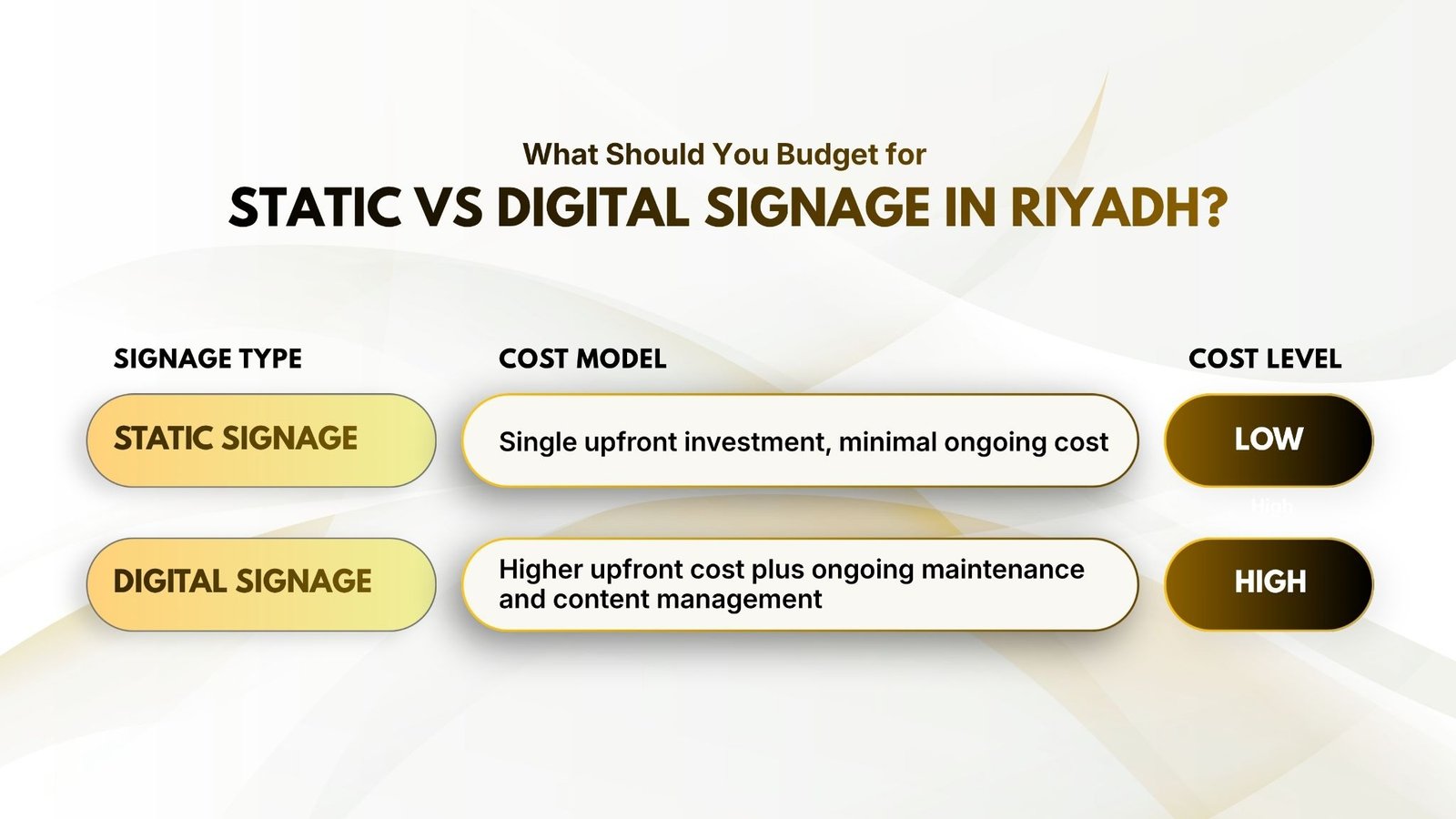
| Signage Type | Cost Model | Cost Level |
| Static Signage | Single upfront investment, minimal ongoing cost | Low |
| Digital Signage | Higher upfront cost plus ongoing maintenance and content management | High |
Static signage cost is driven by material, fabrication complexity, and installation. The model is straightforward; a single upfront investment with minimal ongoing cost for a well-specified installation.
Digital signage in Riyadh has a higher upfront cost and an ongoing cost component that needs to be budgeted for explicitly. Screen hardware, installation infrastructure, content management, and maintenance are all real costs. Businesses that budget only for the purchase price of the screens and not the total cost of ownership are consistently the ones who end up with underperforming and undermaintained installations two years in.
The businesses seeing the best outcomes are those using both strategically: static where the content is stable and digital where the content needs to move. If you’re not sure which mix is right for your business, message us on WhatsApp and we can help you figure out where static works and where digital would actually earn its cost.
What Should You Verify Before Committing to Either Option?
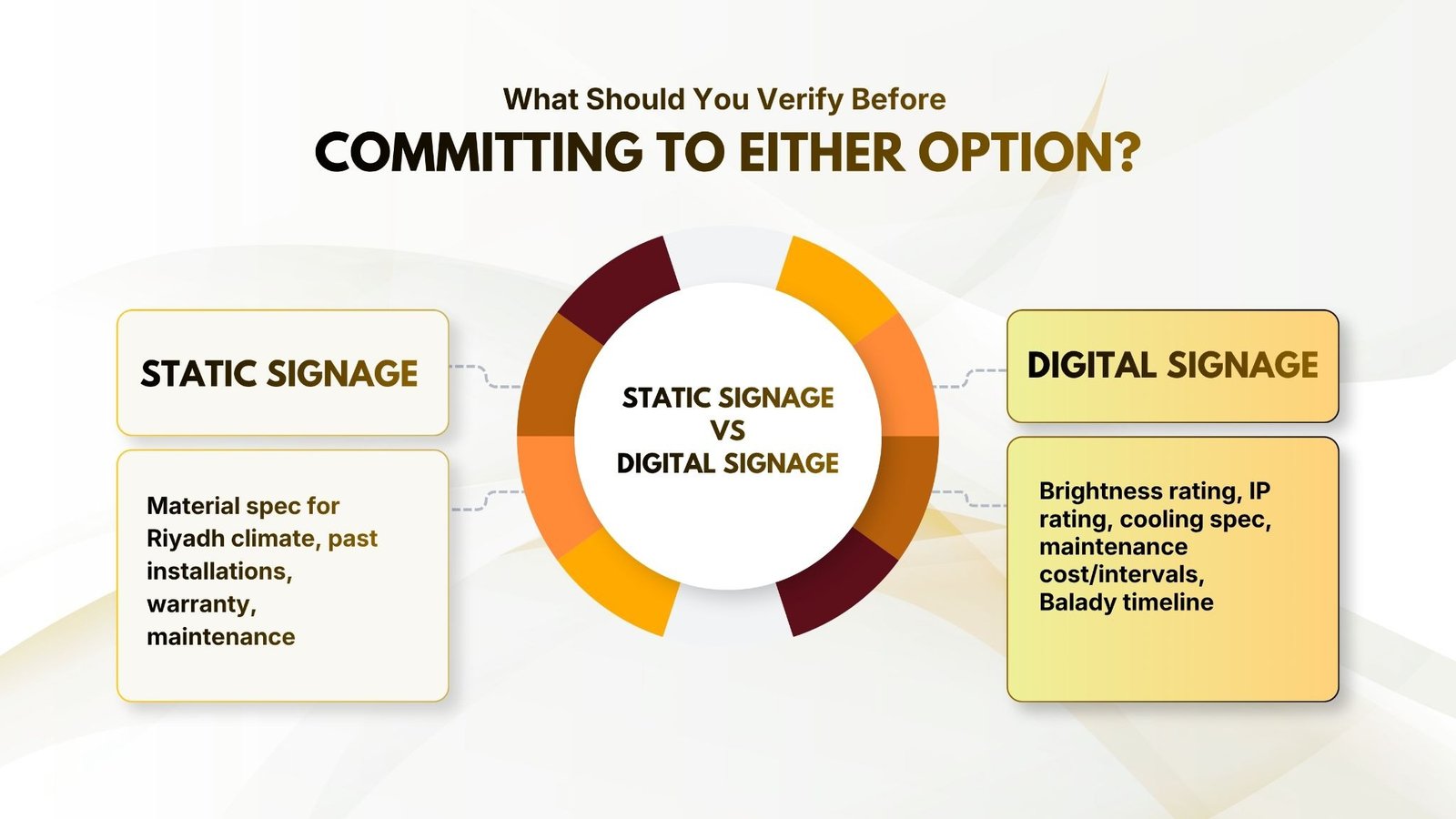
| For This Signage Type | Verify |
| Static Signage | Material spec for Riyadh climate, past installations, warranty, maintenance |
| Digital Signage | Brightness rating, IP rating, cooling spec, maintenance cost/intervals, Balady timeline |
For static signage, confirm the material specification is appropriate for outdoor use in Riyadh’s climate. Ask for examples of similar completed installations. Confirm the installation method, the warranty, and what ongoing maintenance looks like.
For digital signage in Riyadh, confirm the screen brightness rating against your location’s light conditions. Confirm the IP rating for dust and moisture protection. Confirm the cooling specification for the ambient temperatures at your site. Ask specifically who manages maintenance, at what intervals, and what that costs annually. Confirm the Balady permit process as well.
Common Mistakes When Choosing Between Static and Digital Signage
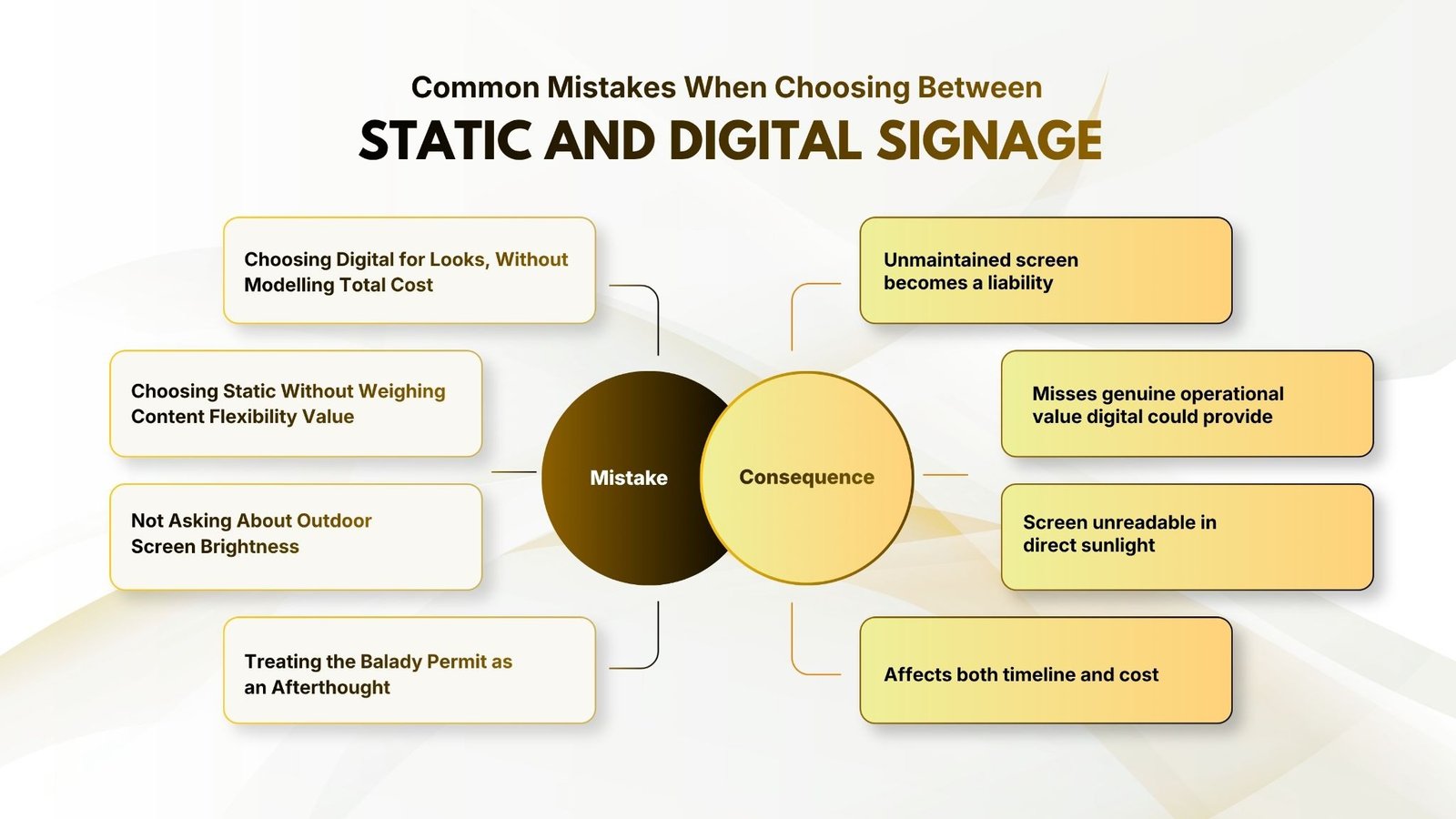
| Mistake | Consequence |
| Choosing Digital for Looks, Without Modelling Total Cost | Unmaintained screen becomes a liability |
| Choosing Static Without Weighing Content Flexibility Value | Misses genuine operational value digital could provide |
| Not Asking About Outdoor Screen Brightness | Screen unreadable in direct sunlight |
| Treating the Balady Permit as an Afterthought | Affects both timeline and cost |
Choosing digital because it looks more impressive in a supplier presentation without modelling the total cost of ownership. An unmaintained screen in a Riyadh summer is not impressive.
Choosing static without asking whether the operational value of content flexibility would pay for the difference in cost over time. For some businesses it genuinely would.
Not asking about outdoor screen brightness specifications for digital signage in Riyadh. A screen that cannot be read in direct sunlight is not functioning as signage.
Treating the Balady permit as an afterthought. Permit requirements affect both the timeline and the cost of outdoor signage installations and should be factored in from the start of the project.
Where to Find Reliable Signage Solutions in Riyadh?
Etihad Golden Falcons fabricates and installs both static signage and digital signage in Riyadh across commercial, hospitality, corporate, and institutional sectors. We manage the full process from specification through installation, including site survey, material sourcing, fabrication, and on-site fitting.
For businesses with complex requirements. multiple locations, mixed signage environments, or phased rollouts, our team offers a free consultation to help you map out the right signage strategy before committing to any spend. Reach out to Etihad Golden Falcons and get expert guidance matched to your site, your content needs, and your budget.
FAQs
Static signage carries fixed content that does not change without physically replacing the sign element. Digital signage in Riyadh uses screens to display content that can be updated remotely as often as needed. The right choice depends on how frequently your content needs to change and what the total cost of each option looks like over the expected lifespan of the installation.
For a small business with stable messaging — a name, a logo, fixed service information — static signage is almost always the more economical investment. For a small business with frequently changing promotions, menu items, or pricing, digital signage can pay for itself over time through saved reprinting costs and the operational flexibility it provides. The honest answer depends on how often the content actually needs to change.
Permit timelines vary based on location, display size, and application completeness. Digital signage permits can take longer than static because of additional regulatory requirements. An experienced signage company will manage the process and give you a realistic timeline based on your specific project from the start.
Yes and many businesses in Riyadh do. Static signage handles permanent brand and wayfinding elements. Digital signage in Riyadh handles locations where content needs to change regularly. Using both strategically gives you the durability and low maintenance cost of static for what does not change and the flexibility of digital where it creates genuine operational value.